NAD+ and AHK-Cu in Metabolic and Longevity Research: A Deep Dive
A research overview of NAD+ and AHK-Cu covering mitochondrial metabolism, sirtuin activation, copper-peptide signaling, and laboratory handling protocols.

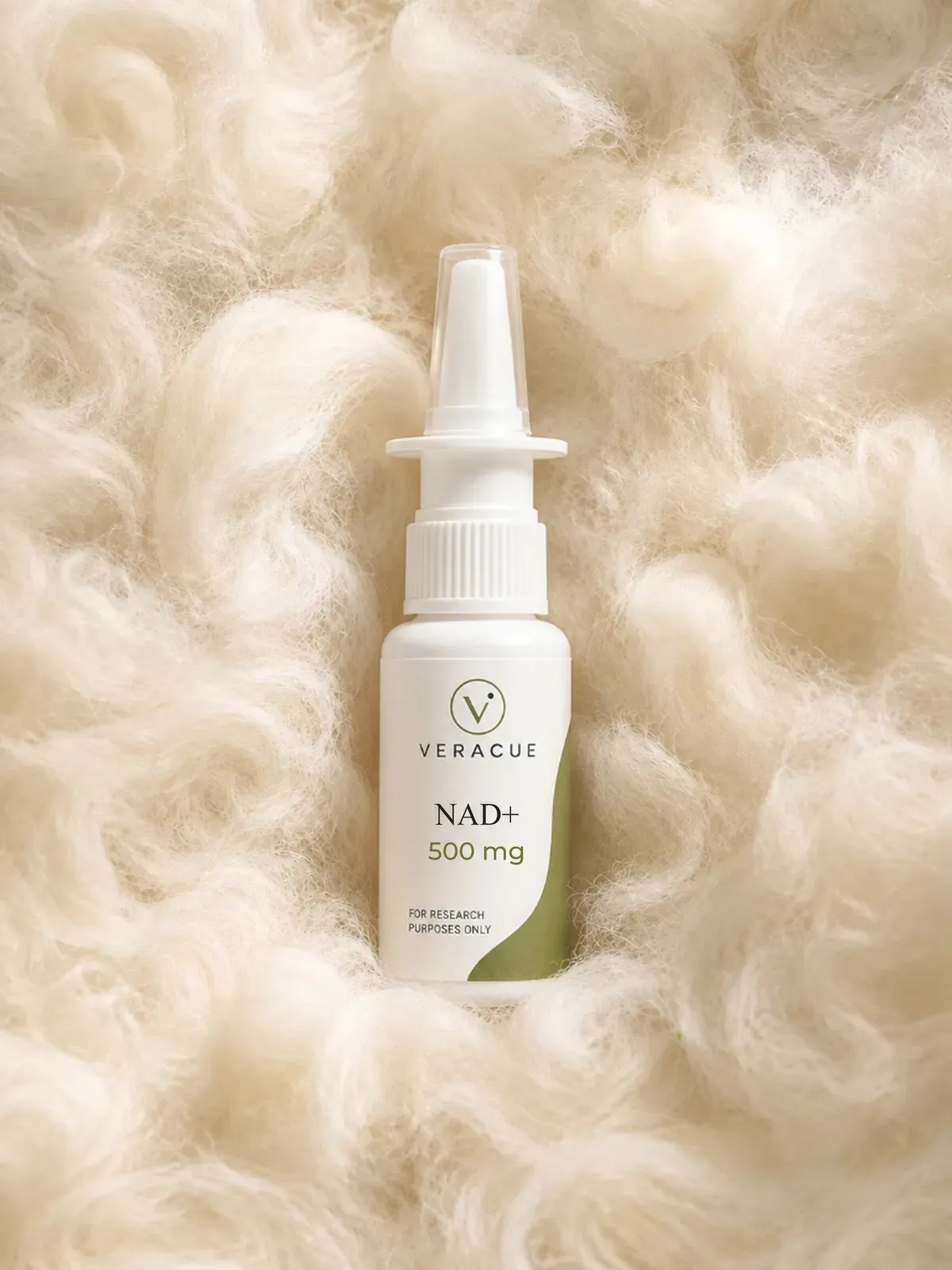
NAD+ Spray supplies oxidized nicotinamide adenine dinucleotide, also known as Coenzyme I, Cozymase or beta-NAD, filed under CAS 53-84-9 and PubChem CID 5892. Written strictly as the cation it is C21H28N7O14P2+ at 664.44 g/mol average mass; most chemical databases instead publish the neutral inner-salt form, C21H27N7O14P2 at 663.43, one proton apart in bookkeeping for the same substance. Confirm which representation a certificate reports before comparing figures. Available in 500 mg and 1000 mg spray-dispensed sizes for laboratory research use only.
Ask for the analytical documentation of any lot.
HPLC is the method used to measure purity
Ask for the report for a specific lot through the contact page
Supplied for laboratory research use only
Mass spectrometry is the method used to confirm identity
NAD+ Spray is Veracue’s spray-dispensed packaging of NAD+, nicotinamide adenine dinucleotide in its oxidized form, a dinucleotide coenzyme built from a nicotinamide nucleotide and an adenine nucleotide joined through a ribose-phosphate-phosphate-ribose bridge. The underlying molecule is identical to the one documented on Veracue’s NAD+ vial listing; only the packaging and dispensing format differ between the two listings.
"Spray" is a packaging and dispensing descriptor, nothing more. It does not establish a route, a concentration, or a formulation, and none of those specifics should be inferred from the product name. Chemical form, hydrate state, concentration and storage conditions are reported on each lot’s own documentation and can be requested through the contact page.
| Product name | NAD+ Spray |
| Scientific name | beta-Nicotinamide adenine dinucleotide |
| USAN/INN | Nadide |
| Other names | Coenzyme I, Cozymase, DPN, beta-NAD |
| Packaging format | Spray-dispensed, Research Use Only |
| CAS Registry Number | 53-84-9 |
| PubChem CID | 5892 |
| ChEBI | CHEBI:15846 |
| KEGG | C00003 |
| Formula (cation) | C21H28N7O14P2+ |
| Formula (zwitterion) | C21H27N7O14P2 |
| Average molecular weight | 664.44 (cation) / 663.43 (zwitterion) |
| Oxidation state | Oxidized |
| Classification | Dinucleotide coenzyme |
| Sizes offered | 500 mg and 1000 mg |
| Research designation | Research Use Only |
Veracue lists NAD+ in more than one packaging format because research groups source and track material differently depending on how it is packaged. Keeping the formats as separate listings keeps lot records, images and documentation specific to the packaging a researcher actually ordered, rather than mixing records across formats.
NAD+ Spray and Veracue’s NAD+ vial listing describe one molecule. The plus sign refers to the positive charge on the nicotinamide ring nitrogen; written strictly as that cation the formula is C21H28N7O14P2+ with an average mass of 664.44, while most chemical databases, including PubChem CID 5892, instead publish the neutral inner-salt form, C21H27N7O14P2 at 663.43. Both describe the same substance under the same CAS number, 53-84-9. Packaging format has no bearing on which formula or mass applies, so these values are identical across both listings.
No. The compound reported under this listing is the same oxidized dinucleotide reported under the vial listing. What differs between the two listings is how the material is packaged and dispensed, not its chemical identity.
In Veracue’s catalog, "Spray" is a packaging and dispensing term, comparable to "vial" or "powder" on other listings. It tells a researcher how the product is dispensed from its container. It does not specify a concentration, a carrier, a route, or a formulation, and it is not shorthand for any particular method of use. Those details, where applicable, live in lot-specific documentation rather than in the catalog name.
Treating a packaging word as a technical specification is a common source of error when comparing listings across suppliers. A researcher documenting materials in a methods section should cite the lot’s own documentation for format-specific details rather than inferring them from the word "Spray" alone, and should still confirm whether the lot in hand is a hydrate, since published molecular weights are anhydrous values.
Several molecules are easily confused with NAD+. The table below is for orientation only: it compares molecular identity, not research outcomes.
| Entity | What it is | Relationship to NAD+ |
|---|---|---|
| NAD+ | Oxidized nicotinamide adenine dinucleotide | The reference entity on this listing |
| NADH | The reduced form of the same coenzyme | Redox partner; same molecule, different electron state |
| NADP+ | A phosphorylated cofactor, C21H28N7O17P3+ | A separate cofactor system, not interchangeable |
| NADPH | The reduced form of NADP+ | Distinct from NADH in its metabolic role |
| Nicotinamide (NAM) | A B3-related metabolite, C6H6N2O | Released when NAD+ is consumed, fed back through salvage |
| NMN | Nicotinamide mononucleotide, C11H15N2O8P | The immediate precursor, converted to NAD+ by NMNAT |
Results generated with a related molecule, such as NMN or nicotinamide, are not results for NAD+ itself, and the table above should be read as a map of distinct identifiers rather than a ranking.
Two roles are documented for this coenzyme at the enzyme level. As a redox cofactor, NAD+ accepts a hydride to form NADH, and that couple runs through the enzymes of glycolysis, the TCA cycle and oxidative phosphorylation. Separately, NAD+ acts as a consumed co-substrate: sirtuins and PARPs cleave it rather than cycling it, as do the NADases CD38 and CD157, and each of these reactions releases nicotinamide, which can re-enter the salvage pathway through NAMPT and NMNAT.
Because "Spray" and "vial" describe packaging rather than chemistry, a methods section should still name the molecule precisely by CAS number or formula, and separately note the catalog format and lot number actually used. This page provides molecular reference information and general enzyme-level context only, and Veracue provides no dosing, administration or usage guidance of any kind.

Identity and content for NAD+ Spray are established the same way as for any NAD+ lot: reverse-phase HPLC with UV detection for chromatographic purity, mass spectrometry to confirm an observed mass consistent with the molecule, a UV scan to confirm redox state, and Karl Fischer titration to establish water content on a hydrated lot. Packaging format has no bearing on which analytical methods apply.
| Method | Tells a researcher | Does not prove by itself |
|---|---|---|
| RP-HPLC (UV, area %) | Chromatographic purity under one stated method | Molecular identity; water content; salt form |
| LC-MS | A measured mass consistent with the expected molecule | Purity; anything mass-identical, including isomers |
| UV scan, A260 and A340 | Redox state. NADH absorbs near 340 nm, NAD+ does not | Purity against impurities that do not absorb there |
| Karl Fischer titration | Water content, converting an as-supplied figure to anhydrous | Chemical purity |
A certificate of analysis describes one lot, never a packaging format or a compound in general. Before relying on any figure, confirm that the lot number on the certificate matches the container and the order record for the spray-format unit received.
A complete certificate separates product identity and CAS number, the specific form (free acid, salt or hydrate), lot number, purity result with method named, assay or content result, water content where relevant, test date and testing laboratory. Where concentration figures are relevant to a spray-format unit, they are reported on that lot’s own documentation rather than inferred from the catalog listing. The certificate page explains how to request lot documentation for either format.
No. The verification question is the same: does this lot match the stated molecule and form, and is the purity figure paired with a mass or assay result from the same lot. Packaging format does not change what counts as adequate documentation.
The cation and zwitterion forms of NAD+ carry slightly different reference masses, and a hydrate or salt form shifts the figure again. If a lot’s documentation leaves the form unstated, any mass-based calculation can carry a silent error. Confirm the form on the lot’s certificate and use the matching reference mass, regardless of packaging format.
No. Beta-NAD is the biologically relevant configuration, and the alpha-anomer is an isomer with an identical molecular mass, so HPLC and mass spectrometry alone cannot separate the two. Chromatographic resolution under a method suited to that distinction, or an enzymatic assay, is what settles the question.
NAD+ Spray is supplied for laboratory research and analytical characterization only. It is not intended for human or veterinary use, or for ingestion, injection or any form of administration. This page contains no dosing, administration or usage guidance of any kind, and the word "Spray" in the product name describes Veracue’s packaging and dispensing format only. See the Medical Disclaimer and the Terms and Conditions for sitewide policies.

RESEARCH PEPTIDE
Spray bottle pairing a 29-residue GHRH analog with the pentapeptide Ipamorelin, 5 mg of each and 45 sprays per bottle. Laboratory research use only.

RESEARCH PEPTIDE
GLP-T Spray pairs a 39-residue peptide, LY3298176 (CAS 2023788-19-2), with a C20 diacid on lysine 20. 10 to 60 mg, research use only, 45 sprays a bottle.

RESEARCH PEPTIDE
A 28-residue, N-acetylated peptide at 3108.3 g/mol, spray-dispensed in a 10 mg bottle with 45 sprays. Supplied for research use only.

RESEARCH PEPTIDE
Seven residues, a lactam ring and an amide terminus: Melanotan II, CAS 121062-08-6, in a 10 mg bottle of 45 sprays. Laboratory research only.