NAD+ and AHK-Cu in Metabolic and Longevity Research: A Deep Dive
A research overview of NAD+ and AHK-Cu covering mitochondrial metabolism, sirtuin activation, copper-peptide signaling, and laboratory handling protocols.

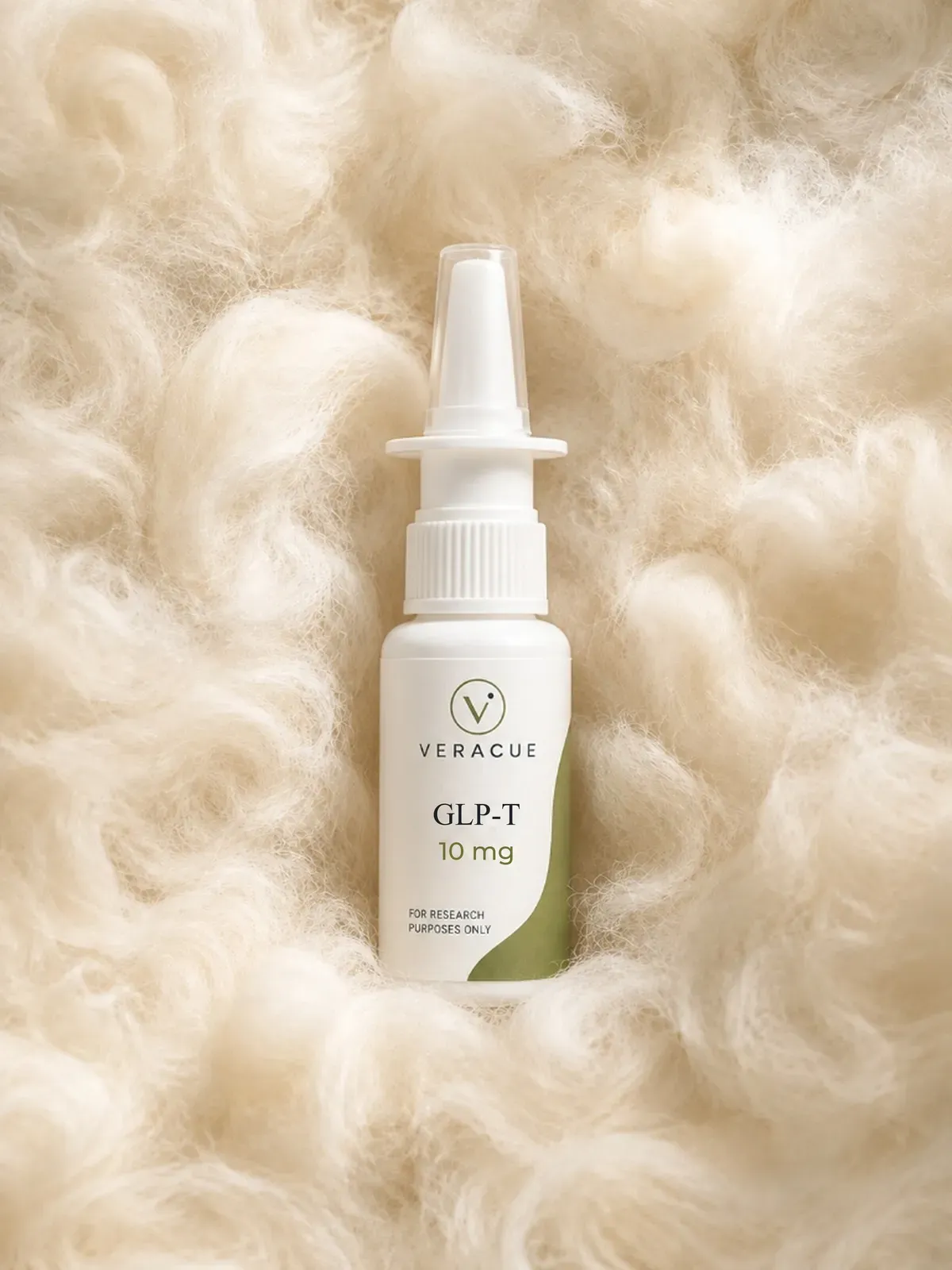
GLP-T Spray is a spray-dispensed bottle of GLP-T, a lipidated 39-residue peptide whose chain follows native GIP, with aminoisobutyric acid at positions 2 and 13 and an amidated C-terminus. A C20 diacid is joined to lysine 20 through a linker. Reference values: formula C225H348N48O68, average mass about 4813.5 g/mol, CAS 2023788-19-2, research code LY3298176. It is one molecule engaging both GIP and GLP-1 receptors in assays, so it should not be mistaken for plain GIP. Each bottle holds 45 sprays, in 10, 20, 30 and 60 mg sizes, for laboratory research use only.
Ask for the analytical documentation of any lot.
HPLC is the method used to measure purity
Ask for the report for a specific lot through the contact page
Supplied for laboratory research use only
Mass spectrometry is the method used to confirm identity
| Product name | GLP-T Spray |
| Format | Spray-dispensed bottle, 45 sprays per bottle |
| Sizes offered | 10 mg, 20 mg, 30 mg and 60 mg |
| Research code | LY3298176 |
| Molecule type | Lipidated synthetic peptide, one defined molecule |
| Chain | 39 residues following the native GIP sequence |
| Non-standard residues | Aminoisobutyric acid (Aib) at positions 2 and 13 |
| C-terminus | Amide |
| Lipid | 1,20-eicosanedioic acid (a C20 fatty diacid) joined to lysine 20 through a linker |
| Molecular formula | C225H348N48O68 |
| Average mass | About 4813.5 g/mol |
| Monoisotopic mass | About 4810.52 Da |
| CAS Registry Number | 2023788-19-2 |
| PubChem CID | 156588324 |
| Receptor targets | GIP receptor and GLP-1 receptor (agonist in receptor assays) |
| Research designation | Research Use Only |
Formula, masses and database numbers are reference values taken from the formula and public chemical databases. They are not measurements of a Veracue lot.
GLP-T is a single engineered molecule, not a blend. Its 39-residue chain follows the native GIP sequence, two standard residues are replaced by aminoisobutyric acid, and a fatty diacid hangs from lysine 20. Veracue supplies it in a pump-spray bottle that delivers 45 sprays, labeled with the product name and the size in milligrams, strictly for laboratory research use.
Salt form, purity and other lot-level results are not stated on the site. Documentation can be requested through the contact page.
Several materials sit close to GLP-T in name or structure. The table shows what separates each one and where that difference would appear in analytical data.
| Look-alike | What differs | Where it shows |
|---|---|---|
| The bare 39-residue chain without its lipid | No C20 diacid or linker on lysine 20 | Intact mass reads clearly below about 4.8 kDa |
| The same chain ending in a free acid | A carboxylic acid at the C-terminus instead of an amide | Mass shifts by roughly 1 Da, so only an accurate mass separates the two |
| Native GIP | No Aib residues and no lipid | Different formula and a different CAS number |
| Other lipidated receptor-agonist peptides | A different chain, lipid and linker | Different formula, mass and CAS number |
| A mixture of separate peptides | GLP-T is one molecule | A single formula and a single CAS number describe the whole material |
| Feature | Position | What it is |
|---|---|---|
| Peptide chain | Residues 1 to 39 | Follows the native GIP sequence |
| Aminoisobutyric acid (Aib) | Positions 2 and 13 | A non-standard residue used in place of a standard one |
| Lysine side chain | Position 20 | The attachment point for the lipid |
| Linker and C20 fatty diacid | On lysine 20 | 1,20-eicosanedioic acid, reached through a linker |
| C-terminus | Residue 39 | Amide |
Aib is not one of the twenty standard amino acids. It carries two methyl groups on its alpha carbon, which limits how freely the backbone can turn around that residue, and each one appears in the sequence record as a defined substitution.
The diacid is what links the molecule to albumin in biological test systems, and it adds a mass difference that is easy to see in an intact-mass result. Protein content in an assay medium can influence how a lipidated peptide behaves, so it is worth writing down beside the lot record. That is a note on reading results, not a handling or preparation instruction.
| Receptor | Name | Behavior in receptor assays |
|---|---|---|
| GIPR | Glucose-dependent insulinotropic polypeptide receptor | Engaged as an agonist, with signaling that resembles native GIP |
| GLP-1R | Glucagon-like peptide-1 receptor | Engaged as an agonist, with cAMP signaling stronger than beta-arrestin recruitment |
GLP-T is called a dual agonist because one molecule engages both receptors, but the two are not engaged evenly. Laboratory work published in 2020 described the peptide as imbalanced, occupying GIPR more strongly than GLP-1R, and as biased at GLP-1R, where it drove less receptor internalization than GLP-1 itself.
An assay built on cAMP and one built on beta-arrestin recruitment can therefore rank the same molecule differently, which matters when results from two systems are compared.
Yes. Activity at both receptors comes from the intact lipidated structure, so a fragment or an altered form should not be assumed to behave the same way in an assay.
Typical settings are receptor-binding and signaling assays in cultured cells, side-by-side cAMP and beta-arrestin readouts, and analytical method work on lipidated peptides. This is research context only, and Veracue provides no dosing, administration or usage guidance of any kind.

At roughly 4.8 kDa the peptide rarely appears as one peak at its neutral mass in electrospray MS. It shows up as a series of multiply charged ions, and the table lists calculated m/z values for four of them, derived from the monoisotopic mass of 4810.52 Da with one proton mass added per charge.
| Charge state | Calculated m/z |
|---|---|
| [M+4H]4+ | 1203.64 |
| [M+5H]5+ | 963.11 |
| [M+6H]6+ | 802.76 |
| [M+7H]7+ | 688.23 |
These numbers come from the formula and are not Veracue lot results. Quoted molecular weights for this molecule run from about 4810.5 to 4814 across databases: the lowest matches the monoisotopic value, and the others are rounded forms of the 4813.5 average. A mass at this size is no longer dominated by its lightest isotope peak, so any report should state which convention it follows.
| Check | What it can show | What it cannot show |
|---|---|---|
| Intact-mass MS | Whether the observed mass fits the lipidated molecule, diacid included | Purity, quantity or the order of residues |
| RP-HPLC | Chromatographic purity under stated conditions | What the main peak actually is |
| Tandem MS | Fragment evidence for the sequence and for where the lipid sits | How much of the material is that molecule |
| Amino acid analysis | Net peptide content | The identity of impurities |
| Counterion analysis | How much of the mass is salt rather than peptide | Peptide quality |
A clean chromatogram and a correct intact mass answer different questions. For a lipidated peptide, a result near the mass of the bare chain suggests the diacid is missing and should not be accepted as a match.
Documentation can be requested through the contact page for particular products. Before relying on any figure in a document, confirm that it belongs to the lot recorded for your order and that each value names the method behind it.
Results describe the lot that was tested and nothing else, so note the lot identifier beside every experiment that uses the material.
GLP-T Spray is sold only to support laboratory research and analytical work. It is not a medicine, supplement, cosmetic or food item, and no human or veterinary use is intended, including any form of administration. Veracue publishes no dosing, administration or usage guidance of any kind, and the science described here is laboratory-level information rather than medical advice. Sitewide policies are set out in the Medical Disclaimer and the Terms and Conditions.
Orders are intended for qualified researchers and institutions, who are responsible for working with the material lawfully and within their own institutional rules.
Each bottle holds 45 sprays and carries the product name and size on its label. Anything beyond that, such as chemical form or fill details, is reported in lot documentation rather than inferred from the listing.

RESEARCH PEPTIDE
Spray bottle pairing a 29-residue GHRH analog with the pentapeptide Ipamorelin, 5 mg of each and 45 sprays per bottle. Laboratory research use only.

RESEARCH PEPTIDE
A 28-residue, N-acetylated peptide at 3108.3 g/mol, spray-dispensed in a 10 mg bottle with 45 sprays. Supplied for research use only.

RESEARCH PEPTIDE
Seven residues, a lactam ring and an amide terminus: Melanotan II, CAS 121062-08-6, in a 10 mg bottle of 45 sprays. Laboratory research only.

RESEARCH PEPTIDE
Ten residues, mass 1302.45 g/mol, CAS 374675-21-5: kisspeptin-10 in a 10 mg bottle with 45 sprays, offered for research use only.