NAD+ and AHK-Cu in Metabolic and Longevity Research: A Deep Dive
A research overview of NAD+ and AHK-Cu covering mitochondrial metabolism, sirtuin activation, copper-peptide signaling, and laboratory handling protocols.

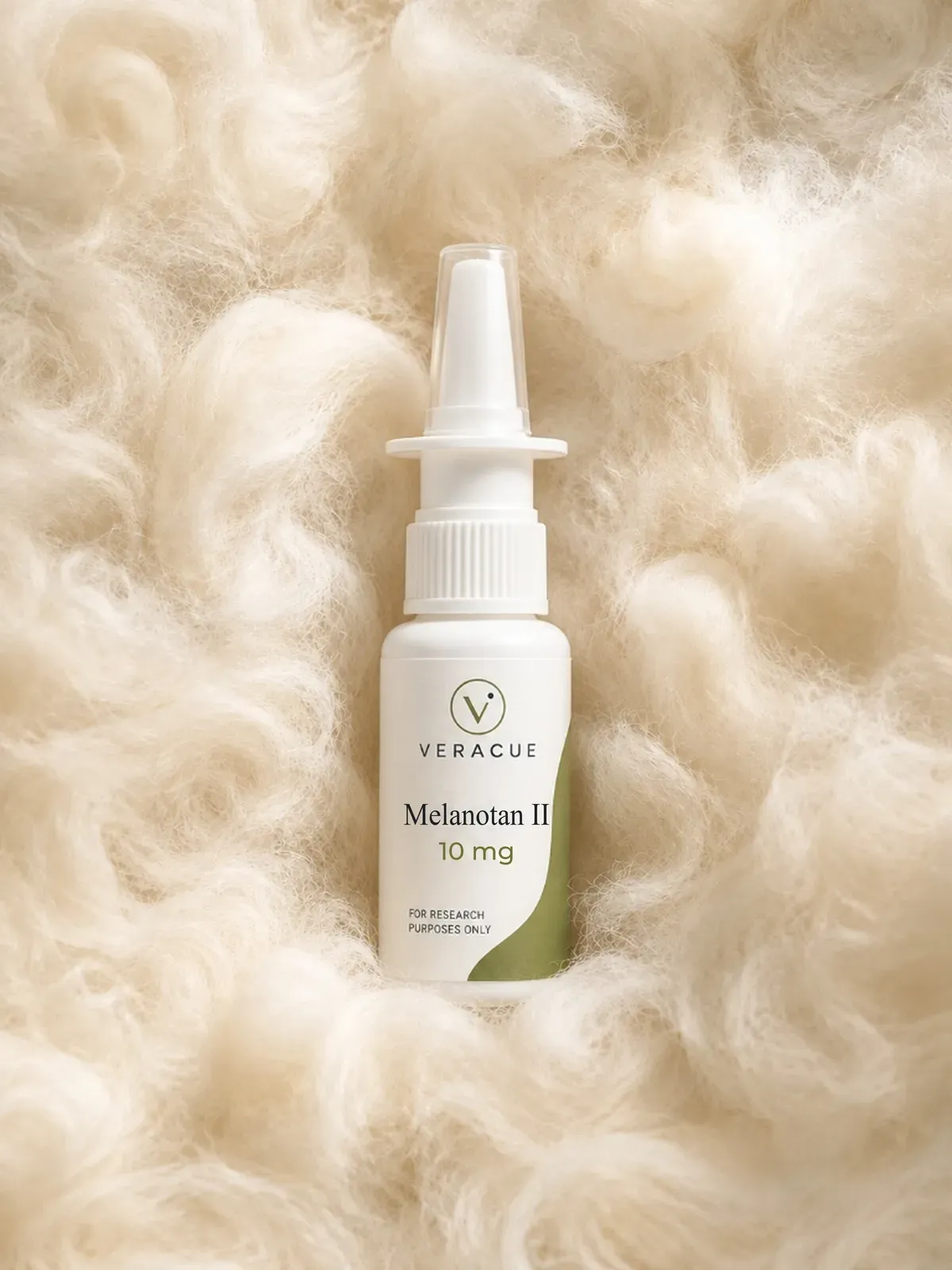
Melanotan II Spray is a spray-dispensed research bottle of Melanotan II, a seven-residue synthetic analogue of alpha-MSH written Ac-Nle-cyclo[Asp-His-D-Phe-Arg-Trp-Lys]-NH2. The ring is a lactam, an amide bond between the Asp and Lys side chains, and the chain ends in an amide. For the free peptide the formula is C50H69N15O9, the average mass is about 1024.2 g/mol and the CAS number is 121062-08-6. Melanotan 1 is a longer linear peptide and PT-141 differs by a free-acid terminus, so sequence and mass are the dependable identifiers. Each 10 mg bottle holds 45 sprays and is for laboratory research use only.
Ask for the analytical documentation of any lot.
HPLC is the method used to measure purity
Ask for the report for a specific lot through the contact page
Supplied for laboratory research use only
Mass spectrometry is the method used to confirm identity
| Product name | Melanotan II Spray (the peptide is also written Melanotan 2, MT-II or MT2) |
| Packaging | Spray-dispensed bottle |
| Sprays per bottle | 45 sprays per bottle |
| Size offered | 10 mg |
| Compound class | Synthetic cyclic heptapeptide analogue of alpha-melanocyte-stimulating hormone |
| Sequence | Ac-Nle-cyclo[Asp-His-D-Phe-Arg-Trp-Lys]-NH2 |
| Ring closure | Lactam, an amide bond between the Asp and Lys side chains |
| C-terminus | Amide (-NH2) |
| Molecular formula (free peptide) | C50H69N15O9 |
| Average molecular weight | About 1024.2 g/mol |
| Monoisotopic mass | About 1023.5403 Da |
| CAS Registry Number | 121062-08-6 |
| PubChem CID | 92432 |
| UNII | UPF5CJ93X7 |
| ChEMBL ID | CHEMBL430239 |
| Research designation | Research Use Only |
The identity rows describe the free peptide as a reference molecule and are not measurements of a Veracue lot. Salt or counterion form, purity, fill volume and concentration belong to lot-level paperwork, and documentation can be requested through the contact page.
The material in Melanotan II Spray is Melanotan II, a seven-residue peptide that keeps the His, Phe, Arg and Trp core of alpha-melanocyte-stimulating hormone (alpha-MSH) and holds it in a ring. Norleucine sits at position 4 of the parent numbering, the phenylalanine at position 7 is the D-isomer, and a lactam bond between aspartic acid and lysine closes the structure. The bottle contains 45 sprays and is supplied for laboratory research only.
Four labels circulate for this one molecule: Melanotan 2, Melanotan II, MT-II and MT2. Each resolves to CAS 121062-08-6, which makes the CAS number the quickest way to match a supplier label to a literature record.
Literature on this peptide keeps the numbering of the parent hormone, which is why a chain of seven residues is described with positions 4 through 10.
| Position | Residue | Structural note |
|---|---|---|
| Ac- | N-terminal acetyl cap | Blocks the free amine at the start of the chain. |
| 4 | Nle (norleucine) | A straight-chain relative of methionine that carries no sulfur. |
| 5 | Asp | Its side-chain carboxyl forms one end of the lactam. |
| 6 | His | Part of the His, Phe, Arg, Trp core. |
| 7 | D-Phe | The mirror-image form of phenylalanine. |
| 8 | Arg | Basic side chain. |
| 9 | Trp | Indole side chain. |
| 10 | Lys | Its side-chain amine forms the other end of the lactam. |
| -NH2 | C-terminal amide | Stands where a free carboxylic acid would otherwise end the chain. |
| Attribute | Melanotan II | PT-141 | Melanotan 1 |
|---|---|---|---|
| Shape | Cyclic, lactam ring | Cyclic, lactam ring | Linear |
| Length | 7 residues | 7 residues | 13 residues |
| C-terminus | Amide | Free acid | Amide |
| Formula (free peptide) | C50H69N15O9 | C50H68N14O10 | C78H111N21O19 |
| Average mass | About 1024.2 g/mol | About 1025.2 g/mol | About 1,647 g/mol |
| CAS | 121062-08-6 | 189691-06-3 | 75921-69-6 |
Melanotan II and PT-141 differ by a single atom swap at the end of the chain: an amide nitrogen in Melanotan II sits where PT-141 has a hydroxyl oxygen. The result is about one mass unit between them, while Melanotan 1 is separated by more than 600 Da.
Five G protein-coupled receptors make up the melanocortin family, MC1R through MC5R, and cyclic AMP formation is the usual readout in cell-based work. Reference pharmacology groups Melanotan II with ligands that engage MC1R, MC3R, MC4R and MC5R without a strong preference among them. MC2R is the odd one out, since it is the receptor for ACTH.
A ligand with a broad receptor profile is convenient as a pharmacological tool and harder to interpret in a mixed system, so selective compounds or defined cell lines are used to assign a signal to one subtype. Published affinity and potency values shift between laboratories and assay formats, so a single figure is best read as a single measurement. This is molecular reference context only, and Veracue provides no dosing, administration or usage guidance of any kind.
Melanotan II holds no cysteine and its formula contains no sulfur, so there is no disulfide bond to reduce. Method notes that mention a reduction step or a disulfide-linked mass change were probably written for a different peptide. The ring is an ordinary amide bond, which does not respond to thiol reducing agents.
Norleucine replaces methionine, so the usual methionine oxidation site is absent, although tryptophan remains in the chain.
At about 1 kDa the peptide appears mostly as singly and doubly protonated ions. These are the calculated monoisotopic values for the free peptide:
| Species | Calculated value |
|---|---|
| Neutral monoisotopic mass | 1023.5403 Da |
| [M+H]+ | m/z 1024.548 |
| [M+2H]2+ | m/z 512.777 |
| [M+Na]+ | m/z 1046.530 |
Instruments that report average mass place the neutral molecule near 1024.2 g/mol, so check which convention a report uses before comparing numbers.
Melanotan II and PT-141 sit about 0.98 Da apart in monoisotopic mass, 1023.5403 against 1024.5243. That gap is close to the spacing between isotope peaks, so the first isotope peak of Melanotan II lands almost on top of the main peak of PT-141, and a low-resolution scan can blur the two. High-resolution mass or fragment data, together with the formula printed in the report (C50H69N15O9 against C50H68N14O10), settles the question.
Documentation can be requested through the contact page. When a lot document is supplied, match its lot number to the label on the bottle first. Then look for the chemical form, because the formula and mass above describe the free peptide and a salt weighs more. Also look for an identity result stated as observed against expected mass, the method behind any purity figure, the test date and the testing laboratory.
For a spray bottle, fill volume and concentration are lot-level facts. The count of 45 sprays is a packaging figure and not a measure of peptide content per spray.
No. A chromatogram shows how much of the detected material elutes together, and a clean trace of PT-141 would look just as tidy. Identity comes from mass and, where needed, fragment data.
C50H68N14O10 matches PT-141 and not Melanotan II. Melanotan II carries 15 nitrogens, one more than PT-141, because its terminus is an amide.
Mass-based calculations should use the formula weight of the form actually present. Applying the free-peptide weight of about 1024.2 g/mol to a salt gives a silent error.
Melanotan II Spray is a laboratory reagent, sold for research and analytical work by qualified researchers and institutions. It is not a drug, dietary supplement, cosmetic or food, and it is not meant for people or animals in any manner, including ingestion, injection or any other form of administration. Veracue provides no dosing, administration or usage guidance of any kind, and buyers are responsible for lawful handling. Sitewide terms are set out in the Medical Disclaimer and the Terms and Conditions.

RESEARCH PEPTIDE
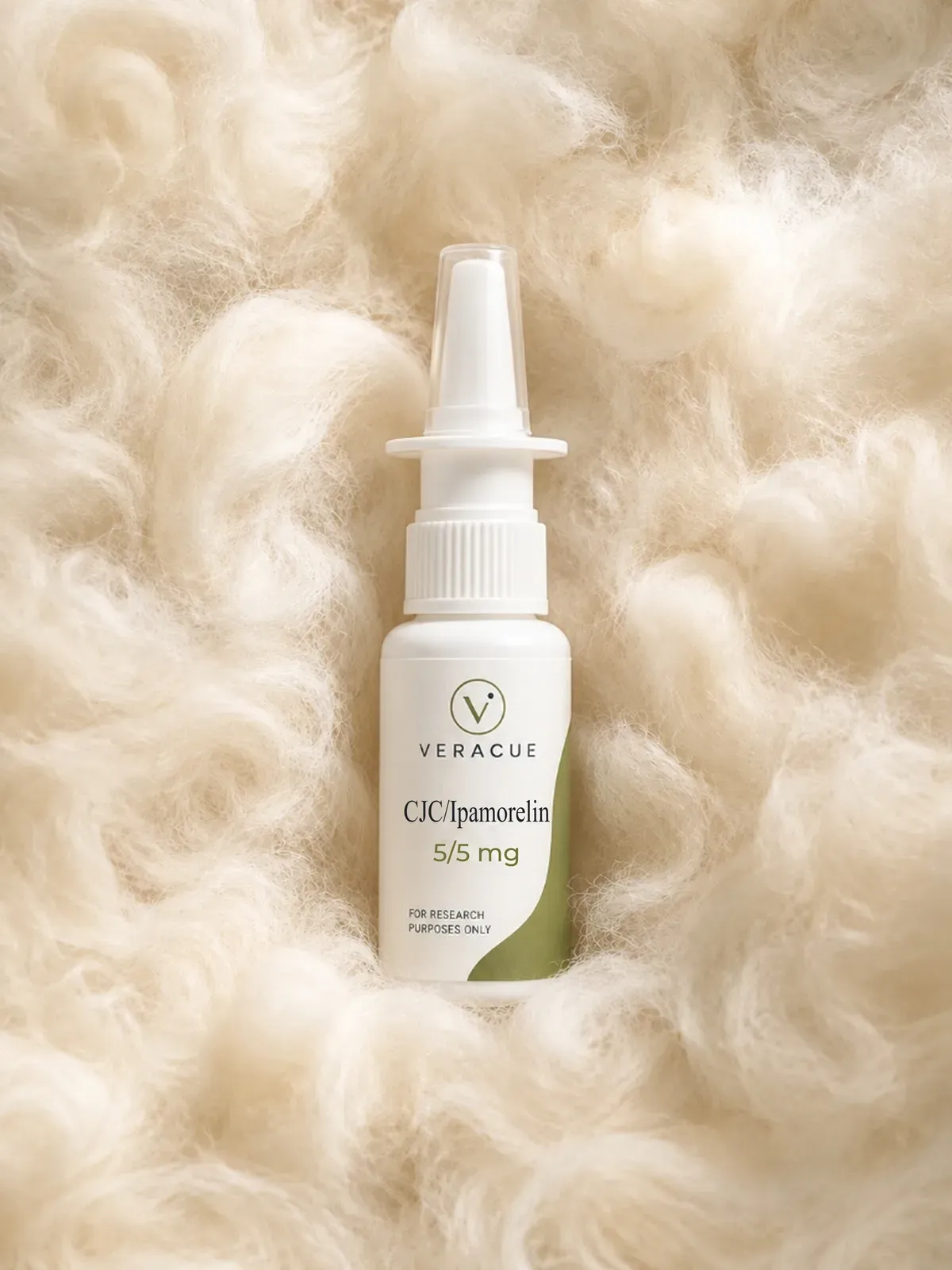
Spray bottle pairing a 29-residue GHRH analog with the pentapeptide Ipamorelin, 5 mg of each and 45 sprays per bottle. Laboratory research use only.

RESEARCH PEPTIDE
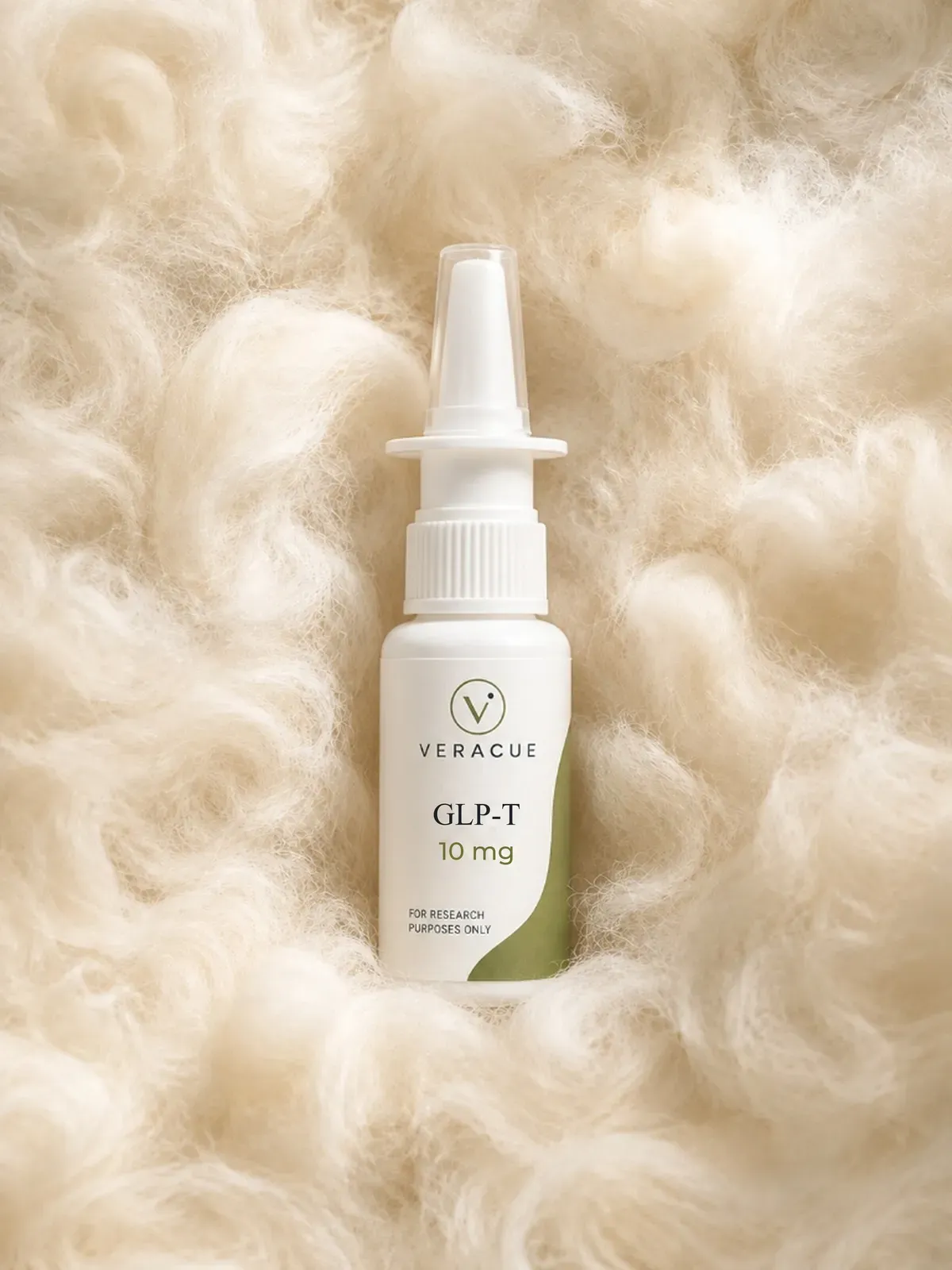
GLP-T Spray pairs a 39-residue peptide, LY3298176 (CAS 2023788-19-2), with a C20 diacid on lysine 20. 10 to 60 mg, research use only, 45 sprays a bottle.

RESEARCH PEPTIDE
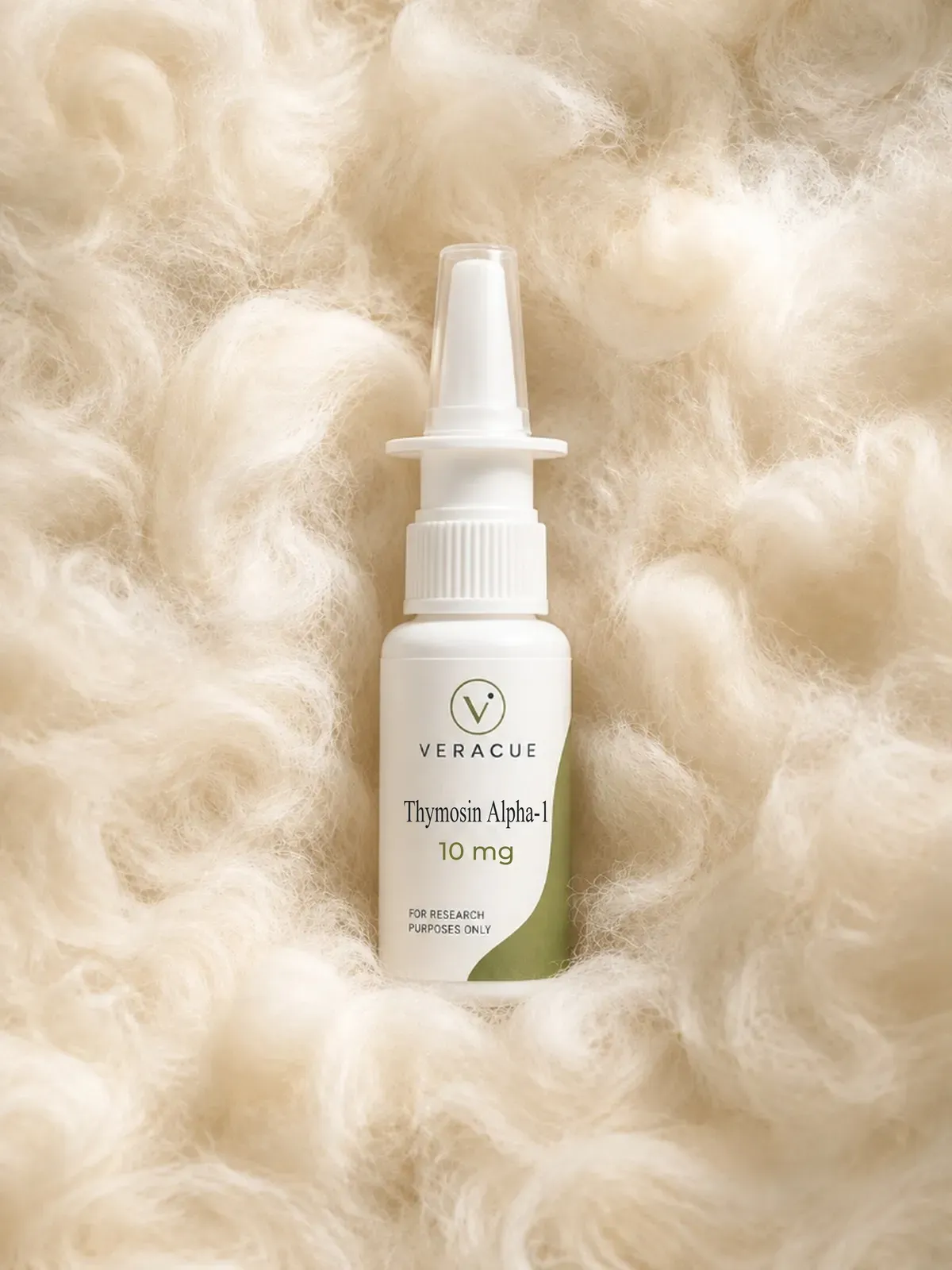
A 28-residue, N-acetylated peptide at 3108.3 g/mol, spray-dispensed in a 10 mg bottle with 45 sprays. Supplied for research use only.

RESEARCH PEPTIDE
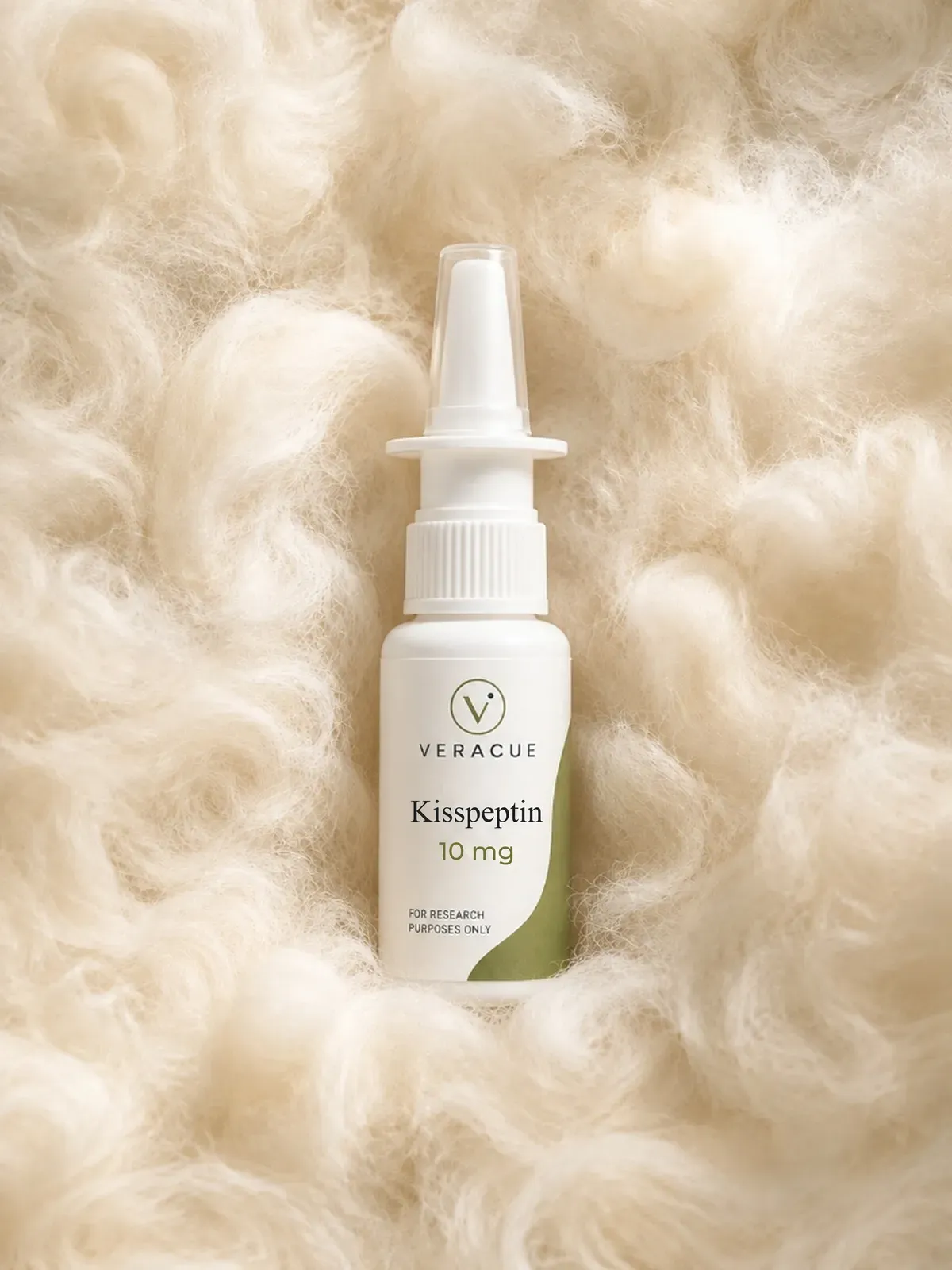
Ten residues, mass 1302.45 g/mol, CAS 374675-21-5: kisspeptin-10 in a 10 mg bottle with 45 sprays, offered for research use only.