NAD+ and AHK-Cu in Metabolic and Longevity Research: A Deep Dive
A research overview of NAD+ and AHK-Cu covering mitochondrial metabolism, sirtuin activation, copper-peptide signaling, and laboratory handling protocols.

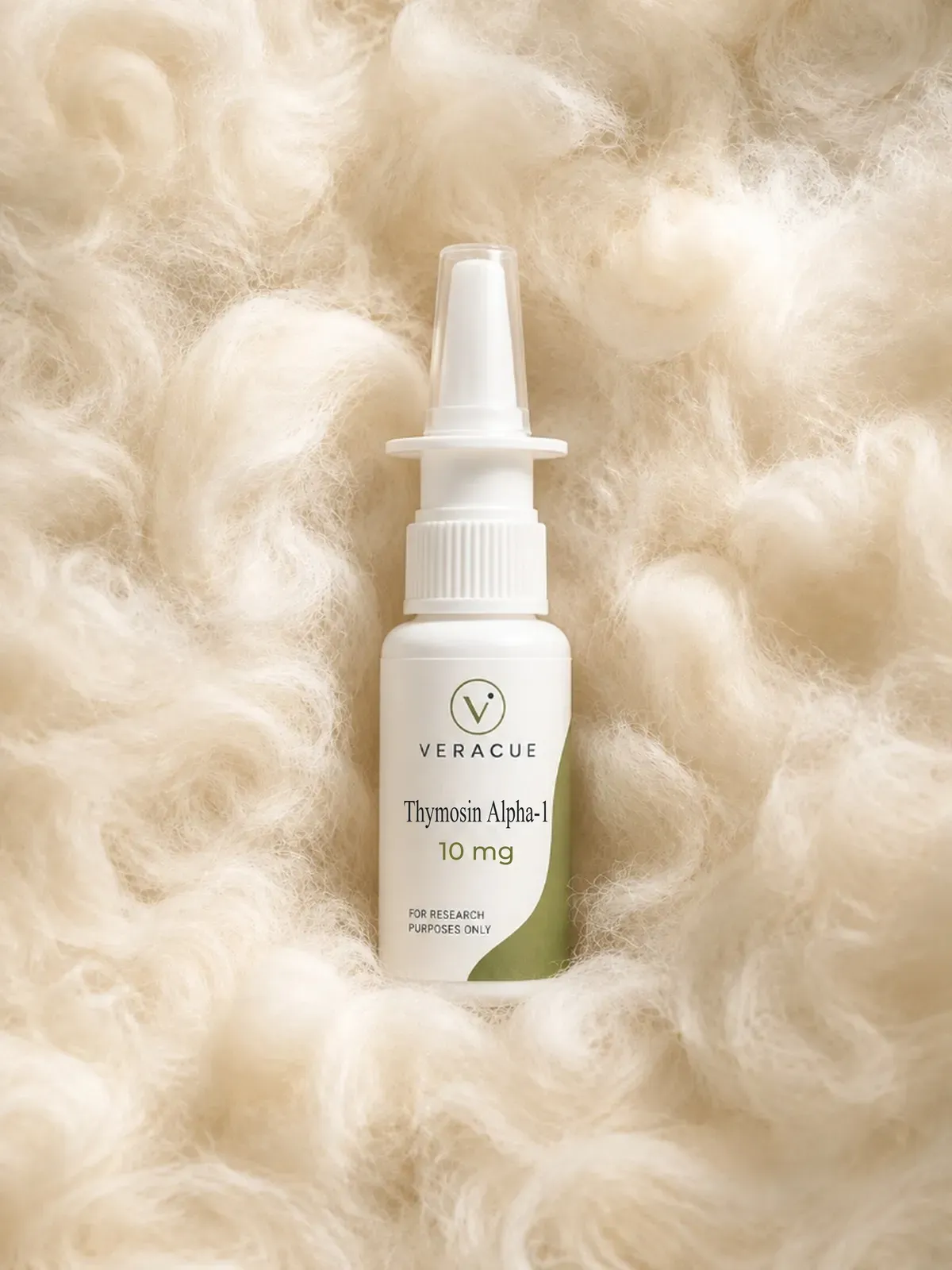
Thymosin Alpha-1 Spray is a spray-dispensed form of thymosin alpha-1, a linear 28-amino-acid peptide with an acetylated N-terminal serine and the sequence Ac-SDAAVDTSSEITTKDLKEKKEVVEEAEN-OH. Reference values for the peptide are formula C129H215N33O55, average mass 3108.3 g/mol and CAS 62304-98-7. The chain is the opening 28-residue stretch of prothymosin alpha, and it is a different molecule from thymosin beta-4 (43 residues) and from TB-500, a seven-residue piece of beta-4. One 10 mg size is offered, with 45 sprays per bottle, strictly for laboratory research use only.
Ask for the analytical documentation of any lot.
HPLC is the method used to measure purity
Ask for the report for a specific lot through the contact page
Supplied for laboratory research use only
Mass spectrometry is the method used to confirm identity
| Product name | Thymosin Alpha-1 Spray (the peptide is also written Tα1 or TA1) |
| Format | Spray-dispensed bottle |
| Sprays per bottle | 45 sprays per bottle |
| Size offered | 10 mg |
| Chain | 28 amino acids, linear, N-terminal serine acetylated, free C-terminal acid |
| Sequence (one-letter code) | Ac-SDAAVDTSSEITTKDLKEKKEVVEEAEN-OH |
| Sequence (three-letter code) | Ac-Ser-Asp-Ala-Ala-Val-Asp-Thr-Ser-Ser-Glu-Ile-Thr-Thr-Lys-Asp-Leu-Lys-Glu-Lys-Lys-Glu-Val-Val-Glu-Glu-Ala-Glu-Asn-OH |
| Origin of the sequence | Residues 1 to 28 of prothymosin alpha |
| Molecular formula | C129H215N33O55 |
| Average mass | 3108.3 g/mol |
| Monoisotopic mass | 3106.50 Da |
| CAS Registry Number | 62304-98-7 |
| PubChem CID | 16130571 |
| Research designation | Research Use Only |
Formula, mass and CAS number describe the peptide as recorded in chemical databases and are not measured results for any bottle. Chemical form, concentration, fill volume and carrier are not stated on the listing. Certificates of analysis are not published on the site yet; documentation can be requested through the contact page for particular products.
The material in the bottle is thymosin alpha-1, a synthetic chain of 28 amino acids. Read from the N-terminus it is serine, aspartic acid, two alanines, valine, aspartic acid, and so on through to a final asparagine. The serine at position 1 carries an acetyl group, and the asparagine at position 28 ends in a free carboxylic acid.
Those 28 residues are the opening stretch of the larger protein prothymosin alpha, which makes the peptide a fragment of that protein. The full precursor is not what is sold here. The listing is one defined molecule at one size, 10 mg, in a bottle that holds 45 sprays.
A purchasing record that says only thymosin cannot tell these apart. The residue count, 28 against 43 against 7, settles the question at once.
Counting the chain gives three each of serine, aspartic acid, alanine, valine and threonine, six glutamic acids, four lysines, and one each of isoleucine, leucine and asparagine.
Nine residues are acidic (three Asp and six Glu) against four lysines, which is why the peptide is strongly acidic, with a reported isoelectric point of about 4.0 to 4.3. The lysines cluster between positions 14 and 20, at positions 14, 17, 19 and 20.
What is absent matters as much. There is no cysteine or methionine, so no disulfide bond and no sulfur anywhere in the formula, and there is no tryptophan, tyrosine or phenylalanine, so the chain has no aromatic side chain at all.
Acetylation adds C2H2O, about 42 Da, to the chain. The same 28 residues with a free amine at the N-terminus would be C127H213N33O54 and average roughly 3066.3 g/mol, so a record quoting that figure describes the non-acetylated chain and not thymosin alpha-1.
| Feature | Thymosin alpha-1 | Thymosin beta-4 | TB-500 |
|---|---|---|---|
| Length | 28 residues | 43 residues | 7 residues |
| Relationship | Fragment of prothymosin alpha | Parent protein of TB-500 | Residues 17 to 23 of thymosin beta-4 |
| Sequence | Ac-SDAAVDTSSEITTKDLKEKKEVVEEAEN-OH | Full 43-residue chain | Ac-LKKTETQ |
| Average mass | 3108.3 g/mol | Higher than either, with 43 residues | About 889 g/mol |
| CAS number | 62304-98-7 | Not listed here | 885340-08-9 |
These are three separate molecules. The shared word in the name is a naming convention and not a shared structure, so a finding reported for one does not carry over to another.
Reports in cultured dendritic cells and related innate-immune cell types point to Toll-like receptor pathways, chiefly TLR2 and TLR9. Typical readouts are maturation markers and the cytokines IL-2 and IFN-γ.
Each result belongs to its assay. The cell type, the stimulus and the form of the peptide all shape what is seen, so a reading from one system describes that system only. Veracue gives no dosing, administration or usage guidance of any kind.
By sequence or formula first and common name second, for example Ac-SDAAVDTSSEITTKDLKEKKEVVEEAEN-OH or C129H215N33O55, with registry number 62304-98-7 as a cross-check. The common name alone, whether thymosin alpha-1, Tα1 or TA1, leaves room for confusion with other thymosins.
The chemical form, the lot identifier on the bottle, the measured mass and the date of receipt. For a spray-dispensed product, add the count of 45 sprays per bottle, and note that concentration, fill volume and carrier are not stated on the listing.

Electrospray of a peptide near 3108 g/mol gives a series of multiply charged ions and not a single peak at the neutral mass. Thymosin alpha-1 has only four lysines and an acetylated N-terminus, so positive mode favors low charge states, while its nine acidic residues allow ions in negative mode as well.
Calculated average-mass values for the ions most often inspected:
Multiply each m/z by its charge and correct for the proton mass, and every peak in a series should return the same neutral value, near 3108.3 g/mol. Instruments that report monoisotopic masses read about 1.8 Da lower, near 3106.50, so check which convention a report uses.
| What the spectrum shows | A reasonable reading |
|---|---|
| Peaks that all convert to one neutral mass near 3108.3 | One species seen in several charge states |
| A main mass about 42 Da lower, near 3066.3 | The acetyl group is missing, so the chain has a free N-terminus |
| A main mass lower by one residue mass, such as 71.1 (Ala), 87.1 (Ser) or 129.1 (Glu) | A deletion species missing one residue from the chain |
| Peaks about 22 Da above the main mass | Sodium adducts, which move observed values without changing the molecule |
| A main mass far from 3108.3 | A different peptide, a modified chain or another chemical form |
Tryptophan and tyrosine supply most of a peptide’s absorbance at 280 nm, and thymosin alpha-1 contains neither. A concentration estimate read at 280 nm has nothing to measure, and a calculation that assumes a typical extinction coefficient does not hold for this chain. Peptide-bond absorbance at shorter wavelengths or amino acid analysis is the usual route, and net peptide content shows how much of a weighed mass is peptide as opposed to salt or water.
Certificates of analysis are not published on the site yet; documentation can be requested through the contact page for particular products. A document describes one lot and nothing else, so the first check is that its lot number matches the bottle label and the order record.
When a document is supplied, useful fields are the chemical form, an observed mass set against the expected 3108.3 g/mol, a chromatographic purity result with its method named, net peptide content, fill volume and concentration, the test date and the testing laboratory. A purity figure with no method or lot number attached cannot be checked.
The figure of 45 sprays per bottle is a packaging count. It says nothing about peptide content per spray, and no purity value, testing method or storage condition is stated for the product on the listing.
No. A chromatogram shows how much of the detected signal sits in one peak, and a related peptide of similar polarity could give an equally tidy trace. The mass result and, where needed, fragment data across the N-terminus carry the identity.
The reference numbers here describe the free peptide, and a counterion adds weight on top of it. Weighing out or comparing masses without knowing which form is present builds in an offset.
Thymosin Alpha-1 Spray is a laboratory reagent, sold for research and analytical work alone. It is not a drug, dietary supplement, cosmetic or food, and it is meant for no human or veterinary use in any form. Veracue provides no dosing, administration or usage guidance of any kind for this or any other research material. Buyers must be qualified researchers or institutions and are responsible for lawful handling. Sitewide terms are set out in the Medical Disclaimer and the Terms and Conditions.

RESEARCH PEPTIDE
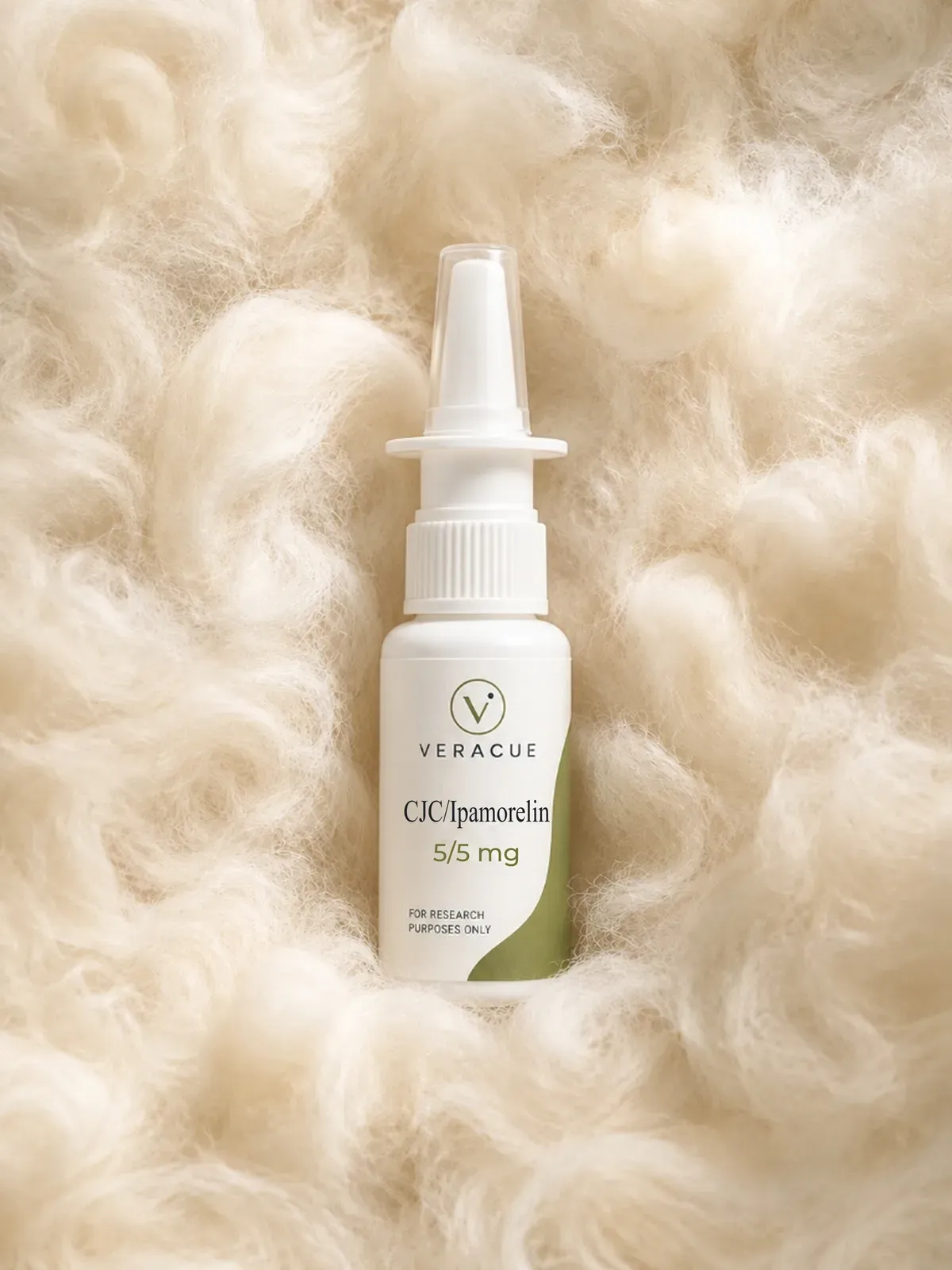
Spray bottle pairing a 29-residue GHRH analog with the pentapeptide Ipamorelin, 5 mg of each and 45 sprays per bottle. Laboratory research use only.

RESEARCH PEPTIDE
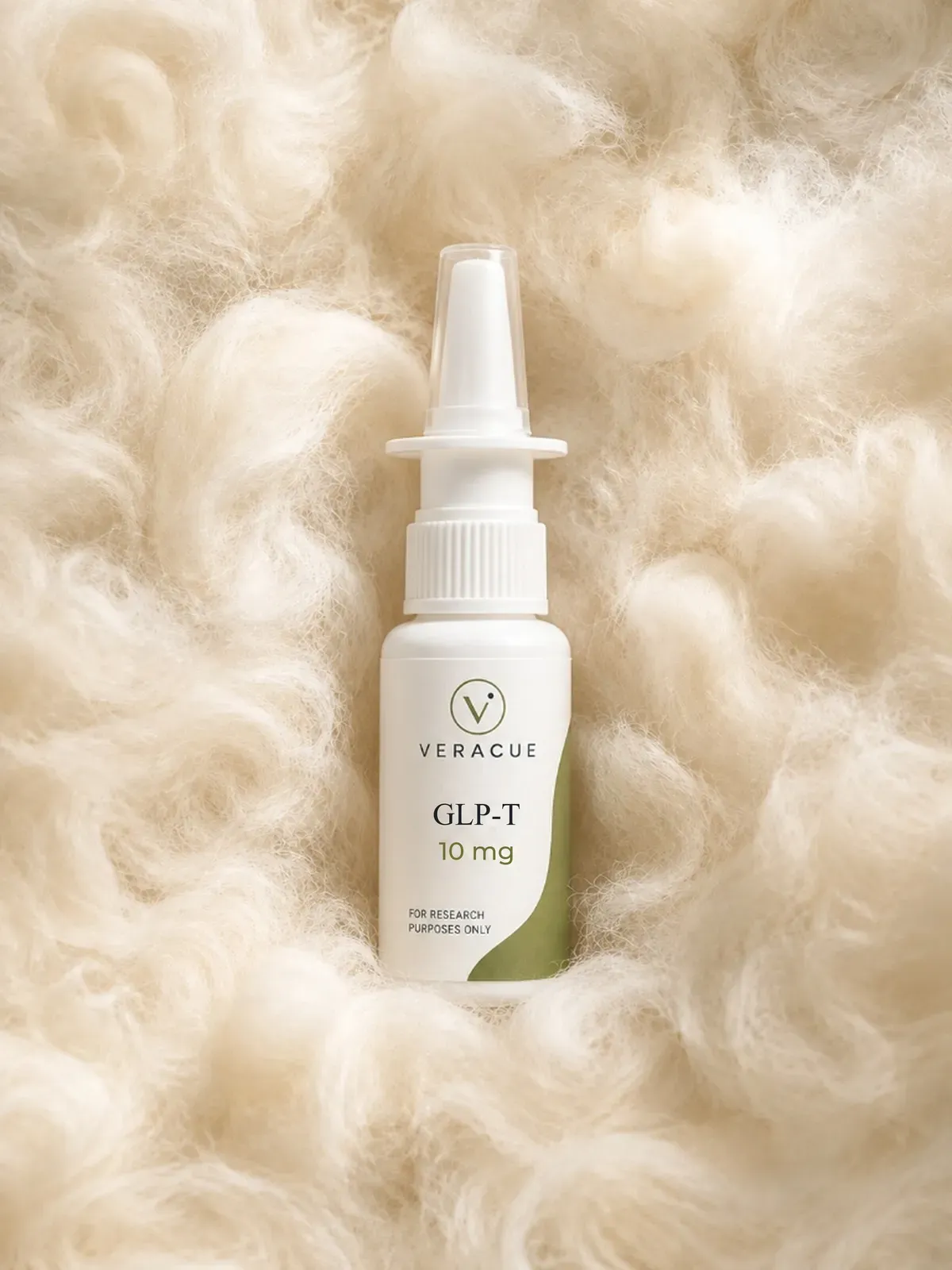
GLP-T Spray pairs a 39-residue peptide, LY3298176 (CAS 2023788-19-2), with a C20 diacid on lysine 20. 10 to 60 mg, research use only, 45 sprays a bottle.

RESEARCH PEPTIDE
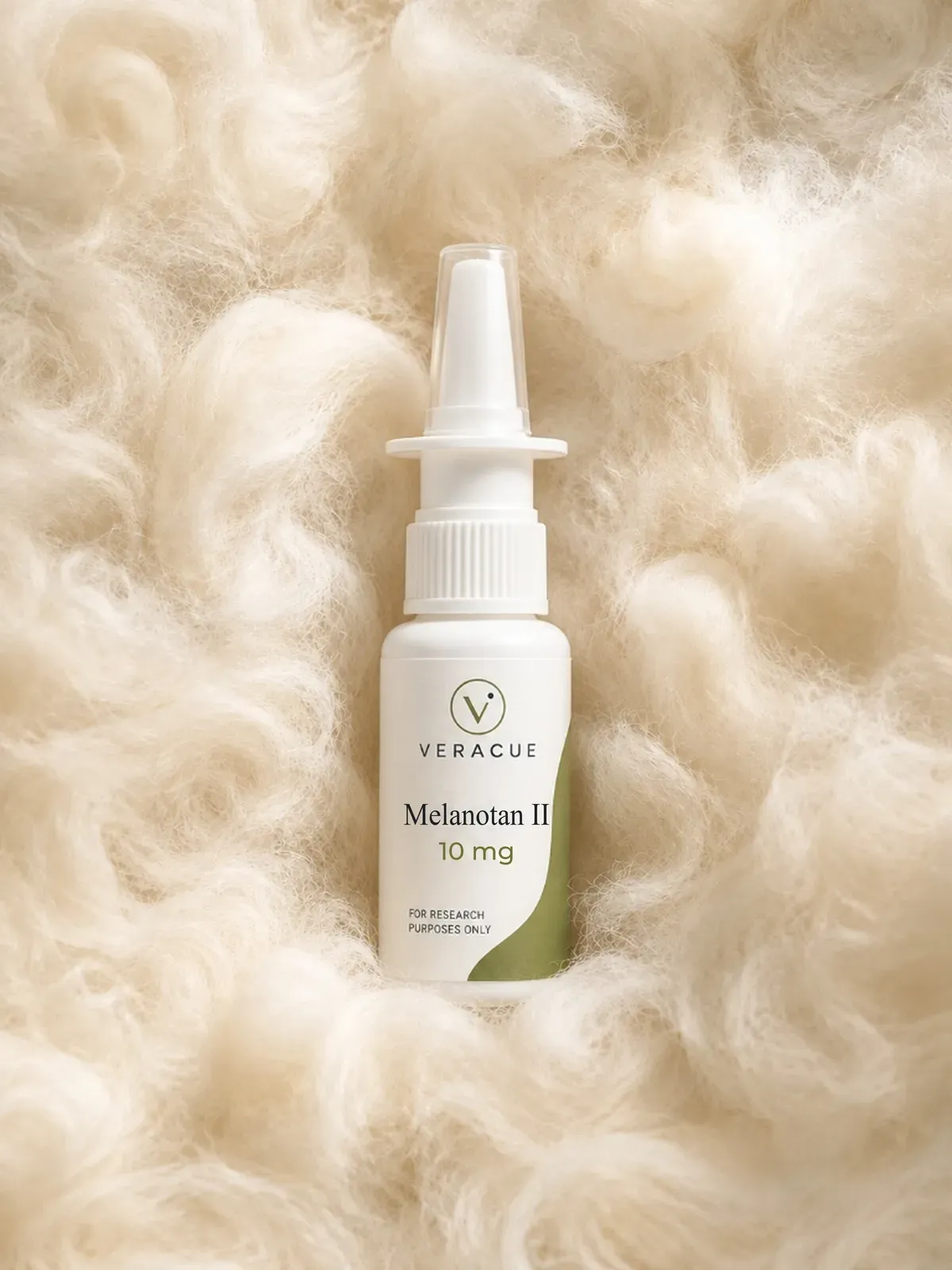
Seven residues, a lactam ring and an amide terminus: Melanotan II, CAS 121062-08-6, in a 10 mg bottle of 45 sprays. Laboratory research only.

RESEARCH PEPTIDE
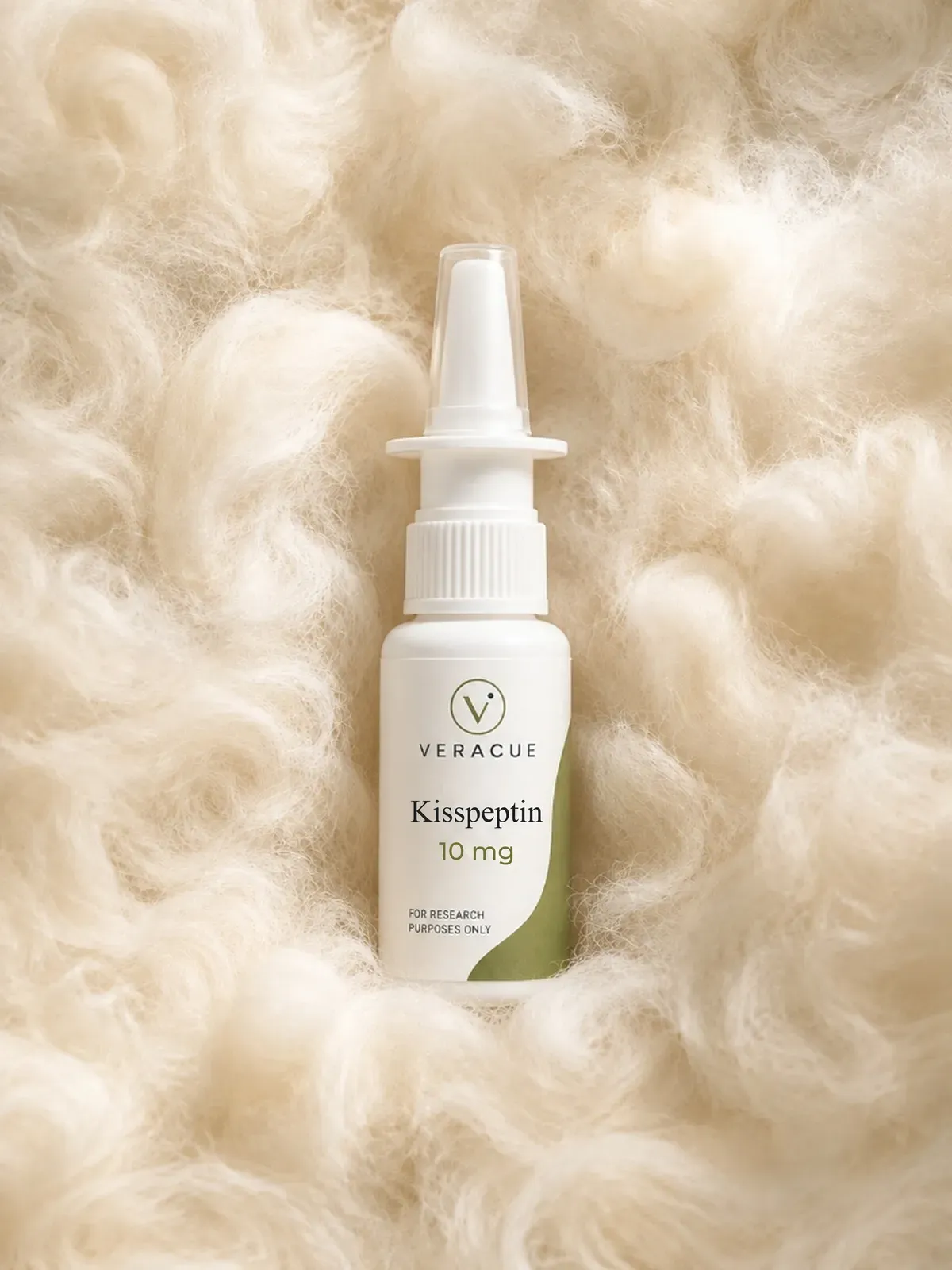
Ten residues, mass 1302.45 g/mol, CAS 374675-21-5: kisspeptin-10 in a 10 mg bottle with 45 sprays, offered for research use only.