
Free Research Tool • No Sign-Up • Instant Results
Peptide Reconstitution & Dosage Calculator
Enter your vial size, bacteriostatic water volume, and target dose. This tool converts the math into an exact syringe draw, in units, instantly.
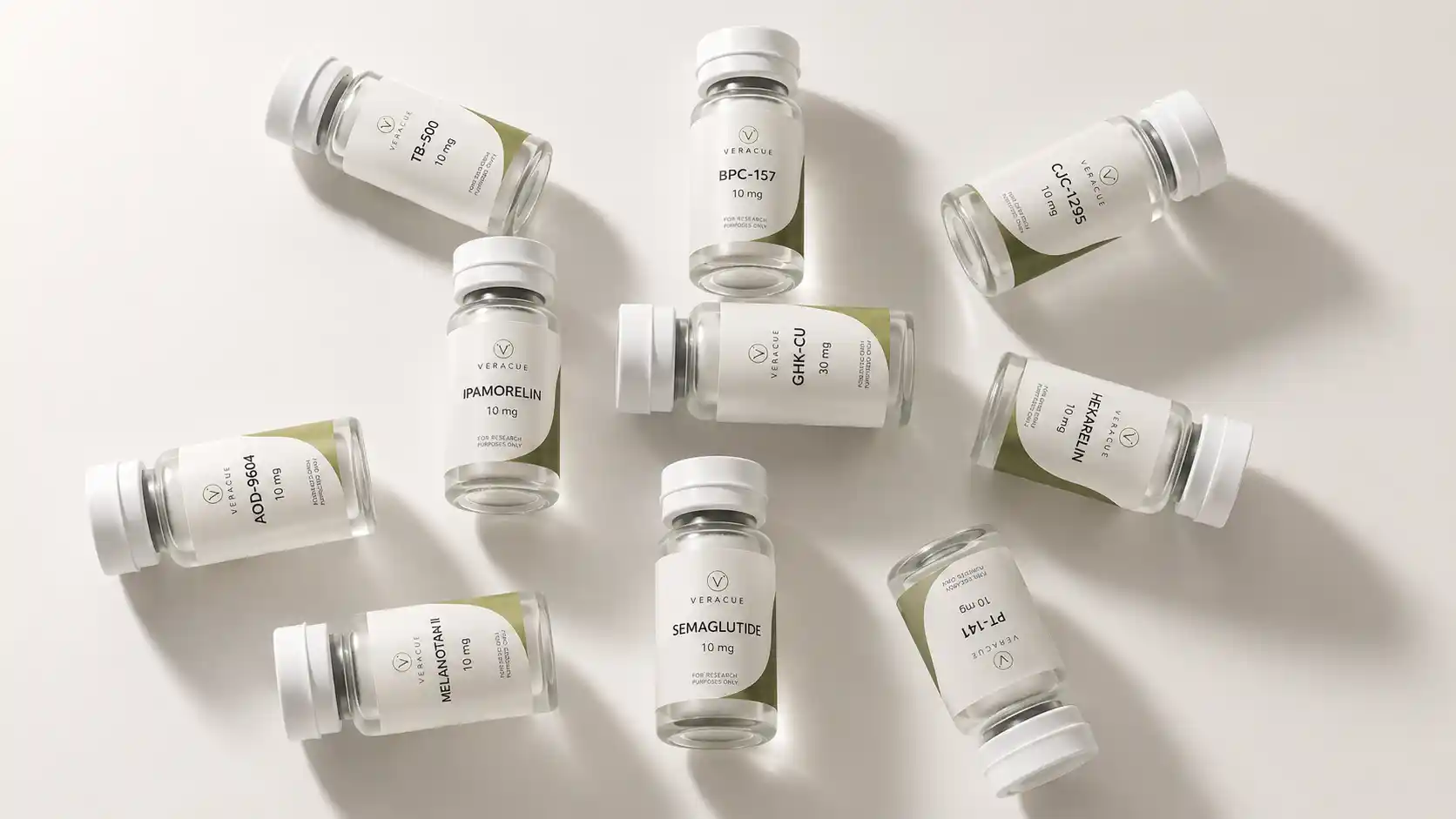
Exact Draw Volume,
Every Time
Precision
Calibration
Works for any vial size.
Converts 2mg, 5mg, 10mg, and 30mg vials into exact U-100 syringe units for your research.
*Parameters update calculations instantaneously. All formulas assume standard laboratory-grade U-100 syringe graduations unless specified.
Precision is
Non-Negotiable.
Whether you're preparing a 2mg or 10mg lyophilized cake, guessing at the diluent math risks a compromised study, irreversible peptide shearing, and data you can't trust.
Eliminate Peptide Hydrolysis
Improper dilution alters osmolarity and pH thresholds, accelerating molecular decomposition before experiments begin.
Consistent Across Sessions
An accurate draw today gives you the same dose next week, so results stay comparable across your whole study.
No More Manual Math
Type in your vial mass, water volume, and target dose, and the calculator gives you the exact U-100 syringe reading.
The Reconstitution Pipeline
Wipe and Dry the Septa
Swab the rubber stopper on both the peptide vial and the bacteriostatic water vial with a fresh 70% isopropyl wipe, then let each one air dry for about 30 seconds before you go near it with a needle.
Add the Water Slowly
Draw the volume the calculator gave you, then angle the needle against the inside wall of the vial. Let the water run down the glass instead of hitting the lyophilized cake directly.
Roll, Never Shake
Shaking stresses the peptide bonds. Roll the vial gently between your palms instead, in slow circles, until the cake fully dissolves into a clear solution with nothing floating in it.
Reading a Standard U-100 Syringe
Tap any preset below to test and visualize exact barrel draw graduation marks in real time:
The Mathematics of Reconstitution
This is the exact formula behind every result above, so you can check it by hand whenever you want:
Benchmark Scenario
- Lyophilized Cake:5 mg (5,000 mcg)
- BAC Water Added:2.0 mL
- Target Dose:250 mcg
Mathematical Resolution
(250 mcg ÷ 5,000 mcg) × 2.0 mL = 0.10 mL
Need to convert between mg, mcg, mL, and IU? Use the Unit Converter above →
Dilution Ratios & Concentrations
| Vial Content | BAC Water Added | Resulting Density | 250 mcg Dose | 500 mcg Dose | 1,000 mcg Dose |
|---|---|---|---|---|---|
| 2 mg | 1.0 mL | 2.0 mg/mL (2,000 mcg/mL) | 12.5 Units (0.125 mL) | 25.0 Units (0.250 mL) | 50.0 Units (0.500 mL) |
| 5 mg | 2.0 mL | 2.5 mg/mL (2,500 mcg/mL) | 10.0 Units (0.100 mL) | 20.0 Units (0.200 mL) | 40.0 Units (0.400 mL) |
| 10 mg | 2.0 mL | 5.0 mg/mL (5,000 mcg/mL) | 5.0 Units (0.050 mL) | 10.0 Units (0.100 mL) | 20.0 Units (0.200 mL) |
| 10 mg | 3.0 mL | 3.33 mg/mL (3,333 mcg/mL) | 7.5 Units (0.075 mL) | 15.0 Units (0.150 mL) | 30.0 Units (0.300 mL) |
| 30 mg | 3.0 mL | 10.0 mg/mL (10,000 mcg/mL) | 2.5 Units (0.025 mL) | 5.0 Units (0.050 mL) | 10.0 Units (0.100 mL) |
Freeze-Dried Powder
In desiccated freeze-dried cakes, peptide bonds maintain stability over long periods when shielded from light and humidity.
- Room Temp (20°C – 25°C)30 – 60 Days
- Refrigerated (2°C – 8°C)Up to 2 Years
- Deep Freeze (−20°C)3 – 5 Years
Reconstituted Liquid
Once hydrated, continuous refrigeration is non-negotiable to prevent rapid peptide bond cleavage.
- Refrigerated (2°C – 8°C)28 – 30 Days
- Post-Reconstitution FreezingNEVER FREEZE
- Room Temperature Exposure< 24 Hours
3 Handling Mistakes That Ruin a Batch
These three errors are the most common way researchers accidentally degrade a compound before they even start.
1. Shaking the Vial
Mechanical shearing permanently breaks fragile peptide tertiary structures. Never shake vigorously. Always roll the vial gently between palms.
2. Freezing Reconstituted Liquid
Freezing a reconstituted solution forms sharp ice crystal lattices that permanently puncture and cleave amino acid polymers.
3. Plain Sterile Water
Standard sterile water lacks the 0.9% benzyl alcohol preservative required to suppress bacterial proliferation across multi-day draws.
Syringe Calibration:
U-100 vs U-40
Grabbing the wrong syringe is the single most common way a dose ends up way off target. Most research peptide work is standardized on U-100 syringes (100 units per 1.0 mL).
Test Liquid Volume:
0.50 mLThe identical liquid volume represents 50 units on a U-100 syringe, but only 20 units on U-40.
Storage Window Guidance
How long a reconstituted vial holds up depends on temperature and time. Here's the window we work within:
Use within this window for the most consistent results.
Keep at 2-8°C; this is the outer edge of the standard storage window.
We don't have stability data supporting use past this point.
Once out of the fridge, plan to use it the same day.
Essential Research Glossary
Core scientific definitions governing synthetic peptide reconstitution:
Lyophilized
Freeze-dried into a stable powder. Removing the water this way keeps the peptide intact until you reconstitute it.
BAC Water
Sterile water carrying 0.9% benzyl alcohol, which keeps bacteria from growing in the vial once it is opened.
mg vs mcg
1 milligram equals 1,000 micrograms. Mixing the two up is the easiest way to be off by a factor of 1,000.
U-100
A syringe marked so that 100 units equals 1.0 mL. It is the scale this calculator uses for every result above.
Calculator FAQ
