NAD+ and AHK-Cu in Metabolic and Longevity Research: A Deep Dive
A research overview of NAD+ and AHK-Cu covering mitochondrial metabolism, sirtuin activation, copper-peptide signaling, and laboratory handling protocols.

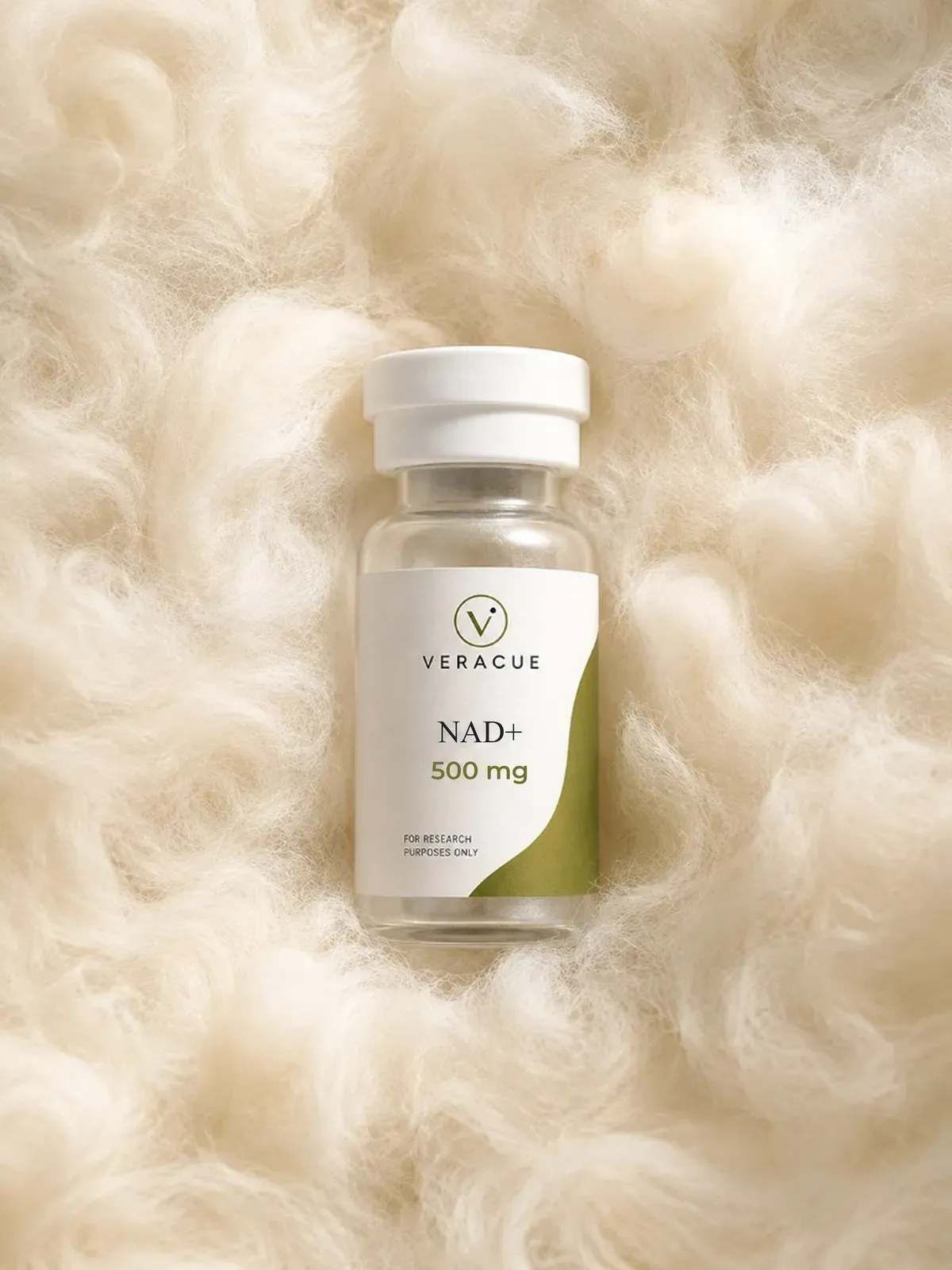
NAD+ is oxidized nicotinamide adenine dinucleotide, a dinucleotide coenzyme rather than a peptide (CAS 53-84-9, PubChem CID 5892). It is written C21H28N7O14P2 as the cation or C21H27N7O14P2 as the neutral inner salt, which is why two molecular weights circulate for the same compound. Its reduced partner NADH and the precursor NMN are separate compounds, so identity checks matter. Vials come in 500 mg and 1000 mg for laboratory research use only.
Ask for the analytical documentation of any lot.
HPLC is the method used to measure purity
Ask for the report for a specific lot through the contact page
Supplied for laboratory research use only
Mass spectrometry is the method used to confirm identity
NAD+ is nicotinamide adenine dinucleotide in its oxidized form, a coenzyme that acts as a redox cofactor in cellular biochemistry. It is a dinucleotide, not a peptide. Veracue supplies it as a research compound under CAS 53-84-9 for laboratory use only.
NAD+ is built from two nucleotides, one carrying nicotinamide and one carrying adenine, joined through a ribose-phosphate-phosphate-ribose bridge. Peptides are chains of amino acids linked by peptide bonds, and NAD+ contains neither. That matters for testing, because sequence confirmation, truncation analysis and amino acid analysis are peptide tools. For NAD+ the useful questions are anomeric configuration, redox state, water content and chromatographic purity under a stated method.
| Product name | NAD+ (nicotinamide adenine dinucleotide) |
| Scientific name | beta-Nicotinamide adenine dinucleotide |
| USAN/INN | Nadide |
| Other names | Coenzyme I, Cozymase, DPN, beta-NAD |
| CAS Registry Number | 53-84-9 |
| PubChem CID | 5892 |
| ChEBI | CHEBI:15846 |
| KEGG | C00003 |
| Formula (cation) | C21H28N7O14P2+ |
| Formula (zwitterion) | C21H27N7O14P2 |
| Average molecular weight | 664.44 (cation) / 663.43 (zwitterion) |
| Oxidation state | Oxidized |
| Classification | Dinucleotide coenzyme |
| Research designation | Research Use Only |
Identifiers and formulas are from the PubChem record and related public databases and describe the reference structure. They are not a statement about the form Veracue supplies. Salt form, hydrate form, water content, physical form, purity, lot results and storage conditions are reported on each lot’s documentation and can be requested through the contact page.
It depends on how the molecule is written. The plus sign in NAD+ refers to the positive charge on the nicotinamide ring nitrogen. Written strictly as that cation, the formula is C21H28N7O14P2+ with an average mass of 664.44. Most chemical databases, including PubChem CID 5892, publish the neutral inner-salt form instead, where a phosphate oxygen carries the balancing negative charge. That form is C21H27N7O14P2 at 663.43.
It is the same substance with the same CAS number, one proton apart in bookkeeping. There is a second, larger correction that matters more in practice. Published molecular weights are anhydrous values. If beta-NAD is supplied as a hydrate, water can be a meaningful fraction of what is in the vial, and salt forms shift the number again. For an accurate molar concentration, work from the water content and form reported on the lot documentation rather than a database value.
Four related molecules get confused with NAD+ often, and confusing them can move evidence from one compound to another where it does not belong. Results generated with a precursor are not results for NAD+.
| Entity | What it is | Relationship to NAD+ | Formula and average mass |
|---|---|---|---|
| NAD+ | Oxidized nicotinamide adenine dinucleotide | The reference entity | C21H28N7O14P2+, 664.44 |
| NADH | The reduced form of the same coenzyme | Redox partner. Same molecule, different electron state | C21H29N7O14P2, 665.4 |
| NADP+ | A phosphorylated cofactor | A separate cofactor system. Not interchangeable | C21H28N7O17P3+, 744.4 |
| NADPH | The reduced form of NADP+ | Distinct from NADH in its metabolic role | C21H30N7O17P3, 745.4 |
| Nicotinamide (NAM) | A B3-related metabolite | Released when NAD+ is consumed, and fed back through salvage | C6H6N2O, 122.12 |
| NR | Nicotinamide riboside | An upstream precursor, converted toward NMN | C11H15N2O5+, 255.25 (free base) |
| NMN | Nicotinamide mononucleotide | The immediate precursor, converted to NAD+ by NMNAT | C11H15N2O8P, 334.22 |
NR is usually sold as the chloride salt, which has a different mass of 290.70. Sodium salt forms of NAD+ also carry a different mass again, so the form always has to come from the lot documentation.
Two roles, and they lead to different research questions. First, NAD+ is a redox cofactor. It accepts a hydride to become NADH, and NADH donates electrons downstream. That NAD+/NADH couple runs through glycolysis, the TCA cycle and oxidative phosphorylation, which is why NAD+ appears in so many bioenergetics protocols.
Second, NAD+ is a consumed co-substrate. Sirtuins, PARPs and the NADases CD38 and CD157 cleave NAD+ rather than cycling it. Each of these reactions releases nicotinamide, which feeds back into the salvage pathway.
Cells rebuild NAD+ through three routes. The de novo route starts from tryptophan through the kynurenine pathway. The Preiss-Handler route starts from nicotinic acid. The salvage pathway converts nicotinamide to NMN through NAMPT, then NMN to NAD+ through NMNAT.
None of this is a claim about what happens when NAD+ is applied to a living system. Biochemical centrality is not an outcome, and compartmentalization means a change in one pool does not imply a change in another.
NAD+ appears as a reagent, a substrate or a measured analyte across several fields. These are research contexts and not statements about any result from using this material.
A percentage on its own does not tell a researcher much, because different methods measure different things and each one leaves a specific blind spot.
| Method | What it establishes | What it does not establish |
|---|---|---|
| RP-HPLC with UV detection, reported as area % | Chromatographic purity under one stated column, mobile phase and detection wavelength | Molecular identity. Anything that does not elute or does not absorb. Water content. Salt form |
| LC-MS | A measured mass consistent with the expected molecule | Purity. Anything mass-identical, including isomers |
| LC-MS/MS | Accurate mass plus fragmentation consistent with the expected structure | Absolute purity. Anomeric configuration, since alpha-NAD and beta-NAD share a mass |
| UV scan, A260 and A340 | Redox state. NADH absorbs strongly near 340 nm, NAD+ effectively does not | Purity against impurities that do not absorb in that region |
| Enzymatic assay tracking change in A340 | Functional NAD+ content, using the NADH extinction coefficient of roughly 6.2 to 6.3 x 10^3 L per mol per cm | The identity of whatever is not NAD+ |
| Karl Fischer titration | Water content, which converts an as-supplied figure to an anhydrous-basis figure | Chemical purity |
| Endotoxin (LAL) | Endotoxin level | Sterility, identity or purity |
No. An HPLC area percentage says what fraction of the detected peak area belongs to the main peak. An assay value says how much NAD+ is present per unit mass. A hydrated material can show excellent chromatographic purity and still contain less anhydrous NAD+ per milligram than the label weight implies.
No. Beta-NAD is the biologically active configuration, and the alpha-anomer is an isomer with an identical molecular mass. Chromatographic resolution or an enzymatic assay is what settles that question.
NAD+ and NADH differ by two mass units and behave very differently in the UV. A UV scan is the simple way to show that material is in the oxidized state.
Certificates vary between laboratories and testing programs, so treat this as what a COA may include rather than a fixed checklist. A number without a method behind it is not verification.
Any field above depends on the lot’s own documentation, and Veracue confirms a field only when the lot certificate reports it. The certificate page explains how to request lot documentation.
NAD+ is hygroscopic, and its degradation routes are well characterized in the literature. Absorbed water accelerates hydrolysis, heat speeds degradation, stability is best near neutral to slightly acidic pH, and UV or near-UV light can drive photodegradation. Solutions are less stable than the solid. These are general properties of the compound. Storage details for a specific lot belong to that lot’s own documentation, which accounts for its form, water content and packaging.
Ask the Veracue team about the documentation available for a specific lot, or browse the certificate library.
NAD+ is supplied for laboratory research, scientific investigation and analytical characterization only. It is not a drug, dietary supplement, cosmetic or food product, and it is not intended for human or veterinary use, or for ingestion, injection, inhalation or any form of administration. This page contains no dosing, administration or usage guidance of any kind. See the Medical Disclaimer and the Terms and Conditions for sitewide policies.

RESEARCH PEPTIDE
Not a peptide: 5-Amino-1MQ is a quinolinium cation, C10H11N2+ (159.21 g/mol); its iodide salt is 286.11. Check the form. Laboratory research, 50 mg.

RESEARCH PEPTIDE
GLP-S is a 31-residue GLP-1 analog with a C18 diacid on lysine 26 (C187H291N45O59, CAS 910463-68-2). Available from 5 to 30 mg, research use only.

RESEARCH PEPTIDE
Is H-Frag just AOD 9604 under another name? No. It opens with Phe, not Tyr, and weighs 1799.1 g/mol (CAS 66004-57-7). A 5 mg vial for laboratory research.

RESEARCH PEPTIDE
GLP-T (LY3298176) is a 39-residue peptide with a C20 fatty diacid, CAS 2023788-19-2. See the COA notes. 10 to 60 mg, research use only.