NAD+ and AHK-Cu in Metabolic and Longevity Research: A Deep Dive
A research overview of NAD+ and AHK-Cu covering mitochondrial metabolism, sirtuin activation, copper-peptide signaling, and laboratory handling protocols.

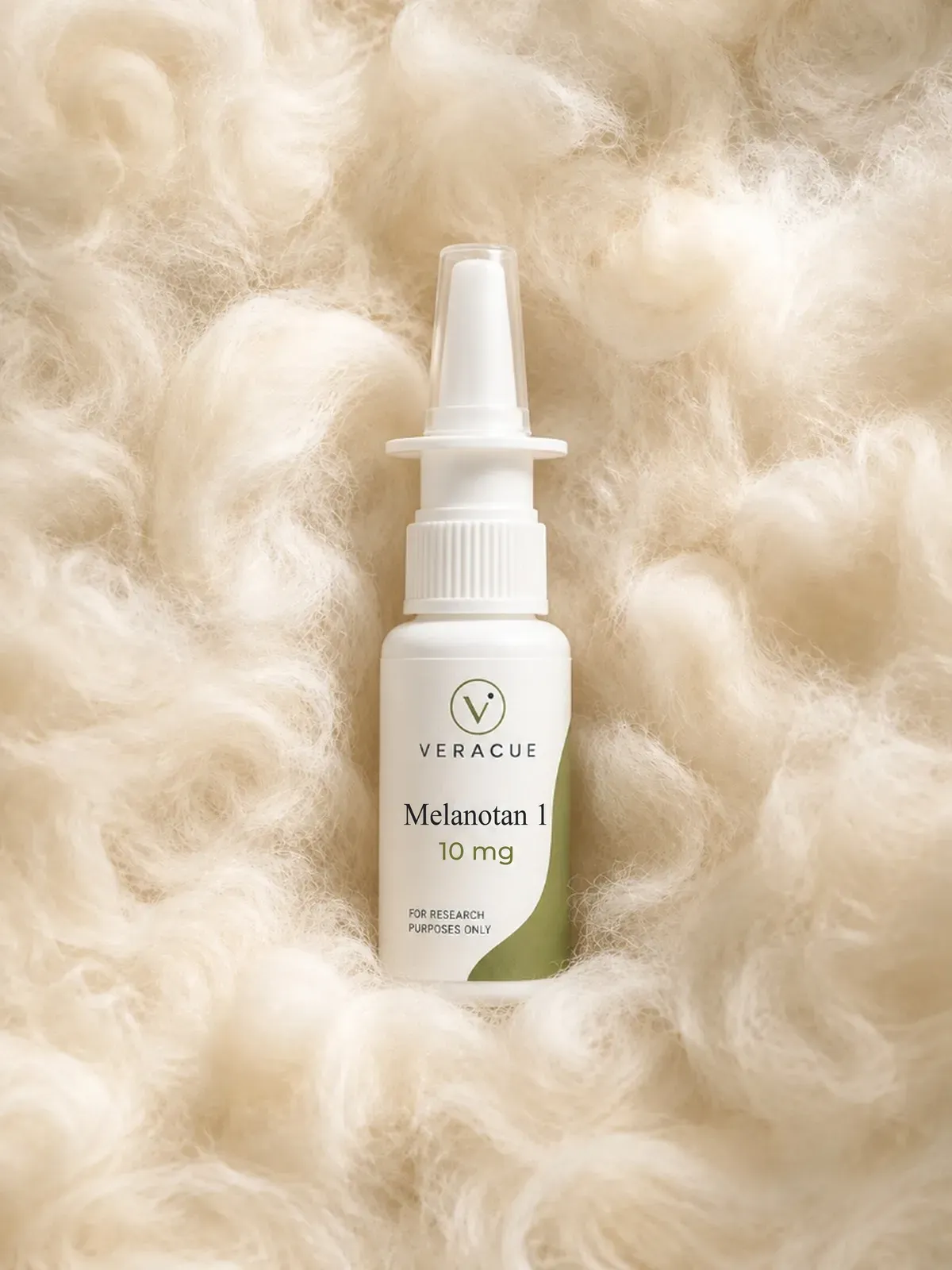
Melanotan 1 Spray supplies Melanotan 1, structural name [Nle4, D-Phe7]-alpha-MSH, a linear 13-residue analogue of alpha-MSH carrying norleucine in place of methionine at position 4 and D-phenylalanine in place of phenylalanine at position 7. Its formula is C78H111N21O19, reference molecular weight about 1,646.8 g/mol, CAS 75921-69-6. It is a different, linear molecule from the cyclic heptapeptide Melanotan 2, and the two should never be confused when comparing masses. Available as a 10 mg spray-dispensed size for laboratory research use only.
Ask for the analytical documentation of any lot.
HPLC is the method used to measure purity
Ask for the report for a specific lot through the contact page
Supplied for laboratory research use only
Mass spectrometry is the method used to confirm identity
Melanotan 1 Spray is Veracue’s spray-dispensed packaging of Melanotan 1, a synthetic melanocortin peptide analogue built on the structure of alpha-MSH, with norleucine in place of methionine at position 4 and D-phenylalanine in place of phenylalanine at position 7. The underlying molecule is identical to the one documented on Veracue’s Melanotan 1 vial listing; only the packaging and dispensing format differ between the two listings.
"Spray" is a packaging and dispensing descriptor, nothing more. It does not establish a route, a concentration, or a formulation, and none of those specifics should be inferred from the product name. Chemical form, concentration, fill volume and storage conditions are reported on each lot’s own documentation and can be requested through the contact page.
| Product name | Melanotan 1 Spray |
| Also written | Melanotan-1, Melanotan-I, MT-1, MT1 |
| Structural name | [Nle4, D-Phe7]-alpha-MSH |
| Peptide class | Synthetic melanocortin peptide; alpha-MSH analogue |
| Packaging format | Spray-top bottle, Research Use Only |
| Length | 13 residues, linear |
| Sequence | Ac-Ser-Tyr-Ser-Nle-Glu-His-D-Phe-Arg-Trp-Gly-Lys-Pro-Val-NH2 |
| Molecular formula | C78H111N21O19 |
| Reference molecular weight | Approximately 1,646.8 g/mol |
| CAS Registry Number | 75921-69-6 |
| Size offered | 10 mg |
| Research designation | Research Use Only |
Veracue lists Melanotan 1 in more than one packaging format because research groups source and track material differently depending on how it is packaged. Keeping the formats as separate listings keeps lot records, images and documentation specific to the packaging a researcher actually ordered, rather than mixing records across formats.
Melanotan 1 Spray and Veracue’s Melanotan 1 vial listing describe one molecule: a linear tridecapeptide with an acetylated N-terminus and an amidated C-terminus, full structural name [Nle4, D-Phe7]-alpha-MSH. Packaging format has no bearing on sequence, formula or mass, so these values are identical across both listings.
No. The compound reported under this listing is the same alpha-MSH analogue reported under the vial listing. What differs between the two listings is how the material is packaged and dispensed, not its chemical identity.
In Veracue’s catalog, "Spray" is a packaging and dispensing term, comparable to "vial" or "powder" on other listings. It tells a researcher how the product is dispensed from its container. It does not specify a concentration, a carrier, a route, or a formulation, and it is not shorthand for any particular method of use. Those details, where applicable, live in lot-specific documentation rather than in the catalog name.
Treating a packaging word as a technical specification is a common source of error when comparing listings across suppliers. A researcher documenting materials in a methods section should cite the lot’s own documentation for format-specific details rather than inferring them from the word "Spray" alone.
The two names are often used as if they were interchangeable. They are different molecules that share a receptor-recognition motif, and the comparison here is scientific only.
| Attribute | Melanotan 1 | Melanotan 2 |
|---|---|---|
| Molecular class | Linear alpha-MSH analogue | Cyclic alpha-MSH analogue |
| Structure | Linear tridecapeptide | Cyclic heptapeptide (lactam-bridged) |
| Sequence | Ac-Ser-Tyr-Ser-Nle-Glu-His-D-Phe-Arg-Trp-Gly-Lys-Pro-Val-NH2 | Ac-Nle-cyclo[Asp-His-D-Phe-Arg-Trp-Lys]-NH2 |
| Approximate molecular weight | 1,646.8 g/mol | 1,024.2 g/mol |
| Catalog formats Veracue offers | Vial and spray | Vial |
This table compares molecular structure only. Catalog format is listed separately because it is a packaging detail, not a property of the molecule itself, and figures quoted for Melanotan 2 should not be applied to Melanotan 1.
The research interest centres on the melanocortin 1 receptor (MC1R), which responds to alpha-MSH and its analogues. In receptor-expressing cell systems, activation of the receptor raises intracellular cyclic AMP. A stable analogue like Melanotan 1, in either packaging format Veracue offers, gives researchers a practical tool for probing that signalling under controlled laboratory conditions.
Because "Spray" and "vial" describe packaging rather than chemistry, a methods section should still name the molecule precisely by sequence or CAS number, and separately note the catalog format and lot number actually used. This page provides molecular reference information and general research context only, and Veracue provides no dosing, administration or usage guidance of any kind.

Identity and purity for Melanotan 1 Spray are established the same way as for any Melanotan 1 lot: reverse-phase HPLC for chromatographic purity, and mass spectrometry (typically ESI-MS or MALDI-TOF) to confirm that the observed mass matches the molecule’s theoretical value. HPLC alone shows that most detected material elutes together; it does not by itself confirm identity, since a closely related peptide can produce an equally clean trace.
Packaging format has no bearing on which analytical methods apply. A spray-dispensed lot and a vial lot of the same molecule are verified against the same sequence, formula and mass references, listed on the Melanotan 1 at a Glance table above.
| Method | Tells a researcher | Does not prove by itself |
|---|---|---|
| RP-HPLC | Chromatographic purity (area %) | Identity |
| ESI-MS / MALDI-TOF | Mass consistent with Melanotan 1 | Sequence order; purity |
| Tandem MS | Sequence evidence | Quantity or purity |
| Amino acid or elemental analysis | Net peptide content | Identity of impurities |
A certificate of analysis describes one lot, never a packaging format or a compound in general. Before relying on any figure, confirm that the lot number on the certificate matches the container and the order record for the spray-format unit received.
A complete certificate separates product identity, lot number, chemical form, HPLC result with chromatogram, mass spectrometry result with observed and theoretical mass, test date and testing laboratory. Where concentration or fill-volume figures are relevant to a spray-format unit, they are reported on that lot’s own documentation rather than inferred from the catalog listing. The certificate page explains how to request lot documentation for either format.
No. The verification question is the same: does this lot match the stated molecule, and is the purity figure paired with a mass result from the same lot. Packaging format does not change what counts as adequate documentation.
Conventions vary. A source may report average or monoisotopic mass, and it may describe the free peptide or a salt form. When comparing figures for a spray-format lot against a reference value, check which convention is in use before assuming two numbers disagree about identity.
For each lot, keep the catalog listing snapshot, the lot-specific certificate, the stated chemical form, the receipt date, labeled storage conditions, and the packaging format actually received. Recording format alongside the usual identity fields keeps multi-format catalogs like this one traceable lot to lot.
Ask the Veracue team about available documentation for a specific lot, or review the certificate library.
Melanotan 1 Spray is supplied for laboratory research and analytical characterization only. It is not a drug, cosmetic, dietary supplement or food, and it is not intended for human or veterinary use, ingestion, injection or any form of administration. This page contains no dosing, administration or usage guidance of any kind, and the word "Spray" in the product name describes Veracue’s packaging and dispensing format only. See the Medical Disclaimer and the Terms and Conditions for sitewide policies.

RESEARCH PEPTIDE
Spray bottle pairing a 29-residue GHRH analog with the pentapeptide Ipamorelin, 5 mg of each and 45 sprays per bottle. Laboratory research use only.

RESEARCH PEPTIDE
GLP-T Spray pairs a 39-residue peptide, LY3298176 (CAS 2023788-19-2), with a C20 diacid on lysine 20. 10 to 60 mg, research use only, 45 sprays a bottle.

RESEARCH PEPTIDE
A 28-residue, N-acetylated peptide at 3108.3 g/mol, spray-dispensed in a 10 mg bottle with 45 sprays. Supplied for research use only.

RESEARCH PEPTIDE
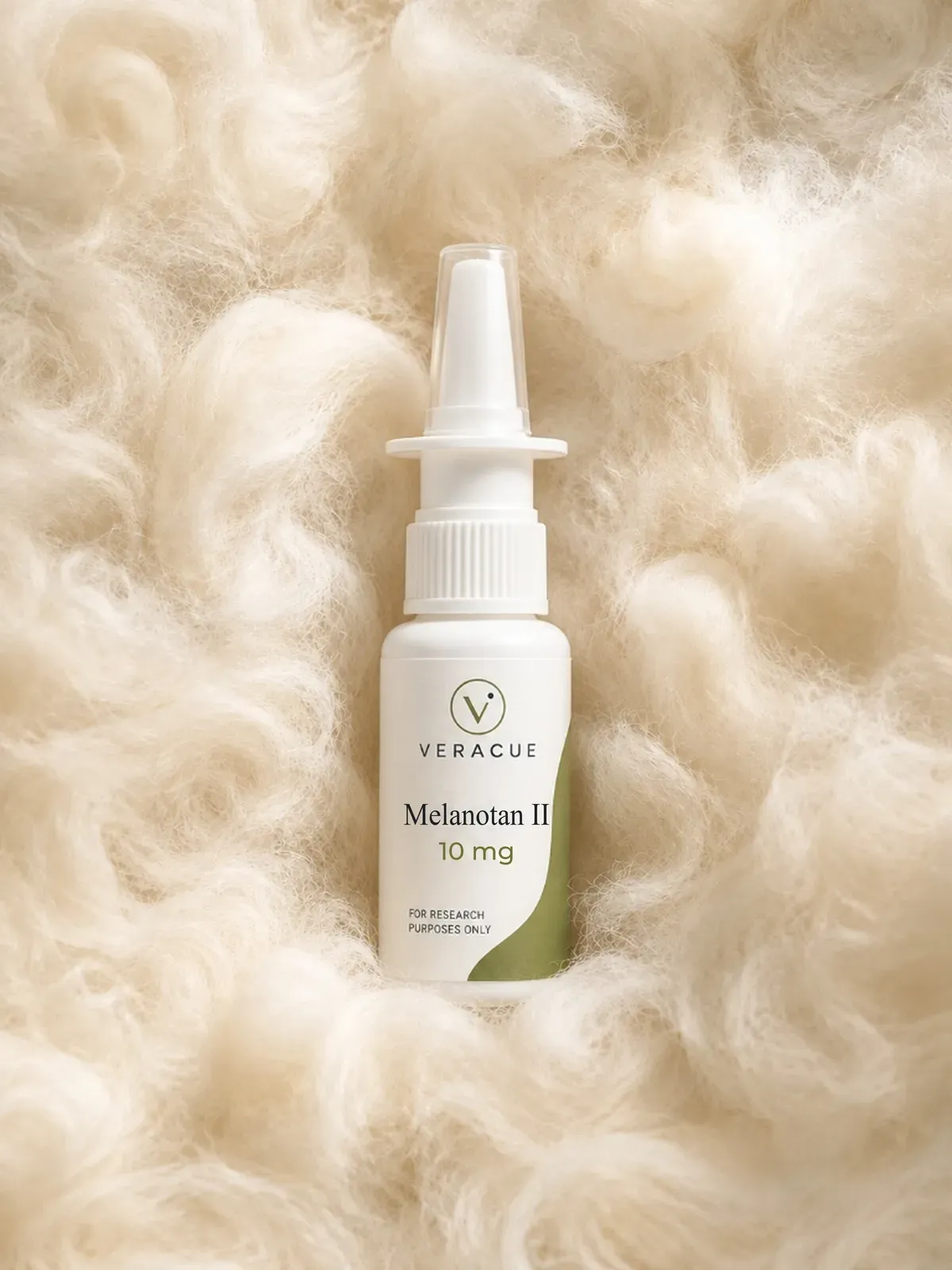
Seven residues, a lactam ring and an amide terminus: Melanotan II, CAS 121062-08-6, in a 10 mg bottle of 45 sprays. Laboratory research only.