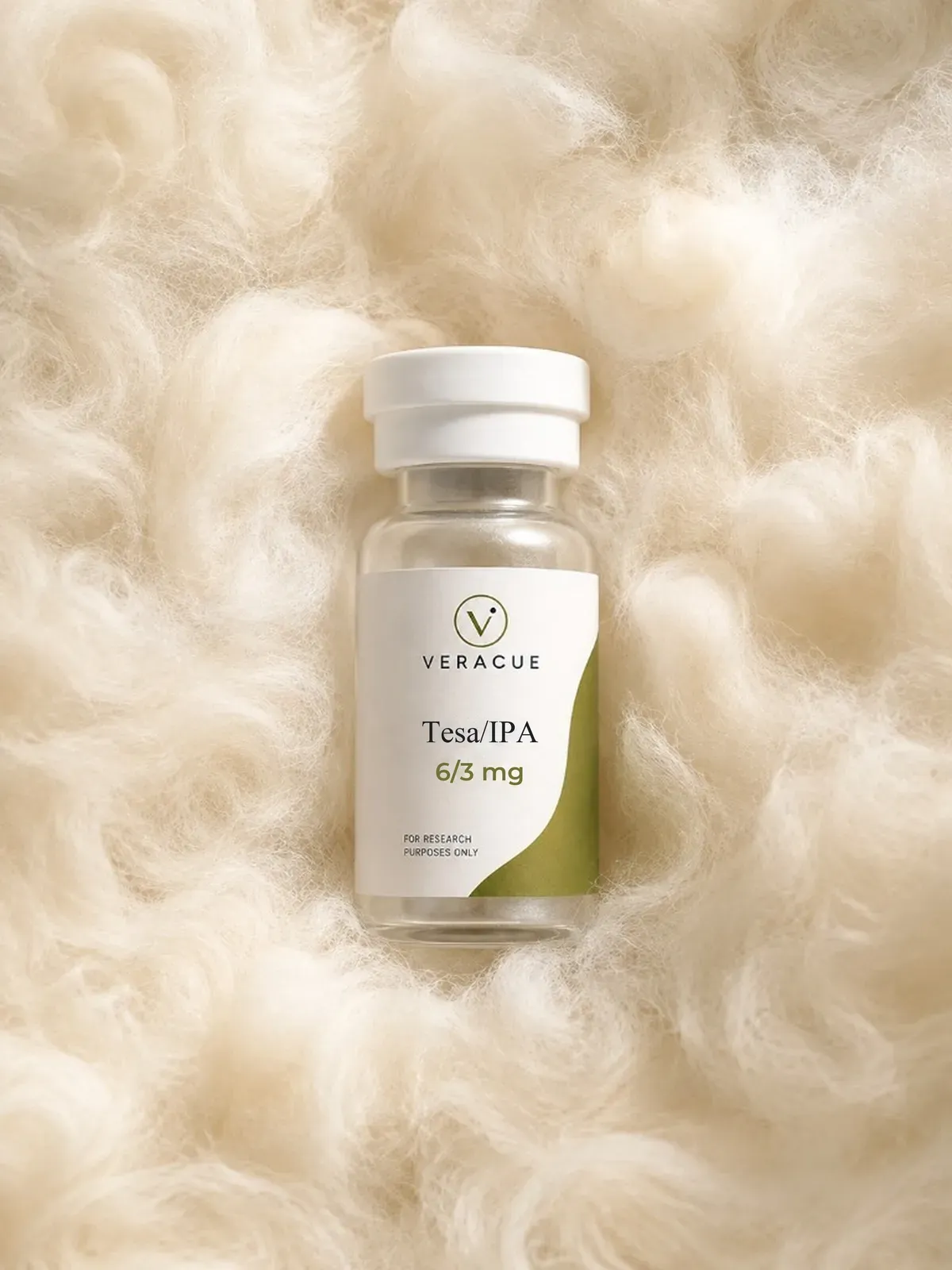
- Tesa/IPA is two separately sourced peptides, tesamorelin and ipamorelin, in one vial — not a single molecule, and the product name does not describe a fixed ratio.
- Across both sizes (6mg/3mg and 13mg/3mg), the ipamorelin figure stays fixed at 3 mg; only the tesamorelin figure scales.
- Tesamorelin acts on the GHRH receptor and ipamorelin on the ghrelin receptor (GHS-R1a) — two distinct receptors in the growth-hormone axis.
- No published study was found testing the tesamorelin-and-ipamorelin combination itself; each peptide's own literature describes that peptide acting alone.
- Veracue's Tesa/IPA is a separate listing from its CJC/Ipamorelin blend (CJC-1295 + ipamorelin, 5mg/5mg) — the two share ipamorelin but pair it with different GHRH-axis analogs.
- A rigorous COA for a two-peptide vial should report identity and purity for each peptide separately, not one combined figure.
Tesa/IPA is not one compound. It is two separately sourced peptides, tesamorelin and ipamorelin, supplied in a single vial, and the easiest way to prove that to yourself is the label: across both vial sizes, the ipamorelin figure never moves. It stays fixed at 3 mg while the tesamorelin figure scales from 6 mg to 13 mg. That asymmetry is the single most useful fact for reading this product correctly, and it's the starting point for everything else below — labeling, evidence, and documentation.
Growth Hormone Secretagogue
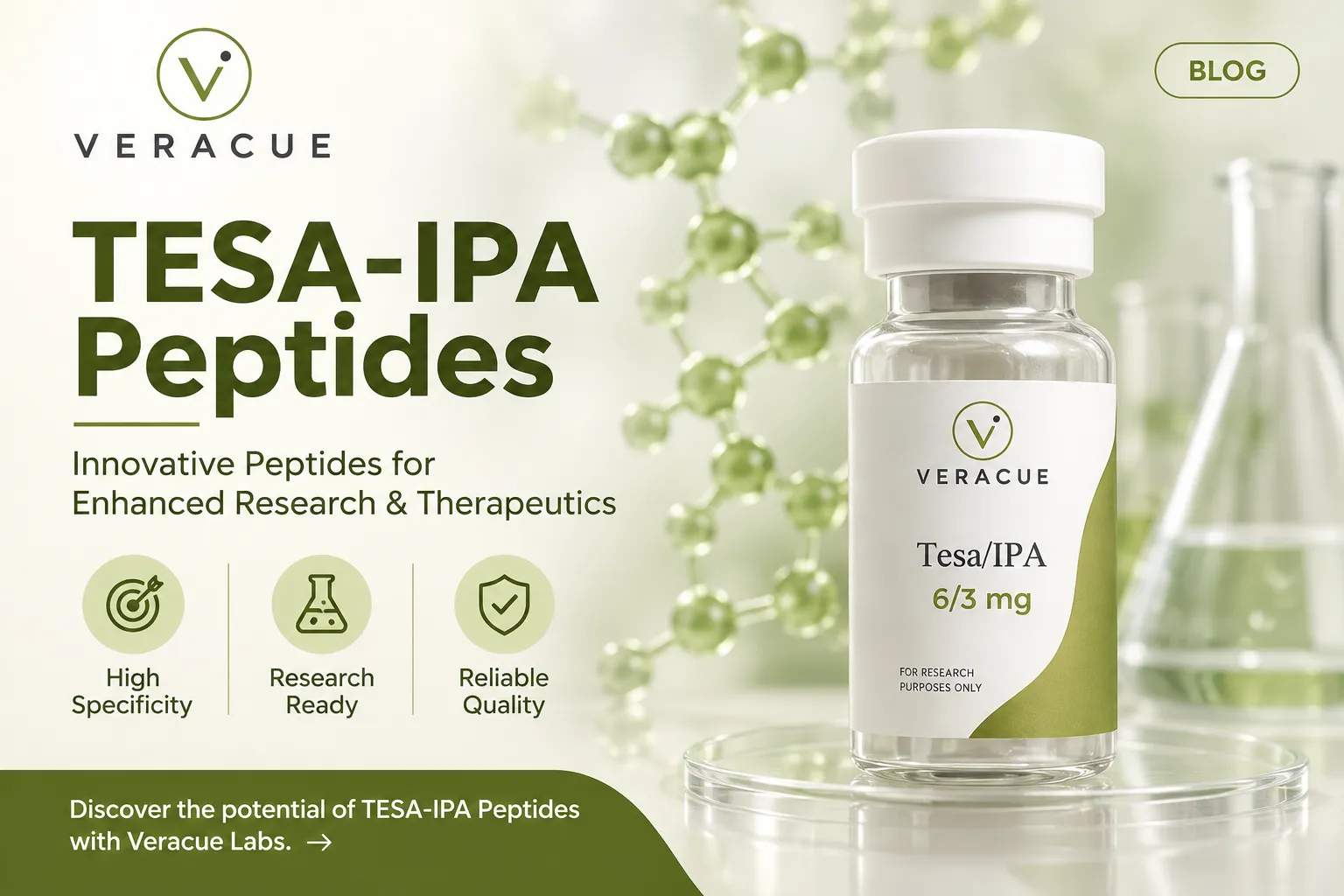
Tesa/IPA
Tesa/IPA is a two-peptide research blend of tesamorelin, a 44-residue GHRH analog (CAS 218949-48-5, about 5,136 g/mol), and ipamorelin, the pentapeptide Aib-His-D-2-Nal-D-Phe-Lys-NH2 (CAS 170851-70-4, 711.9 g/mol). It is easy to confuse with either single peptide, so a certificate should confirm both. Vials come as 6 mg/3 mg and 13 mg/3 mg, tesamorelin over ipamorelin, and are for laboratory research use only, not for human or veterinary use.
Growth Hormone Secretagogue
CJC/Ipamorelin
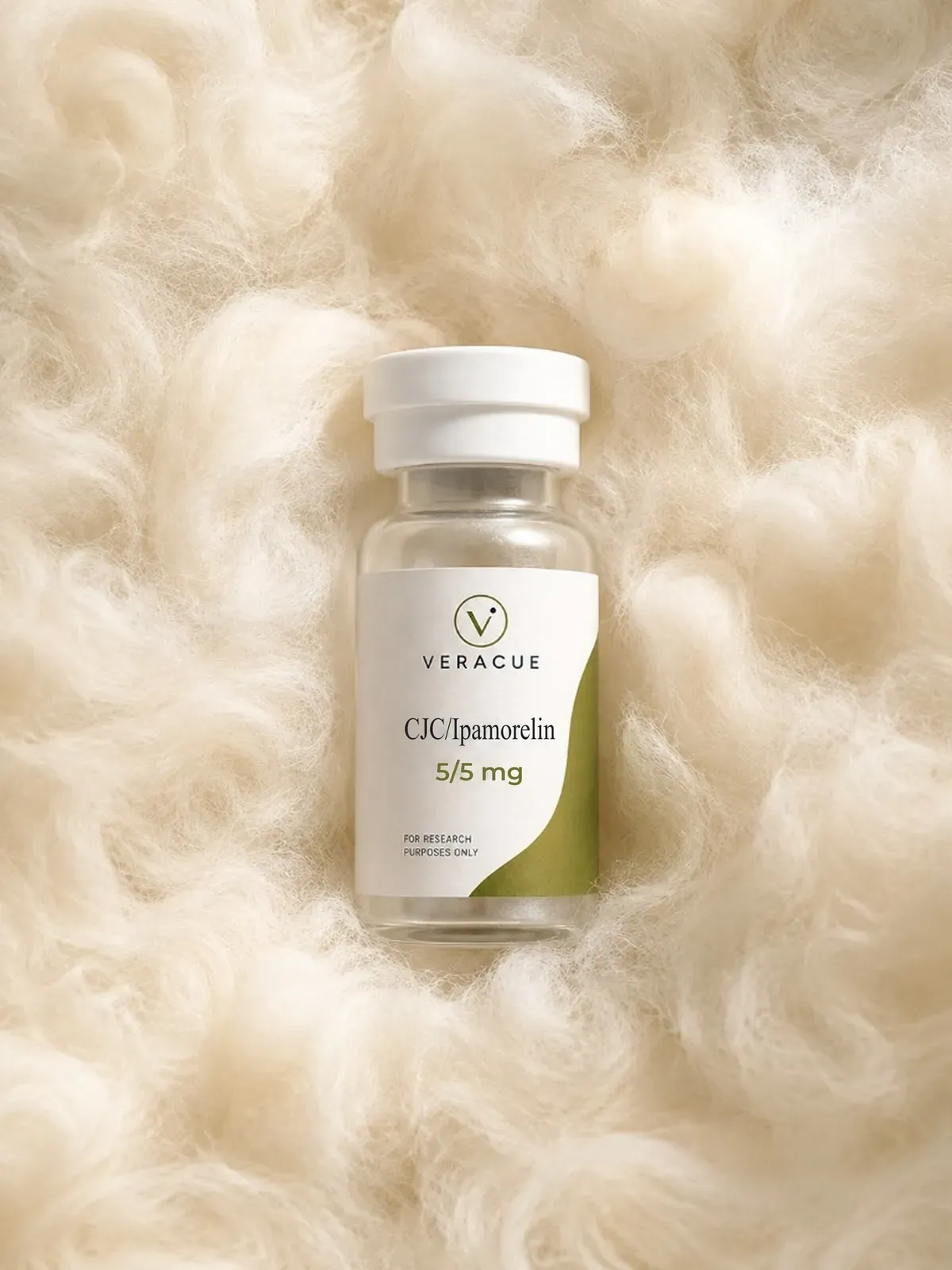
CJC/Ipamorelin is a two-peptide research blend of CJC-1295 No DAC and Ipamorelin, 5 mg of each. CJC-1295 No DAC, also called Mod GRF 1-29, is a 29-residue growth hormone-releasing hormone analog, YADAIFTQSYRKVLAQLSARKLLQDILSR-NH2 with D-alanine at position 2 (C152H252N44O42, average mass about 3367.9 g/mol, CAS 863288-34-0 and 446036-97-1). Ipamorelin is the pentapeptide Aib-His-D-2-Nal-D-Phe-Lys-NH2 (C38H49N9O5, about 711.85 g/mol, CAS 170851-70-4), studied at the ghrelin receptor rather than the GHRH receptor. The vial is labeled 5/5 mg and is supplied strictly for laboratory research use only.
Growth Hormone Secretagogue
Tesamorelin
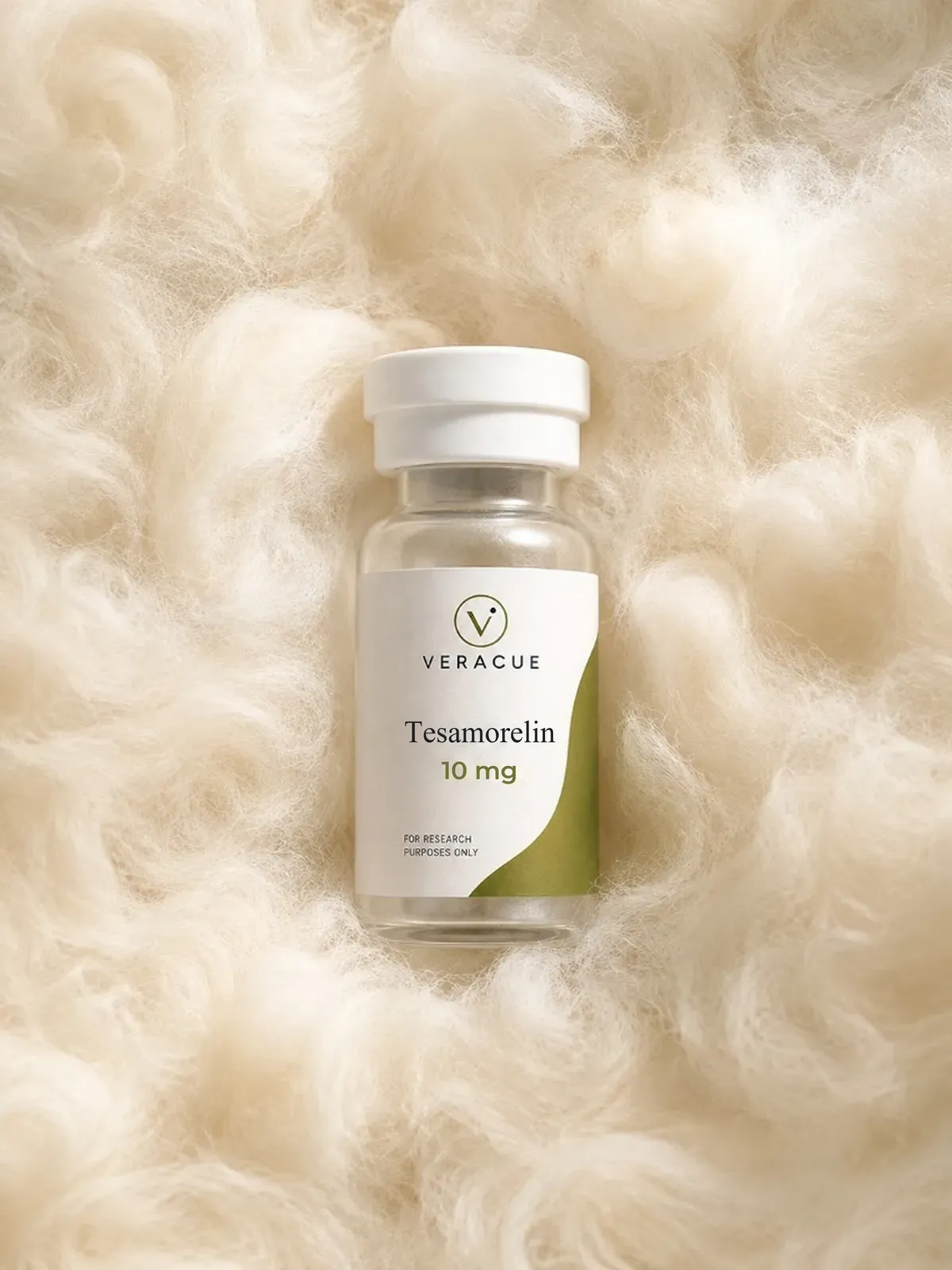
Tesamorelin is a synthetic 44-amino-acid analog of growth hormone-releasing factor: the full native GRF(1-44) chain with a trans-3-hexenoyl group on the N-terminal tyrosine and an amidated C-terminus. The free peptide is C221H366N72O67S, average mass about 5135.9 g/mol, CAS 218949-48-5, while the acetate salt has its own CAS, 901758-09-6. It is a GHRH receptor ligand, not a ghrelin receptor ligand like ipamorelin. Offered in 10 mg and 20 mg vials for laboratory research use only.
Growth Hormone Secretagogue
Ipamorelin
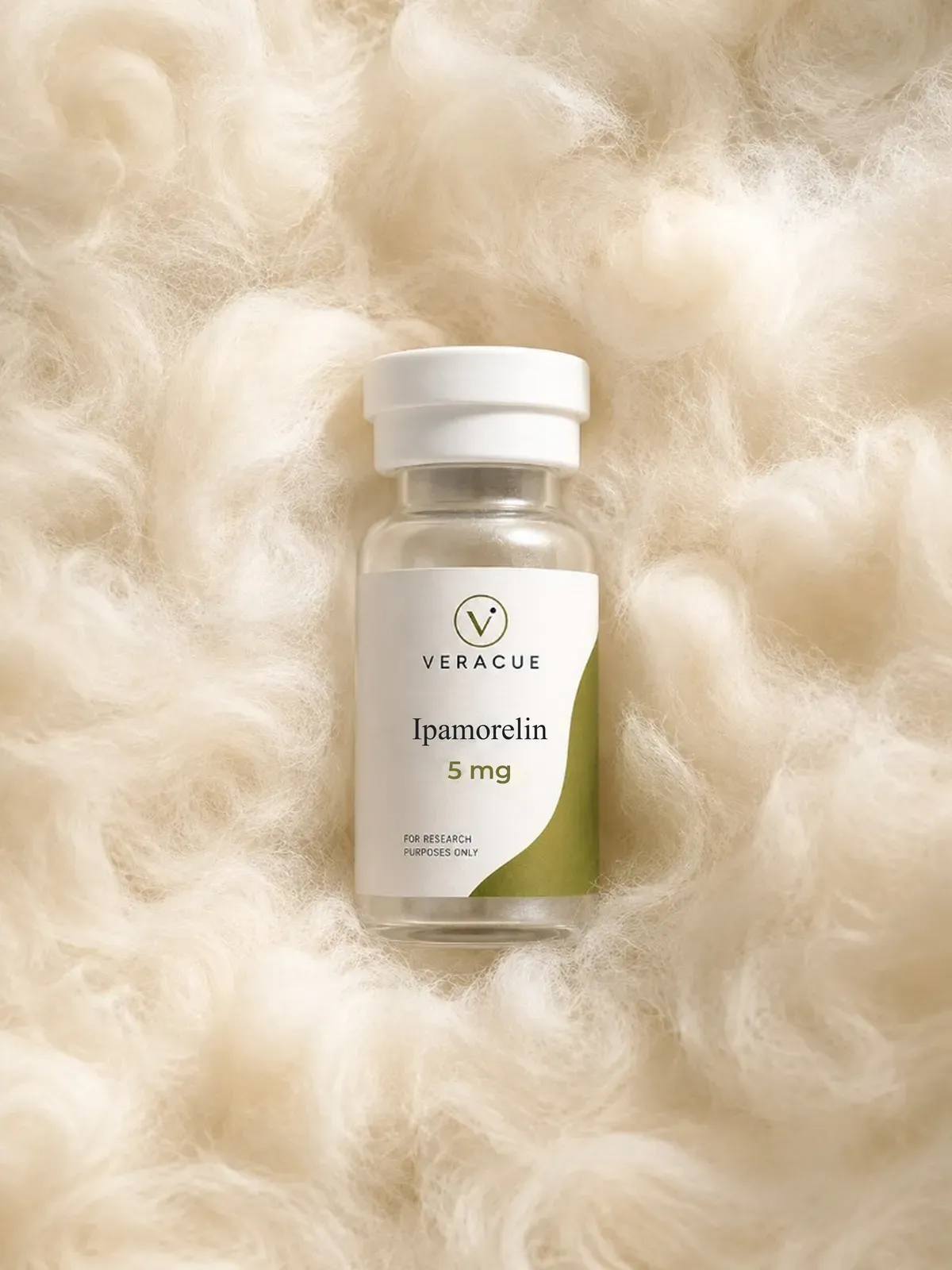
Ipamorelin is a five-residue synthetic peptide, Aib-His-D-2-Nal-D-Phe-Lys-NH2, that includes non-standard residues such as aminoisobutyric acid (Aib) and D-2-naphthylalanine. It has the formula C38H49N9O5, an average mass of about 711.85 g/mol and CAS 170851-70-4, and it is described as a selective agonist of the ghrelin receptor GHS-R1a in receptor assays. Vials come in 5 mg and 10 mg, for laboratory research only, not for human or veterinary use.
Is Tesa/IPA One Peptide or Two?
Tesa/IPA is two separate peptides supplied in the same vial, not a single compound with its own identity. Veracue's Tesa/IPA product page states this directly: the item is not a single molecule, and the name does not describe a fixed ratio. One component is tesamorelin, a 44-residue growth-hormone-releasing-hormone (GHRH) analog. The other is ipamorelin, a synthetic pentapeptide. Each has its own sequence, its own molecular weight, and its own receptor target, and each needs its own identity and purity check on a certificate of analysis. The rest of this guide works through what that separation means in practice, for reading the label, for weighing the evidence, and for requesting documentation.
What Exactly Is the Tesamorelin in This Vial?
Tesamorelin (research synonym TH9507) is a 44-amino-acid analog of human growth-hormone-releasing hormone, carrying an N-terminal trans-3-hexenoyl modification on tyrosine while retaining the full native GHRH(1-44) sequence. Its PubChem entry (CID 16137828) lists a molecular formula of C221H366N72O67S and a mass of roughly 5,136 g/mol, matching the figure on Veracue's own product page. Its CAS number is 218949-48-5. In the literature, tesamorelin is studied as an agonist at the GHRH receptor (GHRHR), a class B G-protein-coupled receptor expressed on anterior-pituitary somatotroph cells. Veracue already covers tesamorelin's full molecular profile in its own Tesamorelin research guide; this guide treats that identity as established background rather than repeating it in full.
What Exactly Is the Ipamorelin in This Vial?
Ipamorelin (research code NNC 26-0161) is a synthetic pentapeptide with the sequence Aib-His-D-2-Nal-D-Phe-Lys-NH2, a molecular weight of 711.9 g/mol, formula C38H49N9O5, and CAS number 170851-70-4 (PubChem CID 9831659). It was first characterized by Raun and colleagues in a 1998 paper in the European Journal of Endocrinology, which described it as a selective agonist at the growth hormone secretagogue receptor (GHS-R1a), the same receptor activated by endogenous ghrelin. In that paper's pharmacological profiling, ipamorelin released growth hormone in the animal models tested without producing the ACTH, cortisol, or prolactin changes the authors measured for other secretagogues in the same assays. That is a description of what one 1998 study measured in the species it studied, not a claim about any outcome for a person, and it says nothing about tesamorelin or about the combined vial.
Why Two Different Receptor Targets Show Up in the Same Vial
Tesamorelin and ipamorelin act on two distinct receptors in the growth-hormone axis: tesamorelin on the GHRH receptor, ipamorelin on the ghrelin receptor (GHS-R1a). Published research on the GH axis has examined GHRH-receptor agonists and ghrelin-receptor agonists as separate experimental variables, often in the same study design, because the two pathways are mechanistically distinct rather than redundant. That is a statement about how researchers have structured GH-axis experiments generally. It is not evidence that the specific tesamorelin-and-ipamorelin pairing sold as Tesa/IPA has itself been studied as a combination, and no such combination-specific trial is cited here because none was found in a public search.
Attribute | Tesamorelin (TH9507) | Ipamorelin (NNC 26-0161) |
|---|---|---|
Peptide class | 44-residue GHRH(1-44) analog | Synthetic pentapeptide |
Sequence feature | Full native GHRH(1-44) sequence with N-terminal trans-3-hexenoyl modification on Tyr1 | Aib-His-D-2-Nal-D-Phe-Lys-NH2 |
Molecular formula | C221H366N72O67S | C38H49N9O5 |
Molecular weight | ~5,136 g/mol | 711.9 g/mol |
CAS number | 218949-48-5 | 170851-70-4 |
PubChem CID | 16137828 | 9831659 |
Receptor target studied | GHRH receptor (GHRHR) | Ghrelin receptor (GHS-R1a) |
Mass in this vial | 6 mg or 13 mg, by size | 3 mg, both sizes |
*Identity data only — not a comparison of effects or benefits.*
Reading the 6 mg/3 mg and 13 mg/3 mg Labels Correctly
Veracue lists two vial sizes for Tesa/IPA: 6 mg tesamorelin paired with 3 mg ipamorelin, and 13 mg tesamorelin paired with 3 mg ipamorelin. Each number describes the mass of one peptide weighed into that vial. It is not a ratio, a recommended proportion, or a dosing instruction; Veracue does not provide dosing or administration guidance for any product. Notice that the second number never changes between sizes — only the tesamorelin figure scales. For documentation purposes, the two figures should be logged as two separate quantities, each tied to its own peptide, rather than reduced to a single combined number.
Why Tesamorelin Research Doesn't Describe the Blend
A finding from tesamorelin research, on its own, describes tesamorelin. It says nothing about what happens in a system that also contains ipamorelin, because the presence of a second active peptide is itself a variable that changes the experimental conditions. Veracue's own product page makes this rule explicit: evidence for one component does not describe the blend. Carrying a tesamorelin-only finding over to the combined vial, without a study designed around the combination, would be an inference the literature does not support.
Why Ipamorelin Research Doesn't Describe the Blend Either
The same rule applies in the other direction. The 1998 Raun paper and later ipamorelin pharmacology describe ipamorelin acting alone (or alongside the substances specific to those experimental designs). None of that literature was designed to test ipamorelin in the presence of tesamorelin at the concentrations found in this vial. Treating ipamorelin's own receptor-selectivity findings as a description of the combined product would carry the same evidentiary gap as the reverse case above.
Is Tesa/IPA the Same as Veracue's CJC-1295/Ipamorelin Blend?
No. Because tesamorelin and CJC-1295 are both GHRH analogs, and both are sold by Veracue paired with ipamorelin, the two products are easy to confuse in search, but they are not the same item. Tesamorelin and CJC-1295 are chemically distinct molecules, each with its own sequence, modification, and published pharmacokinetic profile in its own literature; a published population-pharmacokinetics study of tesamorelin in HIV-infected patients and healthy subjects reported a plasma clearance of roughly 1,060 L/h and a volume of distribution of about 200 L, pharmacokinetic parameters specific to tesamorelin itself and not transferable to CJC-1295 or to this blend's own, separately undocumented, stability. Veracue's CJC/Ipamorelin blend is a distinct listing, pairing CJC-1295 (not tesamorelin) with the same ipamorelin, at a different vial size (5 mg/5 mg). Anyone comparing the two listings should treat them, and their respective bodies of evidence, as separate from the start.
What a Certificate of Analysis Should Show for a Two-Peptide Vial
Veracue's own guidance states that a COA for Tesa/IPA should confirm identity and quantity for both peptides, with a separate purity result for each. That means mass spectrometry (or an equivalent identity method) run against each peptide's own expected mass, since tesamorelin and ipamorelin have different molecular weights and would show up as separate signals, and HPLC (or an equivalent purity method) run against each peptide's own expected retention behavior. A single combined purity number for the vial would not answer the question a two-component product actually raises: is each peptide present, and how pure is each one individually.
What Should You Ask For Before Logging a Blend in a Study?
Before recording Tesa/IPA as a reagent in a study, it is worth requesting, lot by lot: the lot number, the testing lab, the test date, and the per-component identity and purity results described above. Veracue states purity as available on request rather than published as a fixed figure, and lists physical form, vehicle, storage conditions, and lot results as information that lives on each lot's own documentation. Lot-specific paperwork can be requested through Veracue's Certificates of Analysis page or directly via Contact Veracue Labs. Treating that lot-specific paperwork, rather than a general product description, as the record of what is actually in a given vial is the more defensible documentation practice for a two-component material.
Why Do People Search "Tesa/IPA" When It Isn't a Real Compound Name?
A few questions recur in search and forum discussion about this product: whether "Tesa/IPA" names a single new compound, whether the two numbers on the label describe a ratio, and whether this listing is the same as Veracue's CJC/Ipamorelin blend. All three have the same answer, drawn directly from the product page: it is two peptides, the numbers are two separate masses, and it is not the same listing as the CJC-1295 pairing. Framed this way, most of the apparent complexity in the product name resolves to reading the label literally rather than assuming a shorthand.
What Isn't Publicly Documented for This Blend
A few things are worth stating plainly rather than filling in. No published study was found that tests the tesamorelin-and-ipamorelin combination as such, as distinct from each peptide's separate literature. Veracue's page lists purity as available on request, with no numeric figure published for this product. No storage temperature, humidity guidance, or shelf-life figure is published on the product page for this specific blend; that information lives on the lot-specific documentation and on Veracue's separate FAQ & Storage page. Where a researcher needs any of these figures, the lot's own COA and that storage reference, rather than general literature on either peptide, are the correct source.
Research Use Only (RUO). Veracue Labs' Tesa/IPA research material is supplied strictly for laboratory and analytical research and is not intended, labeled, or approved for use in or on humans or animals, for diagnosis, treatment, cure, or prevention of any disease, or for any form of personal administration. Nothing in this article constitutes dosing, administration, safety, or health-outcome guidance. Specific lot documentation should be requested directly through Veracue Labs for the relevant SKU and lot.
Frequently Asked Questions
Two. Tesa/IPA is tesamorelin and ipamorelin supplied in one vial. Veracue's product page states directly that it is not a single molecule.
The first number is the mass of tesamorelin in the vial; the second is the mass of ipamorelin. They are two separate quantities, not a ratio, and the 13 mg/3 mg size changes only the tesamorelin figure.
A 44-residue analog of human growth-hormone-releasing hormone (GHRH), carrying an N-terminal trans-3-hexenoyl modification, studied as a GHRH-receptor agonist. CAS 218949-48-5, PubChem CID 16137828.
A synthetic pentapeptide (Aib-His-D-2-Nal-D-Phe-Lys-NH2), studied as a selective agonist at the ghrelin receptor (GHS-R1a). CAS 170851-70-4, PubChem CID 9831659.
No. Tesamorelin is studied as a GHRH-receptor agonist, and ipamorelin as a ghrelin-receptor (GHS-R1a) agonist. These are two distinct receptors in the growth-hormone axis.
No. A tesamorelin-only finding describes tesamorelin. It does not describe a system that also contains ipamorelin, and no combination-specific study for this pairing was found.
No, for the same reason. Ipamorelin's own pharmacology, including the 1998 selectivity findings, was not generated in the presence of tesamorelin at the levels in this vial.
No. Tesamorelin and CJC-1295 are different GHRH analogs with different structures and separately documented profiles, even though both are sold paired with ipamorelin, and the CJC/Ipamorelin blend is a distinct 5mg/5mg listing.
A separate identity check (for example, mass spectrometry against each peptide's own expected mass) and a separate purity result (for example, HPLC) for tesamorelin and for ipamorelin, plus lot number, testing lab, and test date.
No. The product page lists purity as available on request, per lot, rather than as a fixed published figure.
Not on the product page itself. Storage guidance lives on Veracue's separate FAQ & Storage page, and lot-specific conditions appear on that lot's own documentation.
Through Veracue's Certificates of Analysis page or by requesting lot documentation directly through the Contact page.
- 01Raun K, Hansen BS, Johansen NL, et al. Ipamorelin, the first selective growth hormone secretagogue. Eur J Endocrinol. 1998;139(5):552-561.
- 02PubChem Compound Summary for CID 9831659, Ipamorelin. National Center for Biotechnology Information.
- 03PubChem Compound Summary for CID 16137828, Tesamorelin. National Center for Biotechnology Information.
- 04Gonzalez-Sales M, Barriere O, Tremblay PO, et al. Population pharmacokinetic analysis of tesamorelin in HIV-infected patients and healthy subjects. Clin Pharmacokinet. 2015;54(3):285-294.
- 05U.S. Food and Drug Administration. Chemistry Review, NDA 22-505 (Egrifta/tesamorelin acetate), 2010.
- 06Veracue Labs, Tesa/IPA Research Blend (GHRH + GHS-R1a) product page.
- 07Veracue Labs, CJC/Ipamorelin Two-Peptide Research Vial product page.
Veracue Research Team
Research & Product Team
Our in-house team tracks published peptide and coenzyme research and translates it into clear, source-cited overviews for the research community.
Reviewed by in-house research chemists
orders@veracuelabs.com