- Sermorelin is a synthetic 29-amino-acid peptide, GRF(1-29)NH2, that reproduces the first 29 residues of native human GHRH with a C-terminal amide — CAS 86168-78-7, PubChem CID 16132413, formula C149H246N44O42S.
- Sermorelin and CJC-1295 (free base) share the identical 29-residue backbone; CJC-1295 DAC is that same sequence with a C-terminal MPA-Lys moiety added for albumin binding, per FDA's own December 2024 review — not a different amino acid count.
- Ipamorelin is an unrelated five-residue peptide acting on the ghrelin/GHS-R1a receptor, not the GHRH receptor, despite frequently being grouped with Sermorelin and CJC-1295 in "stack" marketing.
- Tesamorelin is the full 44-residue GHRH sequence with an added N-terminal modification, and is the molecule behind the FDA-approved drug Egrifta — a separate regulatory category from RUO research material.
- FDA's Pharmacy Compounding Advisory Committee voted against adding Ipamorelin-related substances to the 503A Bulks List in October 2024 and proposed against CJC-1295-related substances in December 2024; both are advisory recommendations, not final rulemaking.
- HPLC purity and mass-spectrometry identity answer different questions, and neither alone establishes net peptide content, which requires amino acid analysis combined with residual-water and counterion testing through mass balance.
Sermorelin is a synthetic 29-amino-acid peptide that reproduces the first 29 residues of human growth hormone-releasing hormone (GHRH) — and it shares its exact backbone with CJC-1295, a connection most commercial listings never mention. This guide is a strictly molecular, analytical, and regulatory look at Sermorelin: its sequence, its relationship to native GHRH, how it compares structurally to Tesamorelin, Ipamorelin, and CJC-1295, and how laboratories verify that a given lot actually is what the label claims. This article is Research Use Only (RUO) material. It does not describe dosing, administration, or any health outcome, and it is not a substitute for a product's own lot-specific documentation. Veracue Labs lists Sermorelin research material with HPLC and mass-spectrometry documentation, available on request per lot.
Growth Hormone Secretagogue
Sermorelin
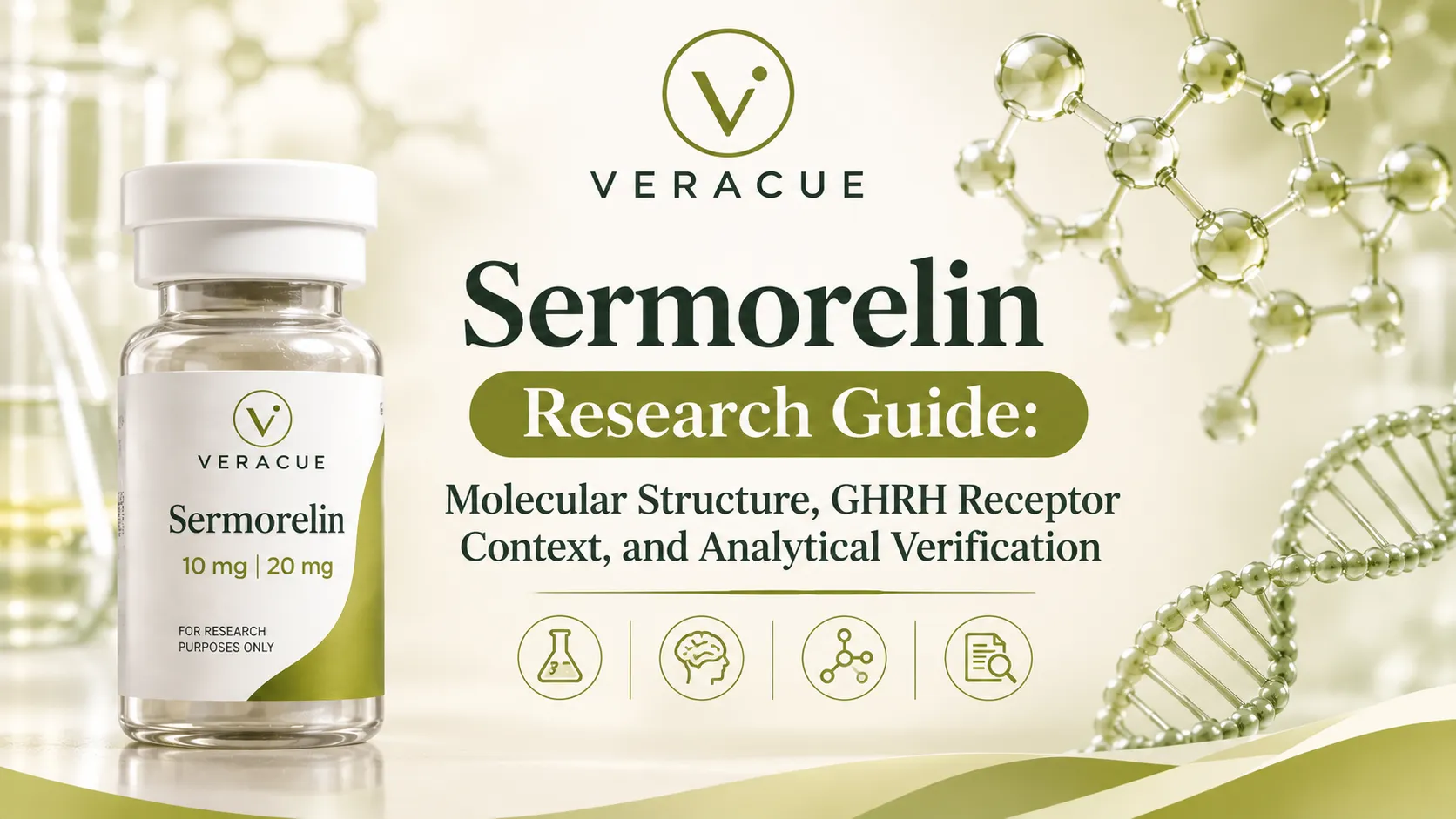
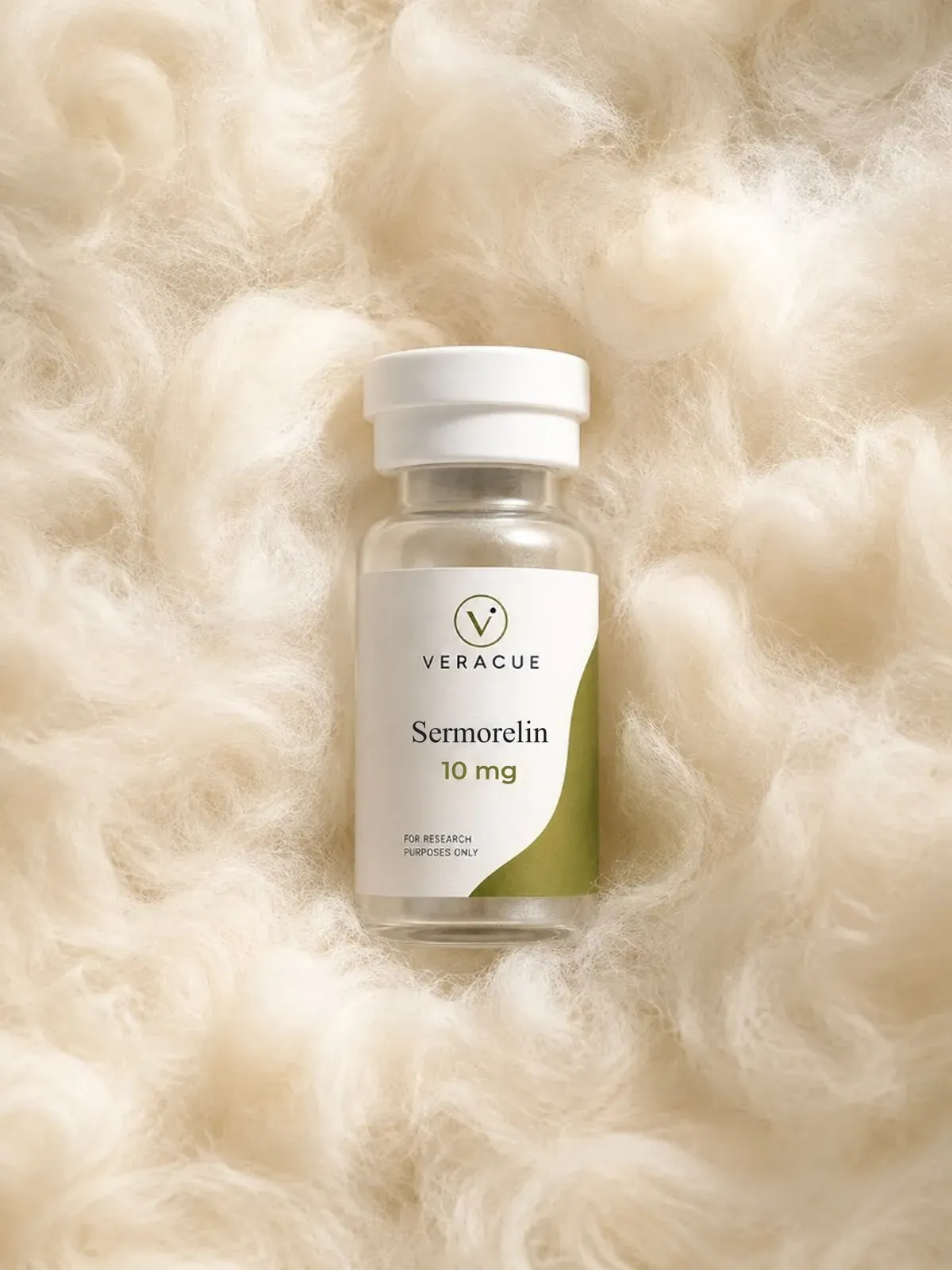
Sermorelin is a linear 29-residue synthetic peptide, YADAIFTNSYRKVLGQLSARKLLQDIMSR-NH2, made of the first 29 amino acids of growth hormone-releasing hormone with a C-terminal amide. Its free-base reference formula is C149H246N44O42S, average mass about 3357.9 g/mol, CAS 86168-78-7. It is easily confused with Tesamorelin, CJC-1295 and Ipamorelin, which are different molecules, and it is not growth hormone itself. Vials come in 10 mg and 20 mg for laboratory research use only.
What Is Sermorelin? Understanding Its Scientific Identity
Sermorelin is a synthetic peptide of 29 amino acid residues that corresponds exactly to the first 29 residues of the 44-residue human growth hormone releasing hormone (GHRH) sequence, carrying a C-terminal amide. Because of that relationship, the compound is recorded under several equivalent names across chemical and regulatory databases: Sermorelin, GRF(1-29)NH2, GHRH(1-29)NH2, and GRF 1-29. The NIH NCATS Inxight Drugs registry describes Sermorelin specifically as "a 29 amino acid analog of human growth hormone-releasing hormone (GHRH)" that is "the shortest synthetic peptide with full biological activity of GHRH," which is the direct source for that characterization in this article (NIH NCATS Inxight Drugs, UNII 89243S03TE). Sermorelin is molecularly distinct from growth hormone (somatotropin) itself. GHRH and GH are two separate molecules in the hypothalamic-pituitary axis: GHRH is the signaling peptide that acts on the GHRH receptor of pituitary somatotroph cells, while growth hormone is the much larger protein those cells secrete. Sermorelin is also structurally distinct from the other GHRH- and GHS-R-class research peptides it is frequently searched alongside, including Tesamorelin, Ipamorelin, and CJC-1295, each covered in its own comparison section below.
What Is Sermorelin's Complete Amino Acid Sequence?
Confusion about Sermorelin's identity usually starts with incomplete product descriptions that name the compound without specifying its sequence, or that truncate the sequence in a way that makes it look interchangeable with other GHRH-class peptides. The reference sequence recorded in PubChem (CID 16132413) and cross-referenced in DrugBank (DB00010) is:
YADAIFTNSYRKVLGQLSARKLLQDIMSR-NH2
That is a linear chain of 29 amino acids read from the N-terminus (tyrosine, position 1) to the C-terminus (arginine, position 29), with the C-terminal carboxylic acid replaced by an amide group, denoted NH2. C-terminal amidation of this kind is a common structural feature among bioactive signaling peptides generally. For Sermorelin specifically, the amide at residue 29 is a defined structural feature of this 29-residue fragment itself, as recorded in its PubChem and DrugBank entries; this article does not assert that the amide group is the native C-terminal chemistry of the full 44-residue human GHRH molecule, which is a separate, longer sequence not addressed in detail here. Sequence accuracy matters for research documentation for a simple reason: a single substituted, deleted, or D-form residue changes the compound's identity, its calculated molecular weight, and in many cases its receptor behavior, which is why GHRH-class analogs with deliberate sequence substitutions (covered below) are treated as distinct research entities rather than variants of the same material.
Field | Value |
|---|---|
Residue count | 29 amino acids |
Sequence (one-letter code) | YADAIFTNSYRKVLGQLSARKLLQDIMSR-NH2 |
N-terminus | Tyrosine (position 1) |
C-terminus | Arginine, C-terminally amidated (position 29) |
Corresponds to | Residues 1 to 29 of native human GHRH(1-44) |
What Is Sermorelin's Molecular Formula, Weight, and CAS Number?
Different databases occasionally display slightly different molecular weight values for the same compound because they are reporting different things: a free-base reference value, a specific salt form, or a rounded figure from an older entry. For the Sermorelin free base, the figures recorded in PubChem (CID 16132413), the FDA's NCATS Inxight Drugs registry (UNII 89243S03TE), and DrugBank (DB00010) agree: molecular formula C149H246N44O42S, with an average molecular weight of approximately 3357.9 g/mol and a monoisotopic mass of approximately 3355.8 Da. The CAS Registry Number for this free-base reference structure is 86168-78-7. This free-base value should not be applied automatically to every Sermorelin product on the market, because a salt form changes the overall formula weight while leaving the underlying peptide sequence unchanged, which is the subject of the next section.
Field | Value |
|---|---|
Molecular formula | C149H246N44O42S |
Average molecular weight | approximately 3357.9 g/mol |
Monoisotopic mass | approximately 3355.8 Da |
CAS Registry Number | 86168-78-7 |
PubChem CID | 16132413 |
DrugBank ID | DB00010 |
UNII | 89243S03TE |
How Does Sermorelin Differ From Sermorelin Acetate?
A common assumption is that "Sermorelin" and "Sermorelin acetate" describe two different peptides with two different formula weights for unrelated reasons. They are not different peptides. Both terms describe the identical 29-residue amino acid sequence; the difference is the counterion attached to the molecule. The free-base form carries CAS number 86168-78-7 and PubChem CID 16132413. The acetate salt form, in which acetic acid counterions associate with the peptide's basic residues, is recorded separately under CAS number 114466-38-5 and PubChem CID 16132412, with a correspondingly higher molecular formula and weight (C151H250N44O44S, approximately 3417.9 g/mol) because the acetate counterions add their own mass to the total. Historically, the originally characterized and FDA-reviewed form of this compound (marketed as Geref before the manufacturer discontinued the product commercially) was the acetate salt, which is one reason "Sermorelin acetate" and "Sermorelin" are used interchangeably in much of the older literature. For research documentation purposes, the salt form in use should always be confirmed against the specific lot's own paperwork rather than assumed from the product name, since a vial labeled only "Sermorelin" could in principle refer to either the free base or an unspecified salt form unless the Certificate of Analysis states otherwise.
Field | Value |
|---|---|
Peptide sequence | Identical, 29 residues, YADAIFTNSYRKVLGQLSARKLLQDIMSR-NH2 |
Free base CAS / PubChem CID | 86168-78-7 / 16132413 |
Acetate salt CAS / PubChem CID | 114466-38-5 / 16132412 |
Free base molecular formula / weight | C149H246N44O42S, approximately 3357.9 g/mol |
Acetate salt molecular formula / weight | C151H250N44O44S, approximately 3417.9 g/mol |
What changes between forms | Counterion mass only; the active peptide sequence is unchanged |
How Does Sermorelin Signal Through the GHRH Receptor?
Descriptions of Sermorelin frequently reference "GHRH receptor signaling" without explaining what that phrase means at the molecular level. According to a 2023 peer-reviewed review in Vitamins and Hormones by Halmos, Szabo, Juhasz, and Schally, the GHRH receptor (GHRH-R) is a member of the class B family of G protein-coupled receptors (GPCRs), built around seven membrane-spanning helical domains. When an agonist such as GHRH or a GHRH(1-29) analog binds the receptor's extracellular region, the receptor activates an associated G protein, which in turn stimulates adenylyl cyclase, an enzyme that converts ATP into cyclic AMP (cAMP) inside the cell. Rising intracellular cAMP activates downstream kinase signaling that, in pituitary somatotroph cells, is coupled to secretion of growth hormone. The same review notes that splice variants of the GHRH receptor exist in other tissues beyond the pituitary, and that splice variant 1 in particular retains the ability to generate a cAMP signal upon GHRH stimulation (Halmos G, Szabo Z, Juhasz E, Schally AV. Signaling mechanism of growth hormone-releasing hormone receptor. Vitam Horm. 2023;123:1-26. DOI: 10.1016/bs.vh.2023.06.004). This section is deliberately limited to that receptor-level, cAMP-signaling description. It does not extend the molecular mechanism into a statement about physiological outcomes in a living organism, which is a separate category of evidence addressed below.
How Does Sermorelin Differ From Tesamorelin?
Sermorelin and Tesamorelin are both described in the literature as GHRH receptor agonists, which is the main reason they are so often searched together, but they are built from different sequences of different lengths. Sermorelin reproduces only the first 29 residues of native GHRH, amidated at the C-terminus. Tesamorelin reproduces the full 44-residue GHRH sequence (confirmed in DrugBank entry DB08869) and adds a trans-3-hexenoyl group attached to the N-terminal tyrosine, a modification reported to increase the analog's resistance to enzymatic cleavage compared to the unmodified peptide. Tesamorelin is also the molecule behind Egrifta, an FDA-approved pharmaceutical product indicated for the reduction of excess abdominal fat in HIV-infected patients with lipodystrophy, per the NIH NCATS Inxight Drugs registry (UNII MQG94M5EEO) and DrugBank (DB08869); that approved pharmaceutical product, and the clinical trial literature behind its approval, is a separate regulatory matter from any RUO research material referencing the Tesamorelin sequence, and the two should not be treated as equivalent. Neither peptide is presented here as structurally superior to the other; they are simply different research tools built on related but distinct chemistry.
Field | Sermorelin | Tesamorelin |
|---|---|---|
Residue count | 29 | 44 |
N-terminal modification | None | trans-3-hexenoyl group on Tyr1 |
Molecular formula (free peptide) | C149H246N44O42S | C221H366N72O67S |
Average molecular weight (free peptide) | approximately 3357.9 g/mol | approximately 5135.9 g/mol |
CAS Registry Number (free peptide) | 86168-78-7 | 218949-48-5 |
Receptor target reported in literature | GHRH receptor (GHRHR) agonist | GHRH receptor (GHRHR) agonist |
Associated pharmaceutical product | Previously Geref (discontinued) | Egrifta (FDA-approved, separate regulatory matter) |
How Do Sermorelin, Ipamorelin, and CJC-1295 Differ?
Sermorelin, Ipamorelin, and CJC-1295 are frequently grouped together in search behavior and in commercial "stack" marketing, but they belong to two different pharmacological classes acting on two different receptors, and the CJC-1295 name itself covers more than one distinct chemical form.
FDA's own December 4, 2024 Pharmacy Compounding Advisory Committee briefing document on CJC-1295-related bulk drug substances defines the family precisely: CJC-1295 (free base) is described as a synthetic 29-amino-acid analogue of GHRH, with CJC-1295 acetate as a salt form of that free base. CJC-1295 DAC (free base) is defined in the same FDA document as CJC-1295 (free base) with an MPA-Lys unit, a maleimidopropionic acid-lysine moiety, added at the C-terminus, with CJC-1295 DAC acetate and CJC-1295 DAC trifluoroacetate (TFA) listed as additional salt forms of that DAC-bearing structure (FDA Pharmacy Compounding Advisory Committee Briefing Document, CJC-1295-related bulk drug substances, December 4, 2024). In other words, the DAC designation does not describe a different amino acid count; it describes an added C-terminal MPA-Lys moiety attached to the same 29-residue backbone, a moiety whose maleimide group is designed to form a covalent bond with free cysteine thiols on serum albumin. FDA's briefing also proposed that CJC-1295 (free base), CJC-1295 acetate, and CJC-1295 DAC (free base) NOT be included on the 503A Bulks List for compounding, a recommendation that remains advisory pending completed rulemaking. Separately, FDA's bulk drug substance safety-risk resource lists CJC-1295 as carrying a flagged concern for immunogenicity and peptide-related impurities depending on route of administration.
Ipamorelin, by contrast, is a five-residue (pentapeptide) compound that acts on an entirely different receptor, the ghrelin or growth hormone secretagogue receptor (GHS-R1a), not the GHRH receptor. FDA's own October 29, 2024 Pharmacy Compounding Advisory Committee briefing document on Ipamorelin-related bulk drug substances describes "Ipamorelin (free base)" as "a pentapeptide hormone containing non-proteinogenic amino acids," with "Ipamorelin acetate" as a salt form of that same five-amino-acid peptide (FDA Pharmacy Compounding Advisory Committee Briefing Document, Ipamorelin-related bulk drug substances, October 29, 2024). At that same meeting, the committee voted against including Ipamorelin (free base) or Ipamorelin acetate on the 503A Bulks List; the exact vote tally is recorded in FDA's official summary minutes rather than restated here with false precision, and like the CJC-1295 proposal above, the outcome is advisory and does not constitute completed FDA rulemaking. Because Ipamorelin and the GHRH-class peptides work through different receptor systems, research combining a GHRH-class agonist with a GHS-R agonist is studying two separate signaling pathways side by side, not two doses of the same mechanism.
Field | Value | ||
|---|---|---|---|
Receptor target | Sermorelin and CJC-1295: GHRH receptor (GHRHR) \ | Ipamorelin: ghrelin/GHS-R1a receptor | |
Residue count | Sermorelin: 29 \ | CJC-1295 (free base and DAC forms): 29, with DAC forms carrying an added C-terminal MPA-Lys moiety rather than an additional amino acid \ | Ipamorelin: 5 |
Backbone relationship | CJC-1295 (free base) shares the Sermorelin GHRH(1-29) backbone; CJC-1295 DAC is that same backbone with an MPA-Lys unit conjugated at the C-terminus for albumin binding; Ipamorelin is an unrelated pentapeptide sequence | ||
CAS Registry Number | Sermorelin: 86168-78-7 \ | Ipamorelin (free base, per FDA PCAC briefing): 170851-70-4 \ | CJC-1295: multiple forms and CAS values described across FDA's own briefing document (free base, acetate, DAC free base, DAC acetate, DAC TFA); verify the specific form per lot |
FDA 503A Bulks List review status (advisory, non-final) | CJC-1295-related substances: reviewed December 4, 2024, FDA proposed against inclusion \ | Ipamorelin-related substances: reviewed October 29, 2024, committee voted against inclusion \ | Sermorelin: not part of either review cited here |
Why Does Sermorelin Have So Many Different Names?
Part of the confusion around Sermorelin comes from the sheer number of names attached to the same molecule across different eras of nomenclature. "Sermorelin" is the International Nonproprietary Name (INN) assigned to the compound. "GRF(1-29)NH2" and "GHRH(1-29)NH2" describe the same structure using growth-hormone-releasing-factor fragment notation: the number in parentheses indicates which residues of the full-length hormone are present (1 through 29 of 44), and the NH2 notation indicates the C-terminal amide on this fragment. Older clinical literature also uses "Geref" as the brand name under which the acetate salt form was previously marketed, and database entries list "somatorelin" and "somatotropin-releasing-hormone(1-29)amide" as additional synonyms (DrugBank DB00010; NCATS UNII 89243S03TE). None of these names describe a chemically different compound; they are different naming conventions applied to the same sequence. In laboratory records and published research, using the precise sequence and an identifier such as the CAS number or PubChem CID alongside any trade or informal name removes the ambiguity that commercial naming alone can introduce.
What Does Scientific Research Actually Establish About Sermorelin?
Research involving Sermorelin and closely related GHRH(1-29) analogs spans several distinct categories of evidence, and treating them as interchangeable is a common source of overstated claims. It is useful to separate them explicitly.
Molecular and chemical evidence establishes the sequence, formula, and identity data already described above, drawn from PubChem, DrugBank, and the NCATS Inxight Drugs registry.
Receptor-level and laboratory evidence covers how the GHRH receptor transduces a signal once an agonist binds it, as reviewed by Halmos et al. (2023) and discussed above. This category includes cell-based and biochemical assay work, not whole-organism outcome studies. A separate PubMed-indexed study of GHRH receptor expression and signaling in human decidual stromal cells (Wu HM, et al. Impact of growth hormone-releasing hormone antagonist on decidual stromal cell growth and apoptosis in vitro. Biol Reprod. 2022;106(1):145-154. DOI: 10.1093/biolre/ioab214) illustrates that GHRH receptor biology is studied in contexts well outside growth hormone physiology, but this study used a GHRH receptor antagonist in a specific cell-culture system, and this article does not extend its findings to any claim about Sermorelin itself or about any outcome in a living organism.
Historical and regulatory literature covers Sermorelin's development and prior regulatory status as a diagnostic agent. The NIH NCATS Inxight Drugs registry and DrugBank both record that Sermorelin acetate was previously approved in the United States as Geref, assigned ATC code V04CD03 under the "tests for pituitary function" classification, and that the manufacturer discontinued the product for commercial reasons around 2008, after which it is no longer marketed as an FDA-approved drug. Different research models (cell-based assays and the older human diagnostic literature) answer different scientific questions, and a finding from one model should not be presented as though it were demonstrated in another.
How Do HPLC and Mass Spectrometry Verify Sermorelin's Identity?
A purity percentage by itself does not fully characterize a peptide sample, because purity and identity are two different questions answered by two different techniques.
Reverse-phase HPLC (RP-HPLC) separates the components of a sample by how they interact with a chromatographic column and reports the proportion of the total detected material attributable to the main peak, which is interpreted as chromatographic purity. RP-HPLC alone cannot confirm that the main peak is actually the intended peptide; an impurity with similar retention behavior can co-elute with the target compound and be counted within the same peak.
Mass spectrometry (commonly ESI-MS or MALDI-TOF for intact-mass analysis) measures the mass-to-charge ratio of ionized peptide molecules and compares the observed molecular mass to the mass calculated from the expected sequence. This is the identity check: it answers whether the detected molecule has the expected molecular weight, not how pure the overall sample is. Tandem mass spectrometry (MS/MS) goes a step further by fragmenting the peptide and reading the resulting fragment masses to confirm structural features consistent with the expected sequence, which is a more detailed identity check than intact-mass analysis alone.
Net peptide content is a separate measurement from both HPLC purity and MS identity, and it is not something amino acid analysis (AAA) establishes on its own. A sample can show a high HPLC purity percentage while still containing water, residual synthesis solvents such as acetonitrile or TFA, or counterions such as acetate, none of which are part of the "main peak" purity figure. Amino acid analysis hydrolyzes the peptide and quantifies its individual amino acids, which confirms amino acid composition and contributes the peptide-mass side of a net-content calculation, but arriving at a complete net peptide content figure typically requires combining AAA with separate, complementary measurements: Karl Fischer titration or an equivalent method for residual water content, and chromatographic or ion-based testing for residual counterions (such as acetate or TFA) and residual organic solvents. Net peptide content is then derived from a mass-balance calculation across these separate results, not read directly off any single assay. A National Institutes of Health-affiliated reference-standard characterization methodology paper describes this combined approach directly: using NMR and mass spectrometry for structural identity, HPLC for chromatographic purity, and amino acid analysis together with separate acetic acid and trifluoroacetic acid HPLC measurements and residual moisture and headspace oxygen testing to characterize peptide content overall. None of these methods individually is a complete quality picture; HPLC purity, MS identity, and the several measurements that feed into net peptide content answer distinct questions and are best read together.
Method | What It Establishes |
|---|---|
Reverse-phase HPLC | Establishes relative chromatographic purity (main peak percentage). Does not independently confirm molecular identity. |
ESI-MS / MALDI-TOF (intact mass) | Establishes whether the observed molecular mass matches the expected sequence mass. Does not quantify overall sample purity. |
Tandem mass spectrometry (MS/MS) | Provides fragment-level structural confirmation of the sequence. A deeper identity check, not a purity measurement. |
Amino acid analysis (AAA) | Confirms amino acid composition and quantifies the peptide-mass component used in a net peptide content calculation. Does not by itself measure residual water, counterions, or solvent. |
Complementary methods (Karl Fischer titration, counterion/solvent testing) | Quantify residual water, acetate/TFA counterions, and organic solvent. Combined with AAA through mass-balance, these give net peptide content. |
What Should a Sermorelin Certificate of Analysis Include?
A generic product specification and a batch-specific Certificate of Analysis (COA) are not the same document, and the difference matters for anyone trying to evaluate a specific lot of research material. A product specification describes what the compound is expected to be in general; a COA documents what a specific lot was actually found to contain when it was tested. A scientifically useful Sermorelin COA should identify the product and its chemical form (free base or a named salt), state the reference amino acid sequence, record a lot or batch number, name the testing laboratory and the date of testing, report the HPLC purity result, ideally alongside the chromatogram itself rather than the percentage alone, report the mass spectrometry identity result with both the observed and theoretical molecular mass, and report net peptide content where that measurement was performed.
On Veracue Labs' own Sermorelin and Sermorelin Spray listings, the identity method is stated as mass spectrometry and the purity method as reverse-phase HPLC. As of this article, Veracue's live certificates archive lists no published batch COA reports for any product, including Sermorelin; the archive's own counter reads zero reports available, and the page states that batch-specific COAs are still being added. For a product already ordered, the page directs researchers to request the relevant lot's documentation directly so the team can send it over, and for older lots it asks for the lot code so the documentation can be located. In other words, no public, already-published Sermorelin batch report currently exists on the site; a specific lot's analytical results should be requested directly through Veracue rather than assumed to be already posted.
The Research Scope Problem: RUO Classification and Scientific Interpretation
"Research Use Only" is a classification, not a marketing phrase, and it carries a specific meaning that is worth stating plainly. An RUO designation means the material is intended and supplied for laboratory research applications, such as in-vitro receptor pharmacology, analytical method development, or structure-activity research, and is not intended, labeled, or approved for use in or on humans or animals. That distinction matters because a large amount of the literature discussed throughout this article, including the historical human diagnostic studies referenced above and the FDA-approved Tesamorelin pharmaceutical referenced earlier, describes work with pharmaceutical-grade material subject to its own separate regulatory pathway, not with RUO research compounds. Reading a molecular description of a peptide's structure and receptor pharmacology is not the same as reading authorization for any particular use of a specific research product, and this article's description of Sermorelin's chemistry and receptor-level signaling should not be interpreted as such.
In summary, Sermorelin is a well-characterized 29-residue synthetic fragment of human GHRH, identifiable by its sequence, its CAS number (86168-78-7 for the free base), and its PubChem record (CID 16132413). It is structurally distinct from its salt form, Sermorelin acetate, from the 44-residue Tesamorelin analog, from the GHS-R-targeting pentapeptide Ipamorelin, and from the DAC-modified CJC-1295 family described in FDA's own 2024 bulk drug substance review. Confirming the identity and purity of any specific research lot requires reading its own HPLC and mass spectrometry results together with net peptide content data, not relying on a general product description or an assumption that a batch report is already published. This article is supplied as RUO scientific reference material and does not constitute dosing, administration, safety, or health-outcome guidance.
Research Use Only (RUO). This article is supplied for Research Use Only. The Sermorelin material described here is intended for laboratory and analytical research use and is not intended, labeled, or approved for use in or on humans or animals, for diagnosis, treatment, cure, or prevention of any disease, or for any form of personal administration. Nothing in this article constitutes dosing, administration, safety, or health-outcome guidance. Specific lot documentation, including HPLC purity, mass spectrometry identity, and Certificate of Analysis data, is not currently published on Veracue's certificates archive and should be requested directly through Veracue Labs for the relevant SKU and lot.
Frequently Asked Questions
Sermorelin is a synthetic peptide of 29 amino acids that reproduces the first 29 residues of human growth hormone-releasing hormone (GHRH), carrying a C-terminal amide. It is also known as GRF(1-29)NH2 or GHRH(1-29)NH2.
Yes. Sermorelin is a linear 29-residue peptide, recorded under CAS number 86168-78-7 and PubChem CID 16132413, with the molecular formula C149H246N44O42S.
The reference sequence is YADAIFTNSYRKVLGQLSARKLLQDIMSR-NH2, read from the N-terminal tyrosine to the C-terminal, amidated arginine.
The free-base reference molecular formula is C149H246N44O42S, with an average molecular weight of approximately 3357.9 g/mol.
The CAS Registry Number for the free-base reference structure is 86168-78-7. The acetate salt form is recorded separately under CAS number 114466-38-5.
They share the identical 29-residue peptide sequence. The difference is the counterion: Sermorelin acetate carries acetic acid counterions, which gives it a different molecular formula and a higher molecular weight than the free base.
No. Sermorelin is a fragment of growth hormone-releasing hormone (GHRH), the signaling peptide that acts on pituitary GHRH receptors. Growth hormone (somatotropin) is a separate, much larger protein that those receptor-activated cells secrete.
Sermorelin is the unmodified 29-residue fragment of GHRH. Tesamorelin is the full 44-residue GHRH sequence with a trans-3-hexenoyl modification added to the N-terminal tyrosine, and is also the molecule behind the FDA-approved pharmaceutical Egrifta, a separate regulatory matter from RUO research material.
Sermorelin and CJC-1295 are both GHRH(1-29)-based peptides acting on the GHRH receptor; FDA's own December 2024 briefing defines CJC-1295 DAC as that same backbone with an added C-terminal MPA-Lys moiety for albumin binding, not a different amino acid count. Ipamorelin is an unrelated five-residue peptide that acts on a different receptor, the ghrelin/GHS-R1a receptor, not the GHRH receptor.
A useful COA should state the chemical form and reference sequence, a lot number, the testing laboratory and date, the HPLC purity result (ideally with the chromatogram), the mass spectrometry identity result with observed versus theoretical mass, and net peptide content where available. On Veracue's own site, batch-specific COAs are not yet published and must be requested directly for a specific lot.
- 01PubChem Compound Summary for CID 16132413, Sermorelin.
- 02DrugBank entry DB00010, Sermorelin.
- 03NIH NCATS Inxight Drugs, UNII 89243S03TE, Sermorelin.
- 04PubChem Compound Summary for CID 16132412, Sermorelin acetate.
- 05Halmos G, Szabo Z, Juhasz E, Schally AV. Signaling mechanism of growth hormone-releasing hormone receptor. Vitam Horm. 2023;123:1-26.
- 06Wu HM, Chen LH, Schally AV, et al. Impact of growth hormone-releasing hormone antagonist on decidual stromal cell growth and apoptosis in vitro. Biol Reprod. 2022;106(1):145-154.
- 07DrugBank entry DB08869, Tesamorelin; NIH NCATS Inxight Drugs, UNII MQG94M5EEO (Tesamorelin) and UNII LGW5H38VE3 (Tesamorelin acetate).
- 08FDA Pharmacy Compounding Advisory Committee Briefing Document, Ipamorelin-related bulk drug substances, October 29, 2024.
- 09FDA Pharmacy Compounding Advisory Committee, Final Summary Minutes, October 29, 2024.
- 10FDA Pharmacy Compounding Advisory Committee Briefing Document, CJC-1295-related bulk drug substances, December 4, 2024.
- 11FDA Pharmacy Compounding Advisory Committee Briefing Document, CJC-1295-related bulk drug substances, Evaluation and Recommendation, December 4, 2024.
- 12FDA, Certain Bulk Drug Substances for Use in Compounding that May Present Significant Safety Risks.
- 13Reference-standard characterization case studies describing NMR, LC-MS/MS, HPLC, amino acid analysis, and residual moisture/counterion testing for peptide identity and content.
Veracue Research Team
Research & Product Team
Our in-house team tracks published peptide and coenzyme research and translates it into clear, source-cited overviews for the research community.
Reviewed by in-house research chemists
orders@veracuelabs.com