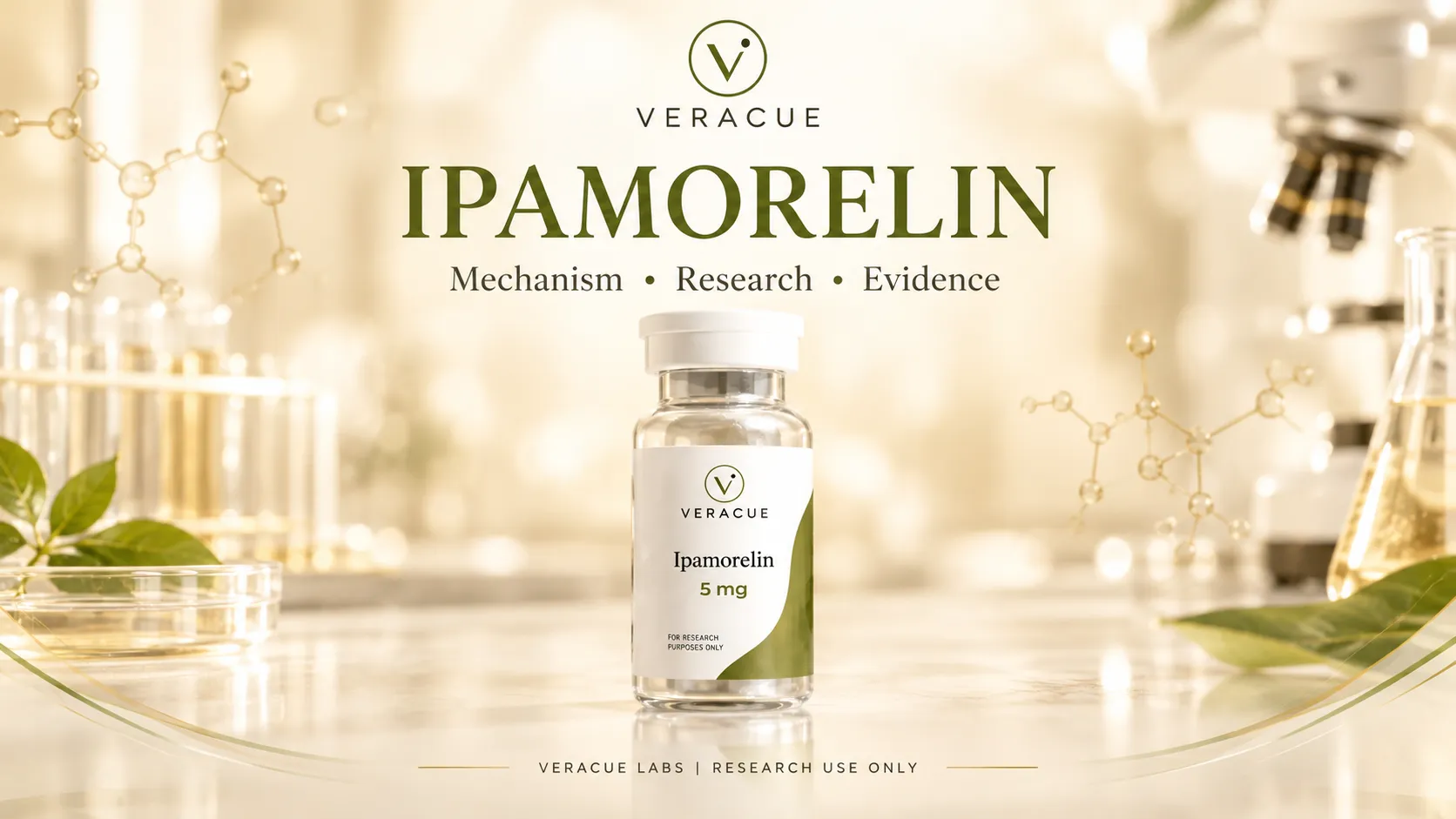
- Ipamorelin is a selective GHS-R1a (ghrelin receptor) agonist that, unlike GHRP-6 and GHRP-2, did not raise ACTH or cortisol in the original swine pharmacology studies — a receptor-selectivity finding, not a demonstrated clinical benefit.
- Human evidence is limited to one intravenous pharmacokinetic study and one Phase 2 efficacy trial for postoperative ileus; the trial's primary endpoint (time to tolerating a solid meal) did not reach statistical significance against placebo.
- In an October 2024 Pharmacy Compounding Advisory Committee review, the FDA reportedly found the available characterization, effectiveness, and safety data insufficient to support listing ipamorelin for 503A pharmacy compounding.
- No published human data exists for subcutaneous dosing or for growth hormone deficiency as an indication, and ipamorelin is distinct from both CJC-1295 (a GHRH-receptor analog) and GHRP-6 (a less selective GHS-R1a agonist) — Veracue Labs supplies it strictly for laboratory research.
Ipamorelin is one of the most receptor-selective growth hormone secretagogues ever characterized — but selectivity at one receptor doesn't resolve open questions about efficacy or safety at the whole-body level. It is not FDA-approved, its only human efficacy trial didn't meet its primary endpoint, and in October 2024 the FDA's Pharmacy Compounding Advisory Committee reportedly recommended against including it on the list of substances approved for 503A pharmacy compounding (FDA briefing document). This guide separates ipamorelin's well-supported receptor pharmacology from what remains thin, proposed, or marketed well past the evidence. Veracue Labs supplies ipamorelin strictly for laboratory research use.
Growth Hormone Secretagogue
Ipamorelin
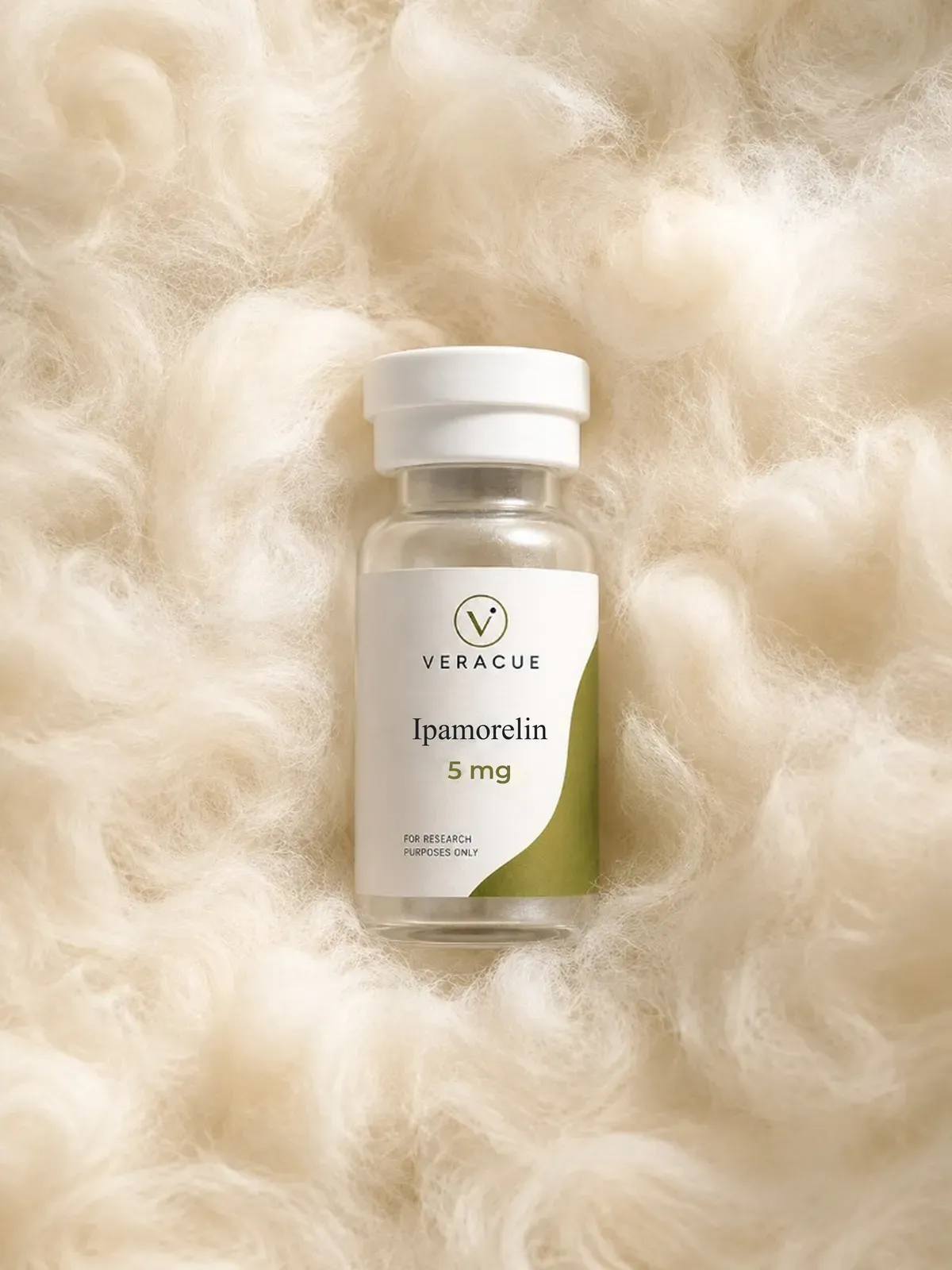
Ipamorelin is a five-residue synthetic peptide, Aib-His-D-2-Nal-D-Phe-Lys-NH2, that includes non-standard residues such as aminoisobutyric acid (Aib) and D-2-naphthylalanine. It has the formula C38H49N9O5, an average mass of about 711.85 g/mol and CAS 170851-70-4, and it is described as a selective agonist of the ghrelin receptor GHS-R1a in receptor assays. Vials come in 5 mg and 10 mg, for laboratory research only, not for human or veterinary use.
Growth Hormone Secretagogue
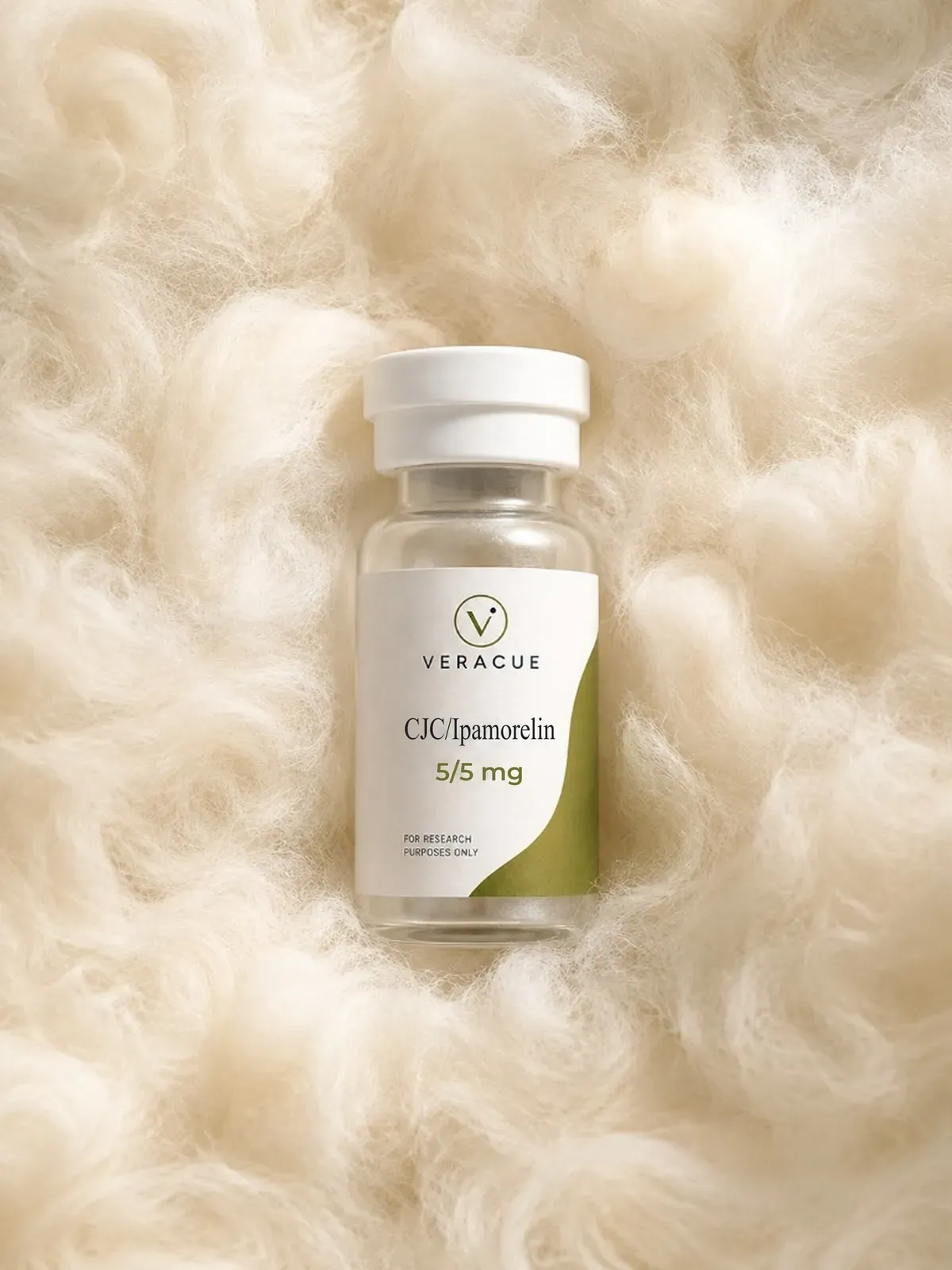
CJC/Ipamorelin
CJC/Ipamorelin is a two-peptide research blend of CJC-1295 No DAC and Ipamorelin, 5 mg of each. CJC-1295 No DAC, also called Mod GRF 1-29, is a 29-residue growth hormone-releasing hormone analog, YADAIFTQSYRKVLAQLSARKLLQDILSR-NH2 with D-alanine at position 2 (C152H252N44O42, average mass about 3367.9 g/mol, CAS 863288-34-0 and 446036-97-1). Ipamorelin is the pentapeptide Aib-His-D-2-Nal-D-Phe-Lys-NH2 (C38H49N9O5, about 711.85 g/mol, CAS 170851-70-4), studied at the ghrelin receptor rather than the GHRH receptor. The vial is labeled 5/5 mg and is supplied strictly for laboratory research use only.
Growth Hormone Secretagogue
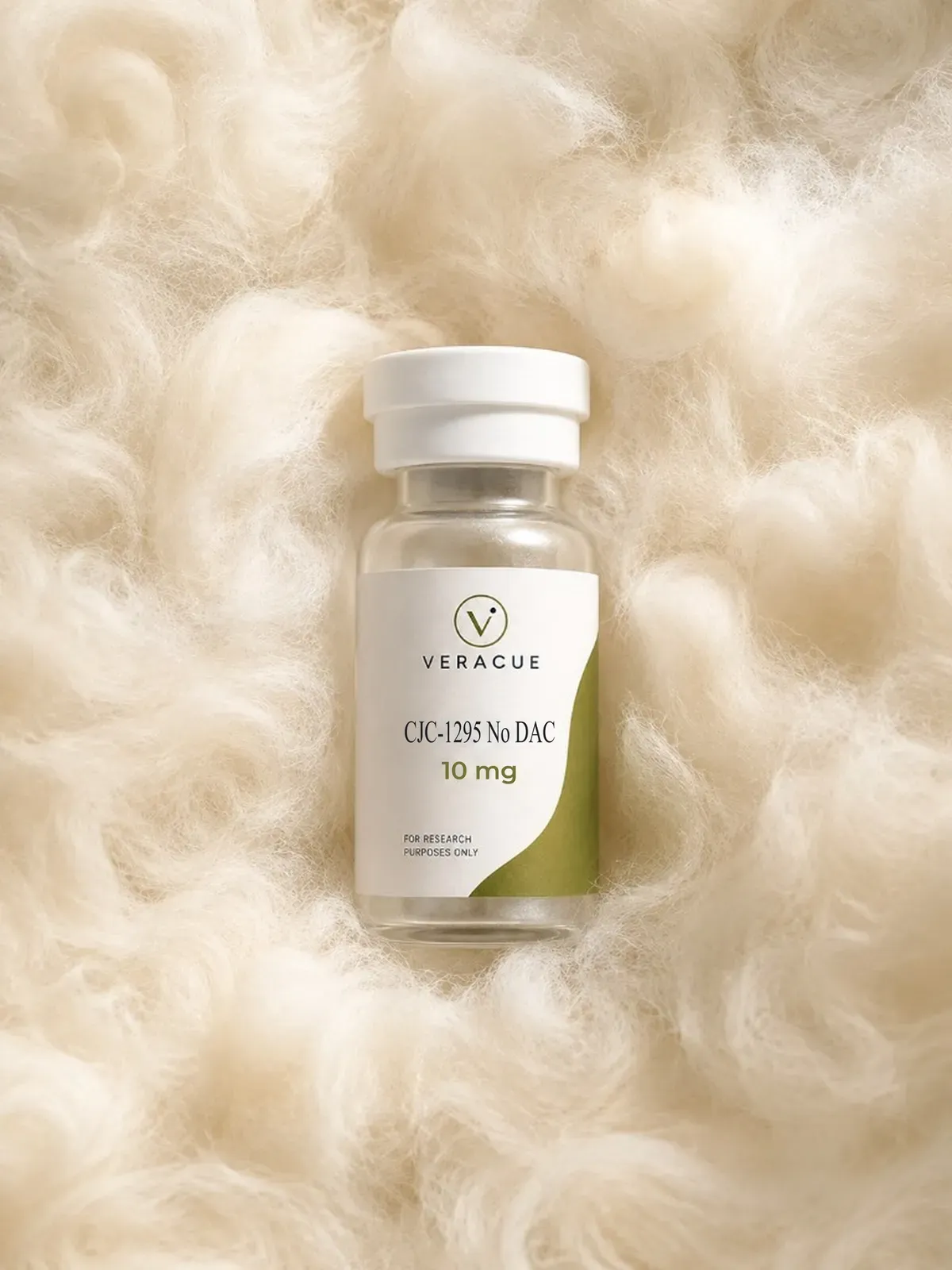
CJC-1295 No DAC
CJC-1295 No DAC, also sold as Mod GRF 1-29, is a 29-residue growth hormone-releasing hormone analog with the sequence YADAIFTQSYRKVLAQLSARKLLQDILSR-NH2: D-alanine sits at position 2, and glutamine, alanine and leucine replace Asn8, Gly15 and Met27 of the native fragment. The free peptide is C152H252N44O42, average mass about 3367.9 g/mol, listed under CAS 863288-34-0 and 446036-97-1. The name means the chain stops at residue 29, with no albumin-binding lysine as in CJC-1295 with DAC, and it weighs about 10 Da more than Sermorelin. Veracue lists it in one 10 mg size, strictly for laboratory research use only.
What Is Ipamorelin?
Ipamorelin is a synthetic pentapeptide — five amino acids — with the sequence Aib-His-D-2-Nal-D-Phe-Lys-NH2. Two of those residues are non-standard: Aib (aminoisobutyric acid) and D-2-Nal (D-2-naphthylalanine), alongside a D-configured phenylalanine and an amidated C-terminus. Its molecular formula is C38H49N9O5, with an average molecular weight of approximately 711.85 g/mol and CAS number 170851-70-4.
It was identified in the mid-1990s by researchers at Novo Nordisk, within a chemistry program exploring analogs of growth hormone-releasing peptide-1 (GHRP-1) that lacked GHRP-1's central Ala-Trp dipeptide (Raun et al., 1998). Veracue Labs lists it strictly as a laboratory research reagent, in 5 mg and 10 mg vials, not as a human-use product.
Ipamorelin is a growth hormone secretagogue — it prompts the pituitary to release its own stored growth hormone — not growth hormone itself. That distinction matters mechanistically: a secretagogue's effect depends entirely on an intact, functioning pituitary, while directly administered growth hormone (somatropin) does not.
How Does Ipamorelin Work?
Ipamorelin binds and activates GHS-R1a, the growth hormone secretagogue receptor — more commonly known as the ghrelin receptor, since it's the native target of the hormone ghrelin. GHS-R1a sits mainly in the hypothalamus and anterior pituitary, with additional expression across the gastrointestinal tract, pancreas, thyroid, and adipose tissue.
In the original 1998 pharmacology paper, Raun and colleagues used GHRP- and GHRH-receptor antagonists to profile ipamorelin's activity and confirmed it stimulates GH release through the same GHRP-like receptor pathway as GHRP-6, not the separate GHRH-receptor pathway. In isolated rat pituitary cell cultures, ipamorelin released GH with somewhat higher potency than GHRP-6 but slightly lower maximal efficacy (EC50 ≈ 1.3 nmol/L, Emax ≈ 85% vs. GHRP-6's EC50 ≈ 2.2 nmol/L, Emax defined as 100%). In anesthetized rats and conscious swine, its potency and efficacy were broadly comparable to GHRP-6, while GHRP-2 was more potent but showed lower maximal efficacy in the same swine model (Raun et al., 1998).
The finding that actually distinguished ipamorelin from the rest of its class was hormonal specificity, not GH potency. GHRP-6 and GHRP-2 both raised circulating ACTH and cortisol in the swine studies — an off-target effect typical of less selective ghrelin-receptor agonists. Ipamorelin did not produce a significant ACTH or cortisol rise relative to GHRH-stimulated levels, even at doses more than 200-fold above the amount needed for half-maximal GH release. None of the secretagogues tested, ipamorelin included, affected FSH, LH, prolactin, or TSH.
That's a receptor-pharmacology and animal-physiology finding. It shows ipamorelin activates GHS-R1a with a cleaner hormonal profile than some earlier compounds in isolated cell and animal systems — it does not, by itself, demonstrate a clinical benefit, an optimal dose, or safety in any specific human formulation or route.
Ipamorelin vs. GHRP-6 and CJC-1295
Compound | Receptor/pathway | Defining research finding | Key caution |
|---|---|---|---|
Ipamorelin | GHS-R1a (ghrelin receptor) agonist | No significant ACTH/cortisol rise in swine studies, unlike GHRP-6/GHRP-2 | One human efficacy trial conducted; it did not meet its primary endpoint |
GHRP-6 | GHS-R1a agonist | Comparable GH-releasing potency to ipamorelin, but raises ACTH/cortisol and stimulates appetite | FDA Category 2 bulk-substance listing for 503B compounding; no long-term human safety data |
CJC-1295 | GHRH-receptor pathway, distinct from GHS-R1a | Modified GHRH analog, not a ghrelin-receptor agonist at all | Not interchangeable with ipamorelin; a combined or synergistic effect is a separate, unproven claim |
Ipamorelin and GHRP-6 share a receptor target and a broadly similar potency/efficacy profile in the original pharmacology data; the real difference between them is the hormonal side-effect pattern described above, not the receptor they act on. Ipamorelin and CJC-1295, by contrast, don't share a receptor at all — CJC-1295 is a growth hormone-releasing hormone (GHRH) analog acting on a separate receptor entirely. Veracue's CJC/Ipamorelin listing and CJC-1295 No DAC listing should each be verified against their own lot-specific documentation; a combination product containing both is not evidence that they act through one shared mechanism, and no controlled human trial evaluating that combination was identified for this guide.
What Does Human Research Actually Show?
Human data on ipamorelin is limited to two studies, and they shouldn't be collapsed into one another.
A dose-escalation pharmacokinetic/pharmacodynamic study gave intravenous ipamorelin across five ascending dose levels to healthy male volunteers (eight subjects per dose level) and measured ipamorelin and growth hormone concentrations. Pharmacokinetics were dose-proportional, with a short terminal half-life of about two hours. Each dose produced a single transient pulse of GH release, peaking around 40 minutes after dosing, with a concentration of roughly 214 nmol/L required for half-maximal GH stimulation (Gobburu et al., 1999). This study measured disposition and an acute hormone pulse — it did not evaluate any clinical outcome.
The one human efficacy trial is a Phase 2, multicenter, double-blind, placebo-controlled study of intravenous ipamorelin (0.03 mg/kg twice daily) for postoperative ileus in 114 adults undergoing bowel resection (ClinicalTrials.gov NCT00672074). The median time to tolerating a solid meal was numerically shorter with ipamorelin than placebo — 25.3 vs. 32.6 hours — but the difference did not reach statistical significance (p = 0.15), and no secondary efficacy endpoint showed a significant benefit either. Overall treatment-emergent adverse events were reported in 87.5% of the ipamorelin group versus 94.8% of the placebo group (Beck et al., 2014). Published development for this indication was reportedly discontinued following these results.
No published human trial evaluating subcutaneous ipamorelin, or any trial for growth hormone deficiency as an indication, was identified for this guide. Earlier rodent work found ipamorelin improved gastric emptying in a surgically induced ileus model (Greenwood-Van Meerveld et al., 2012) and increased body weight and fat-pad mass in both growth-hormone-deficient and growth-hormone-intact mice through a GH-independent mechanism (Lall et al., 2001) — genuine findings, but in rodents, and the one human trial that tested a closely related question didn't replicate a significant benefit.
What Safety Concerns Has the FDA Identified?
The most detailed public safety review of ipamorelin is the FDA's Pharmacy Compounding Advisory Committee briefing document, prepared after two compounding pharmacies nominated ipamorelin-related substances for the 503A bulk drug substances list — a different framework from the 503B Category system that covers compounds like GHRP-6. The FDA evaluated both ipamorelin free base and ipamorelin acetate for that October 2024 meeting.
According to the briefing document, the agency found neither form well-characterized in the publicly available literature, citing a lack of published data on impurities, aggregation, and bacterial endotoxin levels, and noting that submitted certificates of analysis lacked impurity-attribute testing. Peptides generally — and ipamorelin specifically — were flagged as sensitive to formulation, temperature, pH, and storage conditions in ways that can drive aggregation or degradation, which the FDA linked to immunogenicity risk, particularly for injectable routes. For both proposed uses evaluated (growth hormone deficiency and postoperative ileus), the FDA reportedly concluded the available evidence doesn't support effectiveness, and that professional clinical practice guidelines don't mention ipamorelin for either indication. The agency also noted it did not identify published nonclinical data on ipamorelin's acute toxicity, repeat-dose toxicity, genotoxicity, or carcinogenicity.
This is a compounding-safety evaluation, not a completed clinical safety study, and it concerns pharmacy-compounded preparations rather than research-grade material used for its intended laboratory purpose. It doesn't establish a specific risk level for research-only use. It does establish that the published evidence available to answer safety questions about ipamorelin is thinner than its marketing presence suggests, and that open questions about impurity profiles and immunogenicity are specific to formulation, manufacturing process, and route — which is exactly why lot-specific documentation matters more than claims about the molecule in general.
Is Ipamorelin FDA-Approved?
No. Ipamorelin has no FDA-approved drug application and no USP or National Formulary monograph. The relevant 2024 FDA action was a 503A bulk-substances nomination review — a pharmacy-compounding evidence evaluation, not a new-drug approval process — and the agency reportedly did not recommend ipamorelin for inclusion on that list. That's a narrower and different question from GHRP-6's FDA status, which sits in the separate 503B Category 2 system; the two frameworks shouldn't be treated as equivalent or compared head-to-head as if they measured the same thing. Veracue states plainly that ipamorelin has not been evaluated by the FDA and is supplied for laboratory research use only, not for human or veterinary use.
What Are the Main Limitations of Ipamorelin Research?
The evidence on ipamorelin spans several tiers that are easy to blur together. The foundational potency and selectivity data come from isolated rat pituitary cells and receptor-antagonist profiling in animals (Raun et al., 1998) — not human subjects. The only human pharmacokinetic data is from intravenous dosing in healthy men; no human PK data for subcutaneous, oral, or nasal routes was identified. The only human efficacy trial is a small (n=114), single-indication, proof-of-concept study that didn't meet its primary endpoint, and development for that indication was reportedly discontinued afterward. No published human trial has evaluated ipamorelin for growth hormone deficiency, body composition, or any outcome beyond postoperative GI recovery. And separately from the clinical literature, the FDA's review flagged an absence of published nonclinical toxicology data (acute, repeat-dose, genotoxicity, carcinogenicity) for the molecule itself. Treating the 1998 discovery paper's receptor selectivity as a demonstrated clinical benefit, or treating rodent gastric-motility and adiposity findings as predictive of human outcomes, isn't supported by the one human trial that actually tested a related question.
What Do Ipamorelin's Sequence and Chemical Identifiers Tell Us?
Ipamorelin's sequence — Aib-His-D-2-Nal-D-Phe-Lys-NH2 — tells you what the molecule is, not what's in any given vial. Its molecular formula is C38H49N9O5, average molecular weight ~711.85 g/mol, and CAS number 170851-70-4; these values match both the primary literature (Raun et al., 1998) and the FDA's 2024 evaluation. As with any peptide, salt form, net peptide content, and purity are lot-specific figures that live on a certificate of analysis, not in the compound's general chemistry.
How Should Researchers Interpret HPLC, Mass Spectrometry, and a COA?
Reverse-phase HPLC measures chromatographic purity — the proportion of a sample resolving as a single, well-defined peak, separate from synthesis byproducts. It doesn't, by itself, confirm that the material producing that peak is actually ipamorelin rather than something structurally similar — only that whatever's present is relatively uniform. Mass spectrometry addresses identity: it checks whether a sample's measured mass is consistent with ipamorelin's expected mass (~711.85 g/mol), within a stated tolerance. It doesn't quantify purity or rule out near-identical-mass impurities on its own. The FDA's 2024 review specifically flagged that commercially available ipamorelin COAs it reviewed often reported a purity figure without corresponding impurity-attribute or endotoxin data — a passing purity percentage alone doesn't answer every quality question.
As of this review, Veracue's Ipamorelin listing names HPLC and mass spectrometry as its stated testing methods and lists both as available "on request" rather than published for this compound, and some sizes may test below 99% purity. The site's certificates page is the place to request lot-specific documentation — a certificate that doesn't list the lot number printed on the vial in hand doesn't describe that vial, regardless of how reassuring its stated results look.
What Does Research Use Only Mean for Ipamorelin?
"Research Use Only" means ipamorelin is supplied and intended solely for laboratory research — not for human or veterinary use, ingestion, injection, or any other form of administration. It's a scope-of-sale statement, not a claim about safety, efficacy, or regulatory status.
Taken together: established is that ipamorelin reliably and selectively activates GHS-R1a and triggers a measurable, transient GH pulse without the ACTH/cortisol rise seen in earlier compounds in this class — a well-supported, decades-old pharmacology finding. Unresolved is whether that mechanism translates into any clinical benefit; the one controlled human efficacy trial conducted didn't meet its primary endpoint, the FDA's 2024 review found the characterization and safety data incomplete, and no lot-specific identity or purity documentation exists for any individual commercial vial independent of its own certificate of analysis. For anyone evaluating an ipamorelin claim, the practical move is the same as with any research peptide: check the primary source behind a specific figure, rather than taking a secondhand summary — marketing copy included — at face value.
Frequently Asked Questions
Ipamorelin is a synthetic five-residue peptide (Aib-His-D-2-Nal-D-Phe-Lys-NH2) that selectively activates GHS-R1a, the ghrelin receptor, to trigger growth hormone release. It is supplied by Veracue Labs strictly for laboratory research.
It binds and activates GHS-R1a in the hypothalamus and pituitary, triggering a transient pulse of growth hormone release — the same receptor pathway ghrelin naturally activates.
No. Ipamorelin is a secretagogue that prompts the pituitary to release its own stored growth hormone; it is not growth hormone (somatropin) itself, and its effect depends on the pituitary's own capacity to respond.
All three activate GHS-R1a with broadly similar potency, but ipamorelin did not raise ACTH or cortisol in the original swine pharmacology studies the way GHRP-6 and GHRP-2 did — a selectivity difference, not a difference in receptor target.
They act on different receptors entirely. Ipamorelin is a GHS-R1a (ghrelin receptor) agonist; CJC-1295 is a modified GHRH analog acting on a separate receptor. A combined or synergistic effect from using both is a separate claim with no controlled human trial behind it.
Human data is limited to one intravenous pharmacokinetic study in healthy volunteers and one Phase 2 trial for postoperative ileus. The trial's primary endpoint — time to tolerating a solid meal — did not reach statistical significance against placebo (p = 0.15).
No. The one controlled human efficacy trial, for postoperative ileus, showed a numerically shorter but not statistically significant time to meal tolerance versus placebo, and no secondary endpoint reached significance either. Development for that indication was reportedly discontinued afterward.
In an October 2024 Pharmacy Compounding Advisory Committee review, the FDA evaluated ipamorelin free base and ipamorelin acetate for the 503A bulk drug substances list and reportedly concluded the available characterization, effectiveness, and safety data did not support inclusion.
No. Ipamorelin has no FDA-approved drug application and no USP or National Formulary monograph, and the FDA's 2024 compounding review did not recommend it for the approved 503A bulk-substances list.
A certificate of analysis documents one specific manufacturing lot — typically an identity result (often mass spectrometry) and a purity result (often HPLC), tied to a lot number, test date, and testing laboratory. It describes that lot only, not the compound in general.
HPLC measures chromatographic purity but doesn't, by itself, confirm that the peak is specifically ipamorelin rather than a structurally similar impurity. Identity confirmation requires a separate method, typically mass spectrometry.
Peptide manufacturing can introduce impurities or aggregates specific to a given synthesis run or storage history. The FDA's 2024 review noted that publicly available ipamorelin COAs often reported purity without impurity-attribute or endotoxin data — a certificate tied to a different lot number than the vial in hand doesn't describe that vial's actual contents.
Ipamorelin's molecular formula is C38H49N9O5, with an average molecular weight of approximately 711.85 g/mol and CAS number 170851-70-4.
It means the material is supplied exclusively for laboratory research, not intended for human or veterinary administration, and has not been evaluated by the FDA for any therapeutic use.
- 01Raun K, Hansen BS, Johansen NL, et al. Ipamorelin, the first selective growth hormone secretagogue. Eur J Endocrinol. 1998.
- 02Gobburu JV, Agersø H, Jusko WJ, Ynddal L. Pharmacokinetic-pharmacodynamic modeling of ipamorelin, a growth hormone releasing peptide, in human volunteers. Pharm Res. 1999.
- 03Beck DE, Sweeney WB, McCarter MD, et al. Prospective, randomized, controlled, proof-of-concept study of the Ghrelin mimetic ipamorelin for the management of postoperative ileus in bowel resection patients. Int J Colorectal Dis. 2014.
- 04ClinicalTrials.gov. A Study of Ipamorelin in Patients Undergoing Bowel Resection Surgery. NCT00672074.
- 05Greenwood-Van Meerveld B, Tyler K, Mohammadi E, et al. Efficacy of ipamorelin, a ghrelin mimetic, on gastric dysmotility in a rodent model of postoperative ileus. J Exp Pharmacol. 2012.
- 06Lall S, Tung LY, Ohlsson C, et al. Growth hormone (GH)-independent stimulation of adiposity by GH secretagogues. Biochem Biophys Res Commun. 2001.
- 07U.S. Food and Drug Administration. FDA Evaluation of Ipamorelin-Related Bulk Drug Substances (Ipamorelin (free base) and Ipamorelin Acetate). Pharmacy Compounding Advisory Committee Briefing Document, October 2024.
Veracue Research Team
Research & Product Team
Our in-house team tracks published peptide and coenzyme research and translates it into clear, source-cited overviews for the research community.
Reviewed by in-house research chemists
orders@veracuelabs.com