- Tesamorelin keeps the complete, untruncated 44-residue native GHRH sequence, with a single N-terminal trans-3-hexenoyl modification and a C-terminal amide — unlike Sermorelin (truncated to 29 residues) or CJC-1295 (truncated and substituted).
- It is most often supplied as the acetate salt (CAS 901758-09-6); the free base carries CAS 218949-48-5.
- Its molecular formula (free base) is C221H366N72O67S, average molecular weight 5135.86 Da, independently confirmed against Veracue Labs' own live product listing.
- It differs structurally from CJC-1295 and Modified GRF(1-29) (29-residue, substituted), Sermorelin (29-residue, unmodified), and Ipamorelin (5-residue, ghrelin-receptor pentapeptide).
- Tesamorelin acetate is the FDA-approved active ingredient in Egrifta/Egrifta SV, a fact kept separate from any RUO listing of the same chemical name.
Tesamorelin is a 44-amino-acid synthetic analog of human growth hormone-releasing hormone (GHRH) — and unlike Sermorelin or CJC-1295, it keeps the complete native sequence rather than a truncated fragment. This guide sets dosing and outcome questions aside entirely and stays with the chemistry: what the Tesamorelin peptide actually is, how its 44-residue sequence is built, what its N-terminal and C-terminal modifications mean, and how it differs structurally from Ipamorelin, Sermorelin, and CJC-1295. Every figure below traces to a primary source (the FDA's own chemistry review and label, or an independently cross-checked chemical database), and any value that could not be verified is marked as such rather than filled in. Veracue Labs lists Tesamorelin research material with HPLC and mass-spectrometry documentation, available on request per lot.
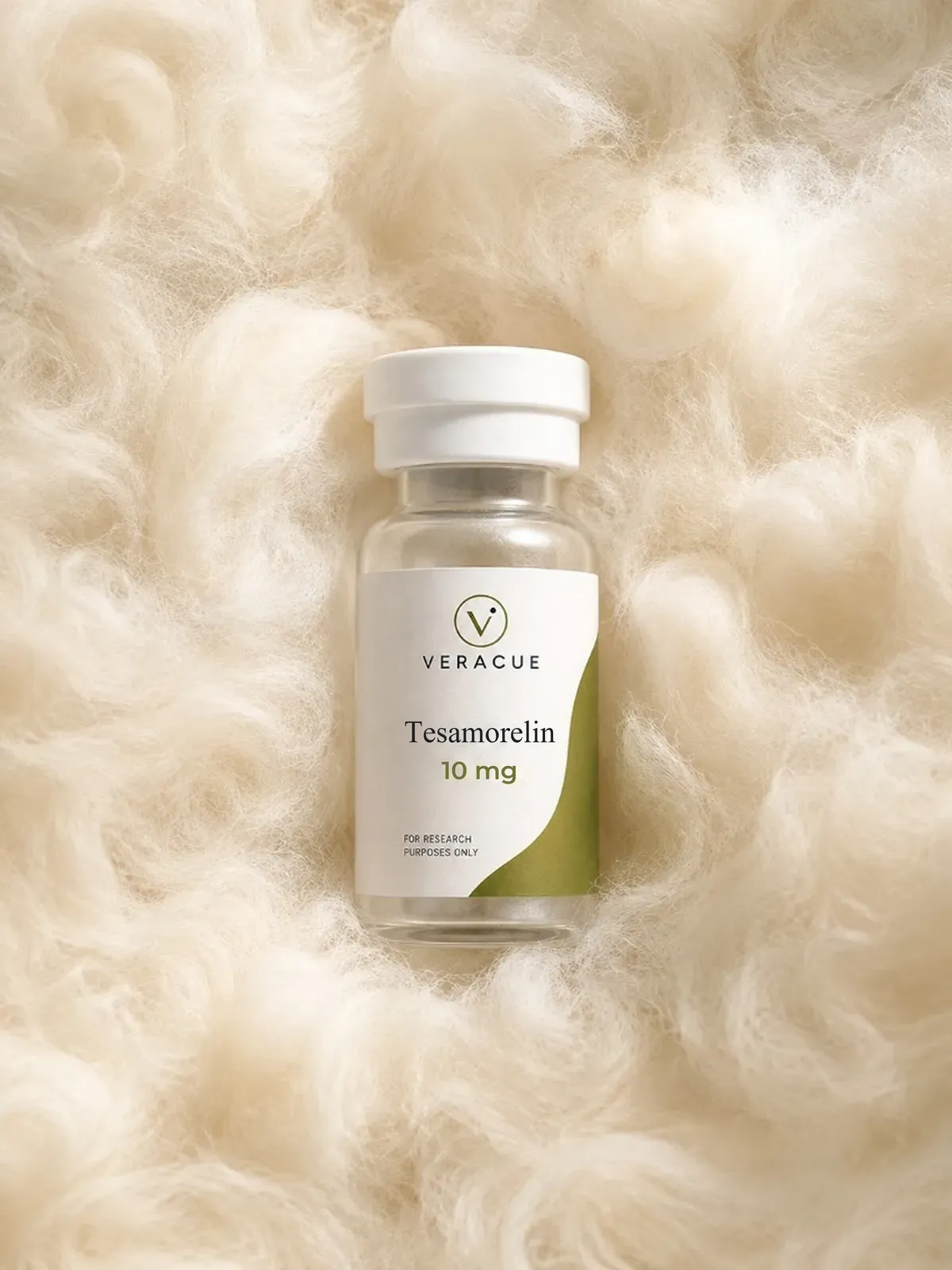
Growth Hormone Secretagogue
Tesamorelin
Tesamorelin is a synthetic 44-amino-acid analog of growth hormone-releasing factor: the full native GRF(1-44) chain with a trans-3-hexenoyl group on the N-terminal tyrosine and an amidated C-terminus. The free peptide is C221H366N72O67S, average mass about 5135.9 g/mol, CAS 218949-48-5, while the acetate salt has its own CAS, 901758-09-6. It is a GHRH receptor ligand, not a ghrelin receptor ligand like ipamorelin. Offered in 10 mg and 20 mg vials for laboratory research use only.
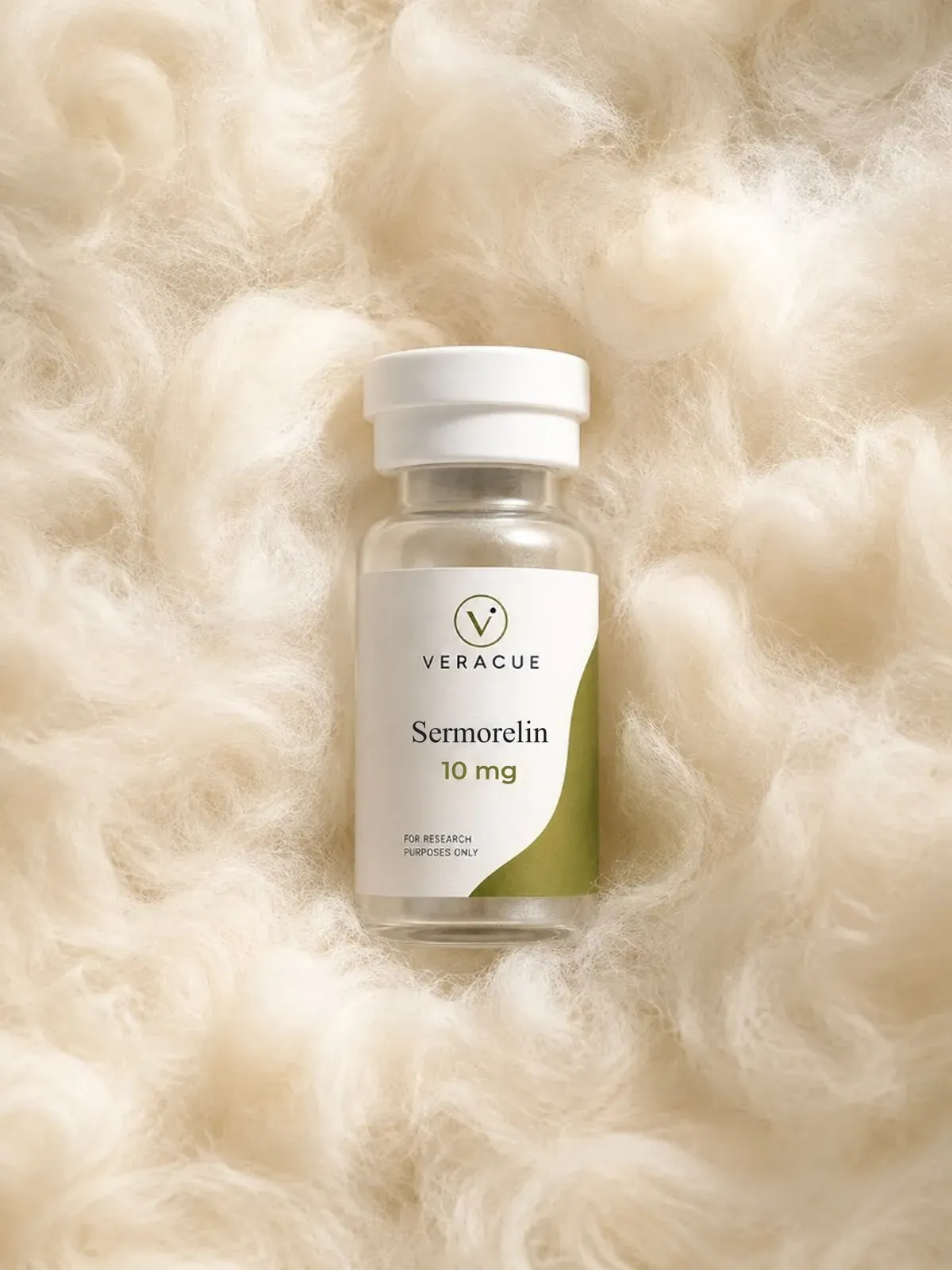
Growth Hormone Secretagogue
Sermorelin
Sermorelin is a linear 29-residue synthetic peptide, YADAIFTNSYRKVLGQLSARKLLQDIMSR-NH2, made of the first 29 amino acids of growth hormone-releasing hormone with a C-terminal amide. Its free-base reference formula is C149H246N44O42S, average mass about 3357.9 g/mol, CAS 86168-78-7. It is easily confused with Tesamorelin, CJC-1295 and Ipamorelin, which are different molecules, and it is not growth hormone itself. Vials come in 10 mg and 20 mg for laboratory research use only.
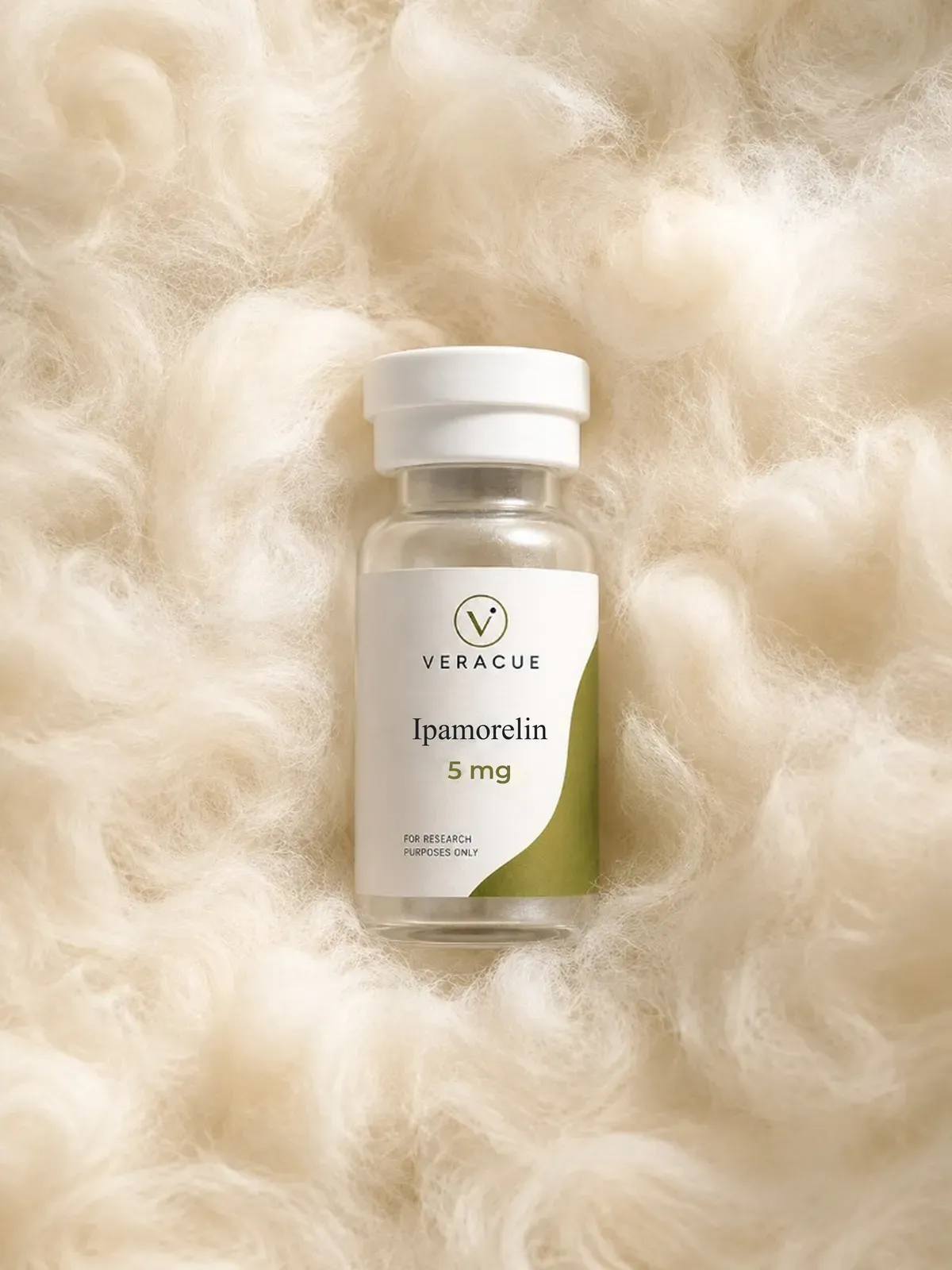
Growth Hormone Secretagogue
Ipamorelin
Ipamorelin is a five-residue synthetic peptide, Aib-His-D-2-Nal-D-Phe-Lys-NH2, that includes non-standard residues such as aminoisobutyric acid (Aib) and D-2-naphthylalanine. It has the formula C38H49N9O5, an average mass of about 711.85 g/mol and CAS 170851-70-4, and it is described as a selective agonist of the ghrelin receptor GHS-R1a in receptor assays. Vials come in 5 mg and 10 mg, for laboratory research only, not for human or veterinary use.
What Is Tesamorelin? Understanding Its Molecular Identity
Tesamorelin is the International Nonproprietary Name (INN) for a synthetic peptide built on the backbone of human growth hormone-releasing hormone (hGHRH, also called GRF). It is a chemically modified analog of the naturally occurring 44-amino-acid hGHRH(1-44) sequence, carrying one defined N-terminal modification, described below. The compound is most often supplied as tesamorelin acetate (CAS 901758-09-6), the salt form named in FDA documentation; the unmodified free base carries its own, separate CAS number (218949-48-5) and UNII code (LGW5H38VE3). A peptide's name and its complete chemical description are not the same thing. The name identifies the research compound; the full description (sequence, modification, salt form, counterion load) is what a laboratory needs to compare one lot, one supplier, or one analytical report against another.
What Is Tesamorelin's Amino Acid Sequence?
Tesamorelin's peptide backbone is the complete 44-residue sequence of native human GRF, unmodified at every internal position. In one-letter notation: YADAIFTNSYRKVLGQLSARKLLQDIMSRQQGESNQERGARARL, terminating in an amide rather than a free carboxylic acid. This full-length sequence is what separates Tesamorelin from truncated GHRH analogs such as Sermorelin or Modified GRF(1-29), both of which stop at residue 29. Nothing about the internal sequence is substituted in Tesamorelin; its modifications sit at the two ends of the chain, covered next.
What Makes the N-Terminal Modification Distinctive?
The feature that defines Tesamorelin as a distinct molecule, rather than simply native GRF(1-44), is a six-carbon acyl group, trans-3-hexenoic acid (hex-3-enoyl), attached by an amide bond to the alpha-amino group of the N-terminal tyrosine residue. This is reflected directly in the compound's formal chemical naming: the USAN/WHO synonym for the acetate salt is written as (3E)-hex-3-enoylsomatoliberin (human) acetate, with "somatoliberin" serving as the formal pharmacological synonym for GRF/GHRH. This single acyl addition is the only point of structural difference between Tesamorelin's N-terminus and that of unmodified native GRF(1-44). It is the detail an analytical method such as LC-MS is checking for when confirming Tesamorelin's identity against native GRF.
What Does C-Terminal Amidation Mean for Tesamorelin?
At the opposite end of the chain, Tesamorelin's C-terminal leucine (residue 44) is amidated rather than left as a free carboxylic acid. FDA's chemistry documentation for NDA 22-505 names the complete compound ending in "L-leucinamide," and its structural formula shows the terminal "-NH2" group explicitly. In peptide nomenclature, amidation at the C-terminus is commonly written as "-NH2" appended to the sequence, distinguishing it from a free-acid form written with no such suffix. This is a structural detail, not a numerical one, but it matters when comparing a written sequence against a certificate of analysis or a mass-spectrometry result, since a free-acid and an amidated form of the same 44 residues carry slightly different molecular weights.
What Is Tesamorelin's Molecular Formula and Weight?
The molecular formula of Tesamorelin free base, as stated in FDA's chemistry review of NDA 22-505, is C221H366N72O67S, with an average molecular weight of 5135.86 Da (also rounded to 5135.9 Da in the approved product's prescribing information, and matching Veracue Labs' own listed value). The acetate salt form is written as C221H366N72O67S times x C2H4O2, where x represents an average of approximately 7.4 acetic acid counterions bound per peptide molecule, bringing the salt form's average mass to roughly 5579 Da by the same chemistry review's figures. Average molecular mass, the value published here, is calculated using the standard atomic weights of each element across the whole molecule. A monoisotopic mass (calculated from only the single most abundant isotope of each atom) is the figure some mass-spectrometry software reports instead, and it was not published in the primary FDA documentation reviewed for this article; rather than estimate one, this guide leaves that figure unstated. The difference between the two conventions is routine for peptides of this size, and it is one reason two sources can report "the molecular weight of Tesamorelin" and arrive at numbers that look inconsistent without actually disagreeing.
Field | Value |
|---|---|
Compound name | Tesamorelin (commonly supplied as the acetate salt) |
Classification | Synthetic growth hormone-releasing hormone (GHRH) analog |
Amino acid length | 44 residues |
Structural modification | N-terminal trans-3-hexenoyl (hex-3-enoyl) acylation; C-terminal amidation |
Molecular formula (free base) | C221H366N72O67S |
Average molecular mass (free base) | 5135.86 Da |
CAS number, free base / acetate | 218949-48-5 / 901758-09-6 |
Molecular form | Free base or acetate salt (about 7.4 mol acetic acid per mol peptide in the acetate form) |
UNII | LGW5H38VE3 (acetate) / MQG94M5EEO (free base) |
How Does Tesamorelin Free Base Differ From the Acetate Salt?
Most peptides, Tesamorelin included, are supplied as a salt rather than a pure free base, because the salt form is typically easier to lyophilize, handle, and store. A salt form means the peptide molecule is paired with a counterion, acetate in Tesamorelin's case, that is not part of the biologically active sequence itself but does add to the measured weight of the material in a vial. FDA's chemistry review documents an average of about 7.4 moles of acetic acid per mole of Tesamorelin acetate. That ratio is exactly why a vial's labeled weight (the gross weight, including the counterion) and its net peptide content (the Tesamorelin molecule weight alone) are not the same number, and why a rigorous certificate of analysis should state which figure it is reporting. The free base (CAS 218949-48-5) and the acetate salt (CAS 901758-09-6) are two distinct, independently registered identifiers for what is, at the peptide level, the same molecule.
How Does Tesamorelin Differ From CJC-1295 and Modified GRF(1-29)?
CJC-1295 and its DAC-free counterpart, often called Modified GRF(1-29), are frequently confused with Tesamorelin because all three are GHRH-receptor-targeted analogs, but their structures diverge sharply. Modified GRF(1-29) is a truncated, 29-residue fragment of native GHRH, reported across chemical-supplier documentation to carry four amino acid substitutions (commonly cited at positions 2, 8, 15, and 27) intended to resist enzymatic breakdown; those exact substitution positions could not be confirmed here against an independent, peer-reviewed structural paper, so they are presented as industry-reported rather than fully verified. CJC-1295 (with DAC) is that same 29-residue backbone with an additional C-terminal Lys-maleimidopropionamide ("Drug Affinity Complex") moiety designed to bind covalently to circulating albumin. Tesamorelin, by contrast, keeps the complete, untruncated 44-residue native sequence and carries no albumin-binding conjugate at all; its only structural departure from native GRF(1-44) is the single N-terminal hexenoyl group described above.
How Does Tesamorelin Differ From Ipamorelin?
Tesamorelin and Ipamorelin are regularly sold alongside each other, but they belong to entirely different structural and pharmacological classes. Ipamorelin is a synthetic pentapeptide (five residues: Aib-His-D-2-Nal-D-Phe-Lys-NH2, CAS 170851-70-4, molecular formula C38H49N9O5, average molecular weight approximately 711.85 to 711.87 Da) built from non-natural amino acids, including 2-aminoisobutyric acid (Aib) and D-configured residues, and it shares no sequence homology with native GHRH. Its target is the ghrelin receptor, also called the growth hormone secretagogue receptor (GHS-R1a), a distinct G protein-coupled receptor from the one Tesamorelin acts on. Tesamorelin, as covered above, is a 44-residue GHRH analog acting at the GHRH receptor itself, part of a different receptor family entirely (the secretin receptor family of class B GPCRs). This is a classification distinction, not a ranking of one compound against the other.
How Does Tesamorelin Differ From Sermorelin?
Sermorelin is the INN for unmodified native GRF(1-29)-NH2, the first 29 residues of native human GHRH with an amidated C-terminus and no other modification (free base CAS 86168-78-7, acetate CAS 114466-38-5, molecular formula C149H246N44O42S, average molecular weight 3357.88 Da). Structurally, Sermorelin's first 29 residues are identical to Tesamorelin's first 29 residues; the two compounds diverge in two places: Tesamorelin continues for 15 additional residues, completing the full 44-residue native sequence, and Tesamorelin carries the N-terminal trans-3-hexenoyl group that Sermorelin does not. Sermorelin, in other words, is a direct, unmodified truncation of native GHRH, while Tesamorelin is the full-length sequence with one defined chemical addition.
Compound | Residues | Backbone | Key Modification | Molecular Formula | Avg. MW (Free Base) | Receptor Target |
|---|---|---|---|---|---|---|
Native GRF(1-44) | 44 | hGHRH(1-44), unmodified | None | C215H358N72O66S | approx. 5039.65 Da | GHRH receptor |
Tesamorelin | 44 | hGHRH(1-44) | N-terminal trans-3-hexenoyl; C-terminal amide | C221H366N72O67S | 5135.86 Da | GHRH receptor |
Sermorelin | 29 | hGHRH(1-29), unmodified | None | C149H246N44O42S | 3357.88 Da | GHRH receptor |
Modified GRF(1-29) / CJC-1295 (no DAC) | 29 | hGHRH(1-29) | Reported four-position substitution (industry sources; not independently confirmed here) | approx. C152H252N44O42 (industry sources, unverified) | approx. 3367.9 Da (industry sources, unverified) | GHRH receptor |
CJC-1295 (with DAC) | 29 | hGHRH(1-29) backbone | Same reported substitutions plus a C-terminal albumin-binding (DAC) moiety | Not independently confirmed in this pass | Higher than no-DAC form due to conjugate | GHRH receptor |
Ipamorelin | 5 | Not GHRH-derived | Aib, D-2-Nal, D-Phe non-natural residues | C38H49N9O5 | 711.85 to 711.87 Da | Ghrelin receptor (GHS-R1a); a different receptor family |
What Should a Tesamorelin Certificate of Analysis Show?
A certificate of analysis (COA) for any research peptide should identify the specific lot or batch it describes, state which molecular form was tested (free base or a named salt, with its counterion ratio if relevant), and report results against a stated specification, typically an HPLC purity percentage and a mass-spectrometry-confirmed identity match. A rigorous COA also notes the testing method, the testing date, and ideally the testing laboratory. The key limitation to understand is scope: a COA documents the sample that was actually tested, from one specific lot, at one point in time. It does not, by itself, certify every vial sold under a given listing, and it does not establish anything about legal status or intended use.
On Veracue Labs' own Tesamorelin listing, the identity method is stated as mass spectrometry and the purity method as HPLC, with purity and lot data available on request rather than published as a fixed figure. As of this writing, Veracue's certificates archive lists zero published batch reports across its catalog and states that batch-specific COAs are still being added; a specific lot's analytical results should be requested directly through Veracue rather than assumed to already exist.
How Do HPLC and LC-MS Verify Tesamorelin's Identity?
High-performance liquid chromatography (HPLC) and liquid chromatography-mass spectrometry (LC-MS) answer two different questions, and neither one alone tells the full analytical story. HPLC separates a sample's components and measures the relative size of the main peak against any other eluting substances, which is how a purity percentage is generated; it says a great deal about how clean a sample is, but very little, on its own, about whether the main peak is actually the molecule it is claimed to be. LC-MS (or related mass-spectrometry methods) measures the mass of the separated components and compares it against the expected value for the target sequence, which is how molecular identity is confirmed; it does not, by itself, quantify purity the way HPLC does. A rigorous identity-and-purity claim for a peptide like Tesamorelin generally requires both methods together, not either one in isolation.
Method | What It Establishes | What It Cannot Establish Alone |
|---|---|---|
HPLC | Relative purity of the main peak against other eluting substances (an impurity profile), usually reported as a percentage | Molecular identity; a clean chromatogram does not by itself confirm what the main peak actually is |
LC-MS / mass spectrometry | Molecular identity, by matching measured mass to the expected sequence mass | Purity level, unless combined with a chromatographic separation step |
Counterion / acetate content analysis | The number of acetic acid (or other counterion) equivalents bound per peptide molecule, needed to convert gross vial weight into net peptide content | The purity or identity of the peptide itself |
Certificate of Analysis, generally | The tested lot's results against its stated specifications | Whether every vial in a listing matches the tested sample, or whether the material suits any particular use |
What Does Research Use Only Mean?
"Research Use Only" is a labeling and intended-use designation for a laboratory or analytical material, signaling that it is not labeled, manufactured, or sold for human or veterinary administration, and that it has not gone through the regulatory review required of an approved drug product. This is separate from Tesamorelin's own regulatory history as a molecule: tesamorelin acetate is the FDA-approved active ingredient in Egrifta and Egrifta SV (NDA 22-505, originally approved in 2010), a prescription product indicated for the reduction of excess abdominal fat in HIV-infected patients with lipodystrophy. That approval attaches to a specific, GMP-manufactured drug product that underwent FDA's full chemistry, manufacturing, and clinical review, not to RUO research material sold under the same INN for laboratory and analytical use. An RUO-labeled vial of Tesamorelin carries none of that drug product's manufacturing pedigree, labeling, or clinical indication, and nothing in this article should be read as suggesting otherwise in either direction.
Research Use Only (RUO). Veracue Labs' Tesamorelin research material is supplied strictly for laboratory and analytical research and is not intended, labeled, or approved for use in or on humans or animals, for diagnosis, treatment, cure, or prevention of any disease, or for any form of personal administration. Nothing in this article constitutes dosing, administration, safety, or health-outcome guidance. Specific lot documentation should be requested directly through Veracue Labs for the relevant SKU and lot.
Frequently Asked Questions
Tesamorelin is the INN for a synthetic 44-amino-acid peptide built on the sequence of native human growth hormone-releasing hormone (hGHRH), carrying a single N-terminal trans-3-hexenoyl modification and a C-terminal amide. It is most often supplied as the acetate salt (CAS 901758-09-6).
44, the complete native hGHRH(1-44) sequence, with no internal substitutions. The only structural change is the added N-terminal acyl group.
A trans-3-hexenoyl (hex-3-enoic acid) group attached to the N-terminal tyrosine, the single defining structural change versus unmodified native GRF(1-44).
The free base is the peptide alone; the acetate salt pairs it with acetic acid counterions, averaging about 7.4 moles per mole of peptide.
Sources report different conventions, average mass versus acetate-salt mass versus monoisotopic mass, which describe different values rather than contradicting each other.
Tesamorelin is the full 44-residue native sequence with one N-terminal modification; CJC-1295 variants are truncated to 29 residues with additional substitutions and, in the DAC form, an albumin-binding moiety.
HPLC measures purity by comparing peak sizes; LC-MS measures identity by matching mass to the expected sequence.
Tesamorelin acetate is the approved active ingredient in Egrifta and Egrifta SV; that approval covers the reviewed drug product, not RUO research material sold under the same chemical name.
- 01U.S. Food and Drug Administration. Chemistry Review, NDA 22-505 (Egrifta/tesamorelin acetate), 2010.
- 02Egrifta SV (tesamorelin) prescribing information, current labeling.
- 03DrugBank entry DB08869, Tesamorelin; NIH NCATS Inxight Drugs, UNII LGW5H38VE3 (acetate) / MQG94M5EEO (free base).
- 04DrugBank entry DB00010, Sermorelin; PubChem Compound Summary for CID 16132413.
- 05FDA Pharmacy Compounding Advisory Committee Briefing Document, Ipamorelin-related bulk drug substances, October 29, 2024 (CAS 170851-70-4, C38H49N9O5).
- 06Modified GRF(1-29)/CJC-1295 (no DAC) formula, MW, and reported substitution positions: sourced only from commercial peptide-supplier documentation, not independently confirmed against a peer-reviewed structural paper.
- 07Veracue Labs, Tesamorelin Research Peptide (GRF 1-44) product page.
- 08Veracue Labs, Ipamorelin Research Peptide (GHS-R1a) product page.
- 09Veracue Labs, Certificates page (batch-specific COAs available on request; archive status checked at time of writing).
Veracue Research Team
Research & Product Team
Our in-house team tracks published peptide and coenzyme research and translates it into clear, source-cited overviews for the research community.
Reviewed by in-house research chemists
orders@veracuelabs.com