NAD+ and AHK-Cu in Metabolic and Longevity Research: A Deep Dive
A research overview of NAD+ and AHK-Cu covering mitochondrial metabolism, sirtuin activation, copper-peptide signaling, and laboratory handling protocols.

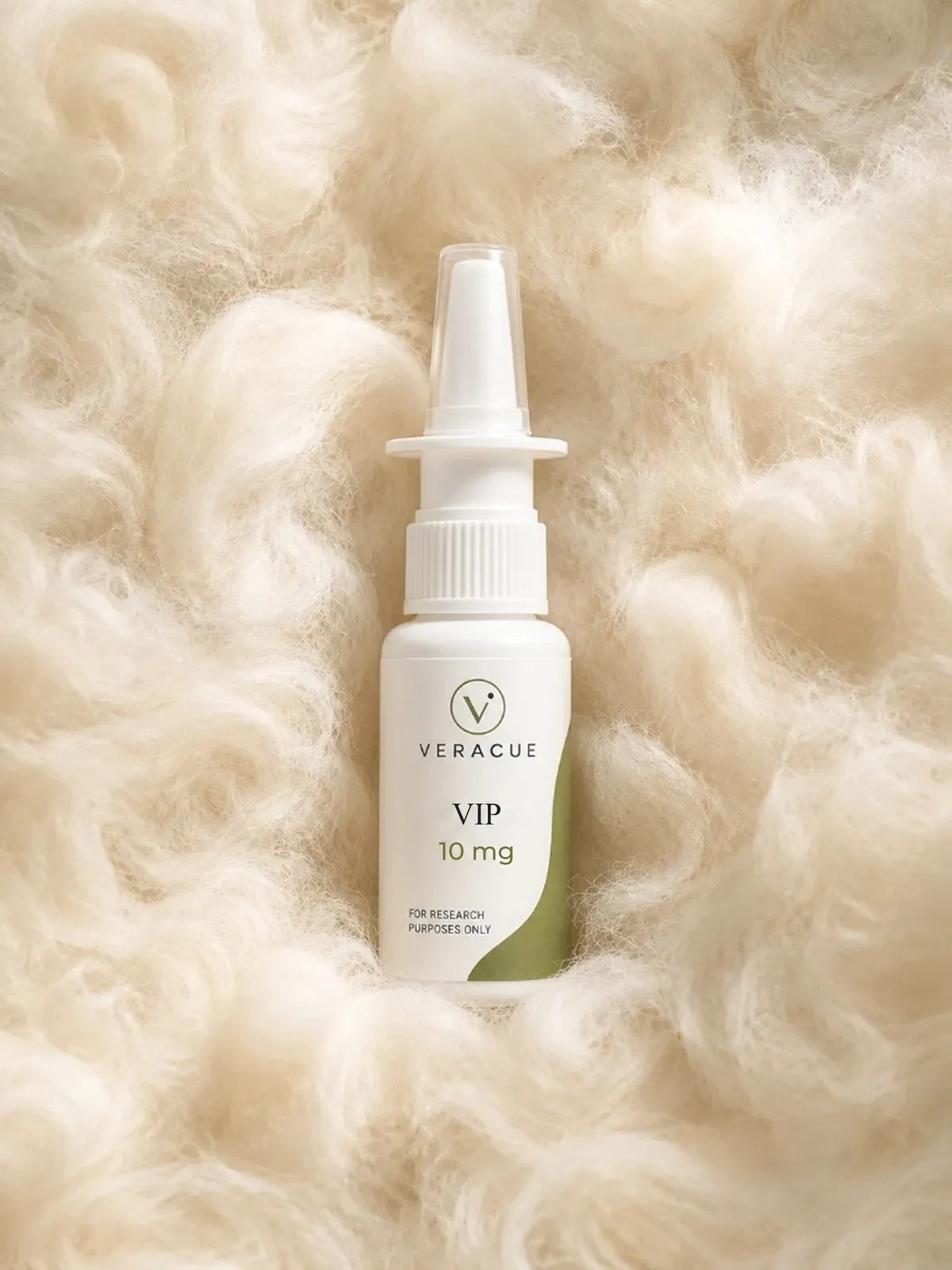
VIP Spray is a spray-dispensed form of vasoactive intestinal polypeptide, a linear peptide of 28 amino acids with an amidated C-terminus and a single methionine at position 17. The free peptide has the formula C147H238N44O42S, an average mass near 3,325.8 g/mol and CAS number 40077-57-4, and the sequence is identical in human, porcine and rat VIP. Secretin, glucagon and PACAP belong to the same peptide family, so identity rests on sequence and mass rather than on family membership. The 10 mg size has 90 sprays per bottle and is for laboratory research use only.
Ask for the analytical documentation of any lot.
HPLC is the method used to measure purity
Ask for the report for a specific lot through the contact page
Supplied for laboratory research use only
Mass spectrometry is the method used to confirm identity
| Product name | VIP Spray |
| Compound | Vasoactive intestinal polypeptide (VIP), synthetic |
| Format | Spray-dispensed bottle |
| Sprays per bottle | 90 sprays per bottle |
| Size offered | 10 mg |
| Chain | 28 amino acids, linear, C-terminal amide |
| Sequence | HSDAVFTDNYTRLRKQMAVKKYLNSILN-NH2 |
| Free-peptide formula | C147H238N44O42S |
| Average mass | About 3,325.8 g/mol |
| CAS Registry Number | 40077-57-4 |
| Research designation | Research Use Only |
Formula, mass and CAS number describe the free peptide as listed in reference sources and are not lot results. Chemical form, fill volume, concentration, purity and storage conditions are reported on the documentation for each lot, which can be requested through the contact page.
The peptide in VIP Spray is vasoactive intestinal peptide, or VIP, a neuropeptide of 28 amino acids first isolated from hog small intestine. Read from the N-terminus the chain is His-Ser-Asp-Ala-Val-Phe-Thr-Asp-Asn-Tyr-Thr-Arg-Leu-Arg-Lys-Gln-Met-Ala-Val-Lys-Lys-Tyr-Leu-Asn-Ser-Ile-Leu-Asn, and the final asparagine is amidated.
VIP is a single defined molecule, not a mixture. The listing is one peptide at one size, with 90 sprays per bottle.
VIP, VIP peptide and vasoactive intestinal polypeptide are interchangeable names for the same chain. Reference suppliers list one sequence for human, porcine and rat VIP, so the species on a record does not change the molecule.
Counting from position 1, the chain carries one phenylalanine (6), tyrosines at 10 and 22, and a single methionine at 17. There is no cysteine, so disulfide bonds are not a factor, and no tryptophan. The basic residues cluster toward the C-terminal half: arginines at 12 and 14, lysine at 15, and a pair of lysines at 20 and 21.
Methionine oxidizes readily, which makes position 17 the first place to look when a mass spectrum shows a minor species near +16 Da.
The last asparagine ends in an amide, not a carboxylate. The free-acid version of the same 28 residues is a different species roughly 1 Da heavier, close enough that a record which drops the amide can pass a casual mass comparison.
VIP sits in a superfamily of structurally related peptide hormones, and the shared ancestry is why labels get mixed up. Each relative below has its own sequence and mass.
None of these matches HSDAVFTDNYTRLRKQMAVKKYLNSILN-NH2 residue for residue, so a VIP lot should show exactly that chain at about 3325.8 g/mol.
The receptors that respond to VIP are class B G protein-coupled receptors. VPAC1 and VPAC2 answer to VIP and PACAP with high affinity, while PAC1 favors PACAP. Gene databases list the first two as VIPR1 and VIPR2, so a literature search is more complete when it uses both naming systems.
Cyclic AMP formation is a common readout for VIP receptor activity. A cell line that expresses several subtypes can blur where a signal comes from, so selective ligands or receptor-knockout models are used to separate them. A result in one defined assay is a laboratory observation under those conditions, and Veracue gives no dosing, administration or usage guidance of any kind.

VIP weighs about 3.3 kDa, a size at which electrospray ionization puts several charge states in the same spectrum. On an average-mass basis the 4+ ion appears near m/z 832.5, the 5+ near 666.2 and the 6+ near 555.3. Because one peptide gives all of these peaks, the spacing between them is what reveals the neutral mass, and a single peak read as if it were the neutral mass points to the wrong molecule.
To check a spectrum, multiply each m/z by its charge and subtract one proton mass per charge. Every peak in the series should return the same value, close to 3325.8 g/mol if the lot is the free peptide. An instrument that reports monoisotopic masses will read about 2 Da lower, so note which convention the report uses.
| What the spectrum shows | A reasonable reading |
|---|---|
| A series of peaks that all convert to one neutral mass | One species seen in several charge states |
| A minor peak about 16 Da above the main mass | Oxidation at methionine 17 is the usual explanation |
| A signal about 1 Da above the main mass | Often the isotope envelope, which is broad at this size; a free-acid terminus or a deamidated asparagine would also fit |
| A main mass well away from about 3325.8 g/mol | A different peptide, a modified chain or a different chemical form |
A certificate describes one lot, never a compound in general, so first confirm that the lot number matches the bottle label and your order record. It should then state the product and chemical form, an HPLC result with its method and chromatogram, a mass result with observed and expected mass, net peptide content, fill volume and concentration, the test date and the testing laboratory. The certificate page explains how to request documentation for a lot.
Reports vary between average mass, monoisotopic mass and charge-state data. Comparing a monoisotopic result directly with the average figure of about 3325.8 g/mol would look like a mismatch of roughly 2 Da, so read the method line first.
Purity describes the share of detected signal in the main peak. Net peptide content describes how much of the weight is peptide rather than counterion, salt or water. A certificate that gives only one of the two leaves a gap.
A salt such as trifluoroacetate adds counterion weight, and the formula above describes only the free peptide. Any calculation that mixes the two forms carries a silent error.
VIP Spray is listed for laboratory research and analytical work only. It is not meant for human or veterinary use, for ingestion, injection or any other form of administration, or as a drug, dietary supplement, cosmetic or food. No dosing, administration or usage guidance of any kind is given by Veracue. Purchasers must be qualified researchers or institutions working within applicable law. See the Medical Disclaimer and the Terms and Conditions for sitewide policy.

RESEARCH PEPTIDE
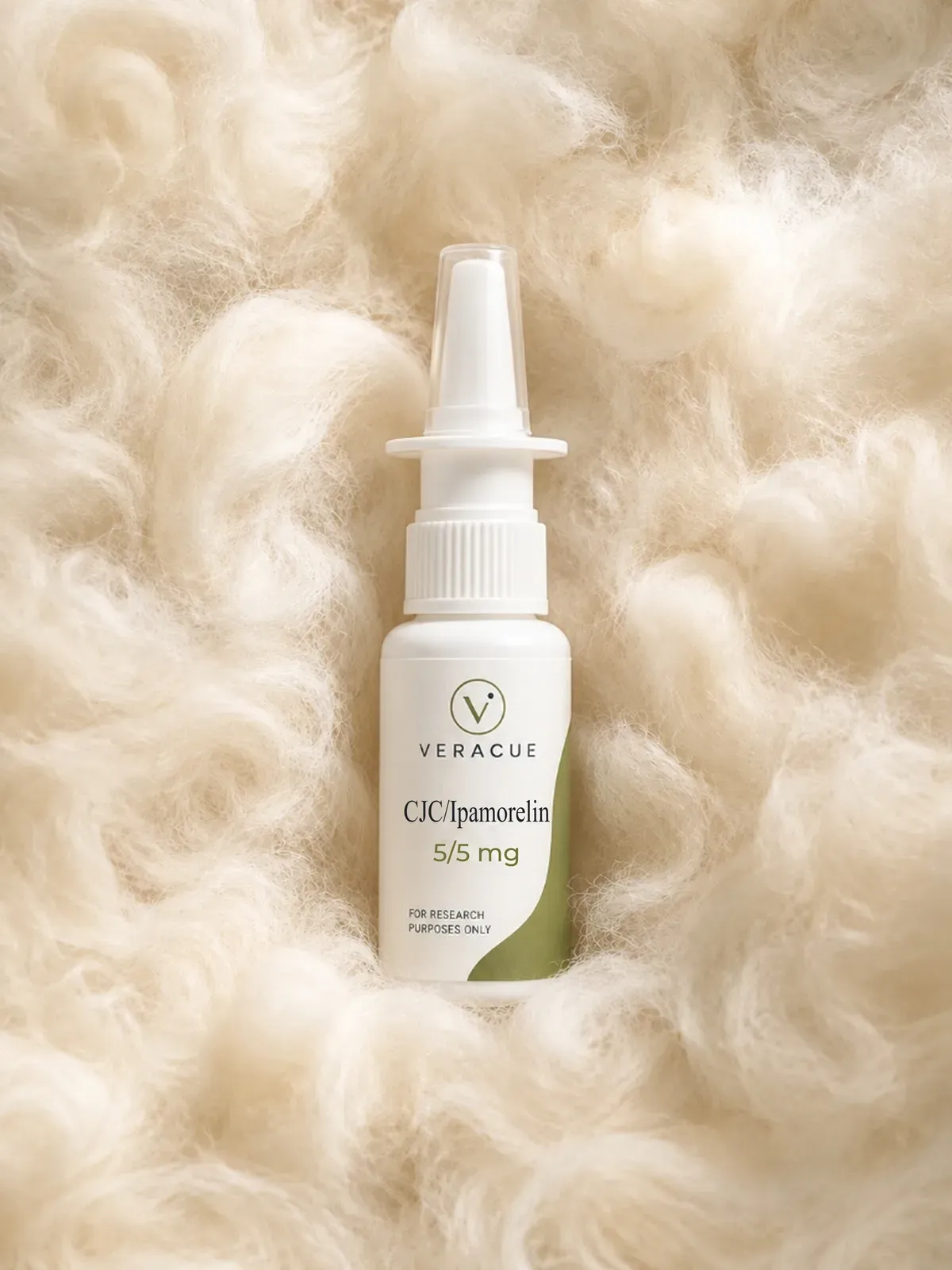
Spray bottle pairing a 29-residue GHRH analog with the pentapeptide Ipamorelin, 5 mg of each and 45 sprays per bottle. Laboratory research use only.

RESEARCH PEPTIDE
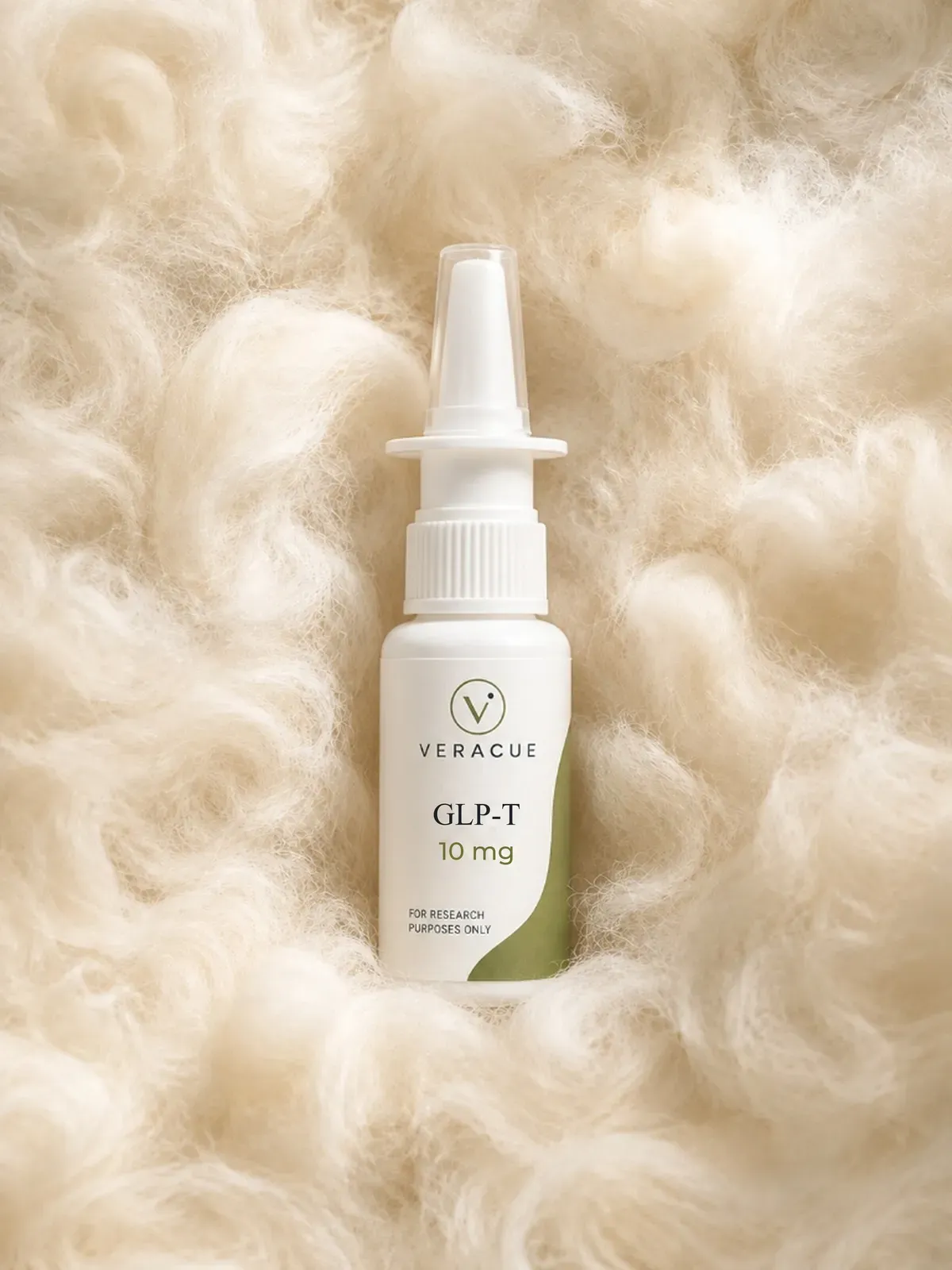
GLP-T Spray pairs a 39-residue peptide, LY3298176 (CAS 2023788-19-2), with a C20 diacid on lysine 20. 10 to 60 mg, research use only, 45 sprays a bottle.

RESEARCH PEPTIDE
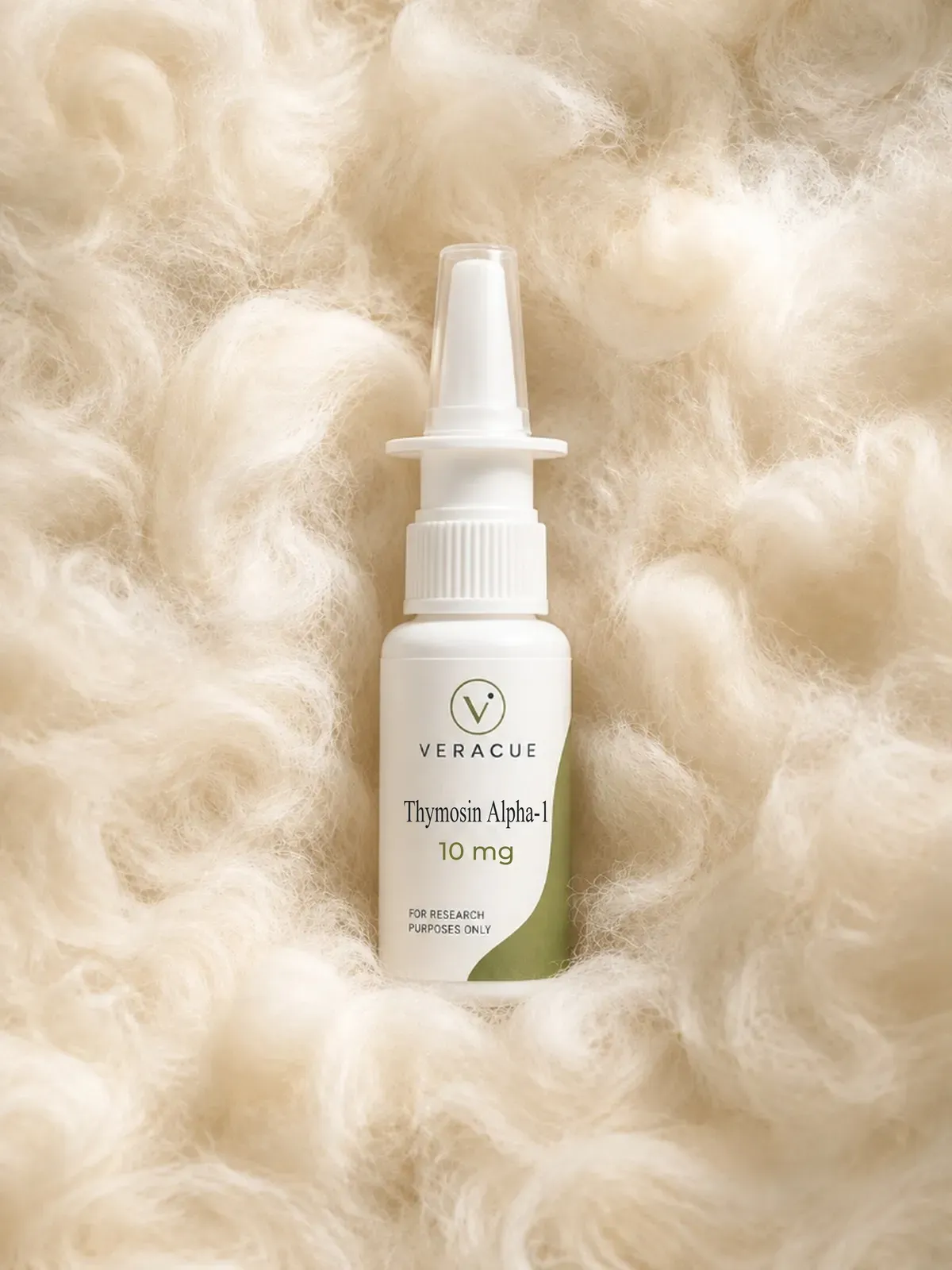
A 28-residue, N-acetylated peptide at 3108.3 g/mol, spray-dispensed in a 10 mg bottle with 45 sprays. Supplied for research use only.

RESEARCH PEPTIDE
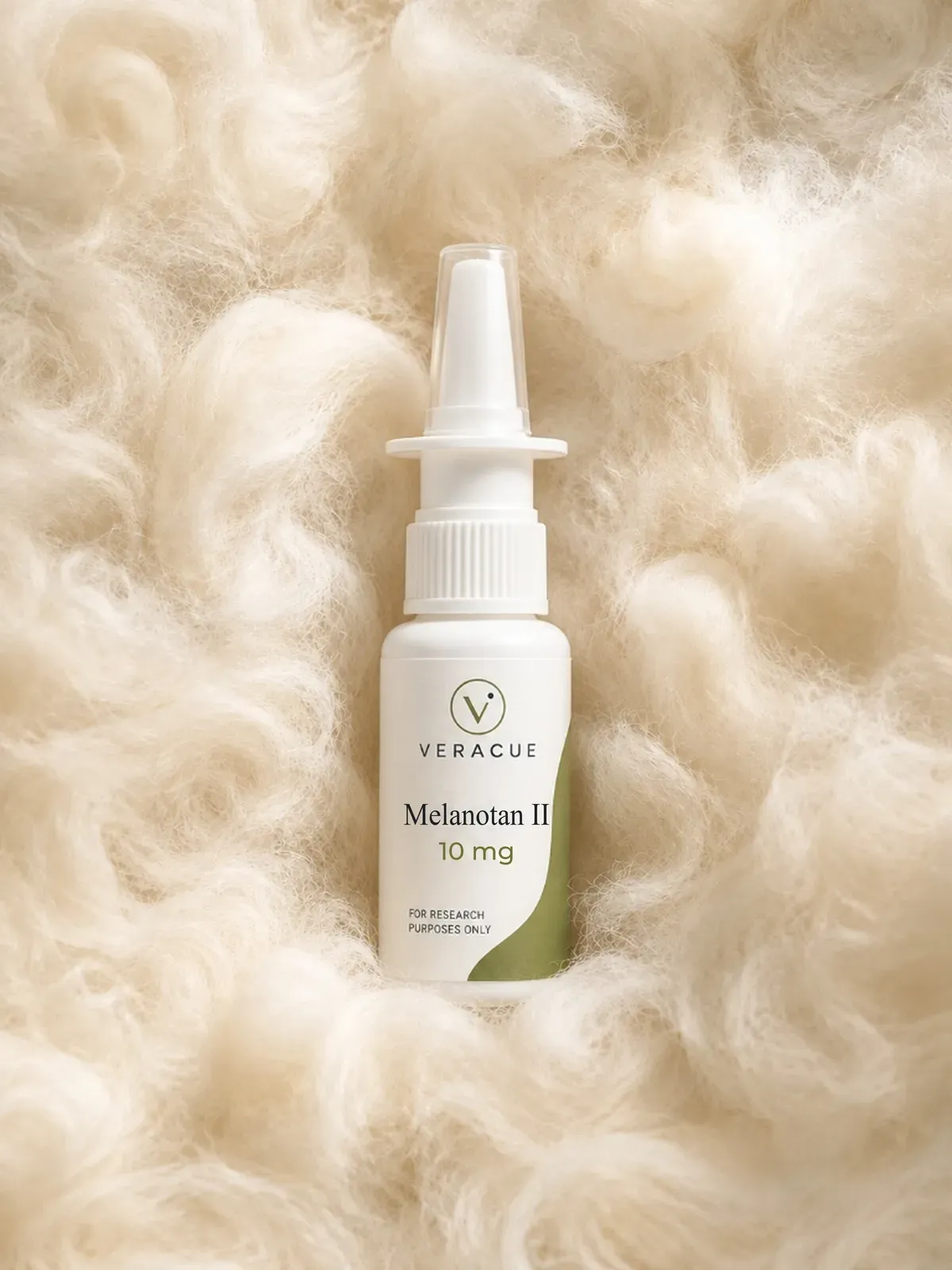
Seven residues, a lactam ring and an amide terminus: Melanotan II, CAS 121062-08-6, in a 10 mg bottle of 45 sprays. Laboratory research only.