NAD+ and AHK-Cu in Metabolic and Longevity Research: A Deep Dive
A research overview of NAD+ and AHK-Cu covering mitochondrial metabolism, sirtuin activation, copper-peptide signaling, and laboratory handling protocols.

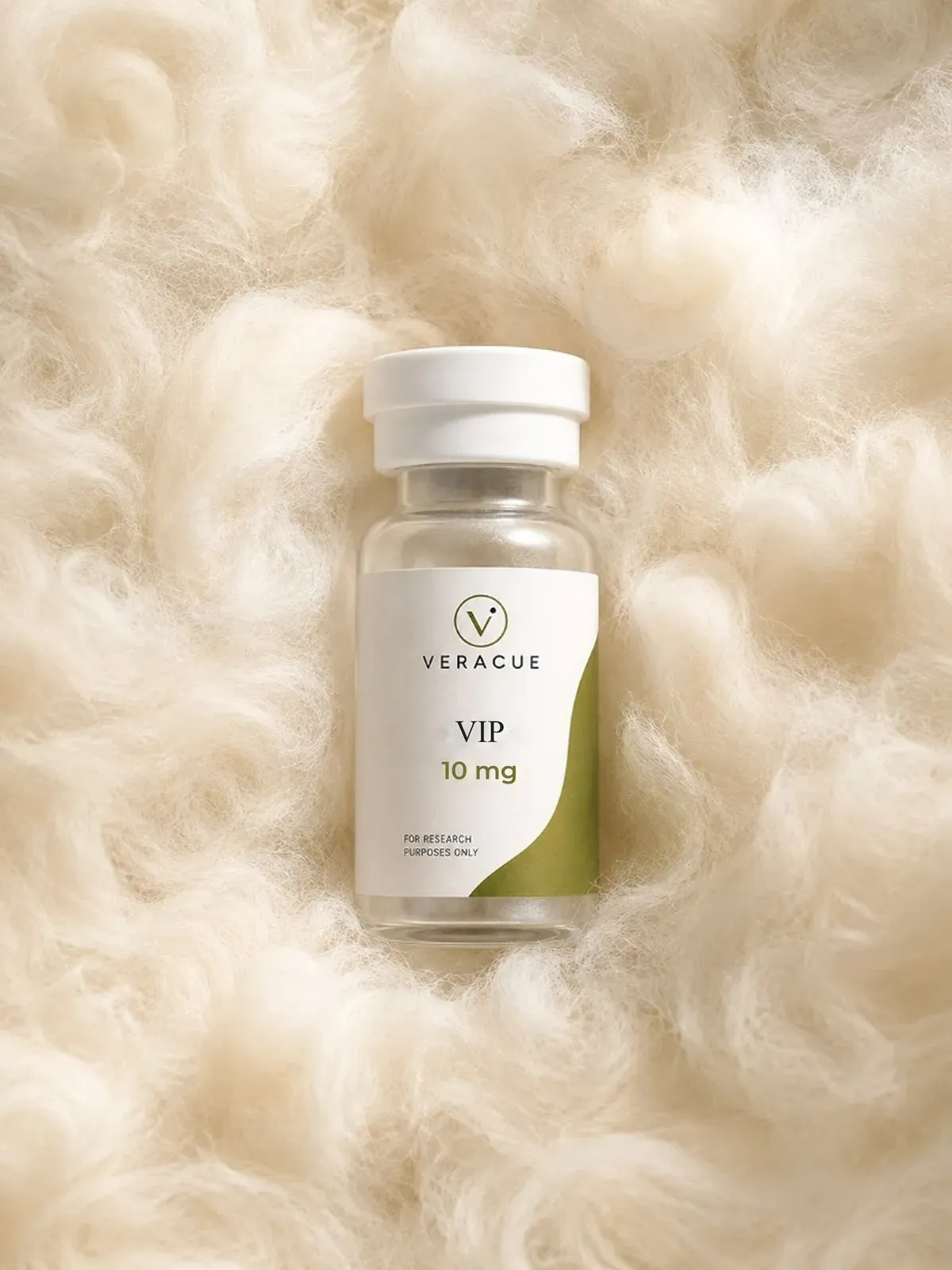
VIP is vasoactive intestinal peptide, a linear 28-residue neuropeptide with the sequence HSDAVFTDNYTRLRKQMAVKKYLNSILN-NH2 and an amidated C-terminus. Reference values are formula C147H238N44O42S, average mass about 3325.8 g/mol and CAS 40077-57-4. Human, porcine and rat VIP share this one sequence. It sits in the same peptide superfamily as PACAP, secretin and glucagon yet differs from each in sequence and mass. Veracue supplies VIP as a 10 mg vial, strictly for laboratory research use only.
Ask for the analytical documentation of any lot.
HPLC is the method used to measure purity
Ask for the report for a specific lot through the contact page
Supplied for laboratory research use only
Mass spectrometry is the method used to confirm identity
VIP stands for vasoactive intestinal peptide, a neuropeptide of 28 amino acids first isolated from hog small intestine in 1970 and also written vasoactive intestinal polypeptide. In one-letter code the sequence is HSDAVFTDNYTRLRKQMAVKKYLNSILN, and the chain ends in an amide rather than a free carboxylic acid. Reference sources list a single sequence for human, porcine and rat VIP, so a record labeled for any of the three describes the same chain.
VIP is one defined peptide. It is not a blend, and it is not any of the neighboring peptides it is often listed beside in search results. Veracue supplies it for research use only.
| Product name | VIP (vasoactive intestinal peptide, also vasoactive intestinal polypeptide) |
| Molecule type | Synthetic linear peptide, 28 residues, C-terminal amide |
| Sequence (one-letter) | HSDAVFTDNYTRLRKQMAVKKYLNSILN-NH2 |
| Sequence (three-letter) | His-Ser-Asp-Ala-Val-Phe-Thr-Asp-Asn-Tyr-Thr-Arg-Leu-Arg-Lys-Gln-Met-Ala-Val-Lys-Lys-Tyr-Leu-Asn-Ser-Ile-Leu-Asn-NH2 |
| Molecular formula (free peptide) | C147H238N44O42S |
| Molecular weight (average) | About 3325.8 g/mol |
| CAS Registry Number | 40077-57-4 |
| Receptor context | VPAC1 and VPAC2, at assay level |
| Size offered | 10 mg vial |
| Research designation | Research Use Only |
Formula, mass and CAS number are reference values for the free peptide, not a Veracue lot result. The chemical form (free peptide or a salt), purity, lot number and storage conditions for a particular vial are reported on its own documentation, which you can request through the contact page.
The 28 residues of HSDAVFTDNYTRLRKQMAVKKYLNSILN break down into three each of asparagine, leucine and lysine, two each of serine, aspartic acid, alanine, valine, threonine, tyrosine and arginine, and one each of histidine, phenylalanine, glutamine, methionine and isoleucine. Five side chains are basic (three lysines and two arginines) against two acidic aspartates, there is no glutamate, and the amidated C-terminus carries no carboxylate, so the peptide is net positive at neutral pH.
VIP has one methionine, at position 17, and no cysteine, so there are no disulfide bonds to account for. Methionine oxidizes readily, and an oxidized chain runs about 16 Da heavier than the intended one. There is no tryptophan; the aromatic residues are phenylalanine at position 6 and tyrosines at positions 10 and 22.
They are different ways of writing one peptide. Suppliers label it loosely, and the receptor gene symbols VIPR1 and VIPR2 turn up in the same searches, so the sequence, formula and CAS number are a safer test of identity than the name.
VIP belongs to a superfamily of structurally related peptide hormones, and neighbors in that family are easy to confuse on supplier lists. The table covers identity and receptor context only.
| Feature | VIP | PACAP |
|---|---|---|
| Relationship | Reference molecule for this listing | Separate peptide in the same superfamily |
| VPAC1 and VPAC2 | Bound with high affinity | Bound with high affinity |
| PAC1 | Not the preferred ligand | Selective ligand |
| Identity check | 28-residue sequence, amidated C-terminus, about 3325.8 g/mol | Different sequence and mass; verify against its own records |
Secretin and glucagon belong to the same superfamily, and helodermin, a relative first reported from lizard venom, is sometimes grouped with them. Because family members have related sequences, a name match is never enough. Confirm the 28-residue chain and the observed mass against the reference values for VIP itself.
VIP acts through class B G protein-coupled receptors, the secretin-receptor-like family. The IUPHAR naming recognizes three: VPAC1 and VPAC2, which bind both VIP and PACAP with high affinity, and PAC1, which is selective for PACAP. In cell-based work VIP is used as a reference ligand in binding and signaling assays, commonly with a cyclic AMP readout.
Which receptor produces a given signal depends on the subtypes a cell line expresses, so assay design has to account for both the ligand and the receptor population. Veracue offers molecular reference information here and provides no dosing, administration or usage guidance of any kind.

Reverse-phase HPLC reports chromatographic purity, the share of detected signal that sits in the main peak, but it cannot say which molecule that peak is. Mass spectrometry supplies the identity check by comparing the measured mass with the expected one.
At about 3325.8 g/mol, VIP is large enough that electrospray mass spectrometry shows it as a series of multiply charged ions rather than one peak at the neutral mass. On an average-mass basis the 3+ ion falls near m/z 1109.6, the 4+ ion near 832.5 and the 5+ ion near 666.2. Convert each observed m/z back to a neutral mass by multiplying by the charge and subtracting one proton per charge, and every peak should land on the same figure. MALDI-TOF mostly shows the singly charged ion instead, near m/z 3326.9.
Monoisotopic readings, which many high-resolution instruments report, sit about 2 Da below the average-mass figure, so compare like with like.
| Method | Tells a researcher | Does not prove by itself |
|---|---|---|
| RP-HPLC | Chromatographic purity (area %) under stated conditions | Identity or net peptide content |
| ESI-MS or MALDI-TOF | Measured mass against the expected value for VIP | Purity or amino acid order |
| Tandem MS | Fragment evidence for the sequence | Overall purity or quantity |
| Amino acid analysis | Net peptide content | Identity of impurities |
Some VIP variants sit very close to the target. A free-acid C-terminus or a deamidated asparagine shifts the mass by only about 1 Da, which low-resolution instruments may not resolve, so HPLC retention and the stated method matter alongside the mass. Methionine oxidation is easier to spot, at roughly +16 Da.
A certificate describes one lot, not the compound in general, so begin by matching the lot number on the document with the vial and your order record.
A complete VIP certificate names the product and its chemical form, because a salt such as trifluoroacetate or acetate adds counterion weight and changes any mass-based calculation. It should give an HPLC result with its method and chromatogram, a mass result stating observed and expected mass on a named convention, net peptide content, the test date and the testing laboratory. Results and storage conditions are reported on each lot’s own documentation, and the certificate page explains how to request it.
No. A single sharp peak shows that most of the detected material behaves alike, not that it is VIP. Pair the purity figure with a mass result from the same lot.
Purity describes the peptide-related signal, while net peptide content describes how much of the vial mass is peptide rather than counterion, salt or water. The two figures answer different questions.
Check the lot number against the vial label, then the stated chemical form, then the observed mass against 3325.8 g/mol read on the same convention. Only when those three agree is the purity figure worth interpreting.
Ask the Veracue team what documentation exists for the lot you are considering, or browse the certificate library.
VIP is sold for laboratory research and analytical characterization. The material is not intended for human or veterinary use, for ingestion, injection or any other form of administration, and it is not a drug, dietary supplement, cosmetic or food. Veracue provides no dosing, administration or usage guidance of any kind. Purchasers must be qualified researchers or institutions and are responsible for handling the material lawfully. The Medical Disclaimer and the Terms and Conditions set out sitewide policies.
RESEARCH PEPTIDE
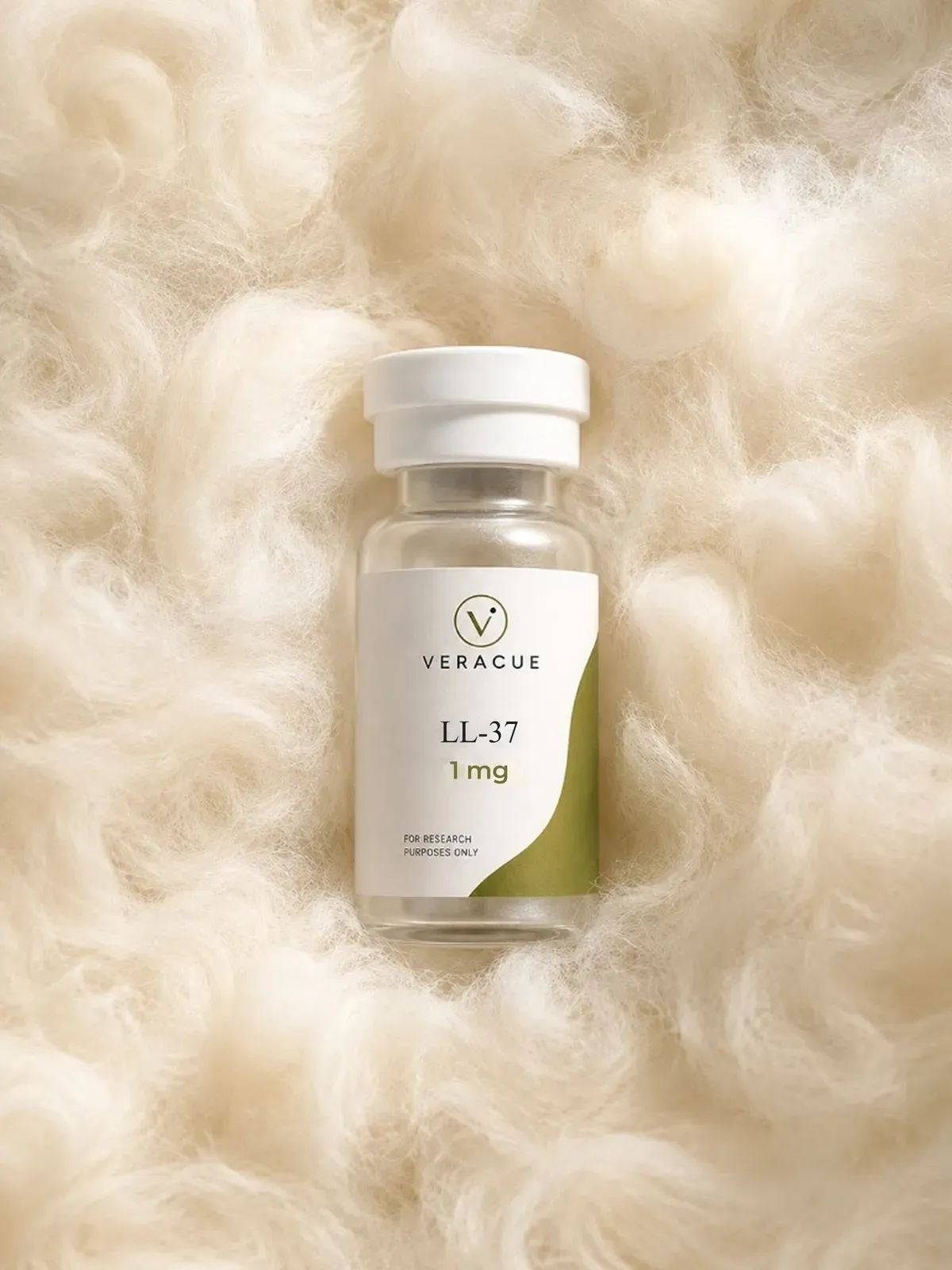
LL-37 or hCAP-18? The vial holds the 37-residue peptide (C205H340N60O53, about 4493.3 g/mol), not the precursor. 1 mg, laboratory research only.

RESEARCH PEPTIDE
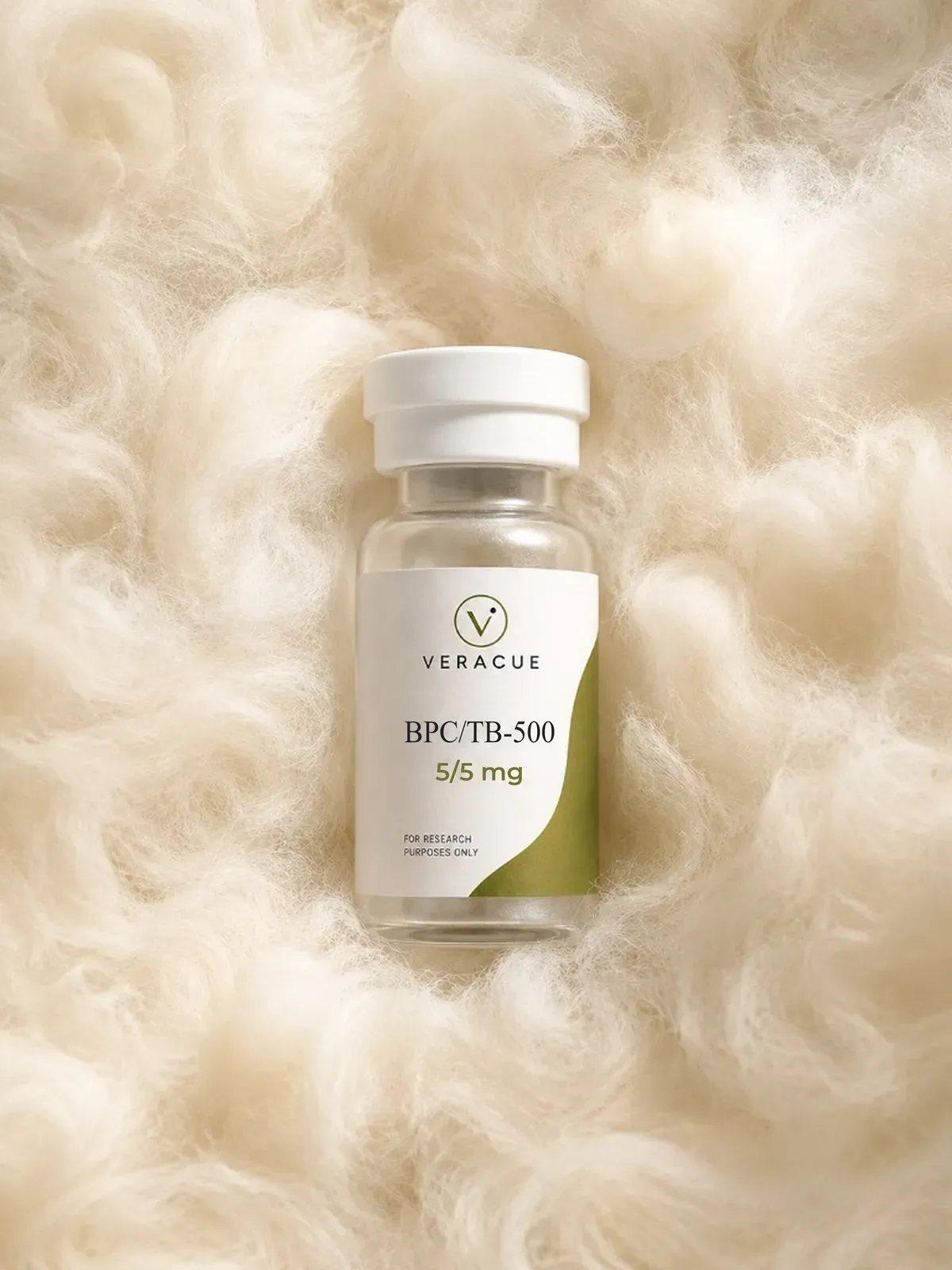
Two peptides in one vial: BPC-157 (GEPPPGKPADDAGLV) and acetylated TB-500 (Ac-LKKTETQ), each with its own CAS number. 5/5 and 10/10 mg, research use only.

RESEARCH PEPTIDE
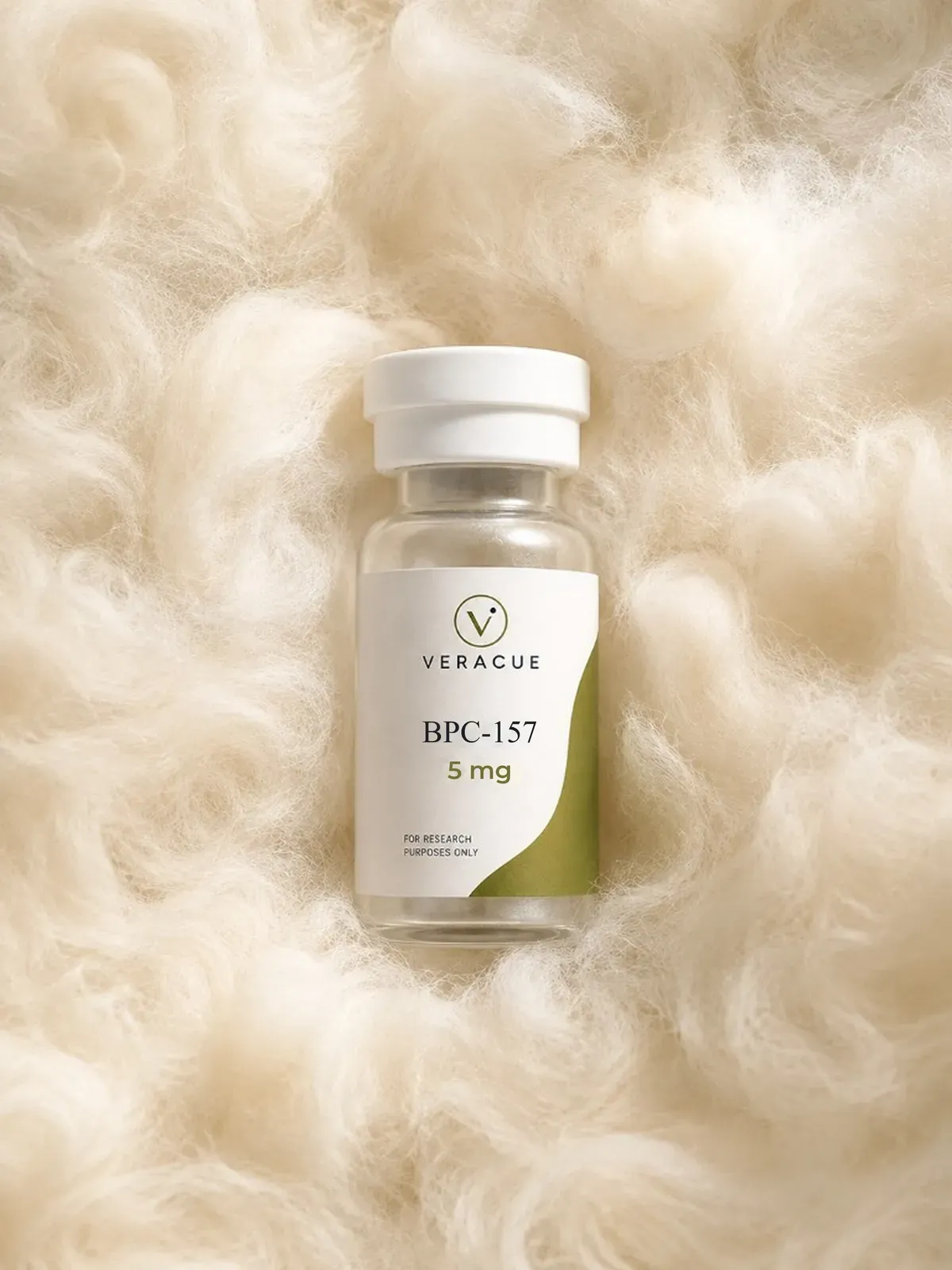
Is BPC-157 a blend or one peptide? It is a single 15-residue molecule, GEPPPGKPADDAGLV (CAS 137525-51-0). Sold in 5 and 10 mg for research use only.

RESEARCH PEPTIDE
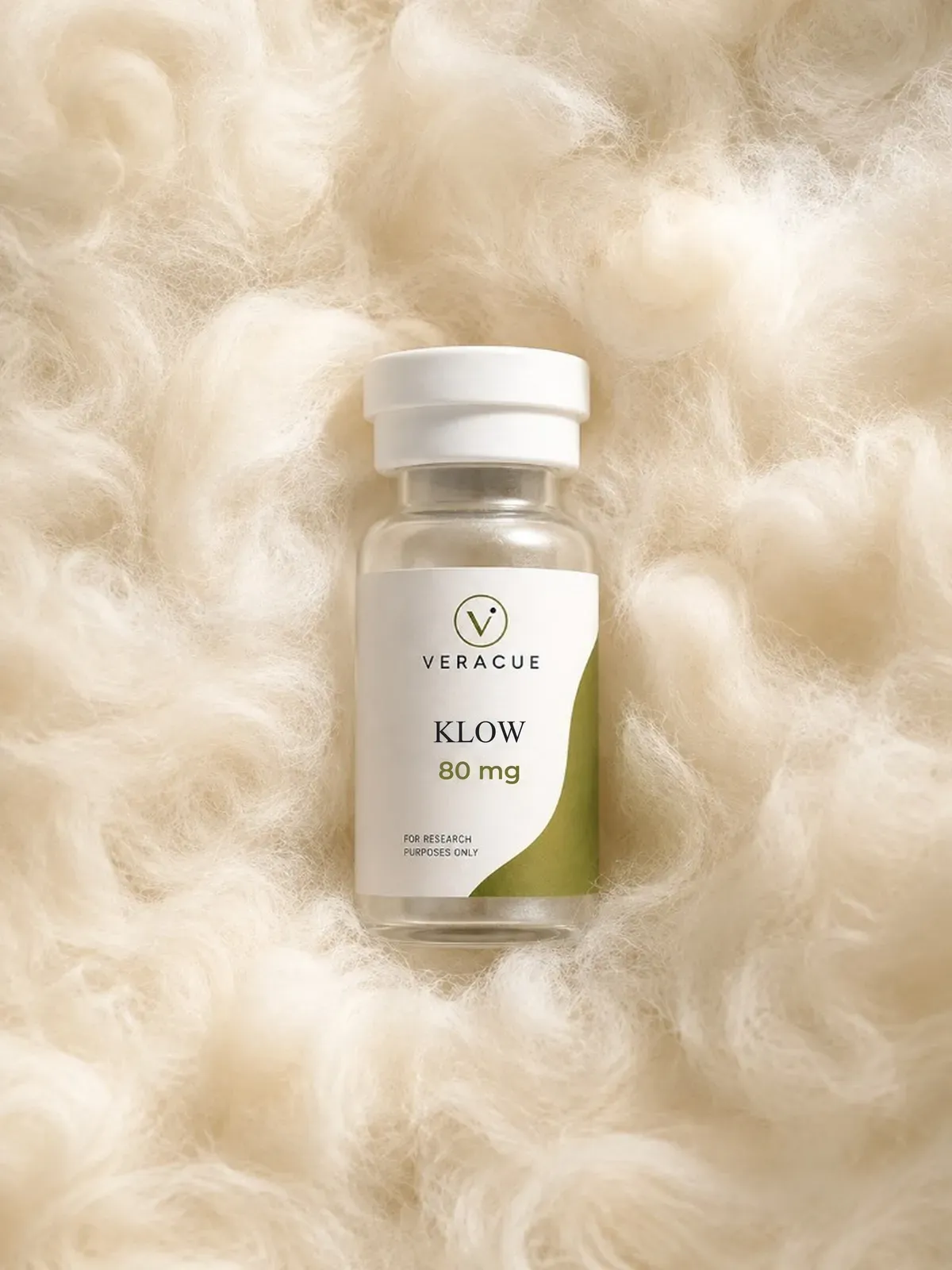
KLOW is a multi-component blend, not one peptide. Learn what a COA should confirm before you compare listings. 80 mg vial, research use only.