NAD+ and AHK-Cu in Metabolic and Longevity Research: A Deep Dive
A research overview of NAD+ and AHK-Cu covering mitochondrial metabolism, sirtuin activation, copper-peptide signaling, and laboratory handling protocols.

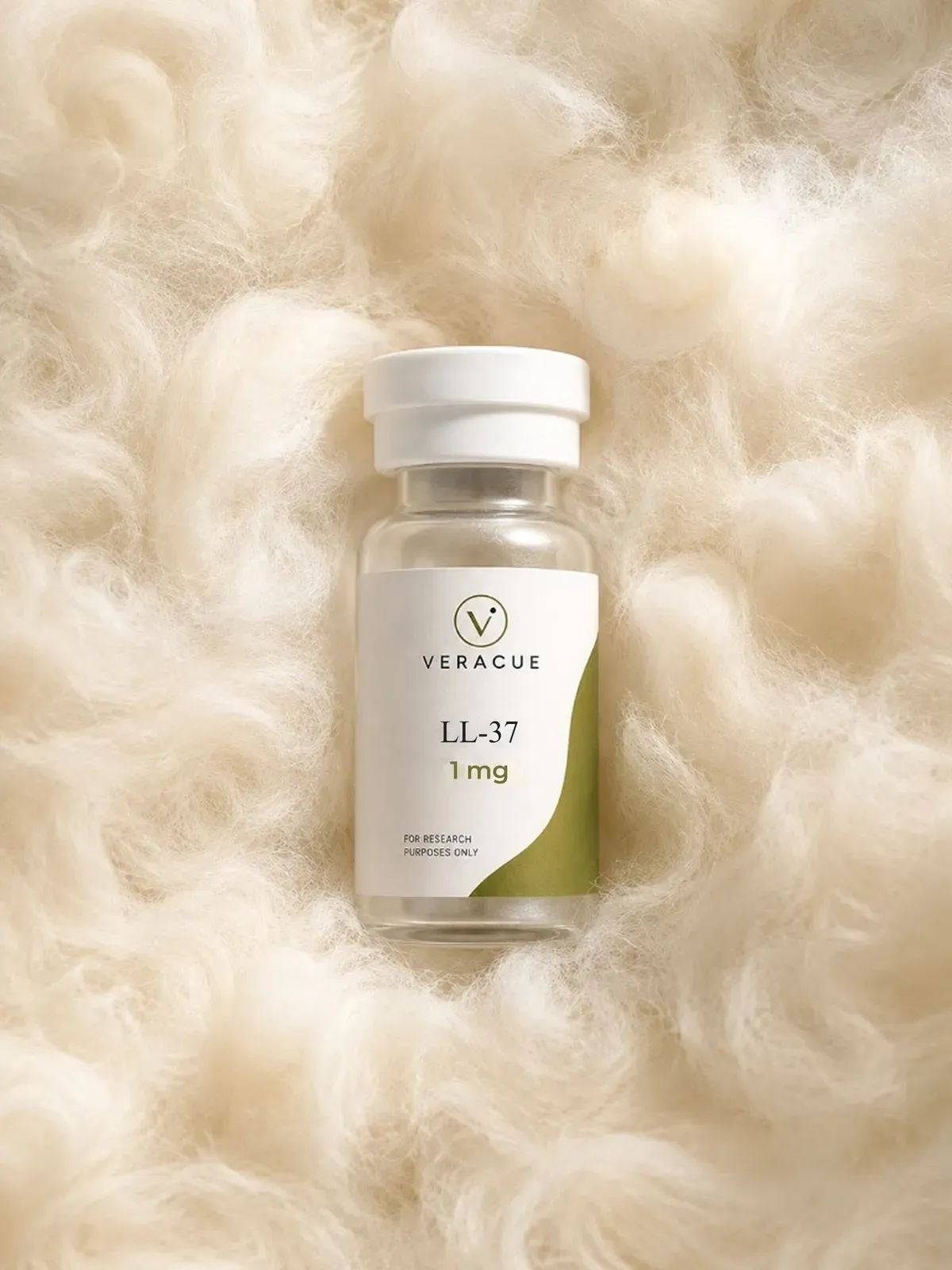
LL-37 is a cationic peptide of 37 residues, LLGDFFRKSKEKIGKEFKRIVQRIKDFLRNLVPRTES, named for its two opening leucines and its length. It is the C-terminal stretch of hCAP-18, the 170-residue human precursor (positions 134 to 170), and its chain holds no cysteine, so there are no disulfide bonds. Reference values are formula C205H340N60O53, average mass about 4493.3 g/mol and CAS 154947-66-7. The precursor protein and the short fragments KR-12 and FK-13 are different molecules. Veracue supplies LL-37 as a 1 mg vial, strictly for laboratory research use only.
Ask for the analytical documentation of any lot.
HPLC is the method used to measure purity
Ask for the report for a specific lot through the contact page
Supplied for laboratory research use only
Mass spectrometry is the method used to confirm identity
LL-37 is a linear peptide of thirty-seven amino acids. The name records two facts about the chain, the pair of leucines at its start and its length, and the one-letter sequence reads LLGDFFRKSKEKIGKEFKRIVQRIKDFLRNLVPRTES. Those 37 residues are the final stretch of hCAP-18, a 170-residue precursor produced from CAMP, the one cathelicidin gene that humans carry. The vial holds the peptide on its own: not the precursor, and not a blend.
Spellings such as LL37, LL 37 and cathelicidin LL-37 all point to the same chain. Veracue supplies it for research use only.
| Product name | LL-37 (also LL37, LL 37, cathelicidin LL-37) |
| Molecule type | Synthetic linear peptide, 37 residues |
| Sequence (one-letter) | LLGDFFRKSKEKIGKEFKRIVQRIKDFLRNLVPRTES |
| Sequence (three-letter) | Leu-Leu-Gly-Asp-Phe-Phe-Arg-Lys-Ser-Lys-Glu-Lys-Ile-Gly-Lys-Glu-Phe-Lys-Arg-Ile-Val-Gln-Arg-Ile-Lys-Asp-Phe-Leu-Arg-Asn-Leu-Val-Pro-Arg-Thr-Glu-Ser |
| Position in the precursor | Residues 134 to 170 of hCAP-18 (170 residues in total) |
| Gene | CAMP |
| Molecular formula (free peptide) | C205H340N60O53 |
| Molecular weight (average) | About 4493.3 g/mol |
| CAS Registry Number | 154947-66-7 |
| Cysteine content | None, so no disulfide bonds |
| Net charge at neutral pH | About +6 (eleven basic residues against five acidic ones) |
| Size offered | 1 mg vial |
| Research designation | Research Use Only |
Formula, mass and CAS number are reference values for the free peptide and are not results from a Veracue lot. Chemical form, purity, lot details and storage conditions for a specific vial belong on its own documentation, and documentation can be requested through the contact page.
Counting the 37 residues gives six lysines, five arginines, four leucines, four phenylalanines, three glutamic acids, three isoleucines, two each of glycine, aspartic acid, serine and valine, and one each of glutamine, asparagine, proline and threonine. Lysine and arginine together supply eleven basic side chains, set against only five acidic ones from aspartate and glutamate, so the chain is strongly net positive near neutral pH. Alanine, histidine and tyrosine do not occur at all.
LL-37 has no cysteine, no methionine and no tryptophan. Without cysteine there are no disulfide bridges to pair up, and without methionine or tryptophan the usual oxidation sites are absent. That keeps identity checking straightforward: once the order of residues and the mass agree with the reference values, there is no folded, cross-linked or oxidized variant to rule out.
LL-37 is both cationic and amphipathic, with charged and hydrophobic residues spaced along the chain so that they can sit on opposite faces of a helix. Biophysical reports describe a flexible chain in dilute buffer that settles into a helix on membrane-like surfaces or under physiological ionic conditions. A statement about the shape of LL-37 therefore needs the medium it was measured in.
Cathelicidins share a conserved N-terminal pro-region, called the cathelin-like domain, joined to a variable C-terminal peptide that only becomes a free peptide after cleavage. Humans have one such gene, CAMP, and its product is hCAP-18. LL-37 is the last 37 residues of that precursor.
The cutting enzyme decides which peptide results. In neutrophils, proteinase 3 releases LL-37 outside the cell. In skin, the kallikreins KLK5 and KLK7 process hCAP-18 and go on to trim it into shorter peptides that are not LL-37. In the reproductive tract, gastricsin yields ALL-38 instead. Each source therefore describes a slightly different material.
Many immunoassays report hCAP-18 and LL-37 together as one signal, and expression data usually track the precursor. Activity data are generated with the mature peptide. Before comparing two papers, check which of the two molecules each one measured.
Several molecules share part of the name, the sequence or the family of LL-37. The table compares identity only and does not rank them.
| Material | What it is | Identity cue |
|---|---|---|
| LL-37 | Mature 37-residue peptide from the C-terminus of hCAP-18 | LLGDFFRKSKEKIGKEFKRIVQRIKDFLRNLVPRTES, about 4493.3 g/mol |
| hCAP-18 | Full-length 170-residue precursor encoded by CAMP | More than four times the length, with a pro-region at the N-terminus |
| KR-12 and FK-13 | Short engineered fragments from the middle of LL-37 | Twelve and thirteen residues, far lighter than the full peptide |
| ALL-38 | Related 38-residue peptide from the same precursor | One residue longer, so a different mass |
| Human beta-defensins | Separate host-defense peptide family | Disulfide-stabilized and rich in cysteine, which LL-37 lacks |
A paper that reports results for a fragment or an analog has not tested LL-37, and the reverse holds too. If a source states neither the sequence nor the terminal chemistry, treat any comparison with it as limited.
In the literature LL-37 serves as a reference host-defense peptide in membrane-interaction experiments, in binding studies with bacterial lipopolysaccharide, and in cell-based assays at the formyl peptide receptor-like 1 receptor, also written FPR2, a G protein-coupled receptor. Reported outcomes depend heavily on ionic strength, pH, peptide concentration and whether serum or another biological fluid is present, so those conditions are primary variables when results are compared.
Published work is concentrated in biochemical, cell-culture and animal-model systems, and each report describes one model and one set of conditions. Findings about LL-37 made inside a tissue, where local enzymes, lipids and proteins are present, do not automatically describe a purified peptide supplied for the bench. Veracue offers molecular reference information here and provides no dosing, administration or usage guidance of any kind.

At about 4493.3 g/mol, LL-37 does not usually show up in an ESI mass spectrum as a single peak at its neutral mass. With eleven basic side chains plus the free amino terminus it takes up several protons, so the spectrum shows a series of multiply charged ions. The table lists calculated average-mass values for the free peptide.
| Ion | Calculated m/z (average mass) |
|---|---|
| [M+4H]4+ | 1124.3 |
| [M+5H]5+ | 899.7 |
| [M+6H]6+ | 749.9 |
| [M+7H]7+ | 642.9 |
| [M+H]+ (typical MALDI-TOF reading) | 4494.3 |
To compare an observed peak with the reference value, multiply the m/z by the charge and subtract one proton per charge. Every ion in the series should land on the same neutral mass. Instruments that report monoisotopic values read about 3 Da lower, near 4490.6, so confirm which convention a result uses before judging a match.
| Method | What it shows | What it cannot show alone |
|---|---|---|
| Reverse-phase HPLC | The share of detected signal in the main peak under stated conditions | Which molecule that peak is |
| ESI-MS or MALDI-TOF | Observed mass against the expected value for LL-37 | Purity, or the order of residues |
| Tandem MS | Fragment evidence for the residue order | Overall purity or quantity |
| Amino acid analysis | Net peptide content | The identity of impurities |
LL-37 has eleven basic sites, and a salt form such as an acetate or trifluoroacetate carries counterion mass at each of them. For this reason fill weight and net peptide content can differ noticeably, and any mass-based calculation should use the chemical form stated on the lot’s own document.
A document describes one lot, never the compound in general. If you receive one for LL-37, first check that its lot number matches the lot reference in your order record, then look for the following.
Documentation can be requested through the contact page, and it is issued for the specific lot you are asking about.
A single sharp peak shows that most of the detected material behaves alike, not that it is LL-37. A precursor, a fragment or a different peptide can score equally well, so the purity figure needs an identity result from the same lot beside it.
Match the lot number first, then the chemical form, then the observed mass against 4493.3 g/mol read on the same convention. Only when all three agree is the purity figure worth interpreting.
Keep the listing as it read when you ordered, the lot document, the stated chemical form, the measured mass, the receipt date and the experiments that used the material. A consistent record lets an unexpected result be traced back to one lot.
Ask the Veracue team about the documentation for the lot you are considering, or return to the catalog.
LL-37 is sold for laboratory research and analytical work only. It is not meant for human or veterinary use, for ingestion, injection or any other form of administration, and it is not a drug, dietary supplement, cosmetic or food. Veracue provides no dosing, administration or usage guidance of any kind. Buyers must be qualified researchers or institutions and are responsible for handling the material lawfully. The Medical Disclaimer and the Terms and Conditions set out the sitewide policies.
RESEARCH PEPTIDE
Two peptides in one vial: BPC-157 (GEPPPGKPADDAGLV) and acetylated TB-500 (Ac-LKKTETQ), each with its own CAS number. 5/5 and 10/10 mg, research use only.

RESEARCH PEPTIDE
Is VIP the same as PACAP? No. It is a 28-residue amidated peptide, C147H238N44O42S, CAS 40077-57-4. Research use only; supplied as a 10 mg vial.

RESEARCH PEPTIDE
Is BPC-157 a blend or one peptide? It is a single 15-residue molecule, GEPPPGKPADDAGLV (CAS 137525-51-0). Sold in 5 and 10 mg for research use only.

RESEARCH PEPTIDE
KLOW is a multi-component blend, not one peptide. Learn what a COA should confirm before you compare listings. 80 mg vial, research use only.