NAD+ and AHK-Cu in Metabolic and Longevity Research: A Deep Dive
A research overview of NAD+ and AHK-Cu covering mitochondrial metabolism, sirtuin activation, copper-peptide signaling, and laboratory handling protocols.

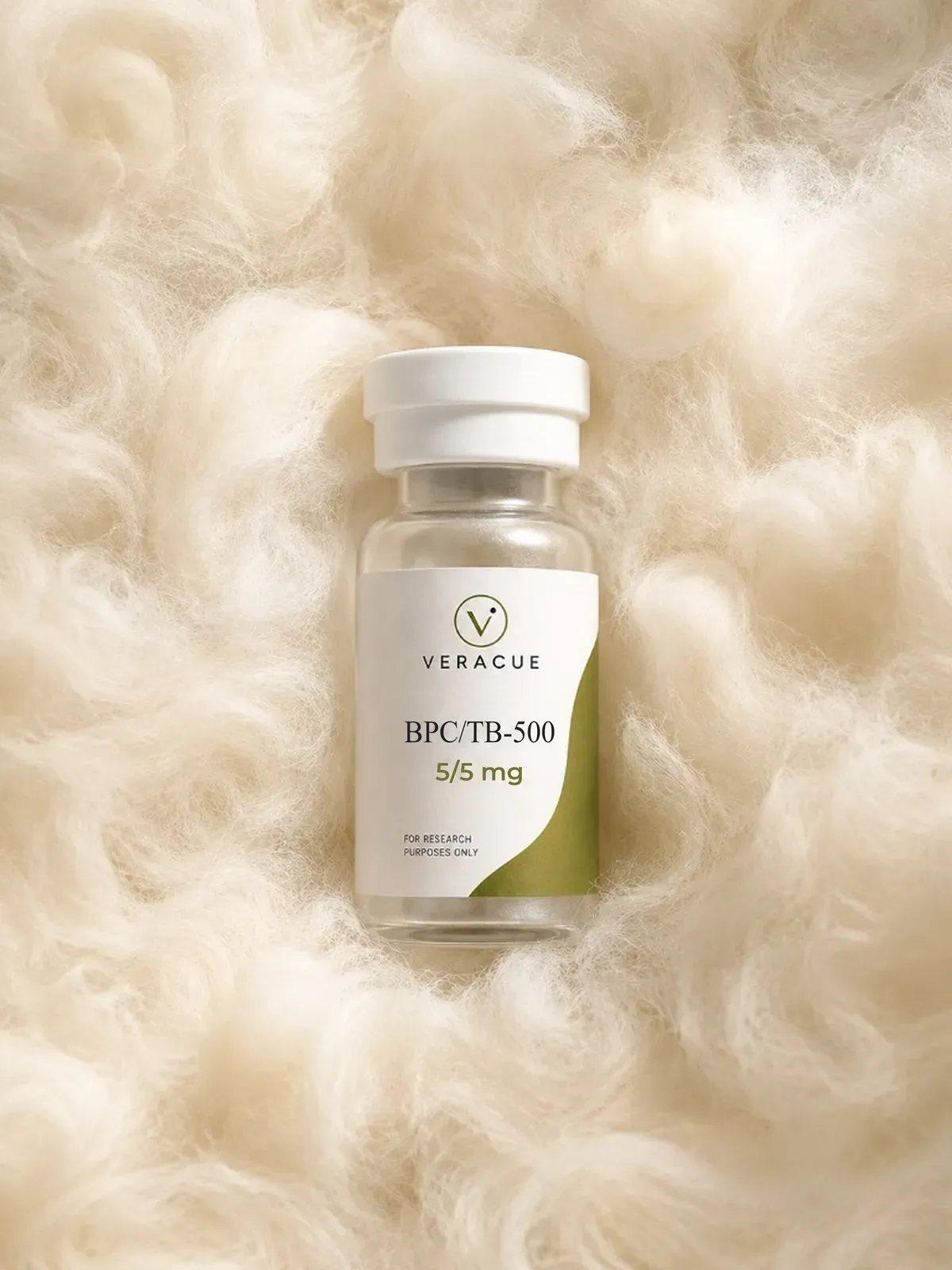
BPC/TB-500 is a two-peptide research material that places BPC-157 and TB-500 in one vial. BPC-157 is the 15-residue chain GEPPPGKPADDAGLV (C62H98N16O22, average mass about 1419.56 g/mol, CAS 137525-51-0). TB-500 is the N-acetylated 7-residue thymosin beta-4 fragment Ac-LKKTETQ (C38H68N10O14, about 889 g/mol, CAS 885340-08-9). The peptides are not chemically joined, so each keeps its own identifiers and the vial as a whole has no single formula or CAS number. Veracue supplies it in 5/5 mg and 10/10 mg vials, strictly for laboratory research use only.
Ask for the analytical documentation of any lot.
HPLC is the method used to measure purity
Ask for the report for a specific lot through the contact page
Supplied for laboratory research use only
Mass spectrometry is the method used to confirm identity
BPC/TB-500 is a research material made of two separate synthetic peptides, BPC-157 and TB-500, supplied together in a single vial. The name on the label is shorthand: BPC stands for BPC-157, with its number dropped, while TB-500 keeps its full designation. Each peptide has its own sequence, formula, mass and CAS number, and the identifiers below describe the two molecules one at a time.
The peptides are combined, not bonded. There is no linker, fusion or conjugate, so the vial holds BPC-157 chains and TB-500 chains side by side and no third molecule. It is supplied for research use only.
| Product name | BPC/TB-500 (BPC-157 and TB-500) |
| Composition | Two separate synthetic peptides in one vial |
| BPC-157 sequence | Gly-Glu-Pro-Pro-Pro-Gly-Lys-Pro-Ala-Asp-Asp-Ala-Gly-Leu-Val (GEPPPGKPADDAGLV), 15 residues |
| BPC-157 identity | C62H98N16O22, average mass about 1419.56 g/mol, CAS 137525-51-0, PubChem CID 9941957 |
| TB-500 sequence | Ac-Leu-Lys-Lys-Thr-Glu-Thr-Gln-OH (Ac-LKKTETQ), 7 residues, acetylated at the N-terminus |
| TB-500 identity | C38H68N10O14, average mass about 889 g/mol, CAS 885340-08-9, PubChem CID 62707662 |
| Sizes offered | 5/5 mg and 10/10 mg vials |
| Research designation | Research Use Only |
Formula, mass and database numbers are reference values for the free peptides and are not a Veracue lot result. Chemical form, purity, lot number and the measured content of each peptide in a particular vial belong to that lot’s own documentation. For a particular vial, documentation can be requested through the contact page.
The strength is written as two figures that follow the order of the name. The first belongs to BPC-157 and the second to TB-500, so 5/5 mg labels 5 mg of each peptide and 10/10 mg labels 10 mg of each.
Equal milligrams are not equal numbers of molecules, because TB-500 is the lighter peptide. The figures below are plain arithmetic from the average masses above, ignore any counterion or water, and are therefore a reference point rather than a lot result.
| Labeled strength | BPC-157 amount of substance | TB-500 amount of substance |
|---|---|---|
| 5/5 mg | About 3.52 µmol | About 5.62 µmol |
| 10/10 mg | About 7.04 µmol | About 11.25 µmol |
The two peptides share a vial but little else. The table lists reference data for each molecule, taken from the free peptide.
| Attribute | BPC-157 | TB-500 |
|---|---|---|
| Length | 15 residues | 7 residues |
| One-letter sequence | GEPPPGKPADDAGLV | Ac-LKKTETQ |
| N-terminus | Free amine on glycine | Acetylated leucine |
| C-terminus | Free acid on valine | Free acid on glutamine |
| Molecular formula | C62H98N16O22 | C38H68N10O14 |
| Average mass | About 1419.56 g/mol | About 889 g/mol |
| Monoisotopic mass (calculated) | About 1418.70 Da | About 888.49 Da |
| CAS Registry Number | 137525-51-0 | 885340-08-9 |
| PubChem CID | 9941957 | 62707662 |
| Parent molecule | Derived from a longer protein reported in human gastric juice | Residues 17 to 23 of the 43-residue thymosin beta-4 |
| Net charge at neutral pH (estimated) | About -2 | About 0 |
The charge estimates count the terminal groups and side chains only. BPC-157 carries one lysine against three acidic residues, while TB-500 balances two lysines against one glutamate and its free C-terminal acid.
A formula, an average mass and a CAS Registry Number each describe one molecular species. Adding the two formulas together does not give a compound, because the chains stay separate. A listing that quotes one formula, one molecular weight or one CAS number for BPC/TB-500 is therefore describing only one of the peptides, and it should be checked against the table above.
In this listing BPC means BPC-157. The same peptide appears as BPC 157, BPC157 and Body Protection Compound-157 in different sources, and the sequence GEPPPGKPADDAGLV is the stable identifier behind all of those spellings.
TB-500 is a market name rather than a formal chemical designation, and suppliers have attached it to different materials. Here it means the acetylated heptapeptide Ac-LKKTETQ. The same seven residues without the acetyl group are a separate compound of about 847 g/mol, roughly 42 Da lighter, so a record should say which one it describes.
No. Thymosin beta-4 is a 43-residue protein of roughly 4,963 g/mol, and TB-500 has only about a fifth of that mass. The stretch LKKTET is usually described as the actin-binding region of the parent protein, but sharing a motif shows where a fragment comes from, not that it behaves like the whole.
BPC-157 contains three glycines, four prolines, two alanines, two aspartic acids and one each of glutamic acid, lysine, leucine and valine, with three of the prolines in a row at positions 3 to 5. TB-500 is built from one leucine, two lysines, two threonines, one glutamic acid and one glutamine.
Neither chain has cysteine, methionine or tryptophan, so there are no disulfide bonds and none of the residues that analysts usually watch for oxidation. Neither has any aromatic residue, which changes how the peptides are detected and is covered under Quality & Purity Standards.
Published reports normally describe one material in one experimental system. When a paper names BPC-157, TB-500 or both, record the sequence or residue count, whether the TB-500 is acetylated, and the species or cell type, then compare those details with the table above before setting results next to each other. Findings for one peptide do not carry over to the other, and neither carries over automatically to the pair. Veracue offers molecular reference information here and provides no dosing, administration or usage guidance of any kind.

One vial needs two identity checks. A lot record that confirms BPC-157 and says nothing about TB-500, or the reverse, leaves half of the material unverified. When documentation is reviewed, look for each item below to be reported for both peptides separately.
| Item | What to look for |
|---|---|
| Lot number | Matches the vial label and the order record |
| Peptide names and sequences | Both BPC-157 and TB-500 named, each tied to its own sequence |
| Chemical form | Free peptide or a named salt, stated for each peptide, because a counterion changes the expected mass |
| Identity result | Observed and expected mass for each peptide, with the method and the mass convention used |
| Purity method | Chromatographic conditions, with results reported per peptide or per resolved peak |
| Peptide amounts | The labeled 5/5 or 10/10 mg figures and how they were established |
| Test date and laboratory | When the work was done and by whom |
No purity figure or mass result is stated in this listing, because those belong to one lot, and documentation can be requested through the contact page.
Mass spectra from ESI instruments usually show peptides as charged ions rather than at the neutral mass. The table gives calculated m/z values for each reference formula so an observed spectrum can be checked quickly.
| Peptide | Average mass (g/mol) | Monoisotopic mass (Da) | Ions on an average-mass basis (m/z) |
|---|---|---|---|
| BPC-157 | 1419.56 | 1418.70 | 1+ near 1420.6, 2+ near 710.8, 3+ near 474.2 |
| TB-500 | About 889.0 | 888.49 | 1+ near 890.0, 2+ near 445.5 |
The peptides sit about 530 Da apart, so their signals cannot be mistaken for each other. A spectrum of a genuine two-peptide vial shows both sets of ions, and a spectrum with only one set means the other peptide was not detected. Sodium and potassium adducts shift observed peaks, and monoisotopic readings sit below average-mass ones, so compare like with like.
Tryptophan and tyrosine are what make most peptides absorb near 280 nm, and phenylalanine adds a weak signal nearby. BPC-157 and TB-500 contain none of the three. Chromatographic detection for both therefore relies on the peptide bond, which absorbs in the low UV around 210 to 220 nm, and an absorbance reading at 280 nm will sit close to blank for either peptide.
| Method | Useful for | Cannot show by itself |
|---|---|---|
| RP-HPLC at low UV | How many peaks there are and whether both peptides are resolved | Which molecule each peak is |
| ESI-MS or MALDI-TOF | Observed mass for each peptide against its expected value | Purity or amino acid order |
| Tandem MS | Fragment evidence for each sequence, including the N-terminal acetyl group on TB-500 | Overall purity or quantity |
| Amino acid analysis | Residue composition and net peptide content | Identity of impurities |
Only if the document says how it was calculated. A chromatogram of a two-peptide vial should show at least two main peaks, so a lone percentage could refer to one peak, to both together or to the share of one peptide. Ask which.
By mass. The acetyl group adds about 42 Da, giving about 889 g/mol against about 847 g/mol for the same seven residues without it, and tandem MS can place the group at the N-terminus.
Ask the Veracue team which documentation exists for the lot you are considering.
BPC/TB-500 is supplied for laboratory research and analytical characterization only. It is not intended for human or veterinary use, or for ingestion, injection or any other form of administration, and it is not a drug, dietary supplement, cosmetic or food. The designation applies to both peptides in the vial. Veracue offers no dosing, administration or usage guidance of any kind. Buyers must be qualified researchers or institutions and are responsible for handling the material lawfully. The Medical Disclaimer and the Terms and Conditions set out the sitewide policies.
RESEARCH PEPTIDE
LL-37 or hCAP-18? The vial holds the 37-residue peptide (C205H340N60O53, about 4493.3 g/mol), not the precursor. 1 mg, laboratory research only.

RESEARCH PEPTIDE
Is VIP the same as PACAP? No. It is a 28-residue amidated peptide, C147H238N44O42S, CAS 40077-57-4. Research use only; supplied as a 10 mg vial.

RESEARCH PEPTIDE
Is BPC-157 a blend or one peptide? It is a single 15-residue molecule, GEPPPGKPADDAGLV (CAS 137525-51-0). Sold in 5 and 10 mg for research use only.

RESEARCH PEPTIDE
KLOW is a multi-component blend, not one peptide. Learn what a COA should confirm before you compare listings. 80 mg vial, research use only.