NAD+ and AHK-Cu in Metabolic and Longevity Research: A Deep Dive
A research overview of NAD+ and AHK-Cu covering mitochondrial metabolism, sirtuin activation, copper-peptide signaling, and laboratory handling protocols.

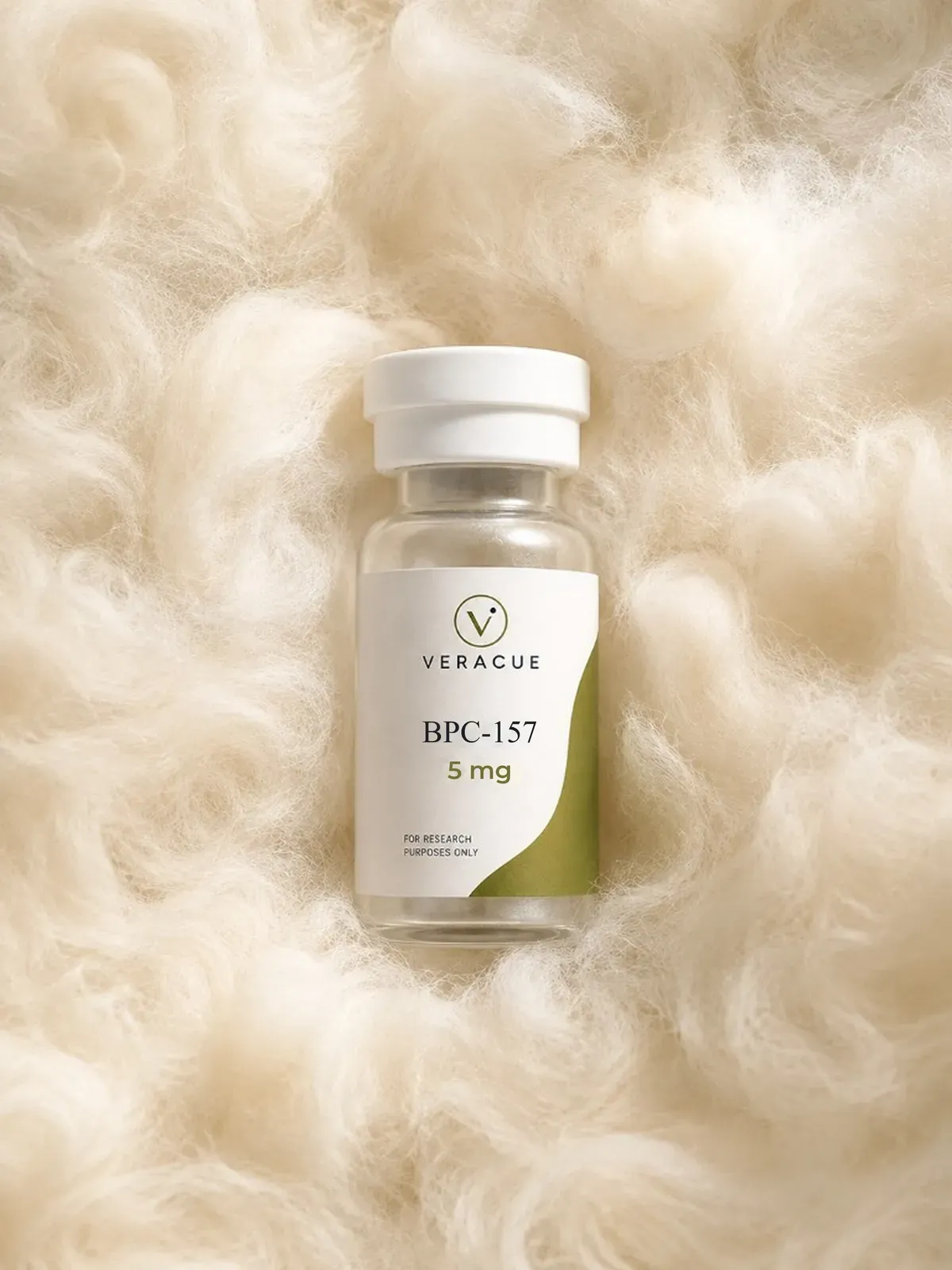
BPC-157 is a synthetic pentadecapeptide with the sequence Gly-Glu-Pro-Pro-Pro-Gly-Lys-Pro-Ala-Asp-Asp-Ala-Gly-Leu-Val, a 15-residue stretch derived from a longer protective protein reported in human gastric juice. It is also written BPC 157 or Body Protection Compound-157, and it is one defined molecule, not a blend. Reference values are formula C62H98N16O22, average mass about 1419.56 g/mol and CAS 137525-51-0. Veracue supplies BPC-157 in 5 mg and 10 mg vials, strictly for laboratory research use only.
Ask for the analytical documentation of any lot.
HPLC is the method used to measure purity
Ask for the report for a specific lot through the contact page
Supplied for laboratory research use only
Mass spectrometry is the method used to confirm identity
BPC-157 is a synthetic peptide made of fifteen amino acids, which is why chemists call it a pentadecapeptide. Its sequence, Gly-Glu-Pro-Pro-Pro-Gly-Lys-Pro-Ala-Asp-Asp-Ala-Gly-Leu-Val, is written GEPPPGKPADDAGLV in one-letter code and was derived from a longer protective protein reported in human gastric juice. The same molecule also appears as BPC 157, BPC157 and Body Protection Compound-157.
BPC-157 is a single defined compound. It is not a proprietary blend, a trade name covering several ingredients or a combination product, so the identifiers below describe the whole material. Veracue supplies it for research use only.
| Product name | BPC-157 (also BPC 157, BPC157, Body Protection Compound-157) |
| Molecule type | Synthetic linear peptide, 15 residues |
| Sequence | Gly-Glu-Pro-Pro-Pro-Gly-Lys-Pro-Ala-Asp-Asp-Ala-Gly-Leu-Val (GEPPPGKPADDAGLV) |
| Molecular formula (free peptide) | C62H98N16O22 |
| Molecular weight (average) | About 1419.56 g/mol |
| CAS Registry Number | 137525-51-0 |
| PubChem CID | 9941957 |
| Sizes offered | 5 mg and 10 mg vials |
| Research designation | Research Use Only |
Formula, mass and database numbers are reference values for the free peptide and are not a Veracue lot result. The chemical form, purity, lot number and storage conditions for a particular vial are reported on its own documentation, which you can request through the contact page.
Counting the residues in GEPPPGKPADDAGLV gives three glycines, four prolines, two alanines, two aspartic acids, and one each of glutamic acid, lysine, leucine and valine. Three of the prolines sit side by side at positions 3 to 5, which gives the middle of the chain its rigid, proline-rich stretch. There are more acidic residues (one glutamate and two aspartates) than basic ones (one lysine), so the peptide is net negative at neutral pH.
The chain has no cysteine, so it cannot form disulfide bonds, and it has no methionine or tryptophan, the residues analysts most often watch for oxidation. That makes BPC-157 a comparatively simple molecule to characterize: identity comes down to getting the sequence and mass right rather than tracking a folded structure or an oxidized variant.
They are different spellings of one peptide. Because naming varies between suppliers and reference sources, the sequence, formula and CAS number together are a more dependable way to confirm what a listing describes than the name alone.
Search results often group BPC-157 with TB-500, but the two are separate molecules with their own sequences and records. The table compares identity data only.
| Feature | BPC-157 | TB-500 |
|---|---|---|
| Length | 15 residues | 7 residues |
| Sequence | GEPPPGKPADDAGLV | Ac-LKKTETQ (N-terminally acetylated) |
| Molecular formula | C62H98N16O22 | C38H68N10O14 |
| Average mass | About 1419.56 g/mol | About 889 g/mol |
| CAS Registry Number | 137525-51-0 | 885340-08-9 |
| Related protein | Derived from a protective gastric protein | A fragment of thymosin beta-4 (residues 17 to 23) |
The mass difference alone, roughly 1420 against 890, means a mass spectrum separates them immediately. Treat each as its own material and verify each against its own lot documentation.
Published work on BPC-157 is concentrated in cell-culture and animal-model systems, and each report describes one model, one set of conditions and one endpoint. When you read a paper, note the species or cell type, the comparator and the exact material used, and check that the sequence matches BPC-157 as written above before comparing results across sources. Veracue offers molecular reference information here, and provides no dosing, administration or usage guidance of any kind.
Two measurements do most of the work for a peptide like BPC-157. Reverse-phase HPLC reports chromatographic purity, the share of detected material that elutes as the main peak, but it does not confirm which molecule that peak is. Mass spectrometry answers the identity question by comparing the measured mass with the expected one.
At about 1419.56 g/mol, BPC-157 usually appears in electrospray mass spectra as multiply charged ions rather than at its neutral mass. On an average-mass basis the 2+ ion falls near m/z 710.8 and the 3+ ion near m/z 474.2, and instruments that report monoisotopic values read slightly lower. Reading a spectrum correctly means converting the observed m/z back to a neutral mass before comparing it with the reference value.
| Method | Tells a researcher | Does not prove by itself |
|---|---|---|
| RP-HPLC | Chromatographic purity (area %) | Identity |
| ESI-MS or MALDI-TOF | Measured mass compared with the expected mass | Purity or amino acid order |
| Tandem MS | Fragment evidence for the sequence | Quantity or overall purity |
| Amino acid analysis | Net peptide content | Identity of impurities |
A certificate of analysis describes one lot, not the compound in general. Start by checking that the lot number on the document matches the vial and your order record.
A complete BPC-157 certificate names the product, the lot number and the chemical form, whether the free peptide or a salt such as acetate, because a salt form changes the expected mass. It should report an HPLC result with its chromatogram, a mass spectrometry result with observed and expected mass, the test date and the testing laboratory. Results and storage conditions are reported on each lot’s own documentation, and the certificate page explains how to request it.
No. A single sharp HPLC peak shows that most of the detected material behaves alike, not that it is BPC-157. Pair the purity figure with a mass result from the same lot, reported as observed against expected mass. Documentation with only one of the two is incomplete.
The free peptide and its salt forms share one sequence but not one formula weight. If a certificate leaves the form unstated, any mass-based calculation can carry a silent error, so record the form shown on the lot’s certificate and use the matching weight.
For each lot, keep a snapshot of the listing, the lot-specific certificate, the stated chemical form, the receipt date, the labeled storage conditions and the experiments that used the material. Consistent records make lot-to-lot differences visible and let unexpected results be traced back quickly.
Ask the Veracue team about the documentation available for a specific lot, or review the certificate library.

BPC-157 is supplied for laboratory research and analytical characterization only. It is not intended for human or veterinary use, or for ingestion, injection or any form of administration, and it is not a drug, dietary supplement, cosmetic or food. This page contains no dosing, administration or usage guidance of any kind. Purchasers must be qualified researchers or institutions and must use the material in line with all applicable laws. See the Medical Disclaimer and the Terms and Conditions for sitewide policies.

RESEARCH PEPTIDE
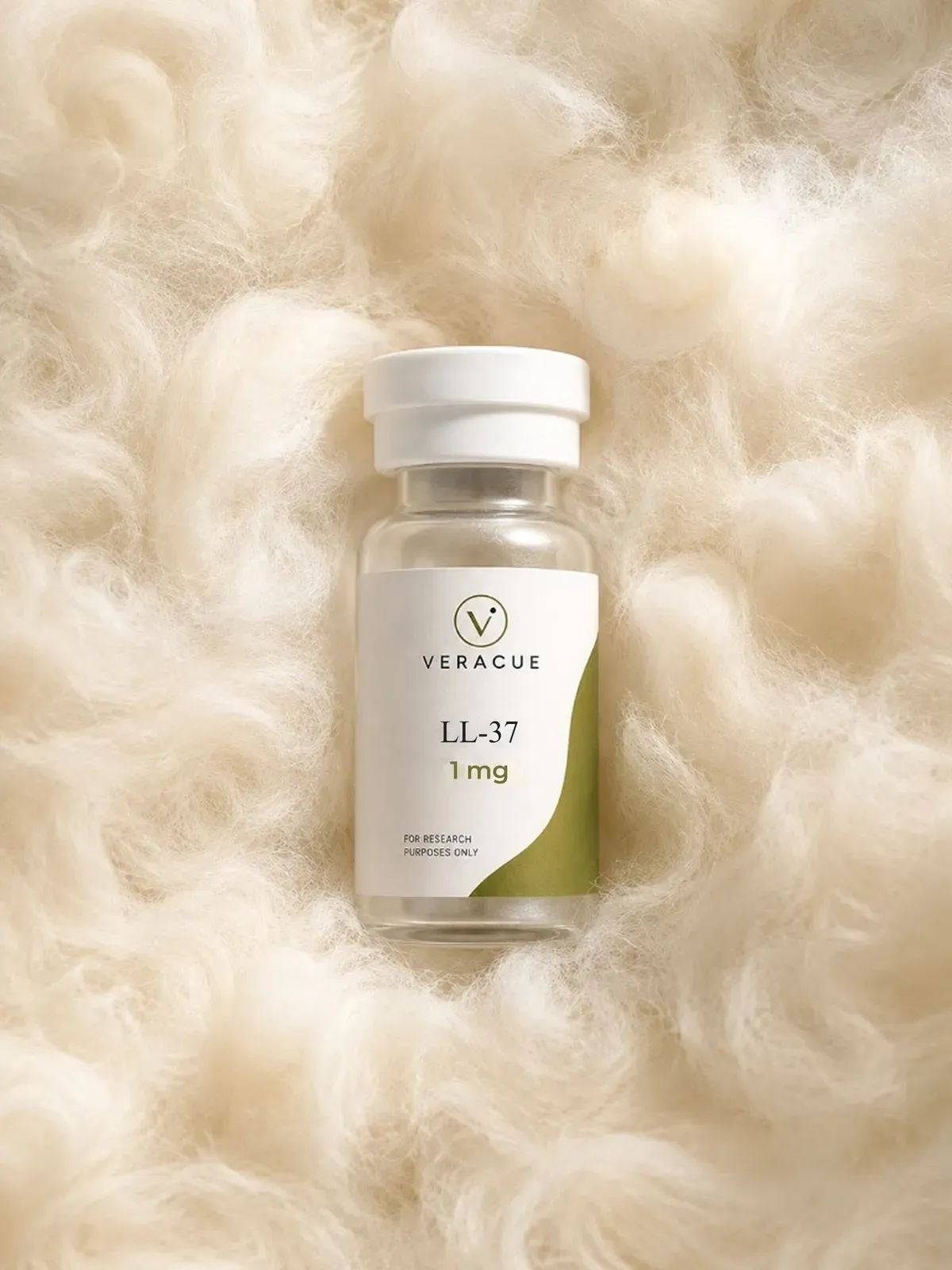
LL-37 or hCAP-18? The vial holds the 37-residue peptide (C205H340N60O53, about 4493.3 g/mol), not the precursor. 1 mg, laboratory research only.

RESEARCH PEPTIDE
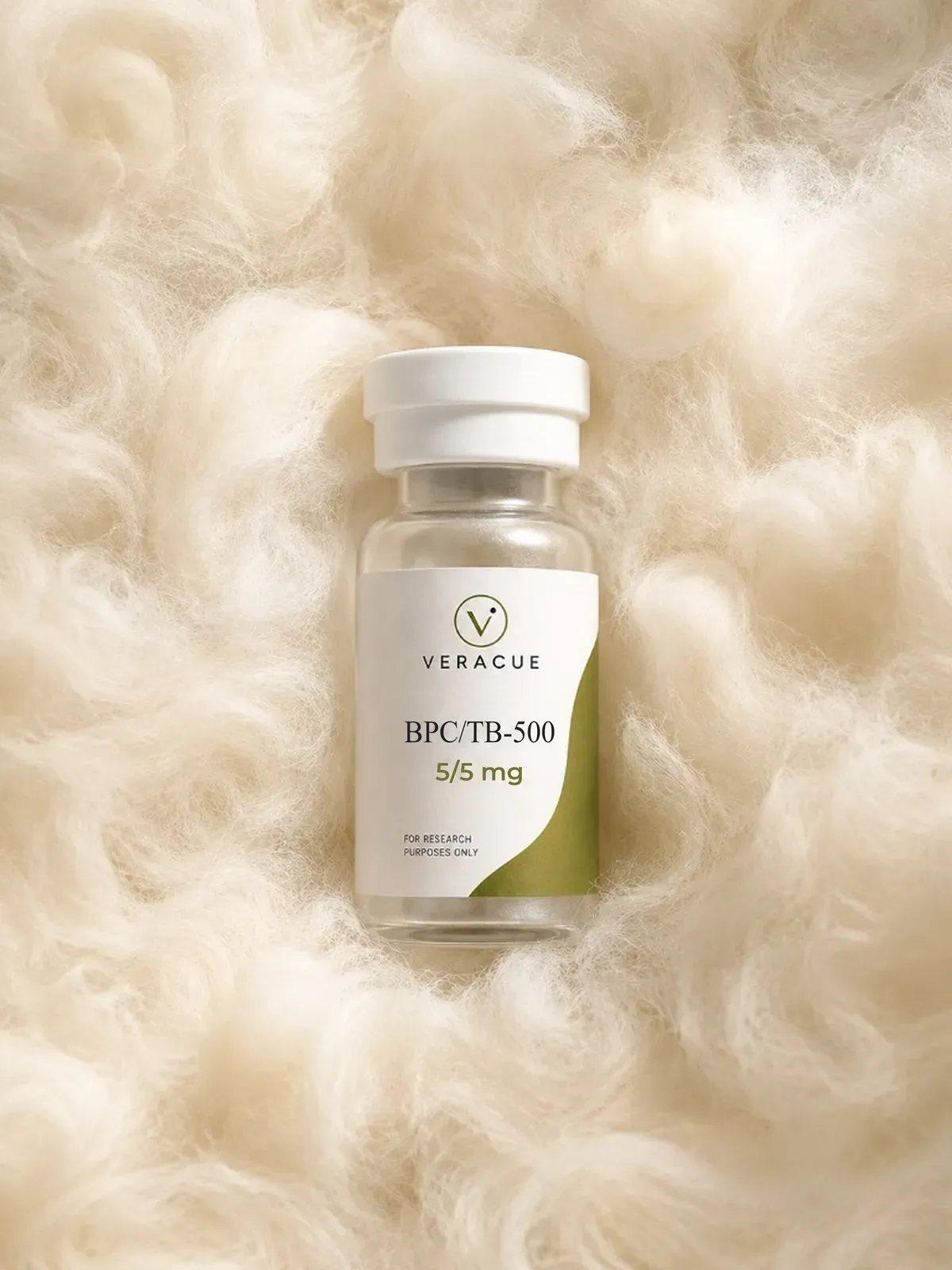
Two peptides in one vial: BPC-157 (GEPPPGKPADDAGLV) and acetylated TB-500 (Ac-LKKTETQ), each with its own CAS number. 5/5 and 10/10 mg, research use only.

RESEARCH PEPTIDE
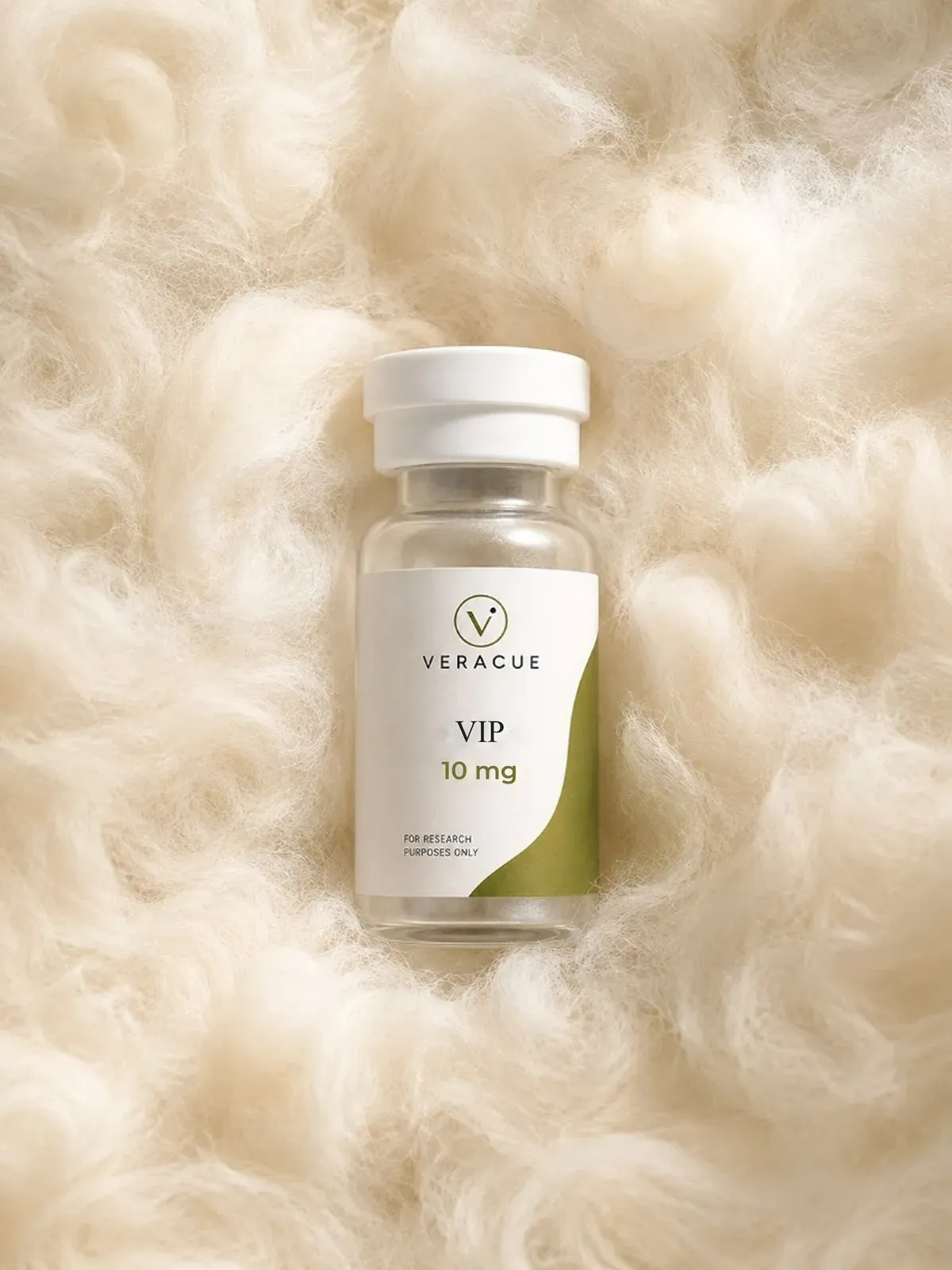
Is VIP the same as PACAP? No. It is a 28-residue amidated peptide, C147H238N44O42S, CAS 40077-57-4. Research use only; supplied as a 10 mg vial.

RESEARCH PEPTIDE
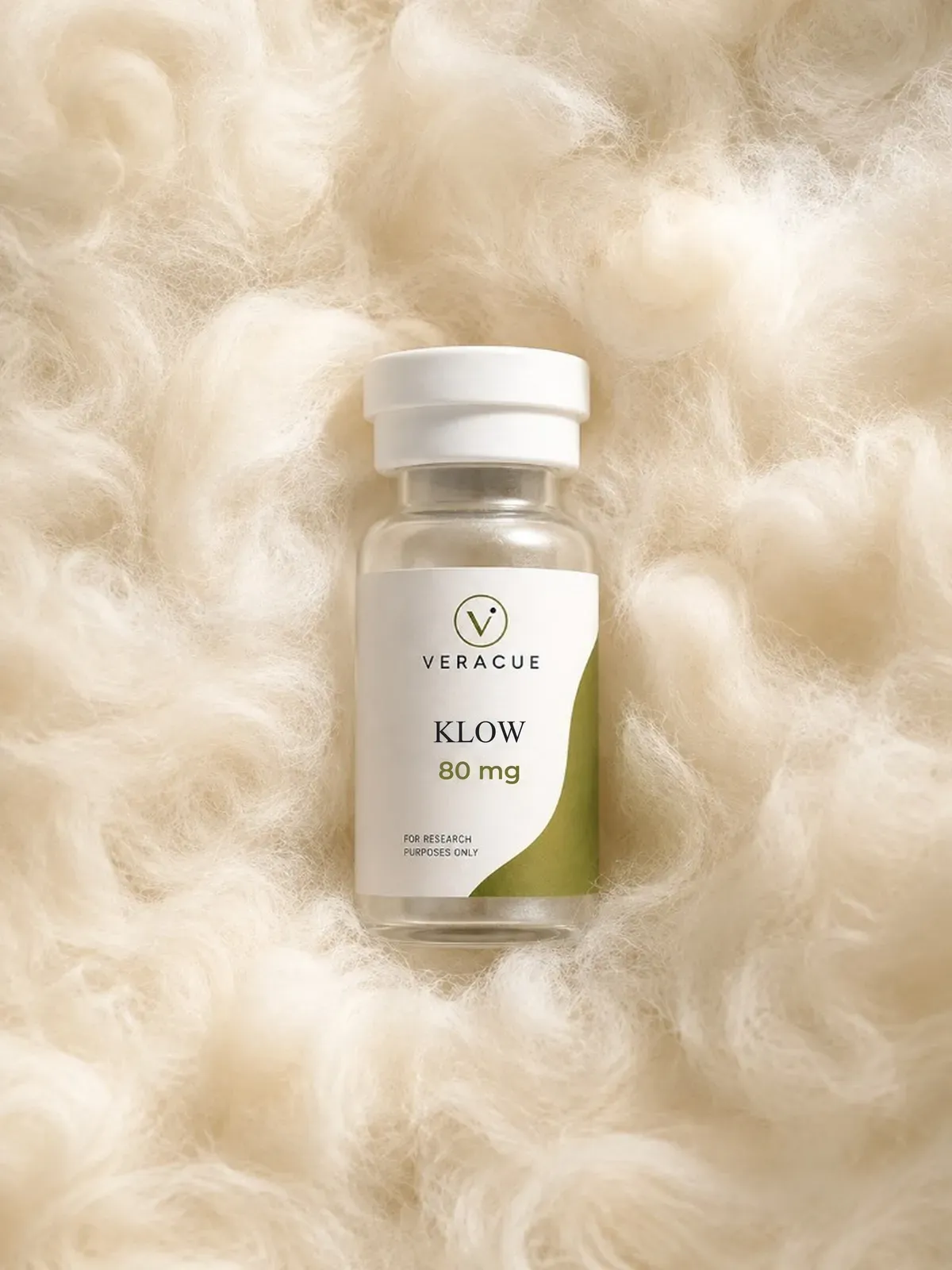
KLOW is a multi-component blend, not one peptide. Learn what a COA should confirm before you compare listings. 80 mg vial, research use only.