NAD+ and AHK-Cu in Metabolic and Longevity Research: A Deep Dive
A research overview of NAD+ and AHK-Cu covering mitochondrial metabolism, sirtuin activation, copper-peptide signaling, and laboratory handling protocols.

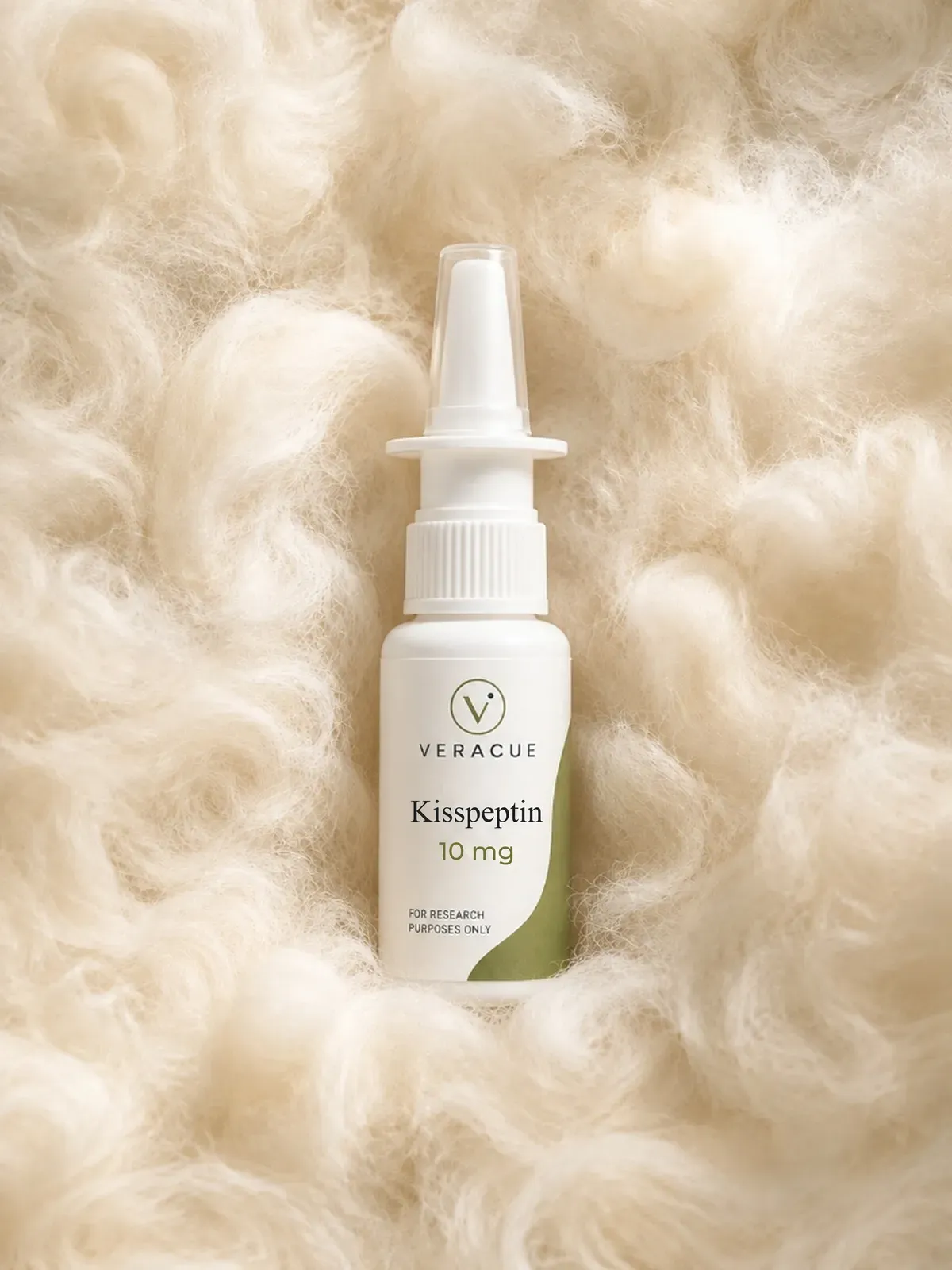
Kisspeptin Spray is a spray-dispensed bottle of kisspeptin-10, the shortest natural kisspeptin: a linear decapeptide, Tyr-Asn-Trp-Asn-Ser-Phe-Gly-Leu-Arg-Phe, with an amidated C-terminus. Reference values for the free peptide are formula C63H83N17O14, average mass 1302.45 g/mol and CAS 374675-21-5. Every natural kisspeptin ends in this same ten-residue core, so a label reading only "kisspeptin" leaves the chain length open, while a mass near 1302 rules out the 54-residue form at about 5857. Sold as a 10 mg bottle with 45 sprays per bottle, for laboratory research use only.
Ask for the analytical documentation of any lot.
HPLC is the method used to measure purity
Ask for the report for a specific lot through the contact page
Supplied for laboratory research use only
Mass spectrometry is the method used to confirm identity
| Product name | Kisspeptin Spray |
| Compound | Kisspeptin-10, synthetic |
| Also written as | Metastin (45-54), KISS-1 (112-121), KP-10 |
| Format | Spray-dispensed bottle |
| Sprays per bottle | 45 sprays per bottle |
| Size offered | 10 mg |
| Chain | 10 amino acids, linear, C-terminal amide |
| Sequence (three-letter code) | Tyr-Asn-Trp-Asn-Ser-Phe-Gly-Leu-Arg-Phe-NH2 |
| Sequence (one-letter code) | YNWNSFGLRF-NH2 |
| Free-peptide formula | C63H83N17O14 |
| Average mass | 1302.45 g/mol |
| Monoisotopic mass (calculated from the formula) | About 1301.63 Da |
| CAS Registry Number | 374675-21-5 |
| PubChem CID | 25240297 |
| Research designation | Research Use Only |
The formula, both masses and the CAS number above are reference values for the free peptide and were not measured on any lot. Anything specific to one lot, such as chemical form, fill volume, concentration, carrier or purity, sits in that lot’s own documentation, and documentation can be requested through the contact page.
The bottle holds kisspeptin-10, the C-terminal ten-residue piece of the longer kisspeptin chain. Read from the N-terminus it is tyrosine, asparagine, tryptophan, asparagine, serine, phenylalanine, glycine, leucine, arginine and phenylalanine, with the last residue amidated. It is one defined molecule, offered in a 10 mg size with 45 sprays per bottle.
Metastin (45-54), KISS-1 (112-121) and KP-10 all name this same ten-residue peptide. The first numbering counts from the start of kisspeptin-54 and the second from the start of the KISS1 gene product, which is why the ranges differ.
Kisspeptin is a family name rather than a single compound. A precursor encoded by the KISS1 gene is cut into peptides of 54, 14, 13 and 10 residues, and the shorter ones sit inside the longer, sharing one C-terminal end. Their receptor is KISS1R, also known as GPR54.
A bare “kisspeptin” label therefore does not fix the chain length, whereas a sequence, formula and mass do.
Counting from the N-terminus: tyrosine at 1, asparagine at 2, tryptophan at 3, asparagine at 4, serine at 5, phenylalanine at 6, glycine at 7, leucine at 8, arginine at 9 and a C-terminal phenylalanine amide at 10. There is no cysteine, so no disulfide bond can form, and no methionine, lysine, histidine or proline. Arginine 9 is the only basic side chain, and the free N-terminal amine is the only other group that readily takes a proton.
Two spots in the chain tend to show up in mass data. Tryptophan 3 can pick up oxygen, which adds about 16 Da. The asparagines at 2 and 4 can lose their amide nitrogen to become aspartate or isoaspartate, which adds just under 1 Da. Tryptophan and tyrosine also absorb near 280 nm, so ultraviolet detection at that wavelength gives a second view of a sample beside the peptide-bond absorbance read at shorter wavelengths.
The last phenylalanine ends in an amide group, not a carboxylic acid. A free-acid version of the same ten residues would be a distinct species, heavier by about 0.98 Da, and that gap is easy to overlook when a record leaves out the “-NH2”.
Kisspeptin-54, covering KISS1 residues 68 to 121, is the longest of the four natural forms and contains all of kisspeptin-10 at its C-terminal end. Its reference values are formula C258H401N79O78, average mass 5857.43 g/mol, CAS 374683-24-6 and PubChem CID 71306396, which puts it about 4555 Da above kisspeptin-10.
Kisspeptin-14 and kisspeptin-13 fall between the two in length. Every residue in a peptide chain adds at least 57 Da, so even kisspeptin-13, three residues longer than kisspeptin-10, would read above 1470 Da. A mass near 1302 therefore points to the ten-residue peptide, and sequence evidence is still needed to confirm residue order.
KISS1R is a G protein-coupled receptor that signals through Gq/11. Engagement activates phospholipase C, which produces inositol trisphosphate and diacylglycerol, and the downstream result is a rise in intracellular calcium together with protein kinase C activation. Calcium mobilization and inositol phosphate accumulation are accordingly common readouts in cell-based work.
Published work reports that kisspeptin-10 activates KISS1R at or near the potency of the longer forms, which is one reason the short peptide is a practical reference ligand. Laboratories use it for receptor pharmacology, for comparisons with the longer forms and for signal-transduction readouts.
What a given assay shows applies to that system and that kisspeptin form only. Veracue offers no dosing, administration or usage guidance of any kind.
A methods section reads best when the molecule is named by sequence or CAS number and the physical item is identified separately, by lot number and bottle label. For this listing the useful entries are the peptide (kisspeptin-10, YNWNSFGLRF-NH2), the 10 mg size, the 45-spray count, the lot number and the date received. The spray count is a packaging figure only.

At 1.3 kDa this peptide is small enough that a singly charged ion is often seen beside the doubly charged one. The values below were calculated from the free-peptide formula.
| Ion | Average-mass m/z | Monoisotopic m/z |
|---|---|---|
| [M+H]+ | 1303.46 | 1302.64 |
| [M+2H]2+ | 652.23 | 651.82 |
To read a peak list, turn each m/z into a neutral mass by multiplying by the charge and taking off one proton mass per charge, then check that the results agree. Note whether a report is on an average or a monoisotopic basis, since the two differ by roughly 0.8 Da at this size.
| Observation | Reasonable reading |
|---|---|
| Every charge state converts to one neutral mass near 1302.45 (average basis) | The expected free peptide, as a single species |
| A minor signal about 16 Da higher | Oxidation, with tryptophan 3 the usual suspect |
| A signal just under 1 Da higher | Isotope pattern, deamidation at asparagine 2 or 4, or a free-acid C-terminus; fragment data helps separate them |
| A dominant mass near 5857 | Kisspeptin-54 rather than kisspeptin-10 |
| A main mass far from both 1302 and 5857 | A different chain length, a modified peptide or a different chemical form |
A lot document speaks only for the lot it names, so begin by matching its lot number to the label on the bottle. Then look for the compound name and chemical form, an HPLC trace with its method, an observed and an expected mass, the test date and the laboratory that ran the work. Documentation can be requested through the contact page.
Fill volume and concentration, where a lot document reports them, are lot-specific details and are not implied by the spray count.
No. A chromatogram reports how much of the detected signal sits in one peak, not what that peak is. A well-resolved trace of a different kisspeptin form would look just as clean, so it needs a mass result from the same lot beside it.
Synthetic peptides are commonly handled as salts, and the counterion adds weight that the free-peptide formula leaves out. A lot document that states its form, and whether its figures count the whole material or only the peptide, lets those numbers be compared with the reference values listed here.
It narrows the options sharply, but two peptides built from the same residues in a different order weigh the same. Residue order is confirmed with fragment-ion data such as MS/MS.
Write to the Veracue team through the contact page about documentation, or browse the full research catalog.
Kisspeptin Spray is a laboratory reagent sold for research and analytical work only. It is not a pharmaceutical, nutritional or cosmetic product, and it is not intended for people or animals in any way. Veracue provides no dosing, administration or usage guidance of any kind. Buyers are qualified researchers or institutions who remain responsible for lawful handling. Sitewide terms are set out in the Medical Disclaimer and the Terms and Conditions.

RESEARCH PEPTIDE
Spray bottle pairing a 29-residue GHRH analog with the pentapeptide Ipamorelin, 5 mg of each and 45 sprays per bottle. Laboratory research use only.

RESEARCH PEPTIDE
GLP-T Spray pairs a 39-residue peptide, LY3298176 (CAS 2023788-19-2), with a C20 diacid on lysine 20. 10 to 60 mg, research use only, 45 sprays a bottle.

RESEARCH PEPTIDE
A 28-residue, N-acetylated peptide at 3108.3 g/mol, spray-dispensed in a 10 mg bottle with 45 sprays. Supplied for research use only.

RESEARCH PEPTIDE
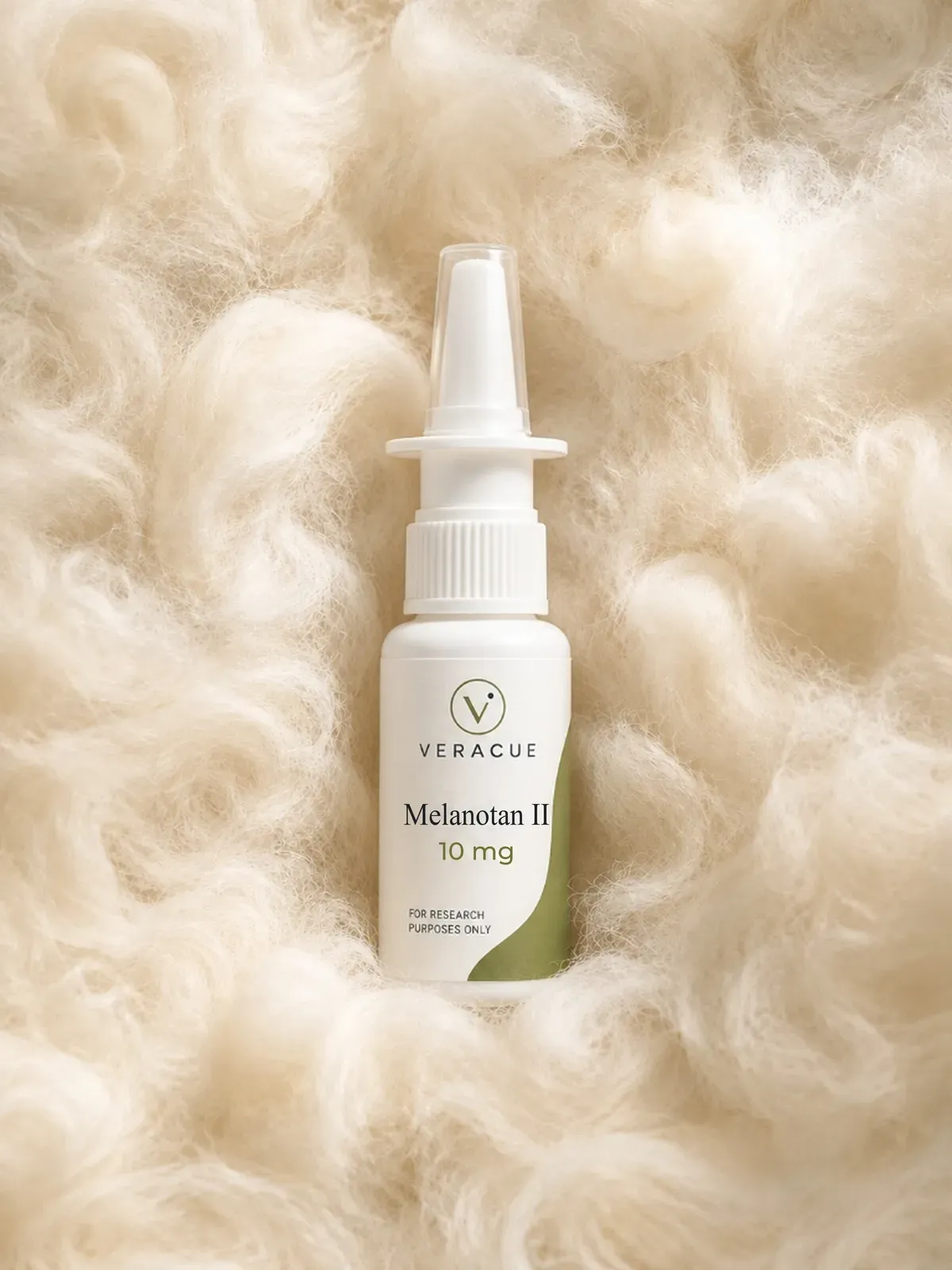
Seven residues, a lactam ring and an amide terminus: Melanotan II, CAS 121062-08-6, in a 10 mg bottle of 45 sprays. Laboratory research only.