NAD+ and AHK-Cu in Metabolic and Longevity Research: A Deep Dive
A research overview of NAD+ and AHK-Cu covering mitochondrial metabolism, sirtuin activation, copper-peptide signaling, and laboratory handling protocols.

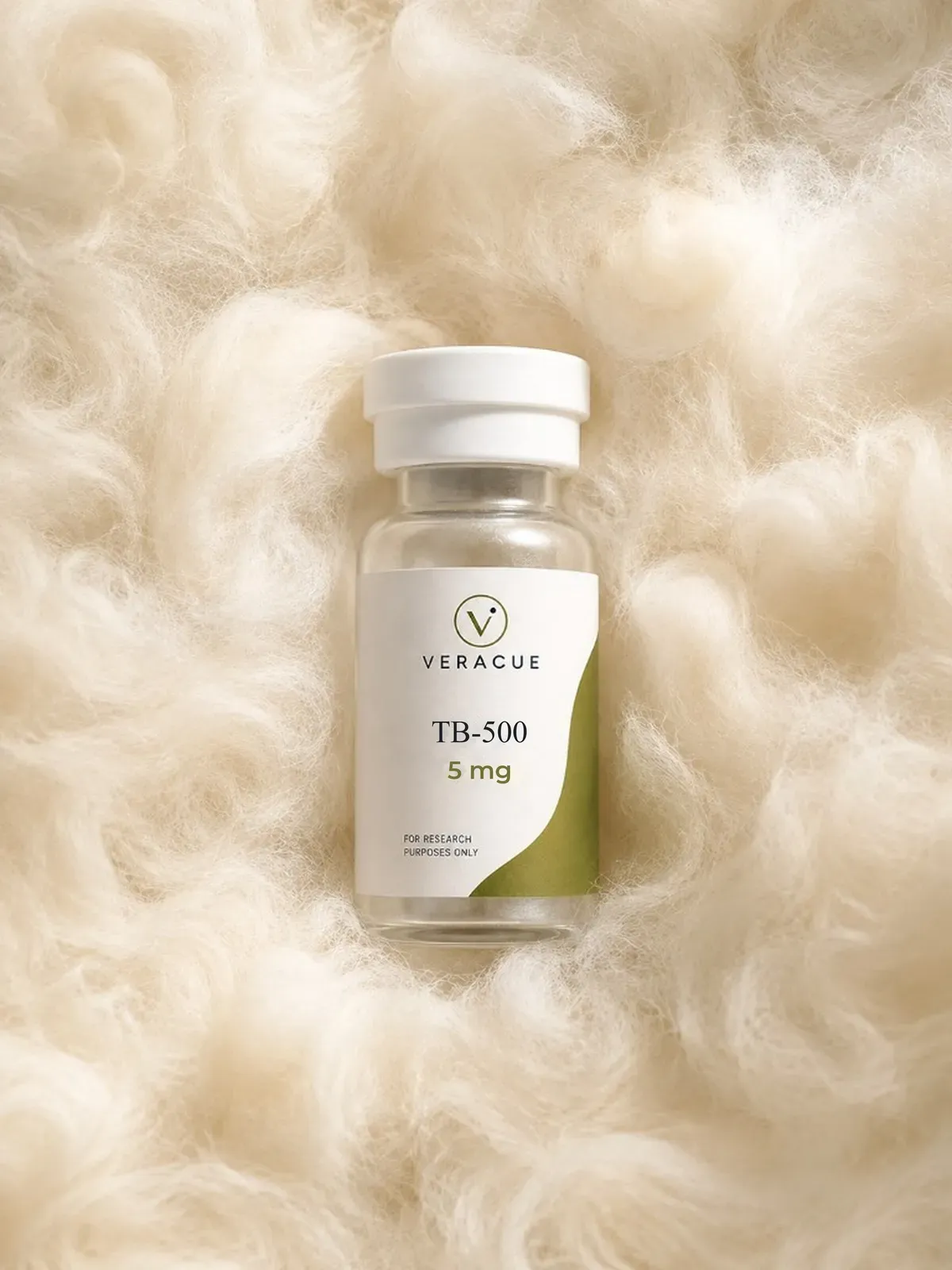
TB-500 is a short synthetic peptide with the sequence Ac-LKKTETQ, seven amino acids with an acetyl group at the N-terminus. It corresponds to residues 17 to 23 of thymosin beta-4, a much larger 43-residue protein, so it is a fragment and not another name for the full molecule. As the free base it has the formula C38H68N10O14, a mass of about 889 g/mol and CAS 885340-08-9. Available in 5 mg and 10 mg vials, for laboratory research only.
Ask for the analytical documentation of any lot.
HPLC is the method used to measure purity
Ask for the report for a specific lot through the contact page
Supplied for laboratory research use only
Mass spectrometry is the method used to confirm identity
TB-500 is the common name for a synthetic peptide with the sequence Ac-LKKTETQ, seven amino acids with an acetyl group on the N-terminus. It matches residues 17 to 23 of thymosin beta-4, a much larger 43-residue protein, so it is related to thymosin beta-4 but is a separate molecule. The free base has the formula C38H68N10O14, a molecular weight of about 889.01 g/mol and CAS number 885340-08-9.
TB-500 is a trade name rather than a formal chemical name, which is why it helps to anchor on the sequence and identifiers. Veracue supplies TB-500 strictly for laboratory use, and lot documentation is available on request.
| Product name | TB-500 |
| Sequence | Ac-Leu-Lys-Lys-Thr-Glu-Thr-Gln-OH (Ac-LKKTETQ) |
| Length | 7 residues |
| Terminal modification | N-terminal acetylation; free C-terminal acid |
| Molecular formula (free base) | C38H68N10O14 |
| Molecular weight (free base) | About 889.01 g/mol |
| CAS Registry Number | 885340-08-9 (free base) |
| PubChem CID | 62707662 (free base) |
| Relationship to thymosin beta-4 | Corresponds to residues 17 to 23 of the 43-residue protein; a fragment of it, not another name for it |
| Research designation | Research Use Only |
Identity values are drawn from chemical databases for the free base and are not a Veracue lot result.
Physical form, salt or counterion, purity, lot results and storage conditions are reported on the documentation for each lot. Request lot documentation through the contact page.
Thymosin beta-4 is a naturally occurring 43-residue protein found throughout the body. TB-500 is a synthetic fragment built from just seven of those residues. They share a sequence overlap, not an identity.
The size difference is substantial. Thymosin beta-4 weighs roughly 4,963 g/mol, while TB-500 comes in at about 889 g/mol, a little over a fifth of the mass. Many sources use the two names interchangeably, but they are separate substances.
| Attribute | TB-500 | Full-length thymosin beta-4 |
|---|---|---|
| Sequence | Ac-LKKTETQ (residues 17 to 23) | 43-residue full sequence |
| Length | 7 residues | 43 residues |
| Molecular weight | About 889 g/mol | About 4,963 g/mol |
| Chemical form | Synthetic fragment, N-acetylated | Naturally occurring protein |
TB-500 is the name Veracue uses for this material. Because the name has no formal chemical designation, different suppliers have at times used it for different salt forms of the same peptide. Sequence, formula and CAS number together describe a specific, checkable molecule, and that makes them more reliable than the name alone.
The reference sequence is acetylated at the N-terminal leucine and carries a free acid at the C-terminus. The non-acetylated version of the same seven residues is a separate compound, about 42 g/mol lighter, with a different charge and behavior. Findings for one form should not be assumed to carry over to the other.
Established. Thymosin beta-4 and related peptides take part in regulating the balance between unpolymerized (G-actin) and filamentous (F-actin) actin, which underlies cell shape and motility. The sequence LKKTET is conventionally described as thymosin beta-4's actin-binding motif, and TB-500 contains it.
Hypothesis. The idea behind TB-500 is that the short LKKTETQ sequence might share some of the actin-buffering behavior of the full-length protein. Structural work suggests that nearly the full length of the parent protein contacts actin, not only this short stretch, so carrying the motif does not by itself show that TB-500 reproduces the parent's behavior. This remains an open research question.
The two names are often used interchangeably, which can suggest they share one body of research.
They do not share an identity. TB-500 is a synthetic seven-residue fragment drawn from thymosin beta-4, while the parent protein has 43 residues and is roughly five times heavier. Results for one should not be treated as automatically applicable to the other.
Researcher takeaway: Related sequence, separate molecules.
Reference material cited for TB-500 sometimes turns out to describe a different material.
Check the methods section rather than the abstract. Look for an explicit statement of acetylation and the residue count used, since 43 residues signals the full-length protein and a non-acetylated seven-residue sequence is a different compound.
Researcher takeaway: Confirm the exact material before borrowing a finding.
The motif is often quoted as if it defines TB-500 completely.
LKKTET is the stretch conventionally described as the actin-binding region of thymosin beta-4, and it forms most of the TB-500 sequence. It identifies where the fragment comes from without settling how the fragment behaves in an assay.
Researcher takeaway: A shared motif describes origin, not equivalence.
Certificates vary between laboratories and testing programs, so treat this as what a COA may include rather than a fixed checklist.
| COA item | What it helps establish |
|---|---|
| Chemical form | Whether the report describes the free base or a named salt |
| Lot number | Links the report to a specific batch |
| Identity method | How identity was assessed, with expected and observed mass |
| HPLC or other purity method | Reports analytical purity under the stated conditions |
| Counterion and water content | Where reported, explains differences between peptide content and purity |
| Test date | Establishes when testing occurred |
| Laboratory | Identifies who performed the analysis |
Which fields appear varies by supplier and by lot, so check the specific document rather than assuming a standard set of tests was run. If a lot-specific certificate is available, use it as the primary source for that lot’s reported results. The certificate page explains how to request lot documentation.
A few points come up often when reviewing TB-500 mass-spectrometry data. Average molecular weight and monoisotopic mass are related but distinct figures. The free base averages about 889.01 g/mol, while the monoisotopic mass is closer to 888.5 Da. The mass an instrument reports (m/z) also depends on charge state, so a doubly charged ion appears at roughly half the singly charged mass. Salt or counterion choice shifts the observed mass as well, and comparing expected and observed mass only makes sense once both refer to the same chemical form.
| Form | Average molecular weight |
|---|---|
| TB-500 free base (Ac-LKKTETQ) | About 889.01 g/mol |
| Non-acetylated LKKTETQ | About 846.98 g/mol |
TB-500 is a common name, so the same label has been used for different forms of the underlying peptide.
Anchor on chemical identifiers rather than the name alone: the sequence Ac-LKKTETQ, CAS number 885340-08-9 for the free base, and formula C38H68N10O14. Stated together, they describe a specific molecule instead of a label.
Researcher takeaway: Ask which form, which identifiers and which method a report used.
A few supplier pages can show several different weights for what is labeled as the same compound.
Most differences come from which form is being described. The free base is around 889 g/mol, adding a salt such as acetate raises that figure, and the non-acetylated sequence is a separate, lighter compound. When a number does not match, the form usually was not specified.
Researcher takeaway: Compare numbers only on the same chemical-form basis.
A purity percentage alone does not confirm what is in a vial, particularly when more than one salt form circulates.
A useful certificate states the exact chemical form, an identity result showing expected and observed mass, chromatographic purity with its detection method, and the lot number, laboratory and test date. Confirming the stated form first avoids most mismatches.
Researcher takeaway: Read a COA for form, method and lot, not just the percentage.
A product page can read like a guarantee, but the material in a vial is a specific lot.
The published identity of TB-500 does not establish the purity, form or specifications of any individual vial. Those are lot-specific properties confirmed by the certificate of analysis and label for that lot. The certificate page explains how to request lot documentation.
Researcher takeaway: Use the page to understand the molecule and the lot record to understand the material.
Ask the Veracue team about available documentation for a specific lot, or review the certificate library.

TB-500 is supplied for laboratory research use only and is not intended for human or veterinary use. It is not a drug, cosmetic, dietary supplement or food, and it has not been evaluated by the FDA. This page contains no dosing, administration or usage guidance of any kind. See the Medical Disclaimer and the Terms and Conditions for sitewide policies.

RESEARCH PEPTIDE
LL-37 or hCAP-18? The vial holds the 37-residue peptide (C205H340N60O53, about 4493.3 g/mol), not the precursor. 1 mg, laboratory research only.

RESEARCH PEPTIDE
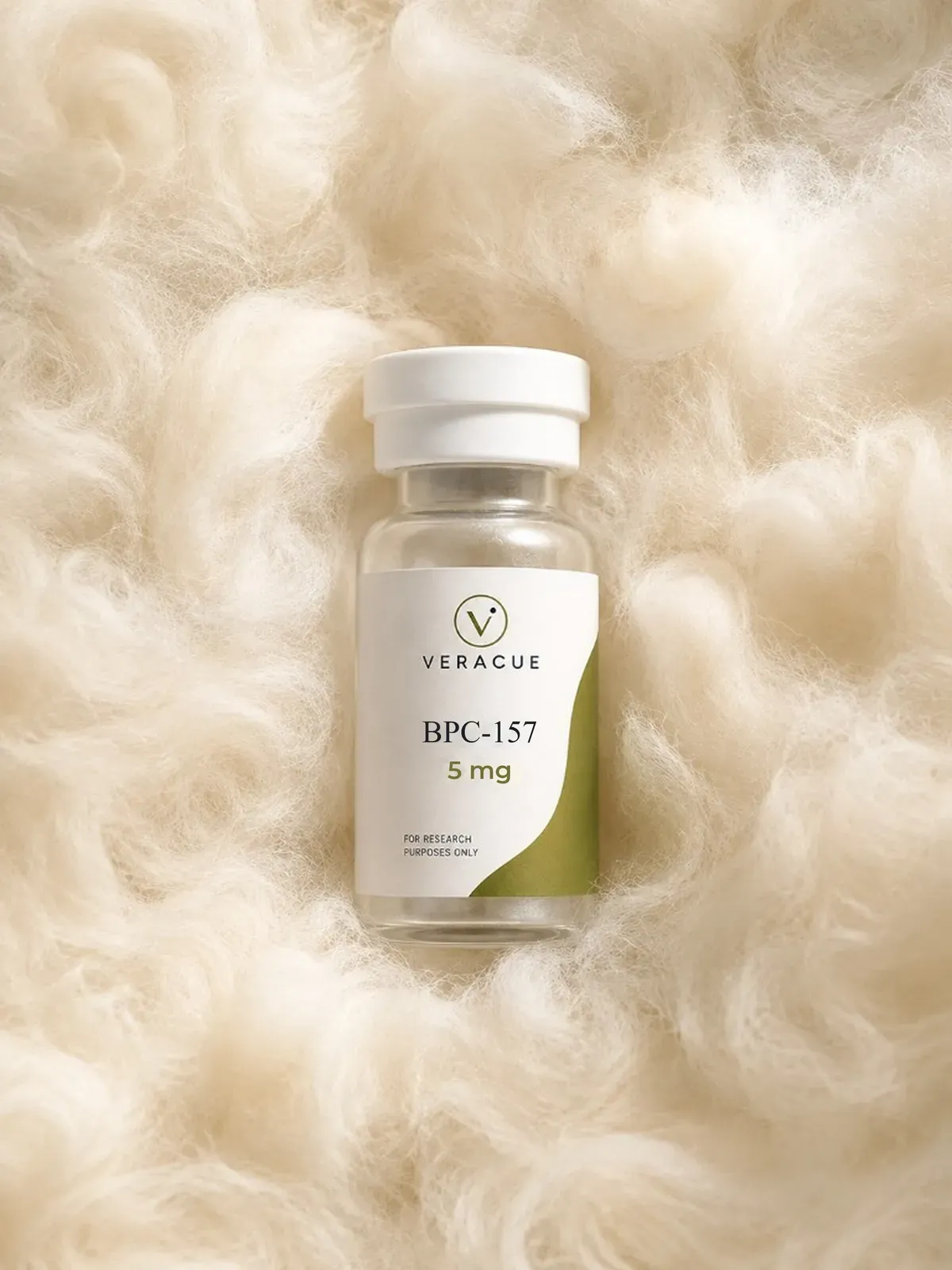
Two peptides in one vial: BPC-157 (GEPPPGKPADDAGLV) and acetylated TB-500 (Ac-LKKTETQ), each with its own CAS number. 5/5 and 10/10 mg, research use only.

RESEARCH PEPTIDE
Is VIP the same as PACAP? No. It is a 28-residue amidated peptide, C147H238N44O42S, CAS 40077-57-4. Research use only; supplied as a 10 mg vial.

RESEARCH PEPTIDE
Is BPC-157 a blend or one peptide? It is a single 15-residue molecule, GEPPPGKPADDAGLV (CAS 137525-51-0). Sold in 5 and 10 mg for research use only.