NAD+ and AHK-Cu in Metabolic and Longevity Research: A Deep Dive
A research overview of NAD+ and AHK-Cu covering mitochondrial metabolism, sirtuin activation, copper-peptide signaling, and laboratory handling protocols.

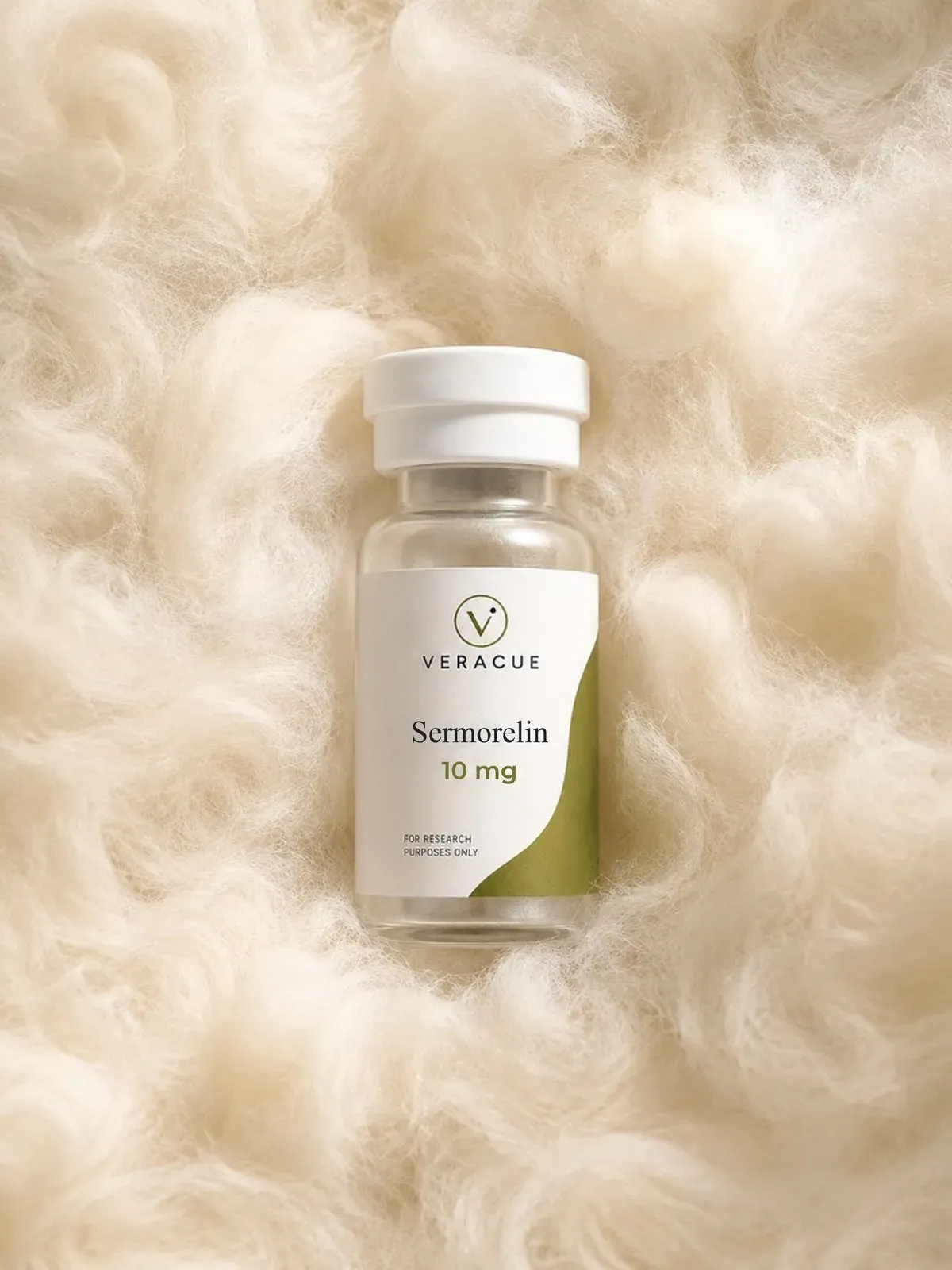
Sermorelin is a linear 29-residue synthetic peptide, YADAIFTNSYRKVLGQLSARKLLQDIMSR-NH2, made of the first 29 amino acids of growth hormone-releasing hormone with a C-terminal amide. Its free-base reference formula is C149H246N44O42S, average mass about 3357.9 g/mol, CAS 86168-78-7. It is easily confused with Tesamorelin, CJC-1295 and Ipamorelin, which are different molecules, and it is not growth hormone itself. Vials come in 10 mg and 20 mg for laboratory research use only.
Ask for the analytical documentation of any lot.
HPLC is the method used to measure purity
Ask for the report for a specific lot through the contact page
Supplied for laboratory research use only
Mass spectrometry is the method used to confirm identity
Sermorelin is a synthetic peptide made of the first 29 amino acids of growth hormone-releasing hormone (GHRH), with a C-terminal amide. Native GHRH has 44 residues. In the laboratory it is studied as a reference ligand for the GHRH receptor. Veracue supplies it for research use only.
Sermorelin is not growth hormone, which is a much larger protein. The 1-29 sequence is a short, defined reference sequence, and that is why researchers keep coming back to it when they compare GHRH-related molecules.
| Product name | Sermorelin (also written GRF 1-29, GHRH(1-29) amide) |
| Sequence | YADAIFTNSYRKVLGQLSARKLLQDIMSR-NH2 |
| Length | 29 residues, linear, C-terminal amide |
| Molecular formula (free-base reference value) | C149H246N44O42S |
| Molecular weight (free-base reference value) | About 3357.9 g/mol (average) |
| CAS Registry Number | 86168-78-7 |
| PubChem CID | 16132413 |
| Sizes offered | 10 mg and 20 mg vials |
| Research designation | Research Use Only |
Formula and mass are free-base reference values from the PubChem record. A salt form has a different formula weight. Chemical form, purity, lot results and storage conditions are reported on each lot’s documentation and can be requested through the contact page.
Sermorelin is a single linear chain with no cysteine and no disulfide bonds. The sequence carries three arginines, two lysines, a free N-terminal amine and one methionine at position 27. Those basic residues and the methionine matter when you characterize a lot, because they affect counterion binding and oxidation.
Sermorelin acetate is the acetate salt of the same peptide. The sequence is identical, but the acetate counterions add mass, so the formula weight differs from the free-base value. The form on a lot’s documentation decides which formula weight applies.
The peptide appears as Sermorelin, GRF(1-29)NH2 and GHRH(1-29)-NH2. Mod GRF 1-29 and CJC-1295 share its backbone but are different compounds. Anchor identity to the sequence rather than the name: any substitution, D-amino acid or added group makes a different molecule, even when the product name looks similar.
| Feature | Sermorelin | Ipamorelin | Tesamorelin | CJC-1295 |
|---|---|---|---|---|
| Structure | Unmodified GHRH(1-29) amide | Synthetic pentapeptide (Aib-His-D-2-Nal-D-Phe-Lys-NH2) | GHRH(1-44) with N-terminal trans-3-hexenoyl group | GHRH(1-29) with four substitutions plus an albumin-binding modified lysine |
| Peptide length | 29 residues | 5 residues | 44 residues | 29 residues plus modified lysine |
| Receptor | GHRH receptor | Ghrelin (GHS) receptor | GHRH receptor | GHRH receptor |
| Signaling context | Adenylyl cyclase / cAMP | Phospholipase C / calcium | Adenylyl cyclase / cAMP | Adenylyl cyclase / cAMP |
| Research role | Reference GHRH-receptor agonist | Selective GH secretagogue at the GHS receptor | Stabilized full-length GHRH analog | Long-acting GHRH analog |
The table compares structure and receptor context only and does not rank the molecules. CJC-1295 without DAC (Mod GRF 1-29) keeps the four substitutions without the albumin-binding group and is a separate compound.
The GHRH receptor is a G protein-coupled receptor on pituitary somatotroph cells, related to the receptors for VIP and secretin. It signals mainly through adenylyl cyclase and cyclic AMP. The ghrelin (GHS) receptor, by contrast, couples to phospholipase C and calcium. Sermorelin therefore sits on the GHRH side of growth-hormone-axis research.
Native GHRH is cleaved at its N-terminus in plasma to an inactive fragment, so the unmodified 1-29 sequence is enzymatically labile. Unrecognized degradation can look like a weak or inconsistent response, so researchers treat stability in their chosen system as an experimental variable and record preparation and handling conditions consistently. It also explains why later GHRH analogs such as CJC-1295 were designed for greater enzymatic resistance and cannot stand in for Sermorelin.
Results depend on the experimental model, the endpoint, exposure conditions, assay method and species. A GH-release readout in cultured pituitary cells answers a different question from a receptor-binding assay. This page offers molecular reference information and general research context only. It cannot establish what is in a particular vial, and Veracue provides no dosing, administration or usage guidance of any kind.
Match comparators to the pathway being tested: GHRH-receptor ligands for GHRH-pathway questions and GHS-receptor ligands for ghrelin-pathway questions. Naming each molecule precisely in methods sections, including any substitutions or modifications, makes work reproducible.
Reverse-phase HPLC reports chromatographic purity: the share of detected material eluting as the main peak. It does not confirm identity, and a closely related peptide can give an equally clean trace. It also reflects only what the detector sees at the chosen wavelength.
Mass spectrometry, usually ESI-MS or MALDI-TOF, checks whether the measured mass matches Sermorelin’s theoretical value. An intact mass cannot prove sequence order, so tandem MS or another orthogonal method adds confidence where it matters. ESI spectra usually show several multiply charged ions, so reported masses are typically deconvoluted values. Methionine oxidation is one example of a modified species that mass data can flag.
Net peptide content, from amino acid or elemental analysis, shows how much of the powder is peptide rather than counterions and water. With five basic residues and a free N-terminus, Sermorelin binds counterions, so gross weight overstates the peptide present. Net content is a separate figure from HPLC purity, and two lots with identical purity can still differ in actual peptide amount.
| Method | Tells a researcher | Does not prove by itself |
|---|---|---|
| RP-HPLC | Chromatographic purity (area %) | Identity |
| ESI-MS / MALDI-TOF | Mass consistent with Sermorelin | Sequence order; purity |
| Tandem MS | Sequence evidence | Quantity or purity |
| Amino acid or elemental analysis | Net peptide content | Identity of impurities |
A certificate of analysis describes one lot, never the compound in general. The first check is simple: the lot number on the COA should match the vial and the order record.
A complete Sermorelin COA separates product identity, lot number, chemical form, HPLC result with chromatogram, MS result with observed and theoretical mass, test date and testing laboratory. Net peptide content adds value when concentration accuracy matters. A useful COA reports measured results rather than target specifications. Chemical form, lot number, laboratory, test date, HPLC and mass results and storage conditions are reported on each lot’s documentation. The certificate page explains how to request lot documentation.
No. A single sharp HPLC peak only shows that most detected material elutes together. Pair it with a mass spectrometry result from the same lot, reported as observed against theoretical mass. Documentation with only one of the two is incomplete, however high the purity figure.
Sermorelin and Sermorelin acetate share one sequence but not one formula weight. If the form is unstated, mass-based calculations can carry a silent error. Confirm the form on the lot’s COA and use the matching formula weight. Where the documentation does not state the form, record it as unknown rather than assuming one.
For each lot, keep the listing snapshot, the lot-specific COA, the stated chemical form, net peptide content if available, the receipt date, labeled storage conditions and the experiments that used it. Consistent records make lot-to-lot differences visible and let unexpected results be traced back quickly.
Ask the Veracue team about available documentation for a specific lot, or review the certificate library.

Sermorelin is supplied for laboratory research and analytical characterization only. It is not intended for human or veterinary use, or for ingestion, injection or any form of administration. This page contains no dosing, administration or usage guidance of any kind. See the Medical Disclaimer and the Terms and Conditions for sitewide policies.

RESEARCH PEPTIDE
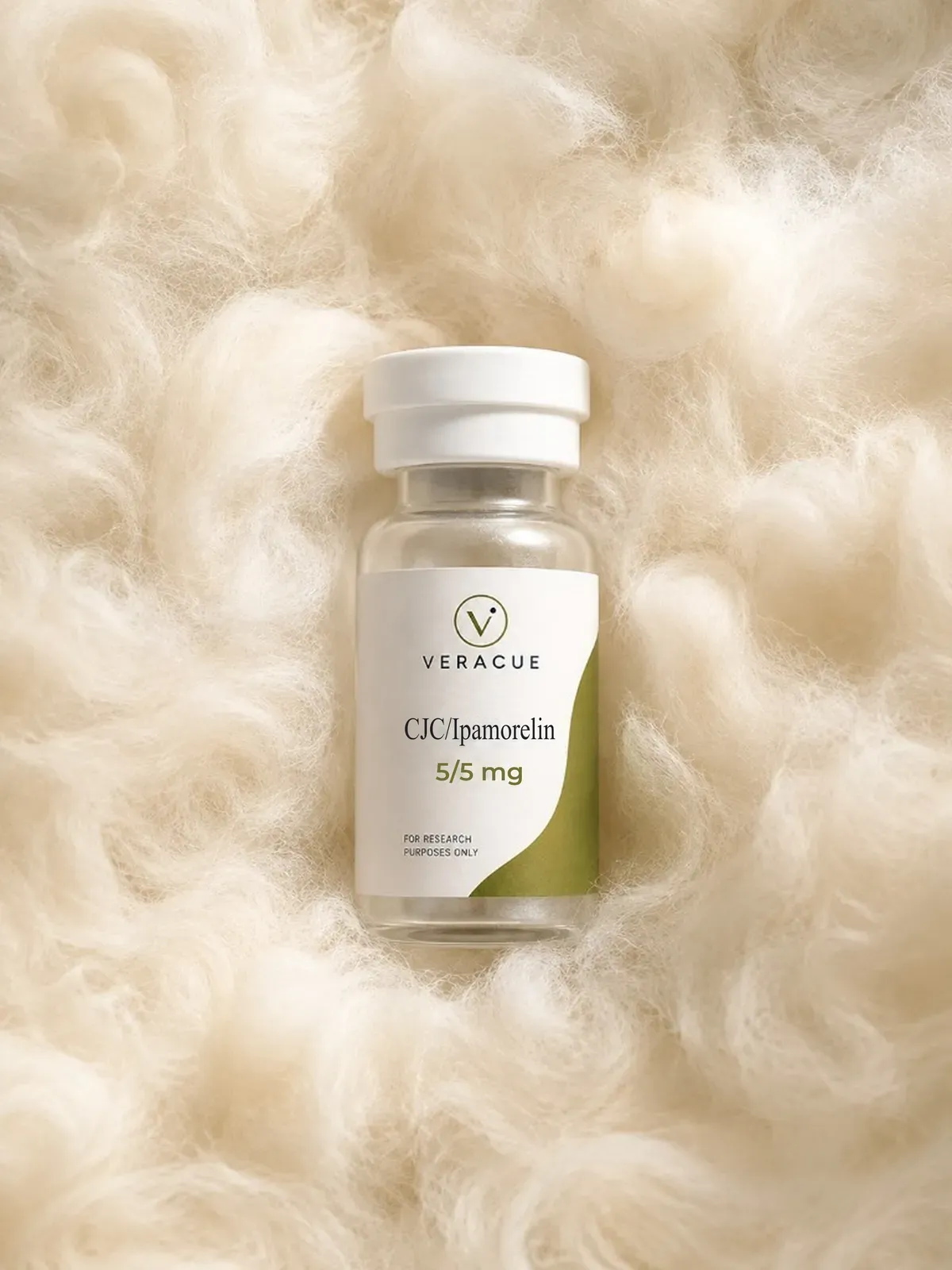
Mod GRF 1-29 plus Ipamorelin in a 5/5 mg vial, for research use only. The two peptides differ by about 2656 Da, so a mass reading separates them.

RESEARCH PEPTIDE
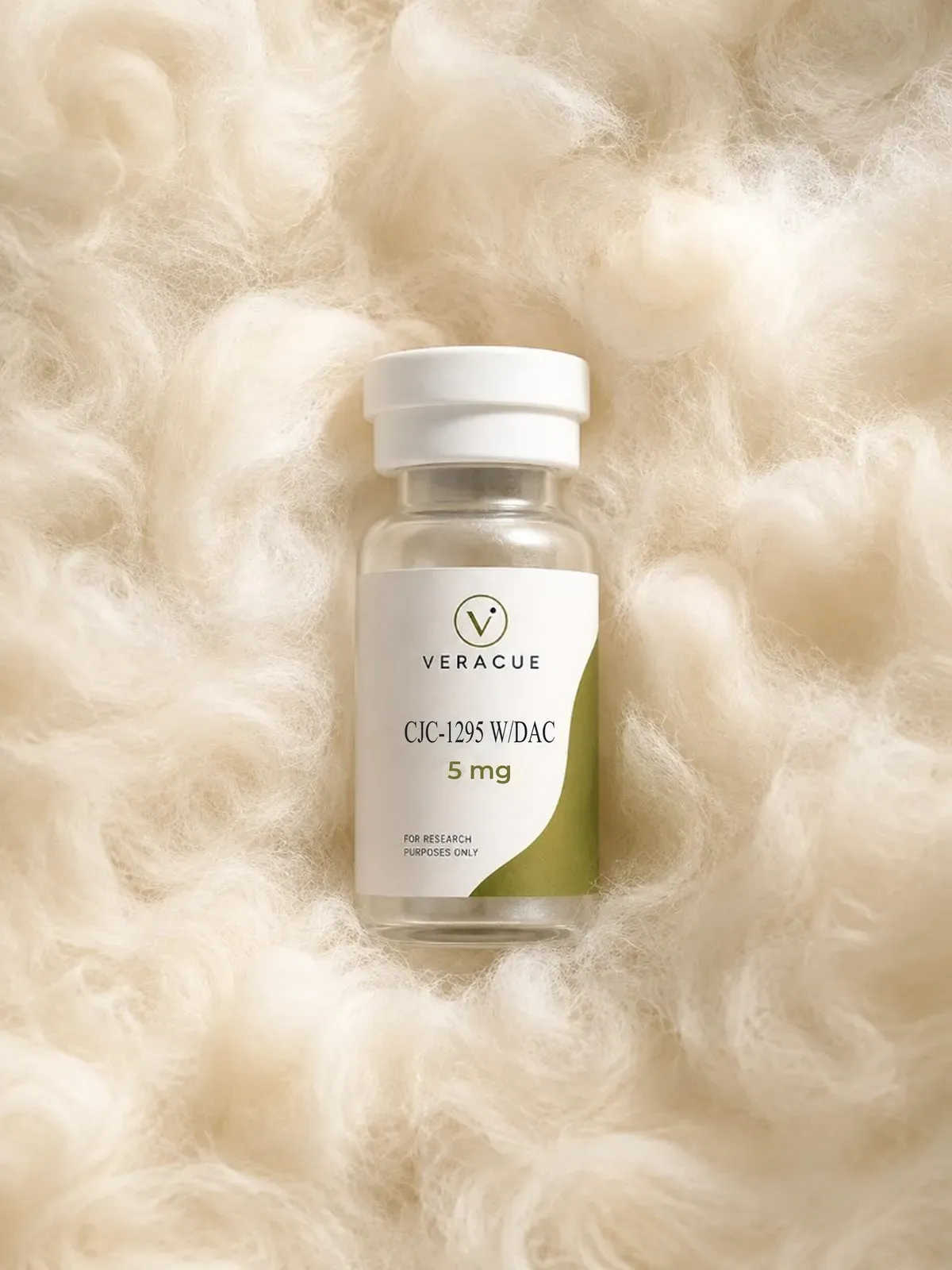
Check the mass: CJC-1295 W/DAC is C165H269N47O46, about 3647.2 g/mol (CAS 446262-90-4), not 3367.9 like its unmodified core. Research use only.

RESEARCH PEPTIDE
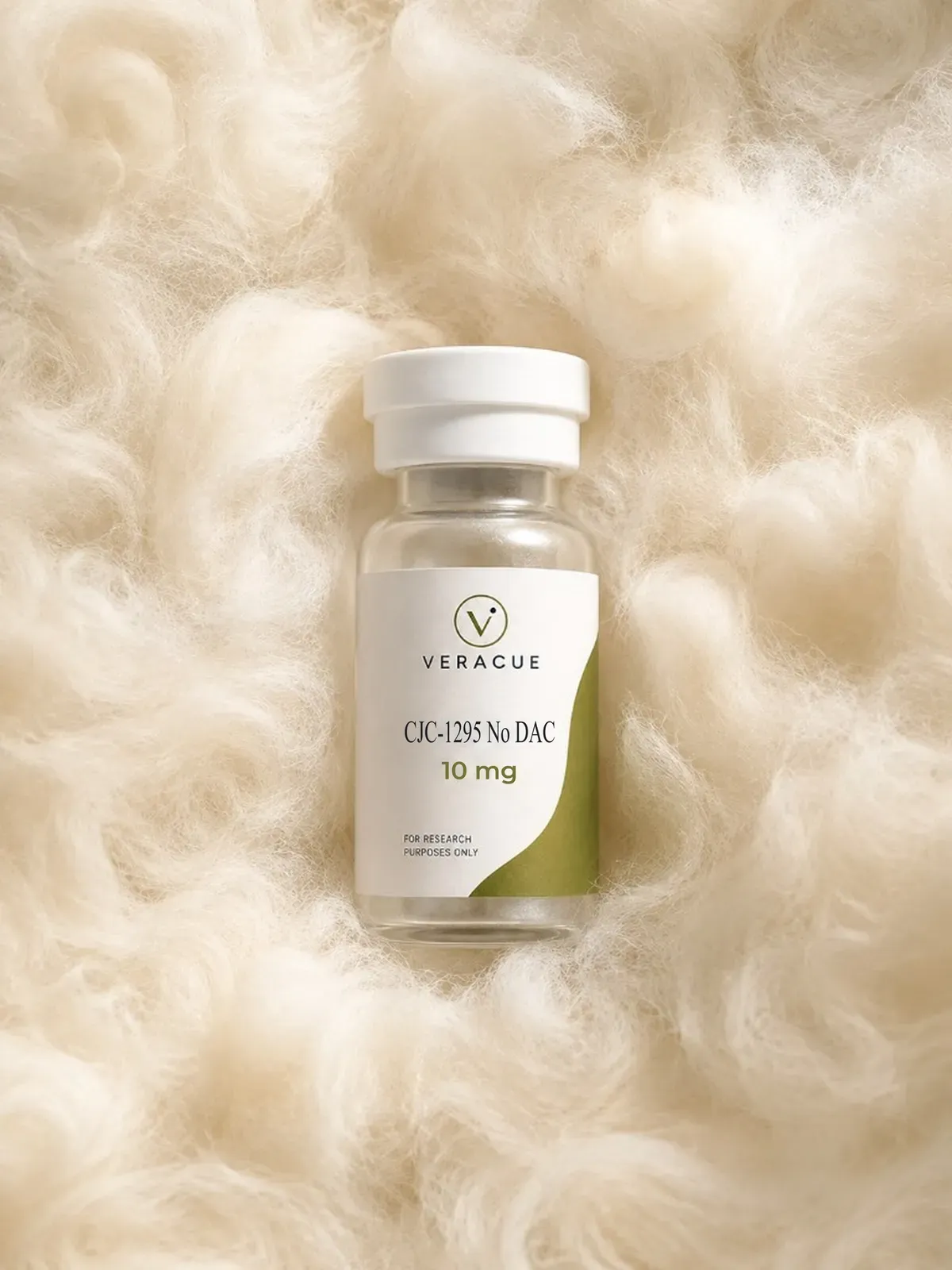
Which CJC-1295 is it? This is the 29-residue peptide with no DAC group (C152H252N44O42, about 3367.9 g/mol). Sold in 10 mg, for research use only.

RESEARCH PEPTIDE
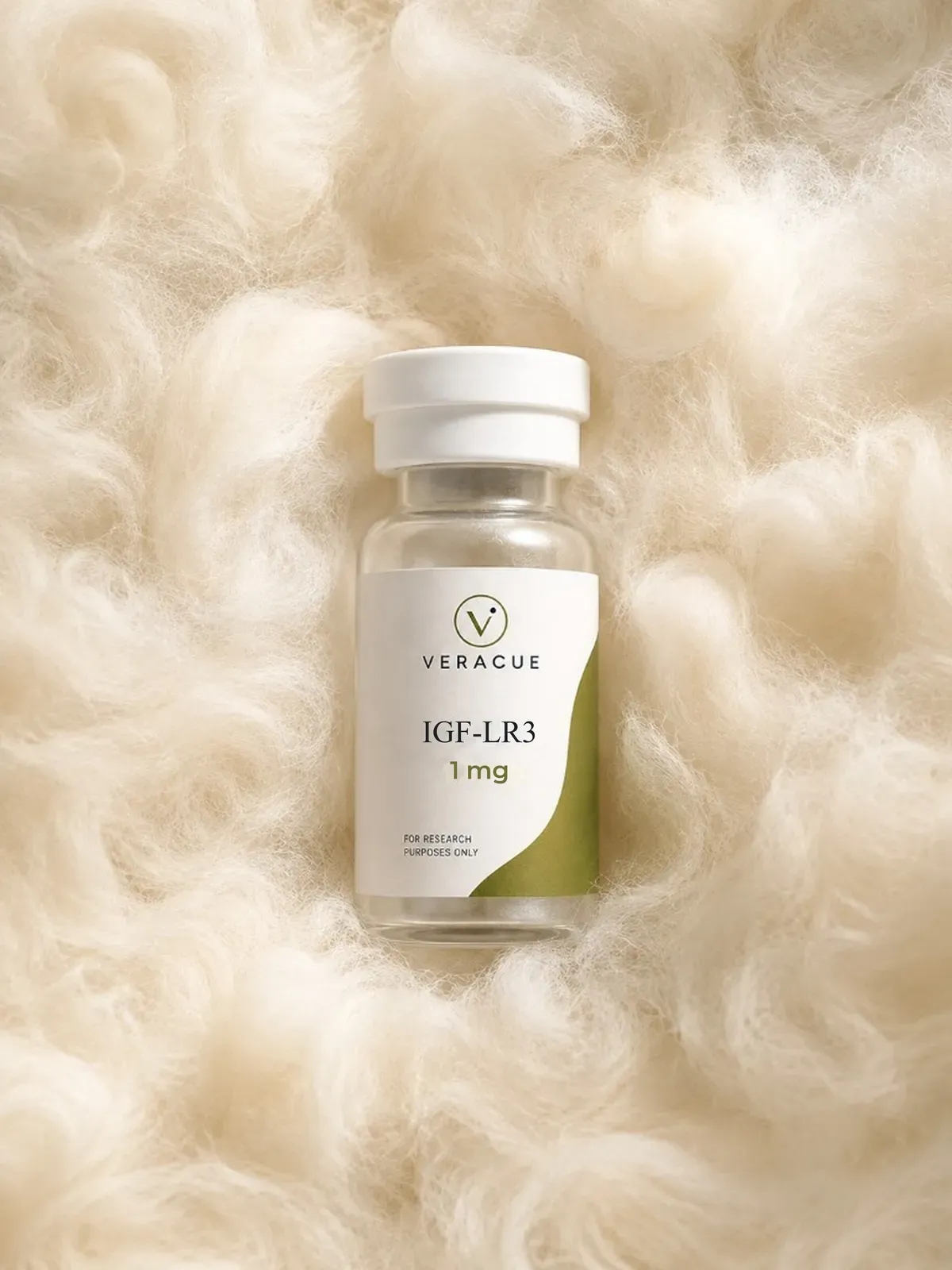
IGF-LR3 is an 83-residue analog, longer than native IGF-1 (CAS 143045-27-6). Read the identity and COA notes. 1 mg vial, research use only.