NAD+ and AHK-Cu in Metabolic and Longevity Research: A Deep Dive
A research overview of NAD+ and AHK-Cu covering mitochondrial metabolism, sirtuin activation, copper-peptide signaling, and laboratory handling protocols.

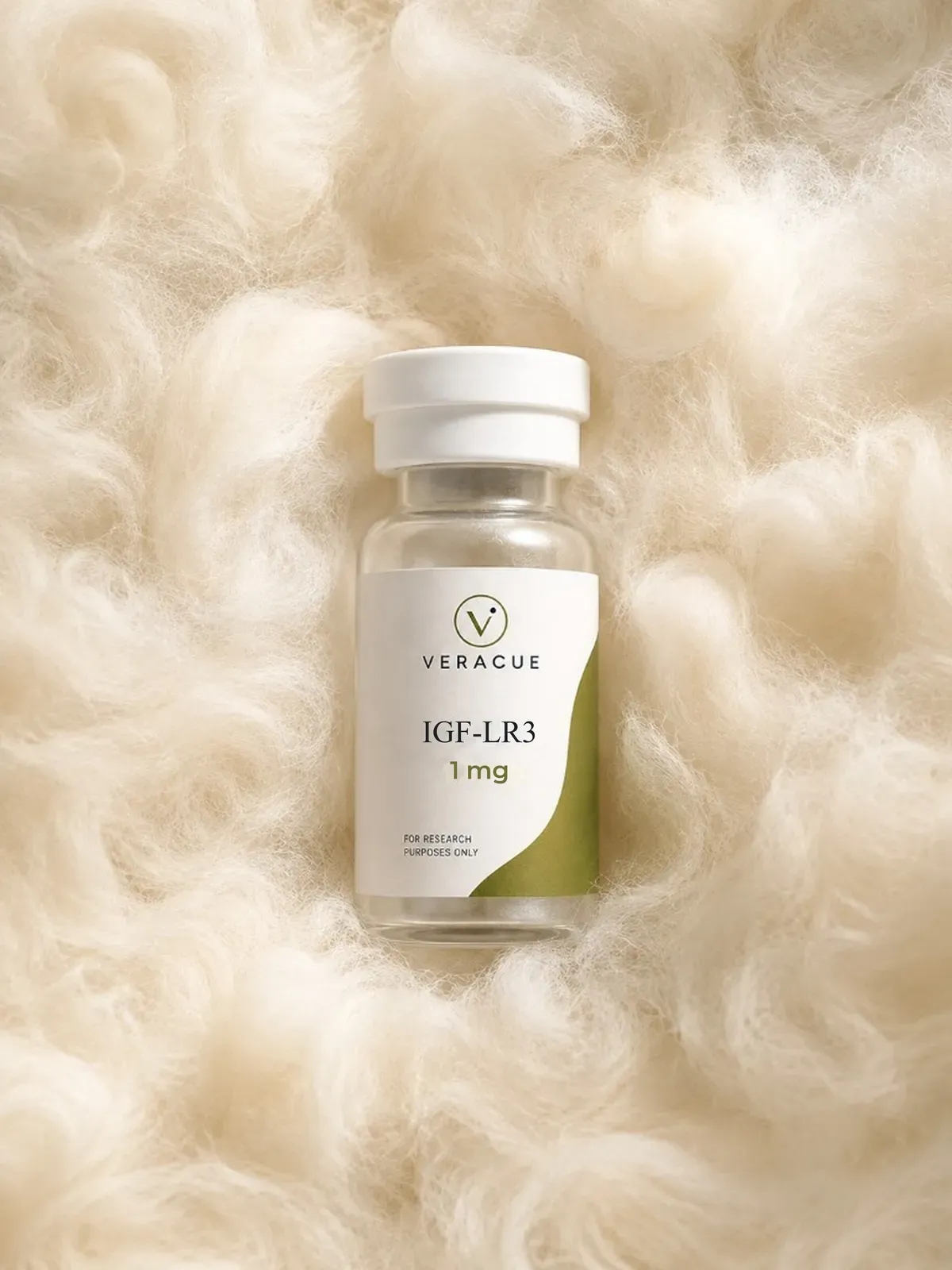
IGF-LR3 is a long, engineered analog of insulin-like growth factor-1, an 83-amino-acid protein of about 9.1 kDa rather than a short peptide. It carries a 13-residue N-terminal extension and a Glu-to-Arg change at position 3 of the IGF-1 sequence, and it is listed under CAS 143045-27-6 with the formula C400H625N111O115S9 for the reduced chain. It is easily confused with native IGF-1, which has 70 residues. Veracue offers it as a 1 mg vial for laboratory research use only.
Ask for the analytical documentation of any lot.
HPLC is the method used to measure purity
Ask for the report for a specific lot through the contact page
Supplied for laboratory research use only
Mass spectrometry is the method used to confirm identity
IGF-LR3, also written Long R3 IGF-I or Long-[Arg3]-IGF-I, is an 83-amino-acid analog of IGF-1. It has a 13-residue N-terminal extension and an arginine in place of glutamate at position 3, and it is held together by three disulfide bonds. Veracue supplies it for laboratory research only.
At 83 residues it is closer to a small protein than a short peptide, which shapes how it is characterized and how its certificate should be read. The name itself records the changes: “Long” is the extension and “R3” is the arginine at position 3.
| Product name | IGF-LR3 (Long-(Arg3) insulin-like growth factor-I) |
| Also known as | IGF-1 LR3; Long R3 IGF-1; Long R3 IGF-I; Long-[Arg3]-IGF-I; LR3 IGF-1 |
| Length | 83 amino acids |
| Structural changes | 13-residue N-terminal extension; Glu-to-Arg at position 3 of the IGF-1 domain |
| Calculated mass | About 9.1 kDa (9,117.6 Da reduced chain; 9,111.5 Da with three disulfide bonds) |
| CAS Registry Number | 143045-27-6 |
| UNII | M9L22Y19H9 |
| Size offered | 1 mg vial |
| Research designation | Research Use Only |
Masses are calculated reference values for the molecule in general, not measured results for a Veracue lot. Physical form, salt or counterion, formulation, purity, lot results and storage conditions are reported on each lot’s documentation and can be requested through the contact page.
“R3” marks the replacement of glutamate with arginine at position 3 of the mature IGF-1 sequence. “Long” marks a 13-residue extension at the N-terminus, MFPAMPLSSLFVN. In the original 1992 constructs, that extension was the first 11 residues of a methionyl porcine growth hormone followed by Val-Asn. A listing that lacks either feature describes a different molecule.
The reference sequence has 83 residues: MFPAMPLSSL FVNGPRTLCG AELVDALQFV CGDRGFYFNK PTGYGSSSRR APQTGIVDEC CFRSCDLRRL EMYCAPLKPA KSA. Six cysteines form three intramolecular disulfide bonds in the native folded structure.
| Molecule | Residues | Structural change | IGFBP interaction |
|---|---|---|---|
| Native IGF-1 | 70 | Reference sequence | Normal |
| IGF-LR3 | 83 | 13-residue N-terminal extension plus Glu3-to-Arg | Markedly reduced |
| R3-IGF-I | 70 | Glu3-to-Arg without the extension | Reduced |
| Des(1-3)-IGF-I | 67 | First three residues absent | Reduced |
Recombinant material with the native 70-residue sequence, sold under the name mecasermin, is a different molecular entity from IGF-LR3. Findings about one should not be carried over to the other.
IGF-binding proteins (IGFBPs) hold IGF-1 in complex and can keep it away from its receptor in a test system. So the amount of IGF-1 added and the amount that acts can differ. Foundational work reported that Long-[Arg3]-IGF-I interacts with IGFBPs far less than native IGF-1 does while still activating its receptor, which makes it useful for separating the two questions.
Solution NMR structures (Laajoki et al., PDB 3LRI) found that the IGF domain closely resembles IGF-1, with the main differences at the N-terminus, where the first three residues are reoriented. The authors linked that change to the lower IGFBP affinity. Reduced binding is a property of the molecule, and its effect depends on the system it is used in.
IGF-LR3 activates the type I IGF receptor, and that is the property most cell-based work relies on. It should not be assumed to act only there. In HEK293 cells, it, insulin and native IGF-1 each activated both the type I IGF receptor and the insulin receptor, and at lower concentrations the analog produced greater activation of both than either comparator. A readout on its own does not say which receptor produced it, so receptor-specific readouts and comparators help assign the signal.
Serum-free media remove the factors serum normally supplies, so cultures need a substitute, traditionally insulin. Reports have examined IGF-LR3 as an insulin alternative in CHO and HEK293 cultures. Responses depend on the cell line and even the clone, so titration in the system under study belongs in the methods.
Native IGF-1 can refold into more than one disulfide arrangement. In one in vitro refolding comparison, IGF-1 gave about 45% of the native structure and 24% of a mispaired one, while the Long-[Arg3] analog gave about 85% and 10%. That makes it a common model for how a disulfide-rich protein reaches its fold. It also shows why analytical documentation should address folding, because a mispaired isomer has the same composition, and the same intact mass, as the native protein.
This page gives molecular reference information and general research context. It cannot establish what is in a particular vial. Veracue does not provide dosing, administration or usage guidance of any kind.

Procurement teams learn more from a certificate that answers a few specific questions than from one purity figure, especially for a protein with three disulfide bonds. The table shows what each item can and cannot tell you.
| COA element | What it tells you | What it does not establish |
|---|---|---|
| Lot number | Links the report to the vial in hand | Anything about quality unless it matches the label |
| Identity and reference sequence | The material was compared with the stated 83-residue sequence | Correct folding or purity |
| Observed intact mass and mass form | Whether the measured mass fits the expected species, about 9,117.6 Da reduced or about 9,111.5 Da with three disulfide bonds | Purity, amount of material or correct disulfide pairing |
| RP-HPLC purity and method | Share of detected signal in the main peak under stated conditions | Identity, folding or biological activity |
| Structural or folding evidence, where available | Whether the main species behaves like correctly folded protein | Lot potency in any particular assay |
| Formulation | What else is in the vial and how much protein it holds | Chromatographic purity |
| Testing laboratory and test date | Who tested the lot and when | Independence, unless the relationship is disclosed |
| Endotoxin, if applicable | Endotoxin level in the tested lot | Identity or fold |
Any field above depends on the lot’s own documentation, and Veracue confirms a field only when the lot certificate reports it. The certificate page explains how to request lot documentation.
At about 9.1 kDa, intact-mass work is a standard identity check. The calculated average mass is about 9,117.6 Da for the reduced chain (C400H625N111O115S9) and about 9,111.5 Da with three disulfide bonds (C400H619N111O115S9). A report should name which form its observed mass was matched against, because the two differ by a few daltons.
Chromatographic purity shows the share of signal in the main peak under one set of conditions. It does not show correct disulfide pairing, and intact mass cannot separate disulfide isomers, since they share the same mass. Look for the method, the mass form and some structural or folding evidence, shown and not implied.
The sequence, CAS number and UNII describe IGF-LR3 in general. Only lot-specific analytical documentation describes a particular lot. Keep the intended-use statement, receipt and storage records with the purchase file, and follow the conditions on the lot documentation and label for storage.
Ask the Veracue team about available documentation for a specific lot, or review the certificate library.
IGF-LR3 is supplied solely for laboratory research and analytical characterization. It is not intended for human or veterinary use, and it is not a drug, a dietary supplement or medical advice. This page provides no dosing, administration or usage guidance of any kind. Purchasers are responsible for using the material lawfully and within an appropriate research setting. See the Medical Disclaimer and the Terms and Conditions for sitewide policies, or the FAQ for general questions.
RESEARCH PEPTIDE
Mod GRF 1-29 plus Ipamorelin in a 5/5 mg vial, for research use only. The two peptides differ by about 2656 Da, so a mass reading separates them.

RESEARCH PEPTIDE
Check the mass: CJC-1295 W/DAC is C165H269N47O46, about 3647.2 g/mol (CAS 446262-90-4), not 3367.9 like its unmodified core. Research use only.

RESEARCH PEPTIDE
Which CJC-1295 is it? This is the 29-residue peptide with no DAC group (C152H252N44O42, about 3367.9 g/mol). Sold in 10 mg, for research use only.

RESEARCH PEPTIDE
Tesa/IPA is two peptides in one vial, tesamorelin and ipamorelin, so a COA should confirm both. 6/3 and 13/3 mg vials, research use only.