NAD+ and AHK-Cu in Metabolic and Longevity Research: A Deep Dive
A research overview of NAD+ and AHK-Cu covering mitochondrial metabolism, sirtuin activation, copper-peptide signaling, and laboratory handling protocols.

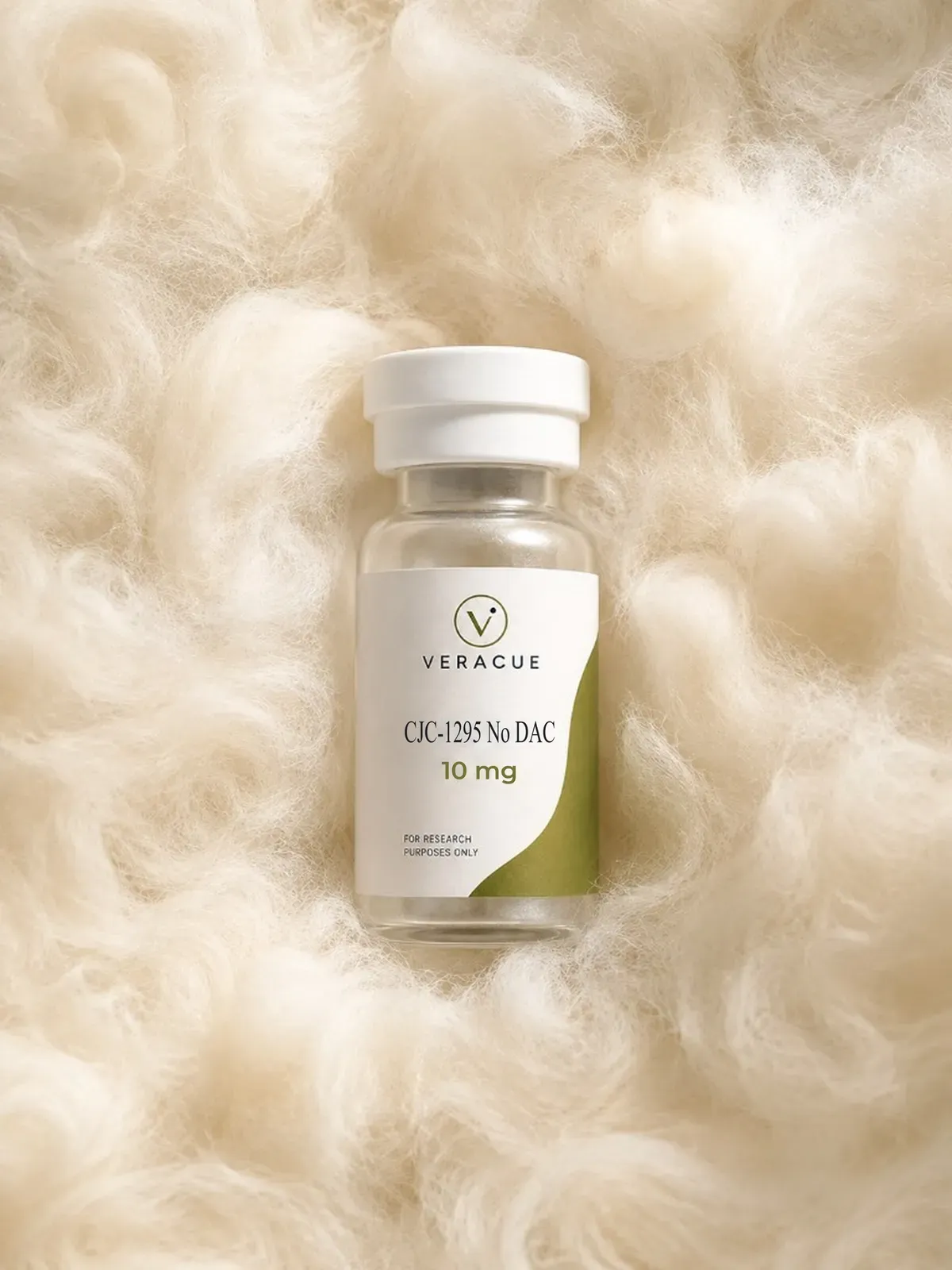
CJC-1295 No DAC, also sold as Mod GRF 1-29, is a 29-residue growth hormone-releasing hormone analog with the sequence YADAIFTQSYRKVLAQLSARKLLQDILSR-NH2: D-alanine sits at position 2, and glutamine, alanine and leucine replace Asn8, Gly15 and Met27 of the native fragment. The free peptide is C152H252N44O42, average mass about 3367.9 g/mol, listed under CAS 863288-34-0 and 446036-97-1. The name means the chain stops at residue 29, with no albumin-binding lysine as in CJC-1295 with DAC, and it weighs about 10 Da more than Sermorelin. Veracue lists it in one 10 mg size, strictly for laboratory research use only.
Ask for the analytical documentation of any lot.
HPLC is the method used to measure purity
Ask for the report for a specific lot through the contact page
Supplied for laboratory research use only
Mass spectrometry is the method used to confirm identity
CJC-1295 No DAC is a synthetic peptide of 29 amino acids, built on the first 29 residues of growth hormone-releasing hormone (GHRH) and finished with a C-terminal amide. Against the native fragment it carries four changes: D-alanine at position 2, glutamine at position 8, alanine at position 15 and leucine at position 27. Chemists also write it as Mod GRF 1-29, modified GRF(1-29) or tetrasubstituted GRF(1-29), and sellers use CJC-1295 without DAC or CJC-1295 W/O DAC for the same molecule.
The words "No DAC" carry chemical information. DAC stands for Drug Affinity Complex, a lysine bearing a maleimidopropionyl group that is added after residue 29 and is intended to link the peptide to albumin. This molecule ends at residue 29 and has no such group. Veracue supplies it for research use only.
| Product name | CJC-1295 No DAC (also CJC-1295 without DAC, Mod GRF 1-29, modified GRF(1-29)) |
| Sequence (three-letter code) | Tyr-D-Ala-Asp-Ala-Ile-Phe-Thr-Gln-Ser-Tyr-Arg-Lys-Val-Leu-Ala-Gln-Leu-Ser-Ala-Arg-Lys-Leu-Leu-Gln-Asp-Ile-Leu-Ser-Arg-NH2 |
| Sequence (one-letter code) | YADAIFTQSYRKVLAQLSARKLLQDILSR-NH2, with D-alanine at position 2 |
| Length | 29 residues, linear, C-terminal amide |
| Changes from native GHRH(1-29) | D-Ala2, Gln8, Ala15, Leu27 |
| Molecular formula (free-base reference value) | C152H252N44O42 |
| Molecular weight (average) | About 3367.9 g/mol |
| CAS Registry Number | 863288-34-0 (446036-97-1 is also listed for this peptide) |
| Size offered | 10 mg vial |
| Research designation | Research Use Only |
Formula and mass are reference values for the free peptide and are not a Veracue lot result. Salt form, purity, lot number and storage conditions for a particular vial are reported on its own documentation, which can be requested through the contact page.
The fastest way to understand CJC-1295 No DAC is to lay it beside the unmodified GHRH(1-29) amide, Sermorelin. Both chains are 29 residues long and they match at 25 of the 29 positions. The four that differ are the whole identity of the molecule.
| Position | Sermorelin | CJC-1295 No DAC | What the change amounts to |
|---|---|---|---|
| 2 | L-Ala | D-Ala | Same atoms in mirror-image arrangement; designed to resist N-terminal cleavage by dipeptidyl peptidase IV |
| 8 | Asn | Gln | One extra CH2, and an asparagine prone to deamidation is gone |
| 15 | Gly | Ala | One extra CH2 |
| 27 | Met | Leu | One extra CH2 and the only sulfur atom removed, so no methionine oxidation site remains |
Added up, that is three CH2 groups gained and one sulfur lost. The formula therefore moves from C149H246N44O42S to C152H252N44O42 and the average mass rises by about 10 Da. D-alanine adds no atoms, so a mass reading by itself cannot tell D-Ala2 from L-Ala2.
| Feature | CJC-1295 No DAC | CJC-1295 with DAC | Sermorelin |
|---|---|---|---|
| Residues | 29 | 30 (a lysine is added after residue 29) | 29 |
| Changes from native GHRH(1-29) | D-Ala2, Gln8, Ala15, Leu27 | The same four | None |
| C-terminal end | Arg29 amide | Lysine carrying a maleimidopropionyl group (the DAC), amide | Arg29 amide |
| Molecular formula | C152H252N44O42 | C165H269N47O46 | C149H246N44O42S |
| Average mass (g/mol) | About 3367.9 | About 3647 | About 3357.9 |
| CAS Registry Number | 863288-34-0 and 446036-97-1 | 446262-90-4 | 86168-78-7 |
| Receptor context | GHRH receptor | GHRH receptor | GHRH receptor |
The table separates identity only and does not rank the molecules. The with-DAC compound is a different material with its own product record and its own documentation, and its formula differs from the one above by C13H17N3O4.
The code CJC-1295 was first attached to the albumin-binding version, and the "No DAC" and "without DAC" tags were added later for the 29-residue chain. A label, listing or paper that says only "CJC-1295" does not say which of the two molecules it means, so the formula, mass or CAS number is a safer anchor than the name.
Catalogs list both 863288-34-0 and 446036-97-1 against this sequence, with the same formula and mass. Two other numbers are often pasted onto the wrong compound: 446262-90-4 belongs to CJC-1295 with DAC and 86168-78-7 belongs to Sermorelin. If a No DAC listing shows either of those, treat it as a mismatch to settle with the supplier.
Like Sermorelin and Tesamorelin, this analog is a GHRH receptor ligand. The GHRH receptor is a G protein-coupled receptor on pituitary somatotroph cells and signals mainly through adenylyl cyclase and cyclic AMP. Ipamorelin works through the ghrelin (GHS) receptor, which couples to phospholipase C and calcium, so the two molecules answer different pathway questions and are not substitutes.
Results from one experimental system describe that system only. When a paper says just "CJC-1295", check its methods for the structure to learn whether the 29-residue peptide or the albumin-conjugated one was used before comparing numbers across sources. Veracue offers molecular reference information here, and provides no dosing, administration or usage guidance of any kind.
Three molecules in this family are easy to confuse, so a mass reading from the lot is the most practical identity check. Peptides of this size usually appear in ESI mass spectra as a series of multiply charged ions rather than at the neutral mass. The table gives calculated average-mass m/z values for the 3+ and 4+ ions of each reference formula.
| Compound | Average mass (g/mol) | 3+ ion (m/z) | 4+ ion (m/z) |
|---|---|---|---|
| CJC-1295 No DAC | 3367.9 | 1123.6 | 843.0 |
| Sermorelin | 3357.9 | 1120.3 | 840.5 |
| CJC-1295 with DAC | About 3647 | 1216.7 | 912.8 |
No DAC and Sermorelin sit only 10 Da apart, roughly 3.3 units of m/z at 3+, so telling them apart needs a calibrated instrument with adequate resolution. The with-DAC compound lies far enough away to be obvious. Sodium and potassium adducts shift observed peaks, so convert an observed m/z back to a neutral mass before comparing it with the reference value.
| Method | What it tells a researcher | What it cannot show alone |
|---|---|---|
| RP-HPLC | Chromatographic purity as peak area | Which molecule the main peak is |
| ESI-MS | Measured mass against the expected mass | Residue order, or D versus L configuration |
| Tandem MS | Fragment evidence for the sequence, including positions 8, 15 and 27 | Overall purity or quantity |
| Chiral amino acid analysis | Whether alanine is present as the D form | Chain length or sequence order |
| Peptide content assay | How much of the vial contents is peptide rather than counterion and water | Identity of impurities |
Treat a certificate as a statement about one lot and nothing wider. Match its lot number to the vial first, then see which compound it names. A document that says only "CJC-1295" leaves the question open until you read the measured mass.
A useful certificate gives the chemical form, either free peptide or a salt such as acetate, because a counterion changes the expected mass. It also shows the observed and expected mass, the HPLC trace with its purity figure, the test date and the laboratory that ran the work. Documentation for a given lot can be requested as described on the certificate page.
No. A single clean HPLC peak says the detected material behaves alike, not that it is the right peptide. A wrong but well-made compound can score just as high, which is why the purity figure has to sit next to a mass result from the same lot.
A reading near 3647 g/mol fits the with-DAC compound, and one near 3358 g/mol fits Sermorelin. Either result would mean the material is not CJC-1295 No DAC, or that the form or adducts need to be reconciled with the paperwork.
Keep the listing as it read when you ordered, the lot-specific certificate, the stated chemical form, the measured mass, the receipt date and the experiments that used the material. A consistent file makes it easy to trace an unexpected result back to a lot.
Ask the Veracue team which documentation exists for your lot, or look through the published certificates.

CJC-1295 No DAC is supplied for laboratory research and analytical characterization only. It is not intended for human or veterinary use, or for ingestion, injection or any other form of administration, and it is not a drug, dietary supplement, cosmetic or food. Veracue provides no dosing, administration or usage guidance of any kind. Buyers must be qualified researchers or institutions and are responsible for lawful handling of the material. The Medical Disclaimer and the Terms and Conditions set out the sitewide policies.

RESEARCH PEPTIDE
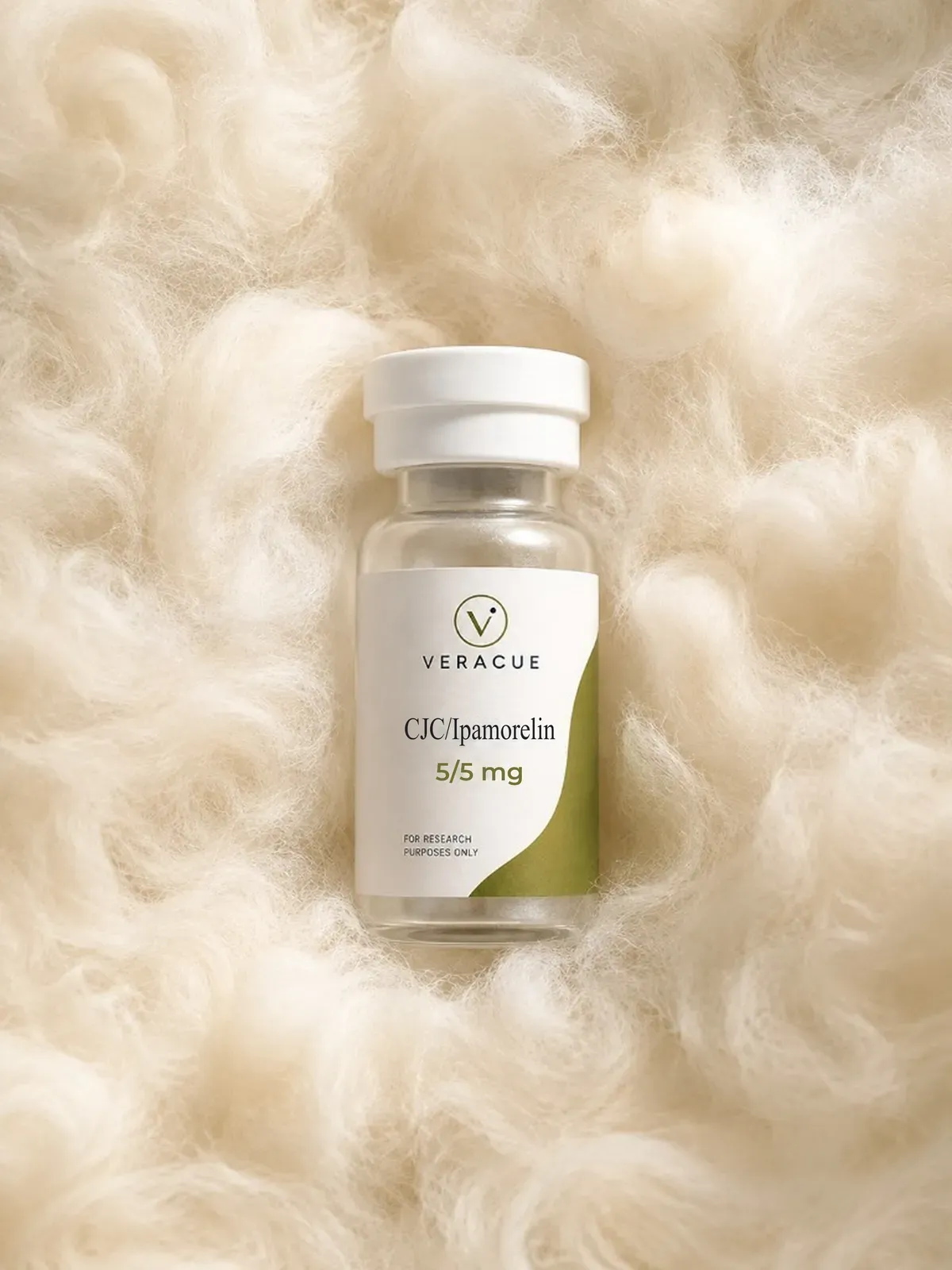
Mod GRF 1-29 plus Ipamorelin in a 5/5 mg vial, for research use only. The two peptides differ by about 2656 Da, so a mass reading separates them.

RESEARCH PEPTIDE
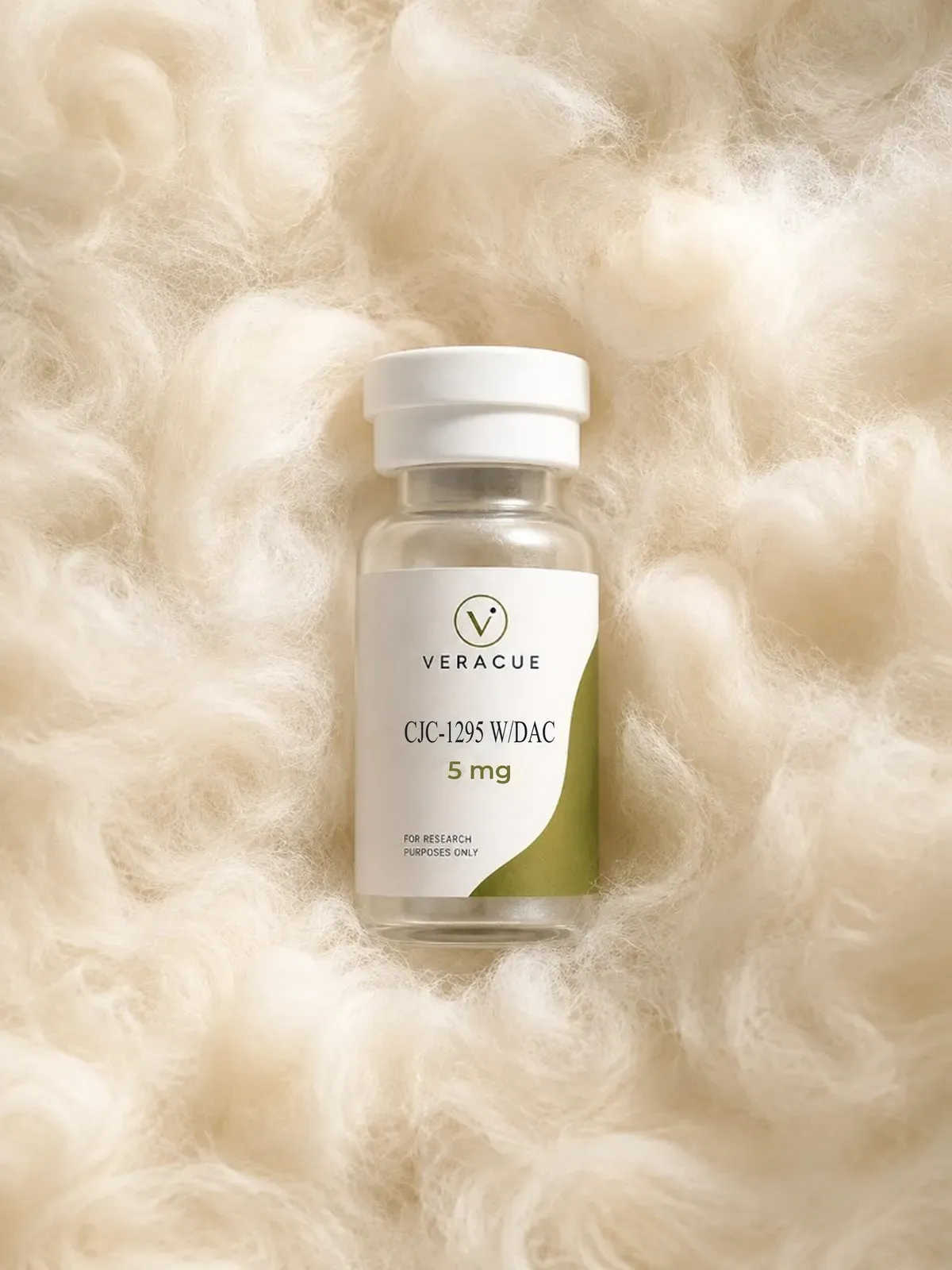
Check the mass: CJC-1295 W/DAC is C165H269N47O46, about 3647.2 g/mol (CAS 446262-90-4), not 3367.9 like its unmodified core. Research use only.

RESEARCH PEPTIDE
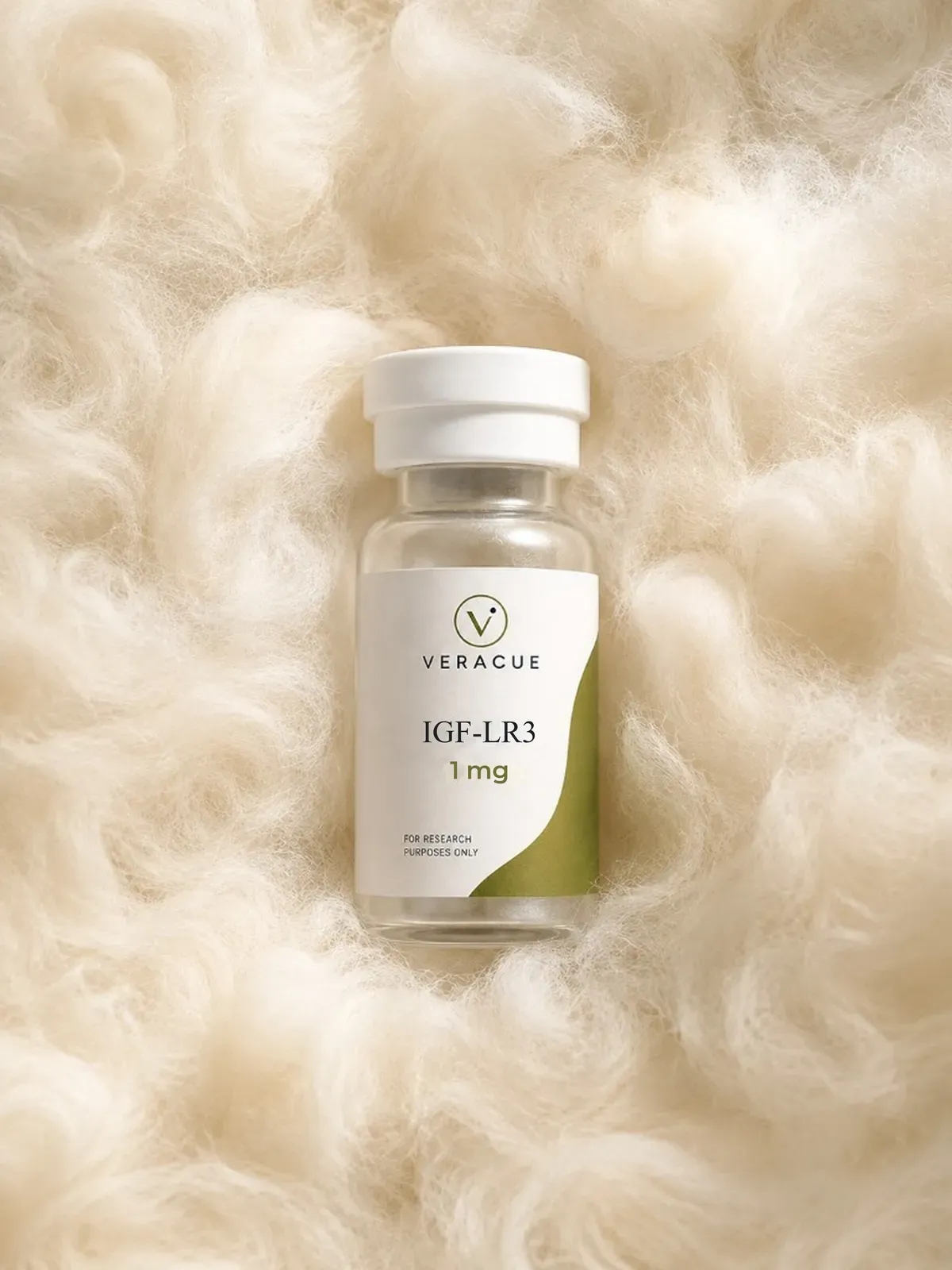
IGF-LR3 is an 83-residue analog, longer than native IGF-1 (CAS 143045-27-6). Read the identity and COA notes. 1 mg vial, research use only.

RESEARCH PEPTIDE
Tesa/IPA is two peptides in one vial, tesamorelin and ipamorelin, so a COA should confirm both. 6/3 and 13/3 mg vials, research use only.