NAD+ and AHK-Cu in Metabolic and Longevity Research: A Deep Dive
A research overview of NAD+ and AHK-Cu covering mitochondrial metabolism, sirtuin activation, copper-peptide signaling, and laboratory handling protocols.

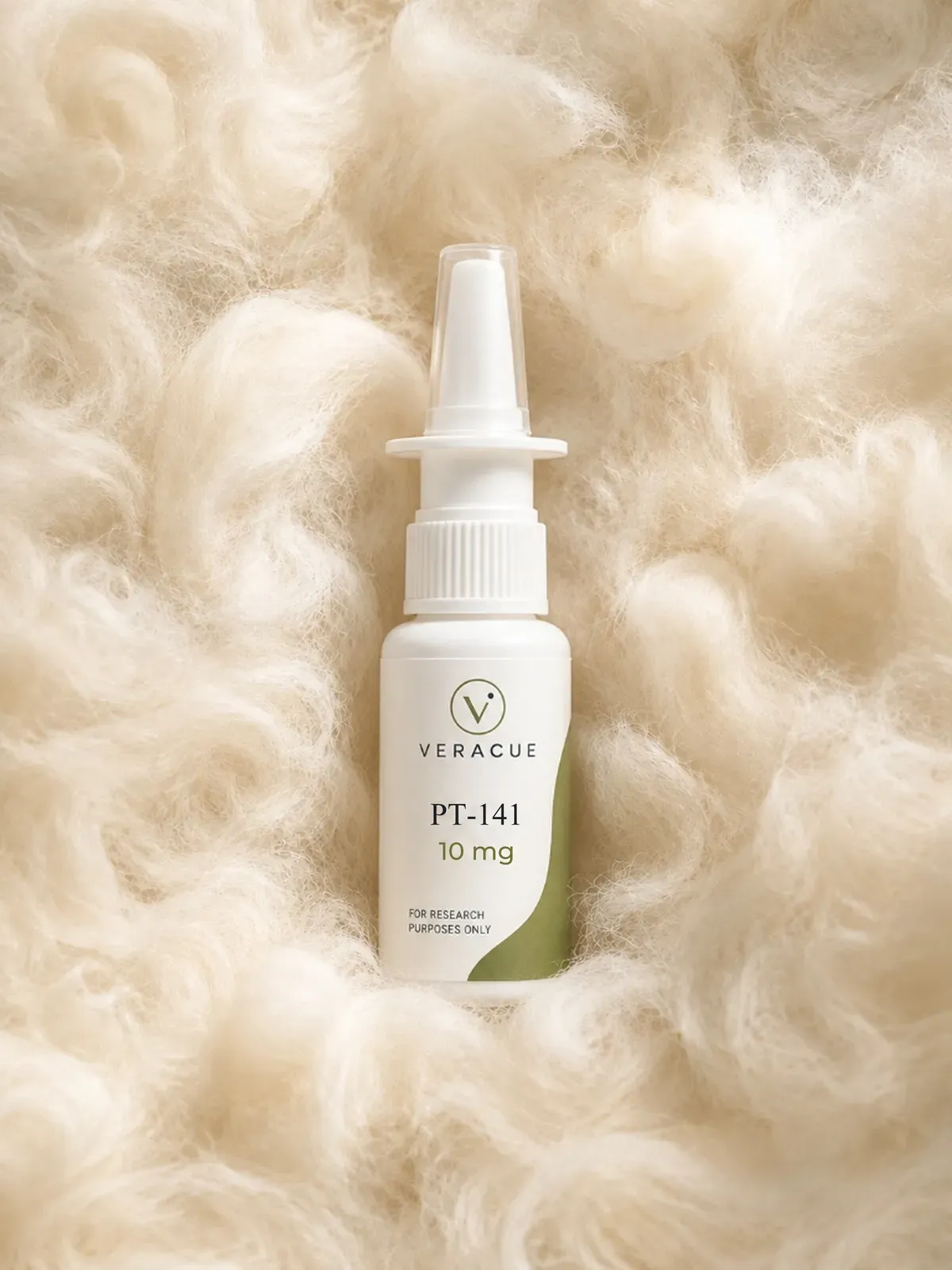
PT-141 Spray is a spray-dispensed research bottle of a seven-residue cyclic peptide: an acetylated norleucine followed by a ring of Asp, His, D-Phe, Arg, Trp and Lys, closed by an amide bond between the Asp and Lys side chains and ending in a free carboxylic acid. Reference values for the free peptide are C50H68N14O10, an average mass near 1025.2 g/mol and CAS 189691-06-3. That acid terminus is what separates it from Melanotan II, which carries an amide and weighs about one unit less. Offered in a 10 mg size with 45 sprays per bottle, strictly for laboratory research use only.
Ask for the analytical documentation of any lot.
HPLC is the method used to measure purity
Ask for the report for a specific lot through the contact page
Supplied for laboratory research use only
Mass spectrometry is the method used to confirm identity
PT-141 is a seven-residue cyclic peptide. An acetyl cap sits on the N-terminal norleucine, and the segment that follows (Asp, His, D-Phe, Arg, Trp, Lys) is folded into a ring by an amide bond running from the aspartic acid side chain to the lysine side chain. The chain finishes with a free carboxylic acid. For the free peptide the reference formula is C50H68N14O10, the average mass is about 1025.2 g/mol and the monoisotopic mass is 1024.52428442 Da.
Veracue supplies PT-141 as a spray-dispensed 10 mg bottle with 45 sprays per bottle, for laboratory research only.
| Product | PT-141 Spray (compound also written PT141) |
| Structure class | Cyclic heptapeptide with a side-chain lactam bridge from Asp to Lys |
| Sequence | Ac-Nle-cyclo(Asp-His-D-Phe-Arg-Trp-Lys)-OH |
| Molecular formula (free peptide) | C50H68N14O10 |
| Average molecular weight | About 1025.2 g/mol |
| Monoisotopic mass | 1024.52428442 Da |
| CAS Registry Number | 189691-06-3 |
| PubChem CID | 9941379 |
| Size offered | 10 mg |
| Sprays per bottle | 45 |
| Packaging | Spray-dispensed bottle |
| Research designation | Research Use Only |
The identity rows describe the free peptide as a reference molecule, not a Veracue lot result. Salt or counterion form, purity and other lot-level details are reported on the documentation for a given lot, which can be requested through the contact page.
| Feature | Where it sits | Why it matters for identity |
|---|---|---|
| Acetyl cap | N-terminal amine of norleucine | Blocks the free N-terminal amine, which is one reason a bare residue string undersells the molecule. |
| Norleucine (Nle) | Position 1, outside the ring | A non-proteinogenic residue with the same elemental composition as leucine and isoleucine. |
| Aspartic acid | Position 2, inside the ring | Its side-chain carboxyl supplies the carbonyl of the lactam bond. |
| His, D-Phe, Arg, Trp | Positions 3 to 6, inside the ring | The His-Phe-Arg-Trp stretch echoes the core of α-MSH, but the phenylalanine is the D-enantiomer. |
| Lysine | Position 7, ring closure | Its side-chain amine supplies the nitrogen of the lactam bond, while its own carboxyl stays free as the C-terminus. |
| Free carboxylic acid | C-terminus | The single point of difference from Melanotan II, which has an amide at this position. |
Some databases write the same structure with numbered ring-closure labels, as Ac-Nle-Asp(1)-His-D-Phe-Arg-Trp-Lys(1)-OH, where the two (1) markers flag the residues joined by the lactam bond. It is the same molecule as the cyclo(...) form used above.
A lactam bridge forms when a side-chain carboxyl and a side-chain amine condense into an amide bond, releasing one molecule of water. That makes the ring-closed peptide about 18 Da lighter than its open-chain form, a gap that mass spectrometry resolves easily. No sulfur is involved, so there is no cysteine and no S-S bond to look for in a PT-141 sample.
| Attribute | PT-141 | Melanotan II |
|---|---|---|
| Shared core | Ac-Nle-cyclo(Asp-His-D-Phe-Arg-Trp-Lys) | Same core |
| C-terminus | Free carboxylic acid (-OH) | Amide (-NH2) |
| Molecular formula | C50H68N14O10 | C50H69N15O9 |
| Average mass | About 1025.2 g/mol | About 1024.2 g/mol |
| Monoisotopic mass | 1024.52428442 Da | About 1023.5403 Da |
| CAS Registry Number | 189691-06-3 | 121062-08-6 |
Trading a terminal amide for an acid replaces a nitrogen-bearing group with an oxygen-bearing one, and that swap accounts for every difference in the table. The comparison is structural only and does not rank the two compounds.
The melanocortin receptors, MC1R through MC5R, are G protein-coupled receptors, and α-MSH is their prototype peptide ligand. In cell-based binding and signaling assays, PT-141 is described as a non-selective agonist with activity at MC1R, MC3R and MC4R.
That description belongs to the assay. Potency and affinity values shift with the cell line, the species and the readout, so none are quoted here, and activity at a receptor in a dish does not establish what that receptor does inside an intact organism.
Supplier naming is not uniform, and PT-141 and PT141 are simply two spellings of one name. A methods section is stronger when the name is paired with the sequence or the CAS number, 189691-06-3, and with the lot number of the material actually used. Veracue provides no dosing, administration or usage guidance of any kind, and the information here is limited to molecular reference data and analytical context.

A mass spectrometer reports mass-to-charge ratio (m/z), not molecular weight. For a peptide of this size in electrospray, the singly and doubly protonated ions are the ones to look for. Calculated from the monoisotopic mass, they fall near 1025.532 for [M+H]+ and 513.269 for [M+2H]2+.
| Species | Neutral monoisotopic mass | [M+H]+ | [M+2H]2+ |
|---|---|---|---|
| PT-141 (free peptide) | 1024.5243 | 1025.5316 | 513.2694 |
| Melanotan II (free peptide) | 1023.5403 | 1024.5475 | 512.7774 |
| PT-141 sequence with the ring left open (adds one water) | 1042.5348 | 1043.5421 | 522.2747 |
Values are calculated from the formulas, not measured on a Veracue lot. On a low-resolution reading the first two rows are easy to blur: the first 13C isotope peak of Melanotan II’s [M+H]+ ion sits only about 0.02 m/z above the monoisotopic [M+H]+ ion of PT-141. Resolving power, not just a rounded mass, decides whether a spectrum separates them.
| Technique | What it reports | What it cannot settle alone |
|---|---|---|
| RP-HPLC | Chromatographic purity as a peak-area share | Which compound the main peak is |
| High-resolution MS | Accurate mass to compare with the calculated values above | Residue order and stereochemistry |
| Tandem MS | Fragment ions that support the sequence and the terminus | Quantity or purity |
| Amino acid analysis | Residue composition and net peptide content | Residue order, and whether the ring is closed |
| Chiral analysis or reference-standard comparison | Whether the phenylalanine is D or L | Purity of the rest of the sample |
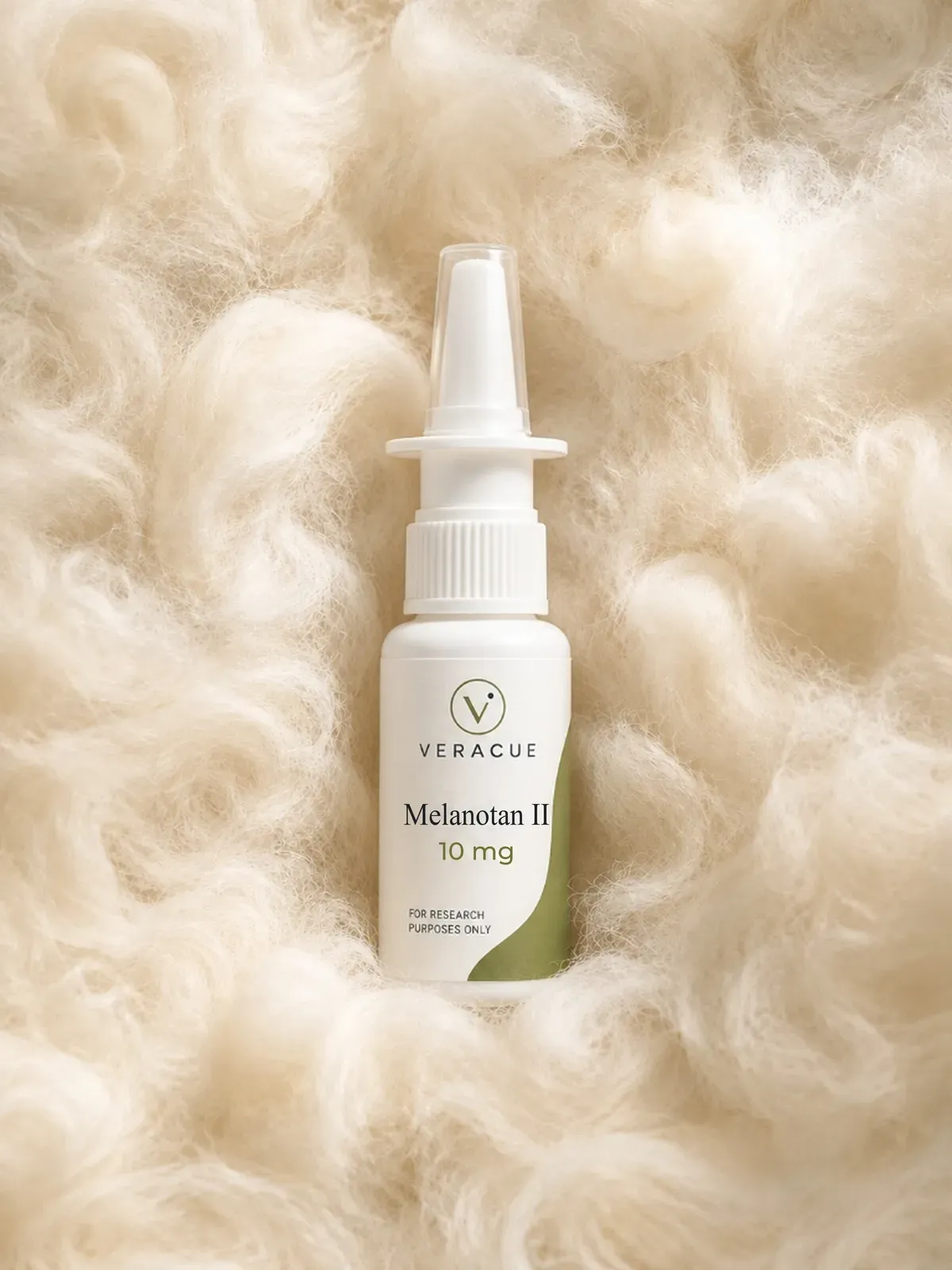
A certificate describes one lot. Check that its lot number matches the bottle you received, then look for the compound name, test date, testing laboratory, named methods and, where mass spectrometry was run, the observed and expected masses with the ion and charge state stated. The label on Veracue’s bottle gives the compound name, the 10 mg strength and a research-purposes-only statement.
Published lot records are listed in the certificate library. If the PT-141 lot you hold is not there, ask for its documentation through the contact page, and include any figure you need stated in writing, such as concentration.
PT-141 Spray is sold for laboratory research and analytical work only. It is not for human or veterinary use, and it is not a drug, cosmetic, supplement or food. Veracue provides no dosing, administration or usage guidance of any kind for this or any other research material.
The information on this listing is limited to molecular identity, structural comparison and analytical verification. See the Medical Disclaimer and the Terms and Conditions for sitewide policies.

RESEARCH PEPTIDE
Spray bottle pairing a 29-residue GHRH analog with the pentapeptide Ipamorelin, 5 mg of each and 45 sprays per bottle. Laboratory research use only.

RESEARCH PEPTIDE
GLP-T Spray pairs a 39-residue peptide, LY3298176 (CAS 2023788-19-2), with a C20 diacid on lysine 20. 10 to 60 mg, research use only, 45 sprays a bottle.

RESEARCH PEPTIDE
A 28-residue, N-acetylated peptide at 3108.3 g/mol, spray-dispensed in a 10 mg bottle with 45 sprays. Supplied for research use only.

RESEARCH PEPTIDE
Seven residues, a lactam ring and an amide terminus: Melanotan II, CAS 121062-08-6, in a 10 mg bottle of 45 sprays. Laboratory research only.