NAD+ and AHK-Cu in Metabolic and Longevity Research: A Deep Dive
A research overview of NAD+ and AHK-Cu covering mitochondrial metabolism, sirtuin activation, copper-peptide signaling, and laboratory handling protocols.

H-Frag, also written HGH Fragment 176-191, is a synthetic 16-residue peptide with the sequence FLRIVQCRSVEGSCGF, copied from the closing stretch of the 191-residue human growth hormone chain. Its two cysteines form a disulfide ring, giving the free peptide the formula C78H123N23O22S2, an average mass of 1799.1 g/mol and CAS 66004-57-7. It begins with phenylalanine, which separates it from AOD 9604, whose first residue is tyrosine and whose mass sits near 1815.1 g/mol. Veracue supplies H-Frag as a 5 mg vial, strictly for laboratory research use only.
Ask for the analytical documentation of any lot.
HPLC is the method used to measure purity
Ask for the report for a specific lot through the contact page
Supplied for laboratory research use only
Mass spectrometry is the method used to confirm identity
H-Frag is the short name for HGH Fragment 176-191, a synthetic peptide of sixteen amino acids copied from the C-terminal end of human growth hormone. Counting from the first residue of the mature hormone, positions 176 to 191 read Phe-Leu-Arg-Ile-Val-Gln-Cys-Arg-Ser-Val-Glu-Gly-Ser-Cys-Gly-Phe, or FLRIVQCRSVEGSCGF in one-letter code. The two cysteines, positions 7 and 14 of the peptide and 182 and 189 of the hormone, are joined by an intramolecular disulfide bond.
The same material turns up as H Frag, HGH Frag, hGH Fragment 176-191, Fragment 176-191 and GH Fragment 176-191. All of these point at one native, unmodified sequence. Veracue supplies it as a single defined compound for research use only.
| Product name | H-Frag (also H Frag, HGH Frag, hGH Fragment 176-191) |
| Peptide length | 16 residues, linear sequence with one internal disulfide ring |
| Sequence | Phe-Leu-Arg-Ile-Val-Gln-Cys-Arg-Ser-Val-Glu-Gly-Ser-Cys-Gly-Phe (FLRIVQCRSVEGSCGF) |
| Source segment | Residues 176 to 191 of mature human growth hormone |
| Disulfide bond | Cys7 to Cys14 of the peptide (Cys182 to Cys189 of the hormone) |
| Chain ends | Free N-terminal amine and free C-terminal carboxylic acid |
| Molecular formula (free peptide) | C78H123N23O22S2 |
| Molecular weight (average) | About 1799.10 g/mol |
| Monoisotopic mass | About 1797.87 Da |
| CAS Registry Number | 66004-57-7 |
| Size offered | 5 mg vial |
| Research designation | Research Use Only |
Formula and masses are reference values for the free peptide with its disulfide intact, and they follow directly from the sequence. They describe the molecule rather than a specific lot. The chemical form, purity, lot number and storage conditions for a particular vial are reported on its own documentation, which you can request through the contact page.
Phenylalanine, arginine, valine, cysteine, serine and glycine each appear twice in the chain, while leucine, isoleucine, glutamine and glutamic acid appear once. Two arginines against a single glutamate leave the peptide mildly basic, with a net charge near +1 at neutral pH once the free amine and free carboxylate at the two ends cancel each other. There is no lysine, proline, histidine, methionine, tryptophan or tyrosine anywhere in the sequence.
The Cys7 to Cys14 bridge closes eight residues, Cys-Arg-Ser-Val-Glu-Gly-Ser-Cys, into a ring. That leaves Phe-Leu-Arg-Ile-Val-Gln trailing at the front and Gly-Phe at the back. In the intact hormone the same two cysteines, numbered 182 and 189, form its C-terminal disulfide. For analysis the ring has a practical consequence: a closed peptide is two hydrogen atoms lighter than the open-chain form, so a reading near 1801.1 instead of 1799.1 points to a ring that has been reduced.
The numbers are residue positions in the mature hormone, counted from 1 to 191, and both ends are included. Positions 176 through 191 therefore make sixteen residues, and the shorter 177-191 stretch starts at leucine. Because position 176 is phenylalanine, the first letter of the sequence is the quickest identity check for H-Frag.
Listings frequently treat H-Frag and AOD 9604, also written AOD-9604 or AOD9604, as one compound. They share fifteen residues, yet they are two molecules with separate records.
| Feature | H-Frag | AOD 9604 |
|---|---|---|
| First residue | Phenylalanine | Tyrosine |
| Sequence | FLRIVQCRSVEGSCGF | YLRIVQCRSVEGSCGF |
| Hormone positions covered | 176 to 191, unmodified | 177 to 191, with an added N-terminal tyrosine |
| Disulfide bond | Cys7 to Cys14 | Cys7 to Cys14 |
| Molecular formula (free peptide) | C78H123N23O22S2 | C78H123N23O23S2 |
| Average mass | About 1799.10 g/mol | About 1815.1 g/mol |
| Monoisotopic mass | About 1797.87 Da | About 1813.86 Da |
| CAS Registry Number | 66004-57-7 | 221231-10-3 |
The whole difference is one hydroxyl group on the aromatic ring at the first position. That adds a single oxygen atom and about 16 Da, a gap that a mass spectrometer resolves easily, which is why a lot’s measured mass settles the question better than any product name. Findings reported for one peptide should not be carried over to the other.
| Feature | H-Frag | Full-length growth hormone |
|---|---|---|
| Length | 16 residues | 191 residues |
| Share of the hormone chain | About 8 percent, positions 176 to 191 | The complete chain |
| Structure | Short peptide closed by one disulfide ring | Folded protein |
| Relationship | Segment copied from the C-terminal end | The parent protein that segment comes from |
A sixteen-residue peptide is not a scaled-down copy of the hormone, and a result obtained with the intact protein tells you nothing automatic about the fragment. Whenever results are compared, name the exact material by sequence or CAS number.
Because HGH Fragment 176-191 and AOD 9604 are confused so often, write the sequence, formula and measured mass next to the product name in any methods note. Veracue offers molecular reference information only, and gives no dosing, administration or usage guidance of any kind.

For a peptide this small, identity comes down to mass. Reverse-phase HPLC reports how much of a sample elutes as one main peak, but a clean peak does not say which molecule it is. Mass spectrometry does, and the expected values for H-Frag are easy to tabulate next to its two nearest neighbors.
| Species | Average mass (g/mol) | Monoisotopic mass (Da) | [M+2H]2+ (m/z) | [M+3H]3+ (m/z) |
|---|---|---|---|---|
| H-Frag, disulfide closed | 1799.10 | 1797.87 | 899.94 | 600.30 |
| H-Frag, ring opened (reduced) | 1801.12 | 1799.88 | 900.95 | 600.97 |
| AOD 9604, disulfide closed | 1815.10 | 1813.86 | 907.94 | 605.63 |
Electrospray spectra usually show multiply charged ions rather than the neutral mass, so convert an observed m/z back to a neutral mass before comparing it with the table. A shift of about 2 Da suggests the ring has opened, and a shift of about 16 Da suggests the tyrosine analogue. A single number is a pointer, not a verdict, and tandem MS fragment data that place the first residue add the sequence evidence.
Neither the HPLC trace nor the mass alone describes a lot completely. Together they tell a researcher what the main component is and how much of the detected material it accounts for.
A certificate speaks for one lot only, so begin by checking that its lot number matches the vial and your order record. Then look for these items.
Results, form and storage conditions are reported on each lot’s own documentation, and the certificate page explains how to request it.
Registry numbers are filed under named substances, and some catalog entries attach this number to a salt-form name such as the trifluoroacetate rather than to the free peptide. A salt adds mass, so a lot reported as a salt will not read 1799.1. Compare the observed mass with the expected mass for the form the document states.
No. Purity and identity are separate measurements, and a sharp HPLC peak can belong to a closely related peptide. Look for a purity figure and a mass result from the same lot, reported side by side.
Keep the sequence or CAS number printed on the document, the observed mass, the stated form, the lot number and the receipt date. With those fields on file, a mix-up between H-Frag and its tyrosine analogue would show up at once.
Ask the Veracue team about the paperwork available for a lot, or browse the published certificates.
H-Frag is supplied for laboratory research and analytical characterization only. It is not intended for human or veterinary use, and it is not a drug, dietary supplement, cosmetic or food. Veracue provides no dosing, administration or usage guidance of any kind. Buyers must be qualified researchers or institutions and must handle the material in line with all applicable laws. See the Medical Disclaimer and the Terms and Conditions for sitewide policies.
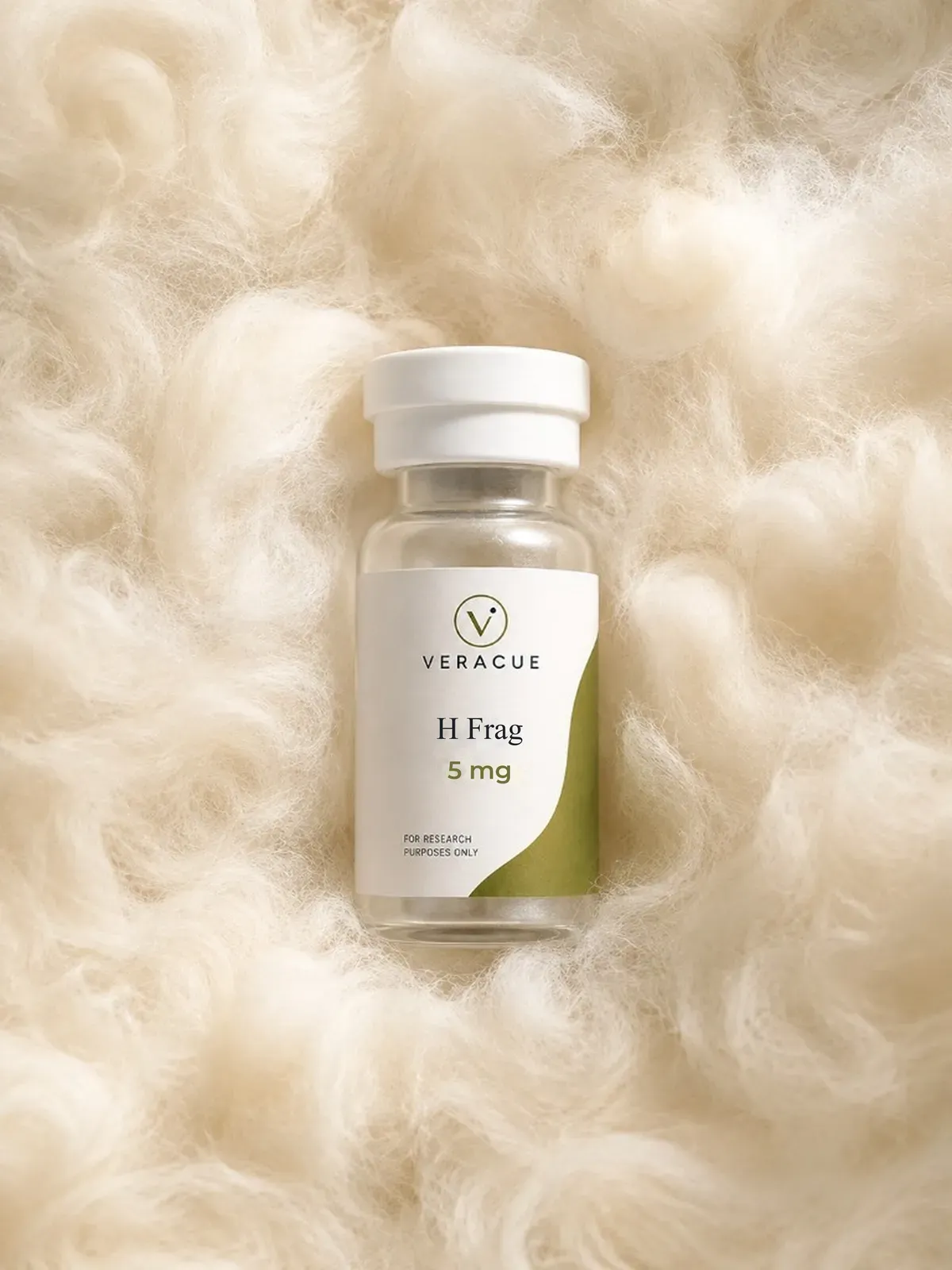
The identity information here, covering sequence, ring structure, formula, mass and CAS number, describes the H-Frag molecule in general. It cannot establish the purity, content or chemical form of any single vial. Those facts come only from the documentation issued for that lot, which is why certificate checks are always tied to a lot number.
H-Frag is also not a substitute for any other growth hormone fragment. Each related peptide has its own sequence and records, and each should be sourced and documented under its own name.

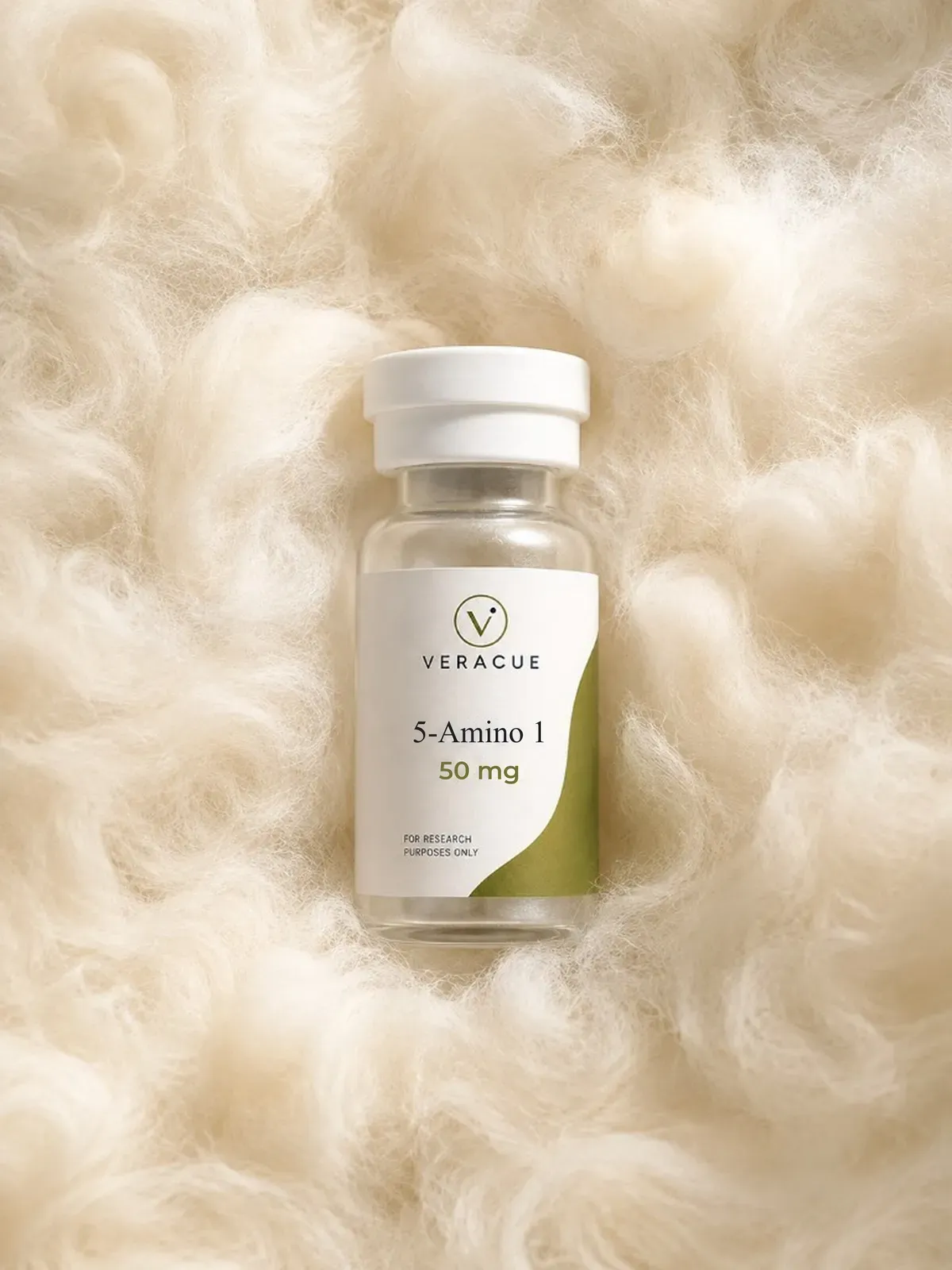
RESEARCH PEPTIDE
Not a peptide: 5-Amino-1MQ is a quinolinium cation, C10H11N2+ (159.21 g/mol); its iodide salt is 286.11. Check the form. Laboratory research, 50 mg.

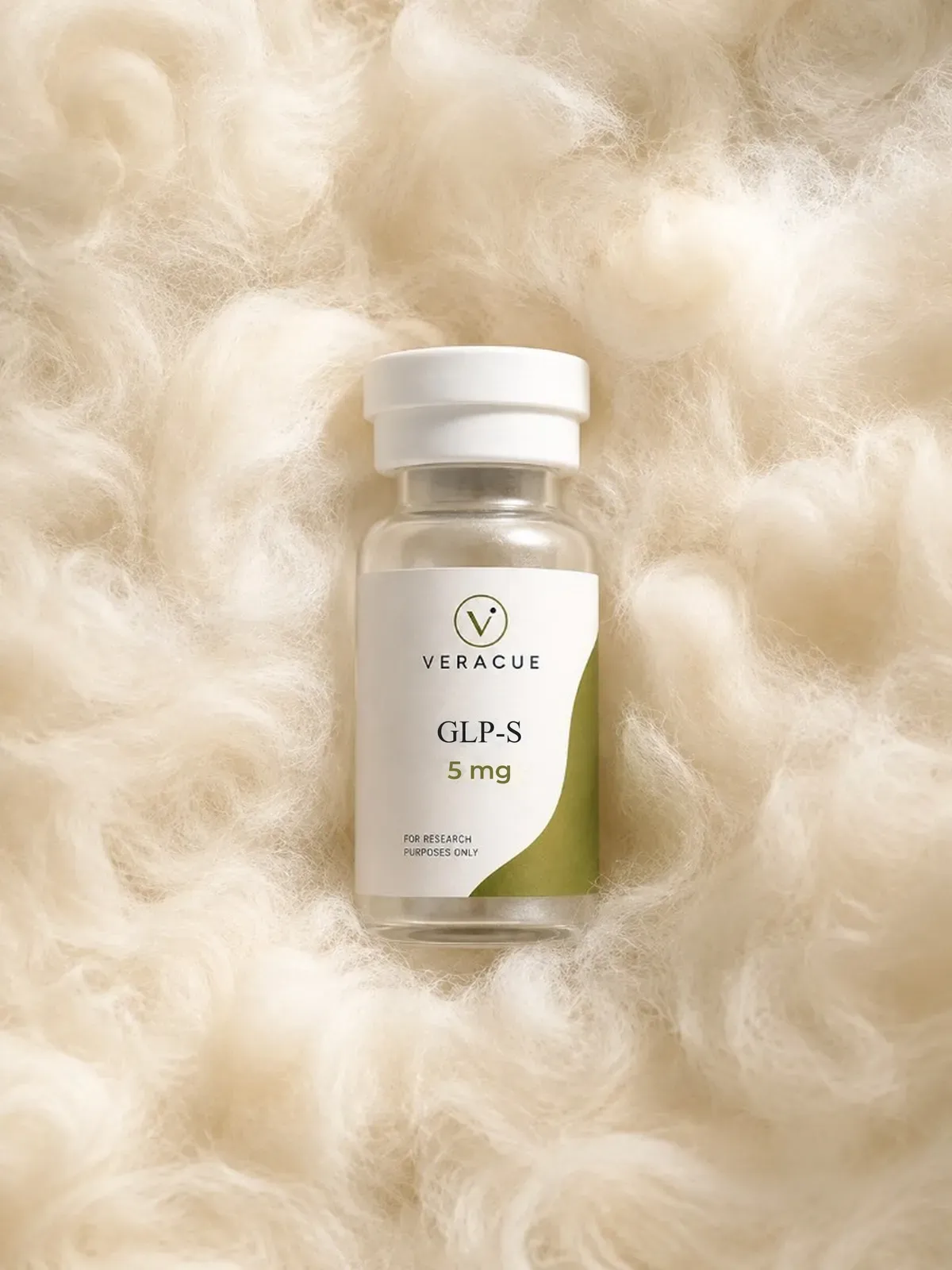
RESEARCH PEPTIDE
GLP-S is a 31-residue GLP-1 analog with a C18 diacid on lysine 26 (C187H291N45O59, CAS 910463-68-2). Available from 5 to 30 mg, research use only.

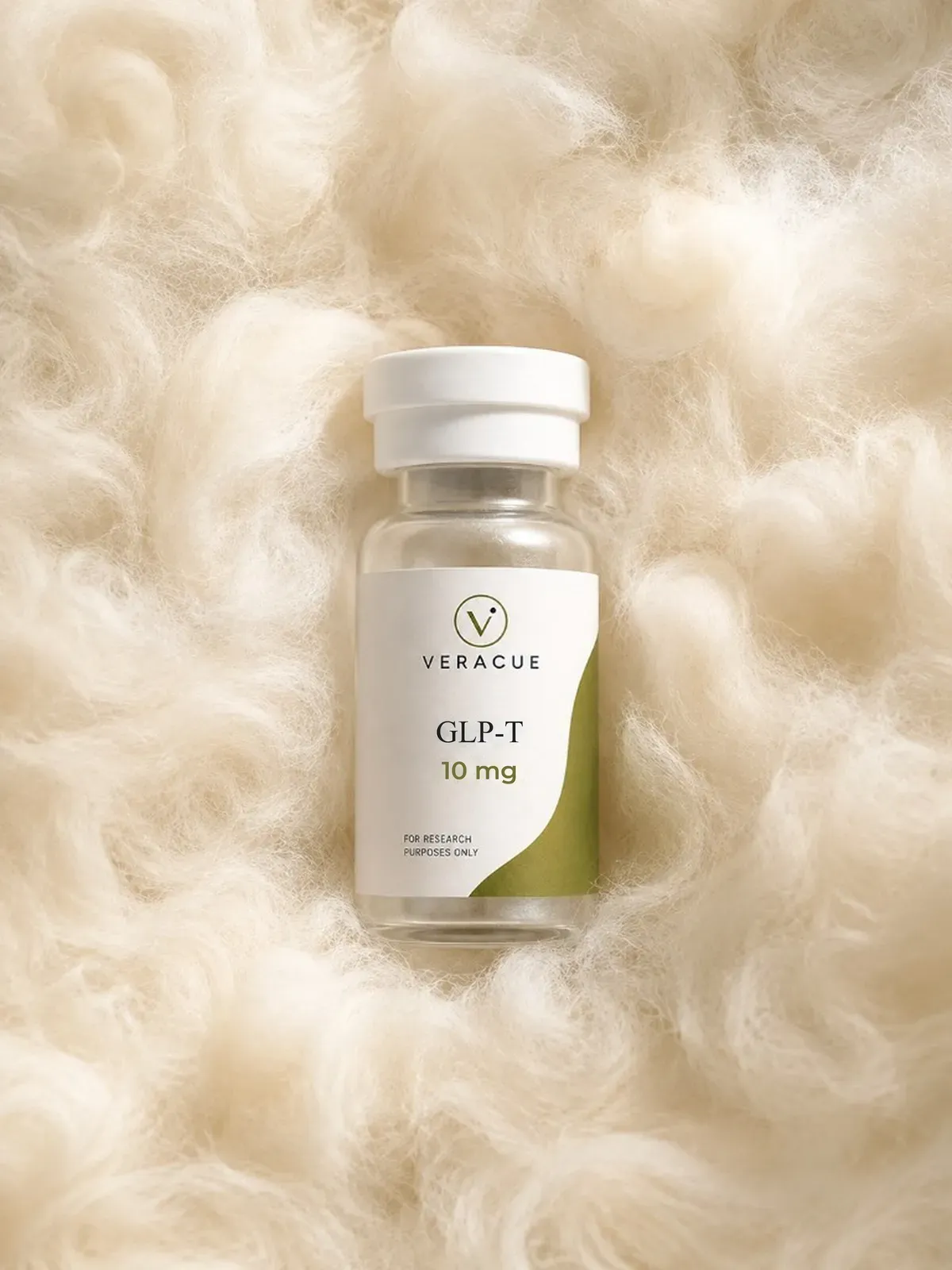
RESEARCH PEPTIDE
GLP-T (LY3298176) is a 39-residue peptide with a C20 fatty diacid, CAS 2023788-19-2. See the COA notes. 10 to 60 mg, research use only.

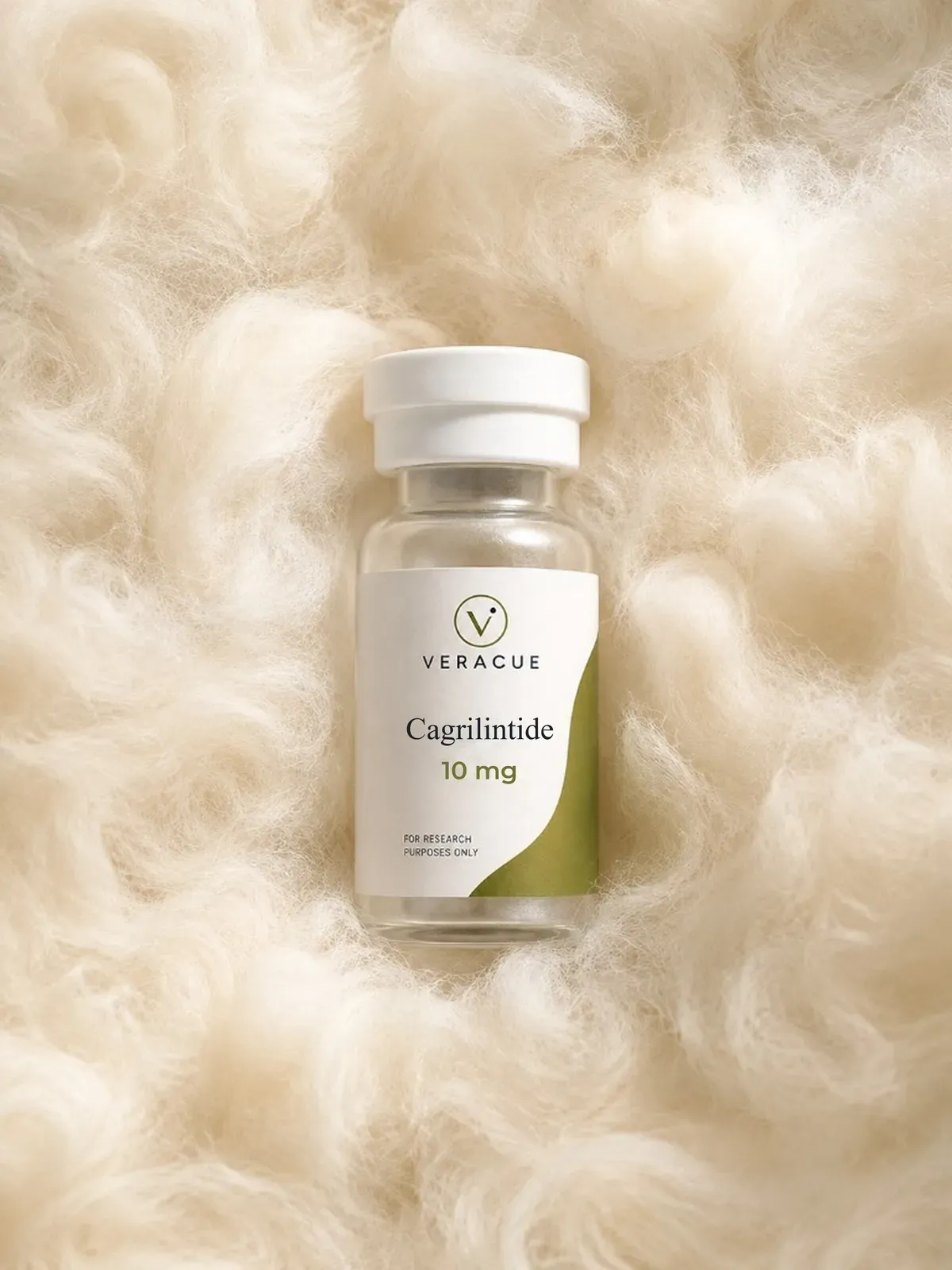
RESEARCH PEPTIDE
Cagrilintide (AM833) is a 37-residue lipidated peptide (CAS 1415456-99-3). Read the identity data and COA checks. 10 mg vial, research use only.