NAD+ and AHK-Cu in Metabolic and Longevity Research: A Deep Dive
A research overview of NAD+ and AHK-Cu covering mitochondrial metabolism, sirtuin activation, copper-peptide signaling, and laboratory handling protocols.

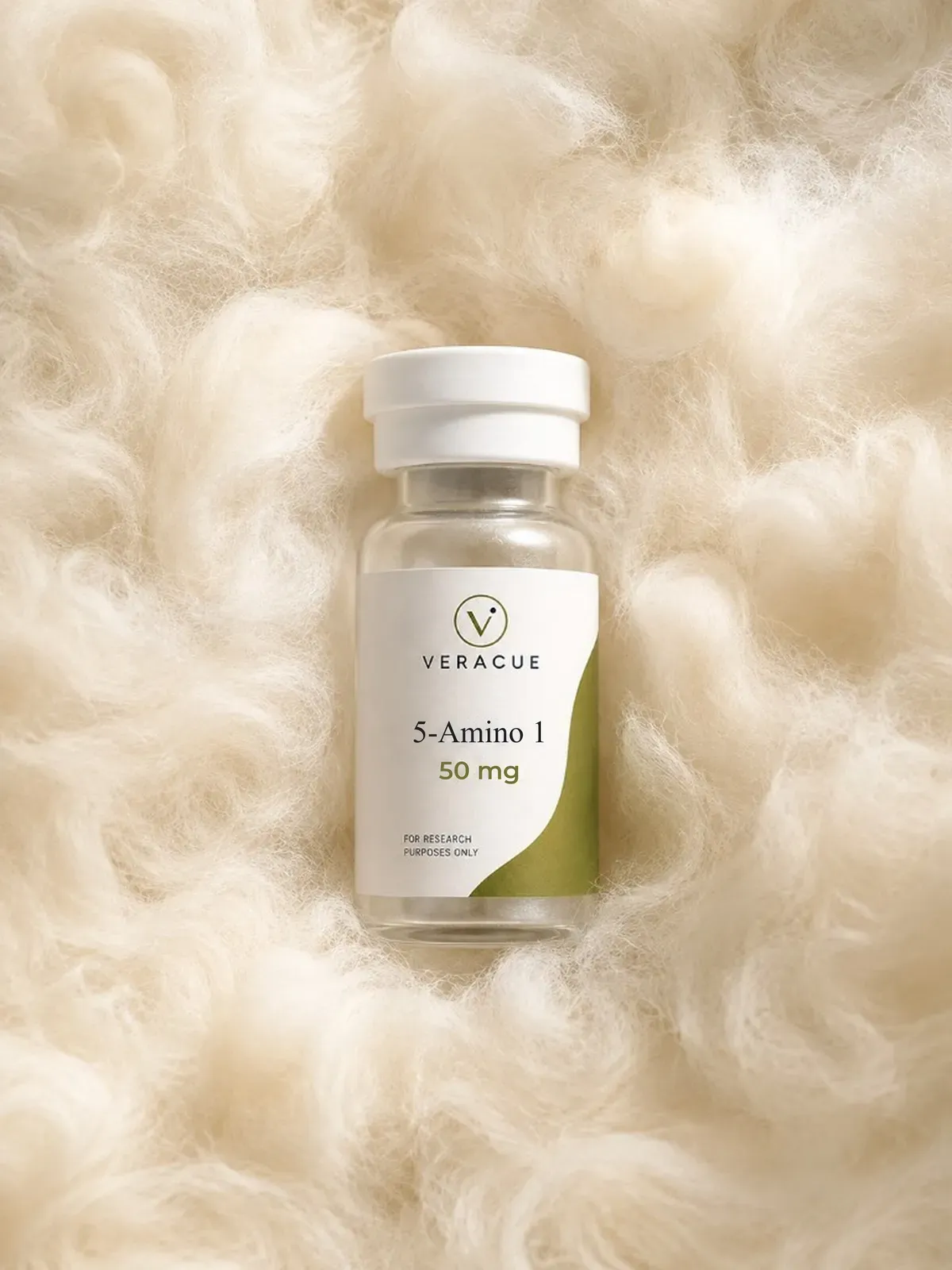
5-Amino-1MQ is a quinoline-based organic cation, formally 5-amino-1-methylquinolinium, with no amino acid sequence, so it is not a peptide. The cation has the formula C10H11N2+ and an average mass near 159.21 g/mol (PubChem CID 950107); its iodide salt, C10H11IN2, weighs 286.11 g/mol and is registered as CAS 42464-96-0 (PubChem CID 66522933), which is why two molar masses circulate for one name. Researchers use it to probe the enzyme NNMT. Veracue supplies 5-Amino-1MQ as a 50 mg vial, strictly for laboratory research use only.
Ask for the analytical documentation of any lot.
HPLC is the method used to measure purity
Ask for the report for a specific lot through the contact page
Supplied for laboratory research use only
Mass spectrometry is the method used to confirm identity
Behind the abbreviation 5-Amino-1MQ is a compact organic ion built on quinoline, a benzene ring fused to a pyridine ring. A methyl group sits on the ring nitrogen, which gives that nitrogen a permanent positive charge, and an amino group is attached at position 5 on the benzene-derived half of the ring system. The result is a cation with the formula C10H11N2+, not a neutral molecule.
There is no chain of residues here, no peptide bond and nothing to sequence, so it is not a peptide, even though catalogs and search results often shelve it beside peptides. Chemically it is a small-molecule enzyme probe, and the checks that matter for it are structural and mass-based rather than sequence-based. Veracue supplies it for research use only.
Each part of the name carries structure. "1MQ" stands for 1-methylquinolinium, the parent ring system, and "5-Amino" places the amine on carbon 5. Related members of the methylquinolinium family carry amino or methyl groups at other positions, so shorthand such as 5A1MQ or 5 amino 1MQ should be checked against the full systematic name before results from two sources are compared.
| Product name | 5-Amino-1MQ |
| Systematic name | 5-Amino-1-methylquinolinium |
| Other spellings | 5A1MQ, 5 amino 1MQ |
| Compound class | Small organic cation, not a peptide |
| Cation formula | C10H11N2+ |
| Cation average mass | About 159.21 g/mol |
| Cation PubChem CID | 950107 |
| Iodide salt formula | C10H11IN2 |
| Iodide salt average mass | 286.11 g/mol |
| Iodide salt CAS Registry Number | 42464-96-0 |
| Iodide salt PubChem CID | 66522933 |
| Supplied size | 50 mg vial |
| Research designation | Research Use Only |
These are database reference values for the cation and for its iodide salt, not measurements from a specific Veracue lot. Which form a given vial contains, together with its purity and lot number, is stated on that lot’s own documentation, and the team can be reached on the contact page.
NNMT, short for nicotinamide N-methyltransferase (EC 2.1.1.1), works in the cell’s cytosol. Its reaction is a single methyl transfer: the donor is S-adenosylmethionine (SAM), the cell’s main source of methyl groups, and the acceptor is nicotinamide. The outcome is 1-methylnicotinamide (1-MNA) plus S-adenosylhomocysteine (SAH).
| Molecule | Role in the NNMT reaction | Why it matters to the wider pathway |
|---|---|---|
| Nicotinamide | Methyl acceptor (substrate) | Also the starting material recycled in NAD+ salvage |
| SAM | Methyl donor (co-substrate) | Also supplies methyl groups to many other methylation reactions |
| 1-MNA | Product | Commonly measured as a readout of NNMT activity |
| SAH | Co-product | Left behind when SAM gives up its methyl group |
Because nicotinamide and SAM are both drawn on by other pathways, NNMT is treated as a point where NAD+ supply and cellular methylation capacity meet. Nicotinamide that is methylated here becomes 1-MNA instead of being recycled toward NAD+.
5-Amino-1MQ comes from a series of methylquinolinium compounds developed as NNMT inhibitors. Characterization of the series reported that analogues carrying primary amine groups crossed membranes readily, and that they did not inhibit the related SAM-dependent methyltransferases or the NAD+ salvage enzymes that were tested. That selectivity is why the compound is used to ask a narrow question: what changes in an enzyme assay or a cell when the NNMT step is blocked and its neighbors are left alone.
In cultured cells, the readouts that have been followed are the NNMT product 1-MNA, intracellular NAD+ and SAM. Lower 1-MNA together with higher NAD+ and SAM is the pattern reported for inhibitors of this series in that work, and it is the mechanistic reason for the research interest.
Published reports on this compound and its series sit in enzyme assays, cultured cells and rodent models. Each describes one system, one set of conditions and one readout, so a result is best read as a statement about that system. Proposed explanations, such as NNMT inhibition changing how much nicotinamide and SAM a cell has to work with, remain open questions, not established facts. Veracue offers molecular reference information only, and provides no dosing, administration or usage guidance of any kind.
Before comparing a paper with your own work, confirm the following:
On a mass basis the cation makes up only about 56 percent of the iodide salt (159.21 of 286.11), so a figure quoted for one form cannot be carried over to the other without correcting for the counter-ion.
Documentation for a peptide leans on sequence confirmation and on multiply charged ions in the mass spectrum. None of that applies to 5-Amino-1MQ. For a small cation the verification questions are narrower: how dominant the main chromatographic peak is, whether the measured mass matches the cation, and which counter-ion accompanies it in the weighed solid.
| Check | What it establishes | What it leaves open |
|---|---|---|
| Reverse-phase HPLC | Share of the detected signal that sits in the main peak, under stated conditions | Identity, and anything the detector does not register, such as counter-ion or water |
| Positive-mode ESI or LC-MS | That the cation is present, at about m/z 159.09 | Which positional isomer it is, since isomers share one mass; also the counter-ion |
| Stated chemical form | Whether the lot is the bare cation or a named salt, and so which formula weight applies | Nothing by itself unless the method behind the statement is named |
| Lot number, laboratory and test date | That the results trace to the vial in hand | Results for any other lot |
| Species | Formula | Average mass | How it shows up |
|---|---|---|---|
| 5-Amino-1MQ cation | C10H11N2+ | About 159.21 g/mol | One positive ion near m/z 159.09 (monoisotopic) in positive mode |
| Iodide salt, as weighed | C10H11IN2 | 286.11 g/mol | The same cation at the same m/z; the iodide anion registers only near m/z 126.9 in negative mode |
| 1-Methylnicotinamide (NNMT product) | C7H9N2O+ | About 137.16 g/mol | A separate cation at a clearly different mass |
A salt reaches the mass spectrometer as its separate ions rather than as one intact formula unit, which is why a spectrum of the iodide salt still shows the cation near m/z 159 and not at 286.
An HPLC purity figure describes the organic signal the method detects. It does not account for the counter-ion, water or other components that add to the weighed mass of a salt, so a high purity percentage does not say how much cation a given weight of solid contains. Read it beside an identity result, the method conditions and the stated form.
A certificate describes one lot, so check the lot number before using any figure and confirm the form before choosing a formula weight. Purity, form and storage conditions for a vial are reported on its own documentation, and it can be requested through the certificate page.
It confirms that a cation of the right mass is present, but positional isomers such as other amino-1-methylquinolinium ions share that mass. Treat the mass result as one piece of identity evidence and look for a second, structure-sensitive one, such as a retention-time match to a reference standard.
The cation and its iodide salt differ by about 127 g/mol, the mass of the iodide (159.21 against 286.11). A calculation built on the wrong one is off by a factor of about 1.8, and a stated form removes the guesswork.
Keep the lot-specific certificate, the stated form, the receipt date and the experiments that used the material. A record like that makes lot-to-lot differences traceable when a result looks unexpected.
Ask the Veracue team which documentation is available for a specific lot, or look through the published certificates.

5-Amino-1MQ is supplied for laboratory research and analytical work only. It is not intended for human or veterinary use, or for ingestion, injection or any other form of administration, and it is not a drug, dietary supplement, cosmetic or food. Veracue provides no dosing, administration or usage guidance of any kind. Buyers must be qualified researchers or institutions and are responsible for lawful handling. Sitewide terms are set out in the Medical Disclaimer and the Terms and Conditions.
The research context given for this product is limited to chemistry and enzyme-level biology. It makes no claim about any effect in people or animals.

RESEARCH PEPTIDE
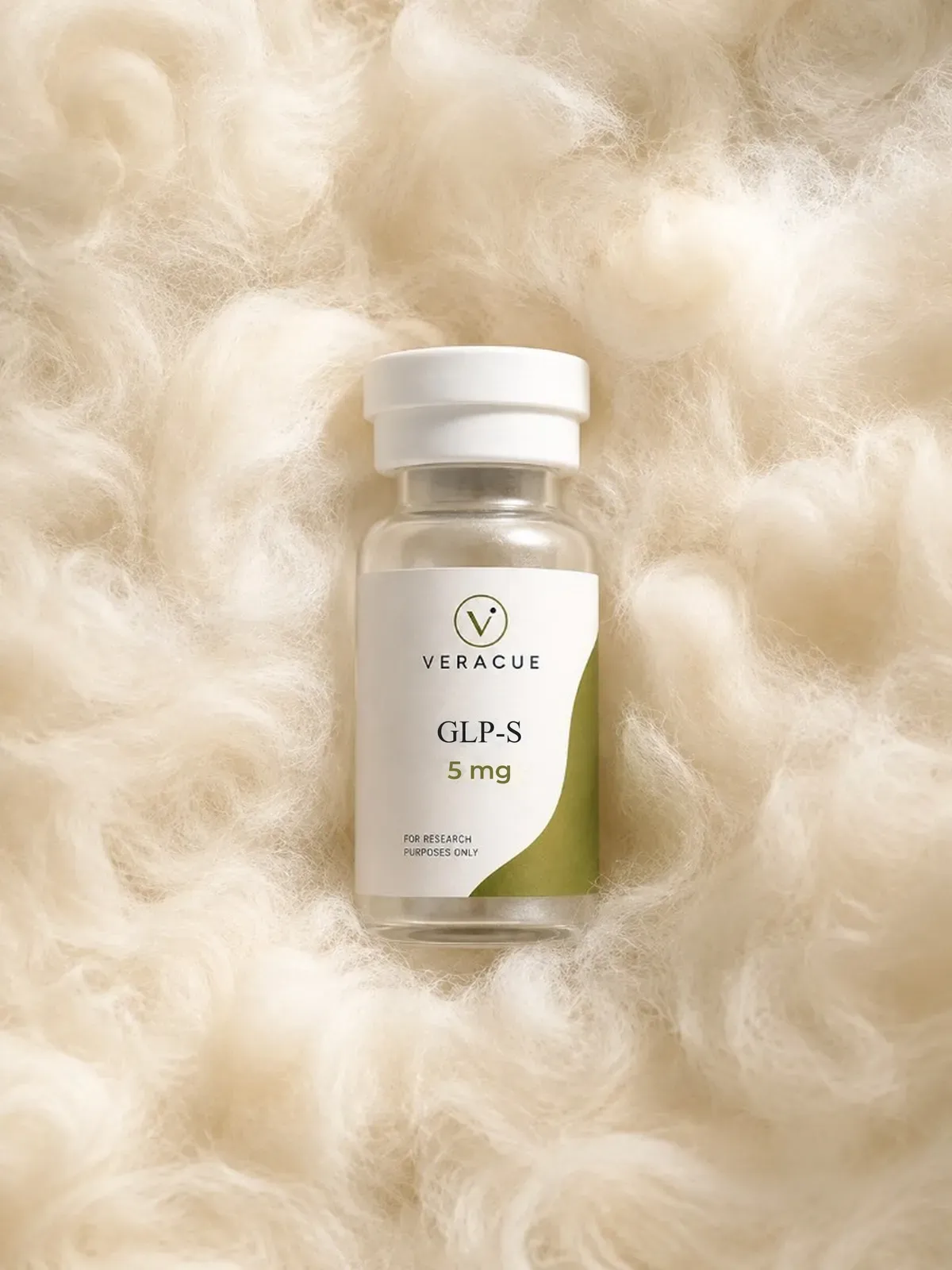
GLP-S is a 31-residue GLP-1 analog with a C18 diacid on lysine 26 (C187H291N45O59, CAS 910463-68-2). Available from 5 to 30 mg, research use only.

RESEARCH PEPTIDE
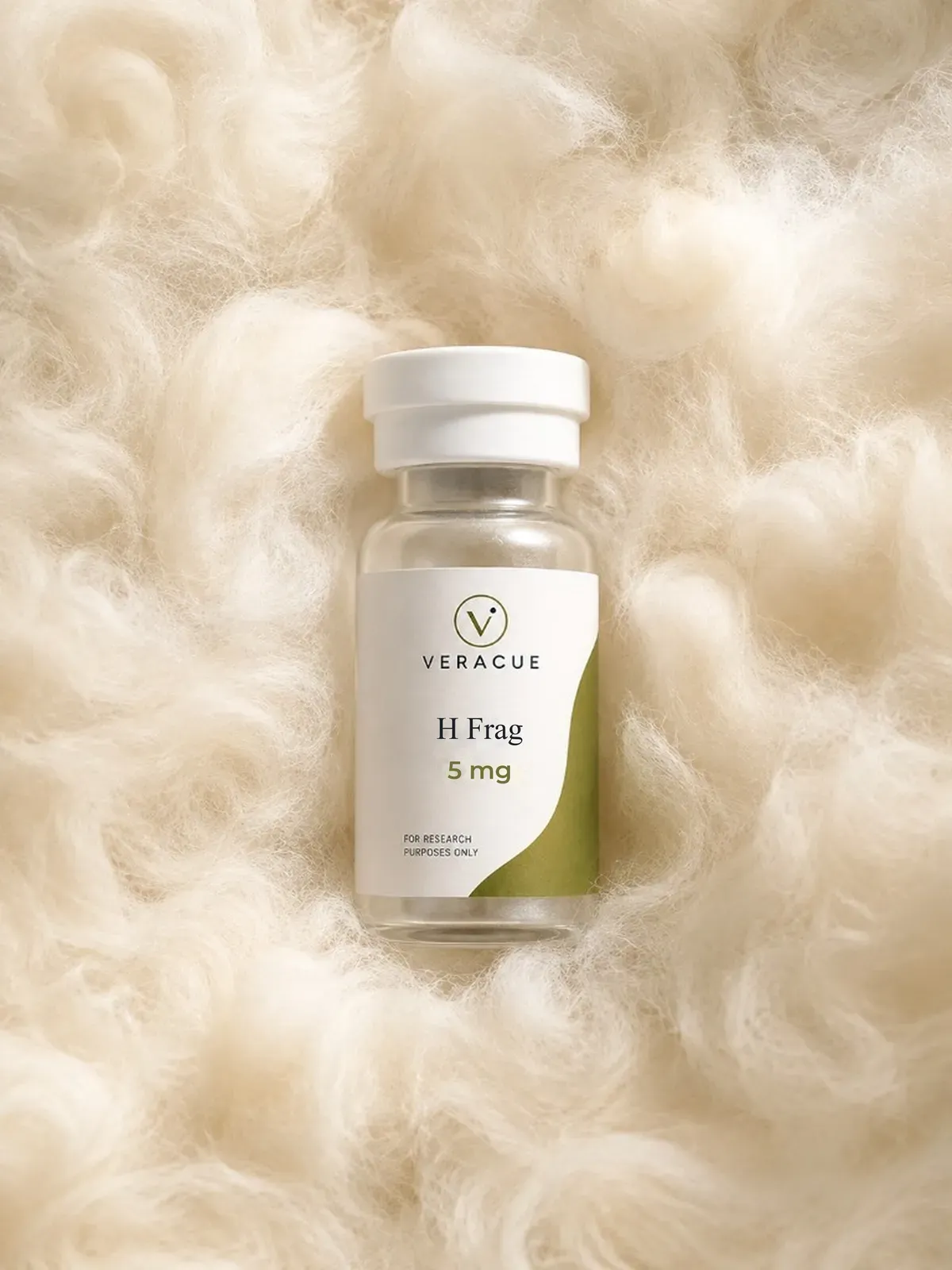
Is H-Frag just AOD 9604 under another name? No. It opens with Phe, not Tyr, and weighs 1799.1 g/mol (CAS 66004-57-7). A 5 mg vial for laboratory research.

RESEARCH PEPTIDE
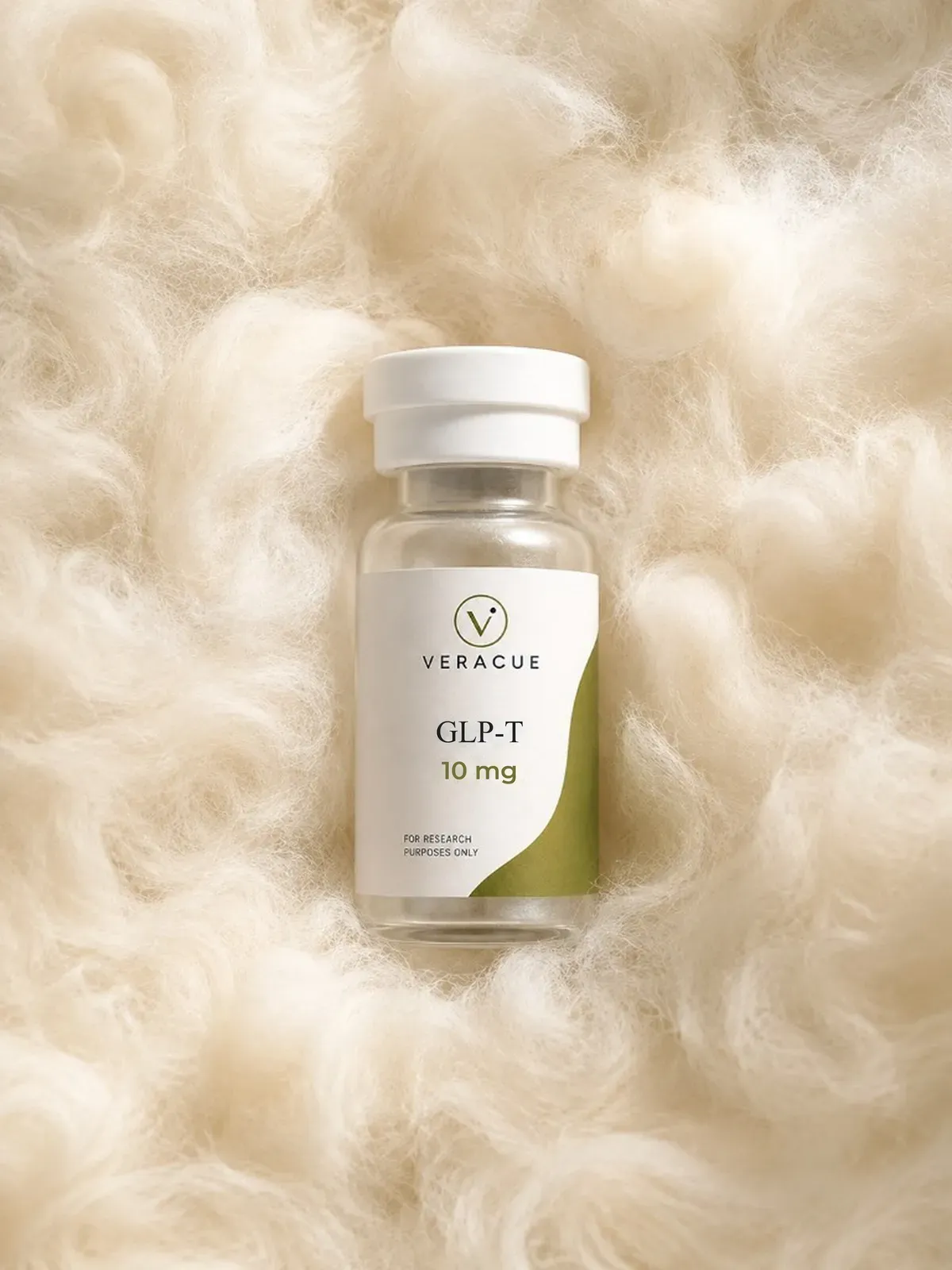
GLP-T (LY3298176) is a 39-residue peptide with a C20 fatty diacid, CAS 2023788-19-2. See the COA notes. 10 to 60 mg, research use only.

RESEARCH PEPTIDE
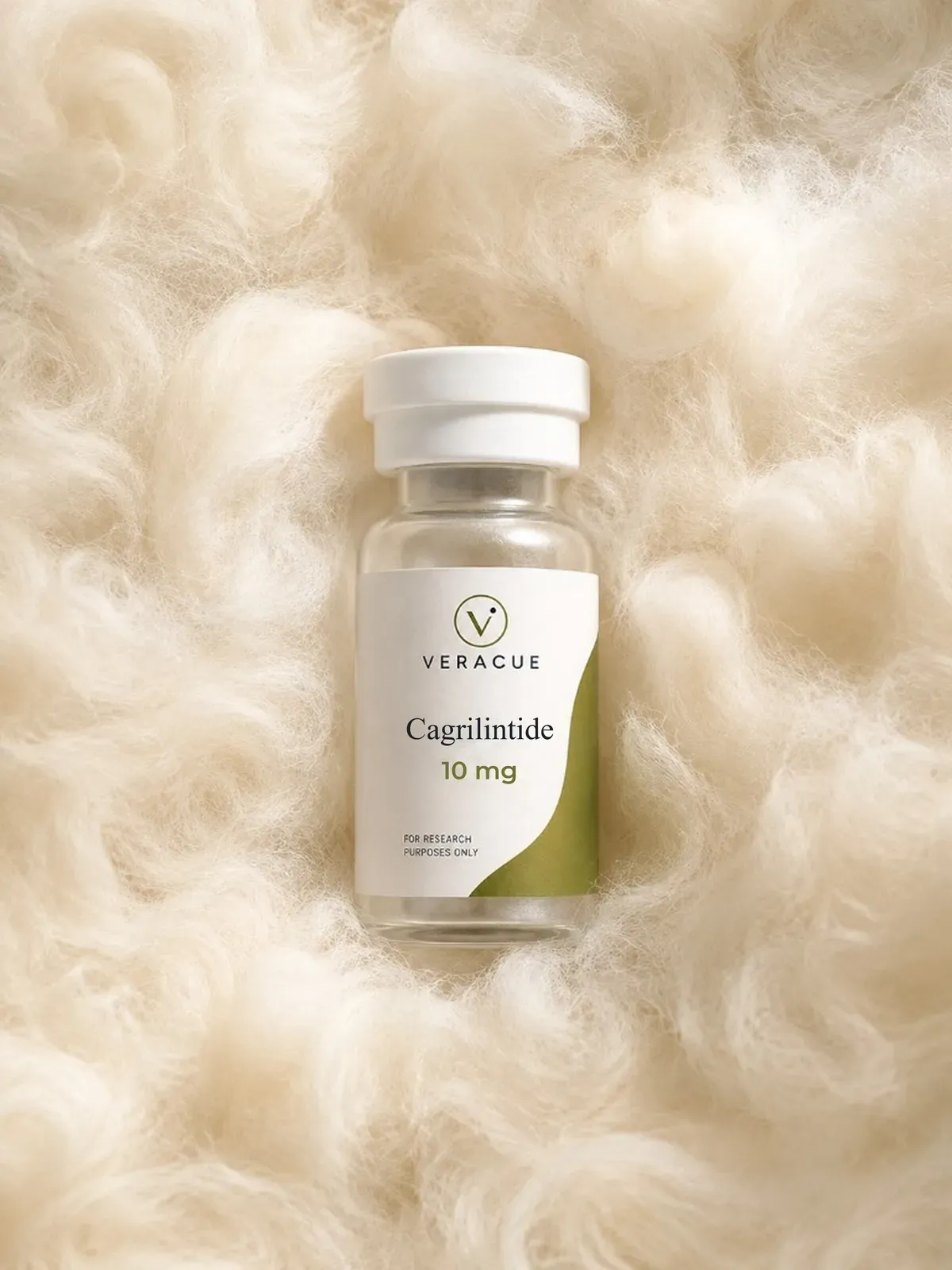
Cagrilintide (AM833) is a 37-residue lipidated peptide (CAS 1415456-99-3). Read the identity data and COA checks. 10 mg vial, research use only.