NAD+ and AHK-Cu in Metabolic and Longevity Research: A Deep Dive
A research overview of NAD+ and AHK-Cu covering mitochondrial metabolism, sirtuin activation, copper-peptide signaling, and laboratory handling protocols.

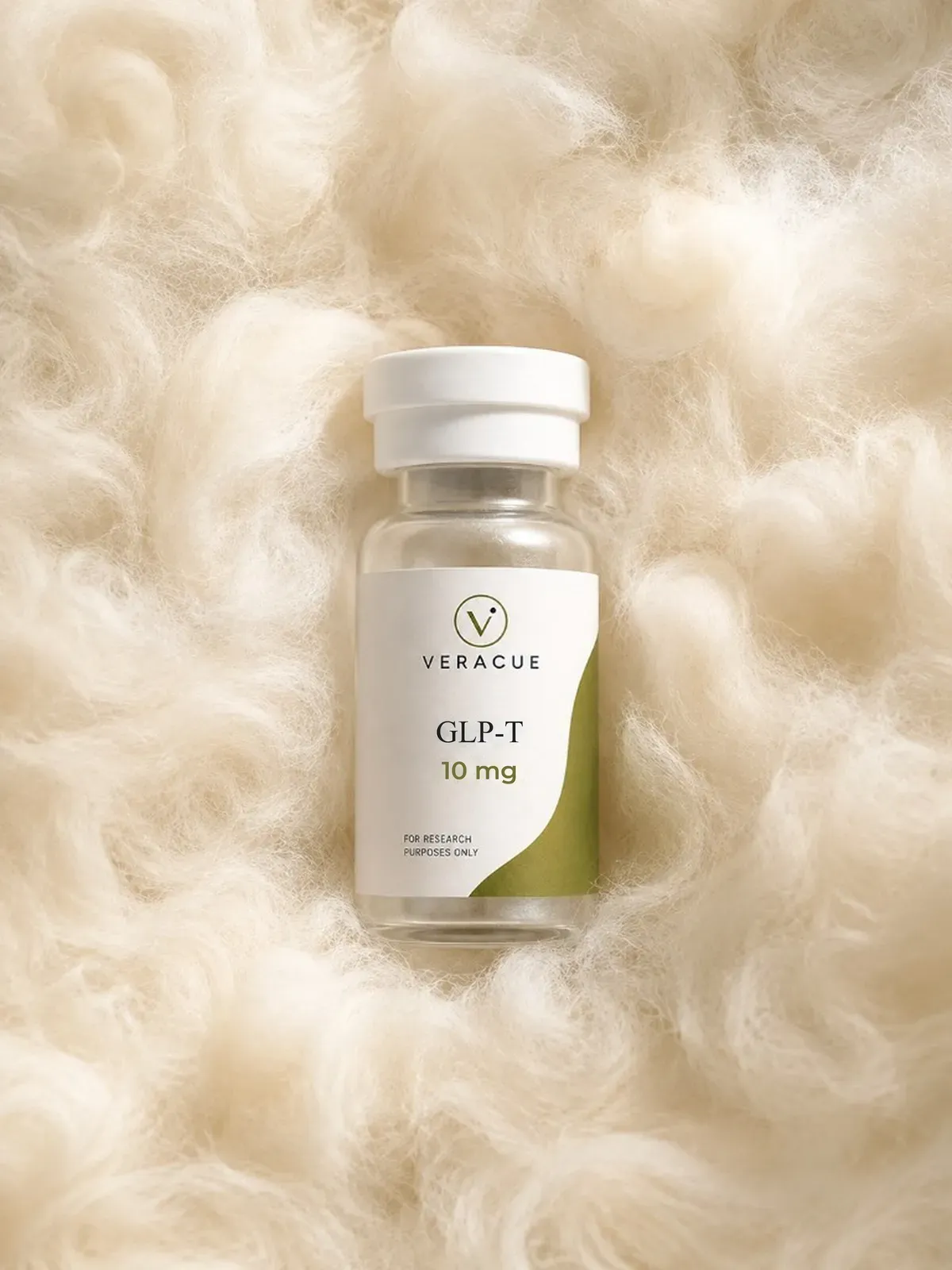
GLP-T is a synthetic 39-residue peptide built on the native GIP sequence, with aminoisobutyric acid at positions 2 and 13, a C-terminal amide and a C20 fatty diacid attached at lysine 20. Its formula is C225H348N48O68, its research code is LY3298176 and its CAS number is 2023788-19-2. It is easy to confuse with plain GIP or other lipid-modified incretin peptides, so identity is best checked against lot documentation. Vials come in 10, 20, 30 and 60 mg, for laboratory research use only.
Ask for the analytical documentation of any lot.
HPLC is the method used to measure purity
Ask for the report for a specific lot through the contact page
Supplied for laboratory research use only
Mass spectrometry is the method used to confirm identity
GLP-T is a synthetic 39-amino-acid peptide with the research code LY3298176 and CAS 2023788-19-2. It is built on the native GIP sequence, carries a C20 fatty diacid on lysine 20, and is studied as a dual GIP and GLP-1 receptor agonist in laboratory systems. Veracue supplies it for laboratory research only.
A name printed on a vial tells you what a material is called, not what it is. What proves identity is the analytical paperwork that belongs to the lot in your hands, which is why this page spends as much time on documentation as on structure.
| Product name | GLP-T |
| Research code | LY3298176 |
| Length | 39 amino acids |
| Backbone origin | Based on the native GIP sequence |
| Key substitutions | Aminoisobutyric acid (Aib) at positions 2 and 13 |
| C-terminus | Amide |
| Lipid attachment | Lysine 20 linked to 1,20-eicosanedioic acid (a C20 fatty diacid) through a linker |
| Molecular formula | C225H348N48O68 |
| Molecular weight (average) | About 4,813.5 g/mol (4813.53 and 4813.45 are both quoted) |
| Monoisotopic mass | About 4,810.52 Da |
| CAS Registry Number | 2023788-19-2 |
| PubChem CID | 156588324 |
| Research designation | Research Use Only |
Physical form, salt or counterion, purity, lot results and storage conditions are reported on the documentation for each lot. Request lot documentation through the contact page.
The backbone is a 39-residue peptide based on the native GIP sequence. Two positions, 2 and 13, hold aminoisobutyric acid (Aib) instead of a standard residue, and the C-terminus is an amide. Lysine 20 carries 1,20-eicosanedioic acid, a C20 fatty diacid, through a linker.
The diacid drives binding to albumin, which is the reason the molecule persists in biological test systems instead of clearing in minutes. It is also the part of the molecule most worth confirming analytically, since a peptide without the lipid would give a clearly different mass.
Published descriptions state a C-terminal amide. Some vendor pages state a free acid, which does not match. That is one more reason to ask what a lot report was compared against.
| Receptor | Full name | Role in this material |
|---|---|---|
| GIPR | Glucose-dependent insulinotropic polypeptide receptor | Agonist target in receptor assays |
| GLP-1R | Glucagon-like peptide-1 receptor | Agonist target in receptor assays |
GLP-T engages both the GIP receptor and the GLP-1 receptor from a single molecule, which is what makes it a dual agonist. The engagement is not symmetrical. A 2020 laboratory study described it as an imbalanced and biased dual agonist, with greater receptor occupancy at GIPR than at GLP-1R.
At GIPR, signaling resembled that of native GIP. At GLP-1R, the molecule favored cAMP generation over beta-arrestin recruitment and drove receptor internalization less strongly than GLP-1 itself. That detail matters to anyone designing an assay, because the readout you choose changes what you see.
No. The term describes the receptor profile of one molecule. Activity at GIPR and GLP-1R comes from a single lipidated structure, so it is best treated as a property of the intact peptide.
Typical uses include incretin receptor pharmacology, GIP and GLP-1 signaling assays in cell systems, and analytical method development for lipidated peptides. None of this is a handling or preparation instruction. It describes how the material is used in research settings.
A percentage on its own answers one narrow question. A useful certificate answers four: what the material is, how pure it is by a stated method, how much is in the vial, and whether the report belongs to your lot.
| COA element | What it establishes | What it does not establish |
|---|---|---|
| Lot or batch number | That the report belongs to a specific production lot | Anything at all, unless it matches the vial label |
| RP-HPLC purity (%) | Share of detected peak area under stated chromatographic conditions | Identity, net peptide content or biological activity |
| Stated HPLC method | Column, mobile phase, gradient and detection wavelength, which is what makes a figure comparable | That impurities not retained or not detected were absent |
| Mass spectrometry result | Whether the observed mass is consistent with the expected species | Purity, or the quantity of material present |
| Mass convention used | Which figure the observed mass was matched against, average or monoisotopic | Identity on its own |
| Net peptide content | How much of the vial’s mass is peptide rather than counterion, water or salts | Chromatographic purity |
| Counterion (commonly TFA or acetate) | What the remaining mass is | Peptide quality |
| Laboratory name and test date | Who ran the test and when | Independence, unless the relationship is disclosed |
Certificates vary between laboratories and testing programs, so treat this as what a COA may include rather than a fixed checklist. Where a lot-specific certificate exists, use it as the primary source for that lot. The certificate page explains how to request lot documentation.
Catalogs quote this molecule at 4813.53, 4813.45 and about 4810.52. None of them is wrong. They describe different measurements.
| Value | What it represents |
|---|---|
| 4813.53 Da | Average molecular weight, one commonly quoted figure |
| 4813.45 g/mol | Average molecular weight listed by reference-standard suppliers, from the same formula |
| About 4810.52 Da | Accurate (monoisotopic) mass, the figure a high-resolution mass spectrometer reports |
The gap between the first two is rounding in atomic mass tables applied to a 225-carbon molecule. The gap to the third is the difference between an averaged isotope distribution and the single lightest isotopologue. A COA that quotes an observed mass without saying which convention it used has left out what you need to judge it.
They answer different questions, and neither one replaces the other.
RP-HPLC separates the target peptide from related substances, truncated and deletion sequences and other chromatographic impurities. It supports a purity percentage under the stated conditions, but it does not say what the main peak actually is.
Mass spectrometry measures mass-to-charge behavior and shows whether the observed mass is consistent with the expected molecule, including the lipidated lysine 20 conjugate. It does not say how much of the sample is that molecule.
Run together, one supports identity and the other supports purity. Run alone, either leaves a gap, and neither speaks to sterility, endotoxin, residual solvents, water content or aggregation. A reported purity above 100 percent is a signal, not a rounding quirk, and is a reason to ask for the chromatogram and the method.
Ask the Veracue team about available documentation for a specific lot, or review the certificate library.

GLP-T is supplied for laboratory research use only. It is not a drug, cosmetic, dietary supplement or food, and it is not intended for human or veterinary use. It has not been evaluated by the FDA. This page contains no dosing, administration or usage guidance of any kind, and the scientific information here describes laboratory research and is not medical advice. See the Medical Disclaimer and the Terms and Conditions for sitewide policies.

RESEARCH PEPTIDE
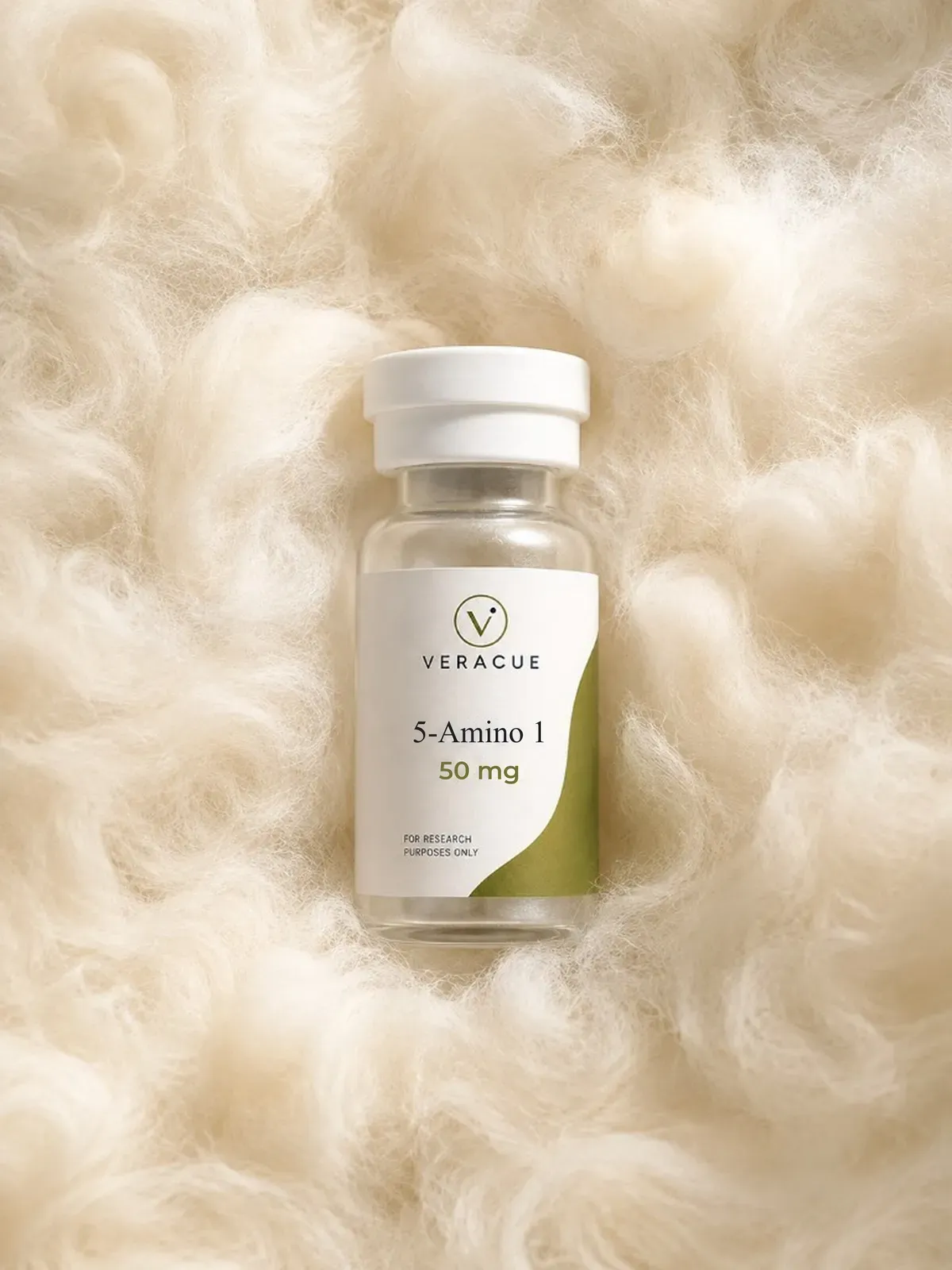
Not a peptide: 5-Amino-1MQ is a quinolinium cation, C10H11N2+ (159.21 g/mol); its iodide salt is 286.11. Check the form. Laboratory research, 50 mg.

RESEARCH PEPTIDE
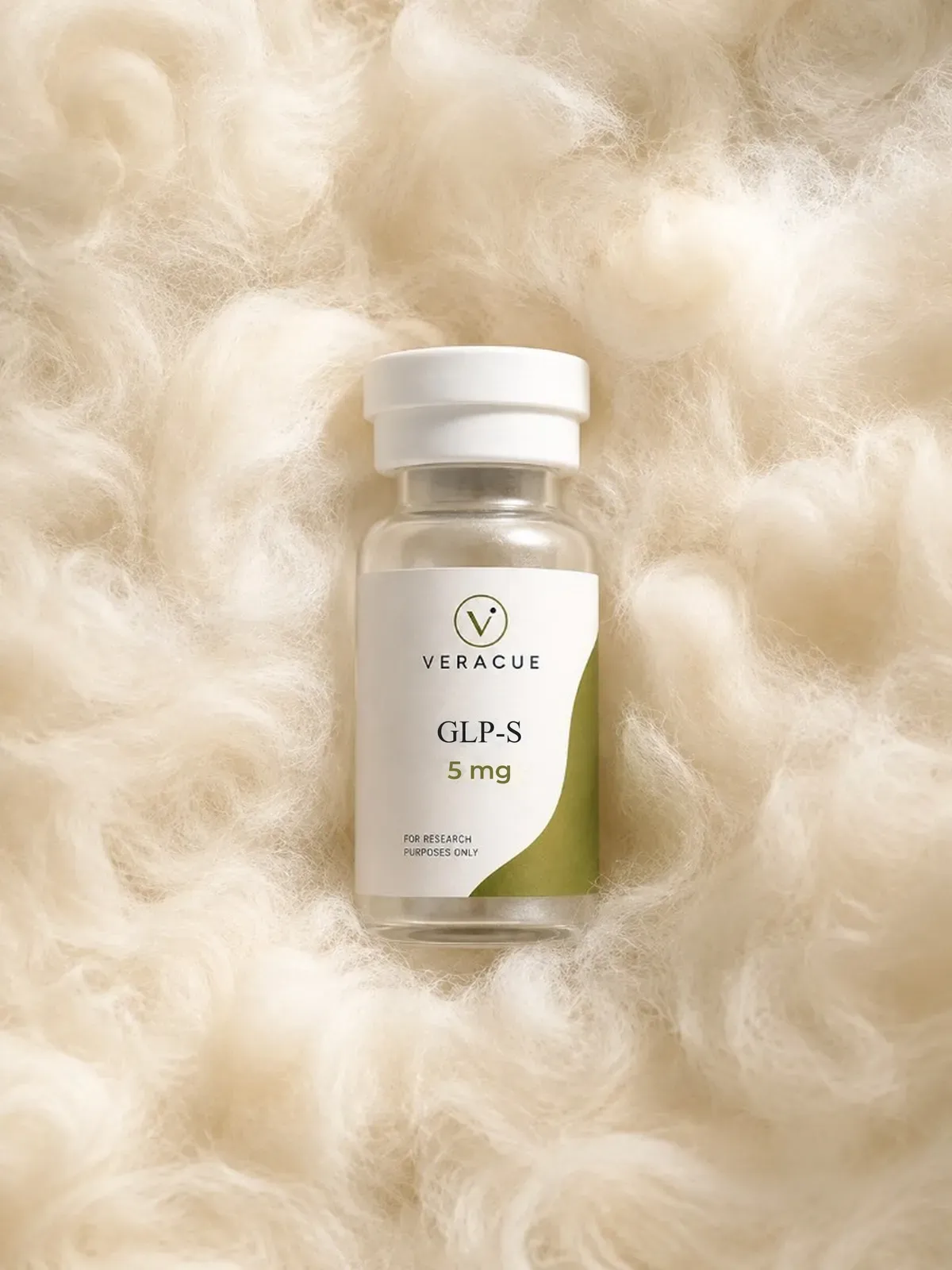
GLP-S is a 31-residue GLP-1 analog with a C18 diacid on lysine 26 (C187H291N45O59, CAS 910463-68-2). Available from 5 to 30 mg, research use only.

RESEARCH PEPTIDE
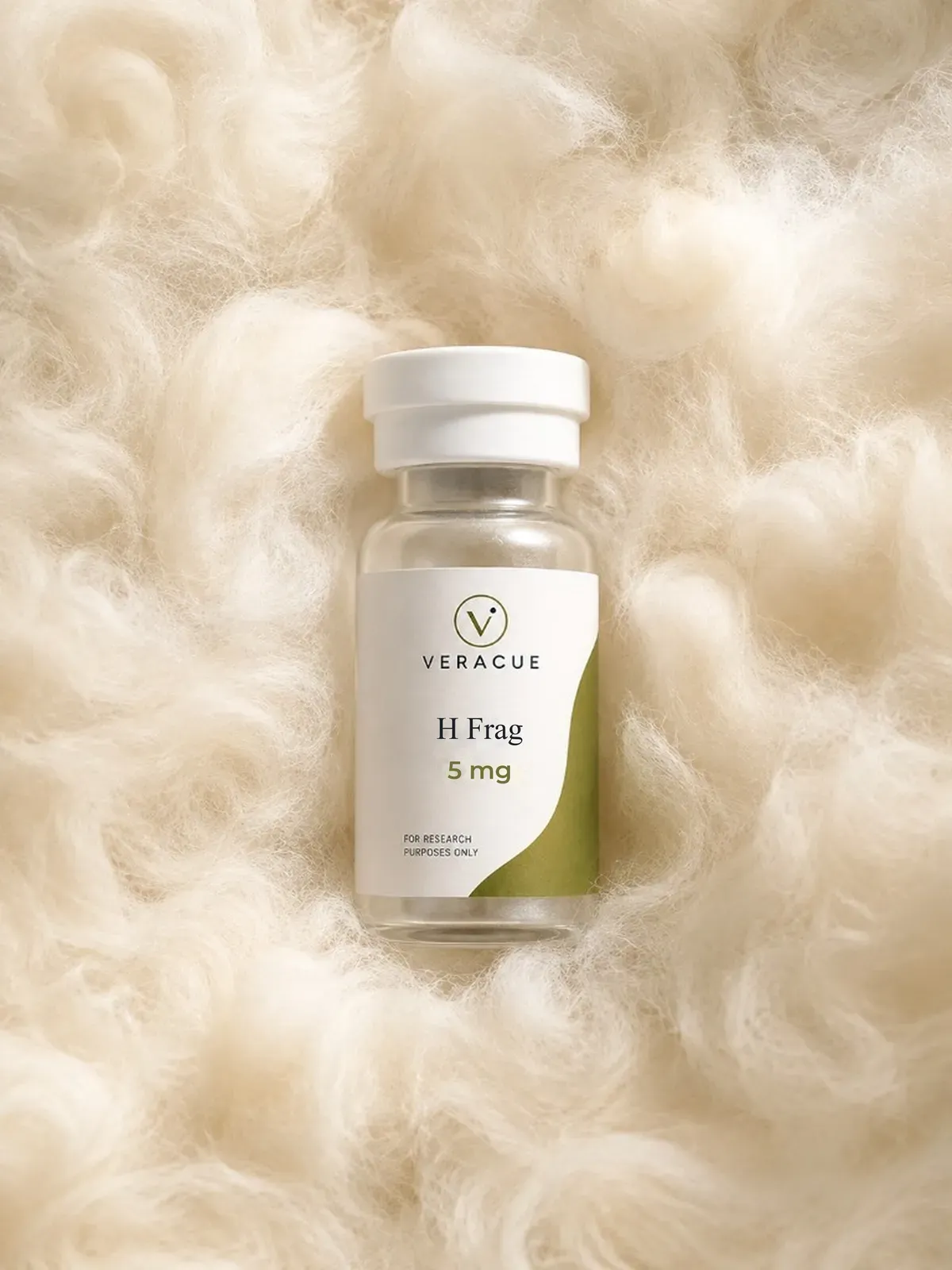
Is H-Frag just AOD 9604 under another name? No. It opens with Phe, not Tyr, and weighs 1799.1 g/mol (CAS 66004-57-7). A 5 mg vial for laboratory research.

RESEARCH PEPTIDE
Cagrilintide (AM833) is a 37-residue lipidated peptide (CAS 1415456-99-3). Read the identity data and COA checks. 10 mg vial, research use only.