NAD+ and AHK-Cu in Metabolic and Longevity Research: A Deep Dive
A research overview of NAD+ and AHK-Cu covering mitochondrial metabolism, sirtuin activation, copper-peptide signaling, and laboratory handling protocols.

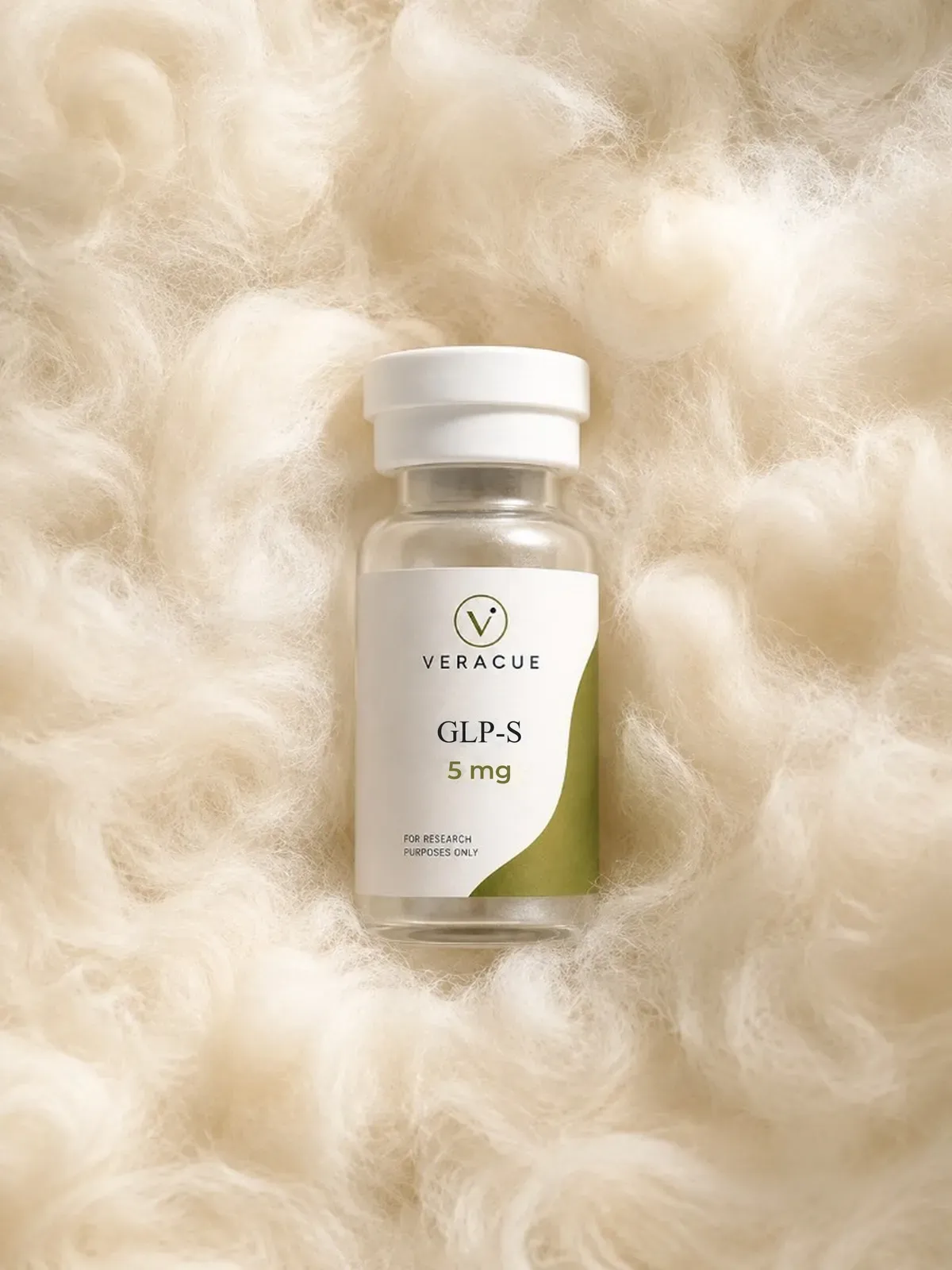
GLP-S is a synthetic 31-residue peptide built on the human GLP-1(7-37) backbone, with aminoisobutyric acid at position 8, arginine at position 34 and a C18 fatty diacid attached to lysine 26 through a gamma-glutamic acid and two-unit OEG spacer. Its formula is C187H291N45O59, its average mass is 4113.58 g/mol (monoisotopic 4111.1154 Da) and its CAS number is 910463-68-2. Because the lipid chain is part of the molecule, an intact-mass check should land near 4.1 kDa and not at the mass of the bare backbone. Vials come in 5, 10, 20 and 30 mg, for laboratory research use only.
Ask for the analytical documentation of any lot.
HPLC is the method used to measure purity
Ask for the report for a specific lot through the contact page
Supplied for laboratory research use only
Mass spectrometry is the method used to confirm identity
GLP-S is a synthetic 31-amino-acid peptide that activates the GLP-1 receptor in laboratory assays. Its chain follows human GLP-1(7-37) at 29 of 31 positions: aminoisobutyric acid (Aib) replaces the native residue at position 8, and arginine replaces the native lysine at position 34. Lysine 26 carries an acyl side chain, a gamma-glutamic acid and two-unit OEG spacer that ends in octadecanedioic acid, a C18 fatty diacid. Veracue supplies it for laboratory research only.
The side chain is covalently part of the molecule, so the identifiers below describe the acylated peptide as a whole and not the bare 31-residue backbone.
| Product name | GLP-S |
| Molecule class | GLP-1 receptor agonist peptide, a lipidated analog of GLP-1(7-37) |
| Backbone | 8Aib,34Arg-GLP-1(7-37)-OH, 31 residues, 29 of them identical to native GLP-1(7-37) (about 94 percent) |
| Backbone sequence | HAEGTFTSDVSSYLEGQAAKEFIAWLVRGRG (positions 7 to 37, Aib at position 8 written as A) |
| Side chain at lysine 26 | Gamma-glutamic acid, two OEG units (8-amino-3,6-dioxaoctanoic acid) and octadecanedioic acid (C18 diacid) |
| Molecular formula | C187H291N45O59 |
| Molecular weight (average) | 4113.58 g/mol |
| Monoisotopic mass | 4111.1154 Da |
| CAS Registry Number | 910463-68-2 |
| PubChem CID | 56843331 |
| ChEMBL ID | CHEMBL3616752 |
| Receptor target | GLP-1 receptor (GLP1R), a class B (secretin-like) G protein-coupled receptor |
| Sizes offered | 5, 10, 20 and 30 mg vials |
| Research designation | Research Use Only |
Masses are calculated from the molecular formula and are reference values, not Veracue lot results.
Salt or counterion, physical form, purity, lot results and storage conditions come from the documentation for each lot. Request lot documentation through the contact page.
Two. Position 8 holds Aib, a non-standard amino acid whose bulk keeps dipeptidyl peptidase-4 (DPP-4) from cleaving the chain at the site where it normally cuts native GLP-1. Position 34 holds arginine where the native peptide has lysine. The remaining 29 residues match GLP-1(7-37), which is why the backbone shares about 94 percent of its sequence with the native peptide.
Native GLP-1 has two lysines, at positions 26 and 34. Changing position 34 to arginine leaves lysine 26 as the only lysine in the chain, so the side chain has a single place to attach. A gamma-glutamic acid and two OEG units link that lysine to octadecanedioic acid. OEG is 8-amino-3,6-dioxaoctanoic acid, a building block that some supplier sheets label AEEA.
It is the albumin-binding anchor. The diacid gives the molecule reversible affinity for albumin, which lengthens how long it persists in biological test systems. It is also the feature most worth confirming analytically, because a molecule that had lost its side chain would show a clearly lower mass and a different chromatographic profile.
The backbone is written 8Aib,34Arg-GLP-1(7-37)-OH, so the C-terminus is a free acid. A sheet that describes an amidated chain is describing a different molecule.
There is no cysteine, so no disulfide bonds, and no methionine, so no methionine oxidation products to track. The single tryptophan is the residue an analyst would watch for oxidation.
| Receptor | Full name | Role in this material |
|---|---|---|
| GLP-1R (GLP1R) | Glucagon-like peptide-1 receptor, a class B (secretin-like) G protein-coupled receptor | Agonist target in receptor assays |
GLP-S engages the same receptor as native GLP-1 and drives the same downstream signaling in cell-based assays. The Aib substitution and the lipid side chain change stability and albumin binding, not what the receptor does. Typical uses are receptor-binding and signaling studies at GLP1R, work on albumin-binding peptide design, stability and degradation studies, and analytical method development for lipidated peptides of this size.
No. GLP-S shares the target and most of the backbone, but two substitutions and an acyl side chain make it a distinct molecule with its own formula, mass and CAS number. A check written for the native peptide would fail on GLP-S, and the reverse is equally true.
Because it changes everything an analyst measures. The acyl group adds mass, raises retention on reversed-phase columns and gives the molecule its albumin-binding behavior, so a report that only addresses the backbone leaves the defining feature untested. None of this is a handling or preparation instruction. It describes how the molecule is built and checked.

A certificate describes one lot, not the compound in general. For a lipidated peptide it needs to answer five questions: what the material is, how pure it is by a named method, whether the side chain is present, how much of the container is peptide, and whether the report belongs to the lot in hand.
| COA item | What it helps establish |
|---|---|
| Lot number | Ties the report to a production lot. It has to match the label on the container. |
| Expected mass and its basis | States 4113.58 g/mol (average) or 4111.12 Da (monoisotopic), so the observed value can be judged against the right figure. |
| Observed intact mass and charge states | Whether the measured mass fits the acylated molecule and not the bare backbone, and which ions were used to reach it. |
| RP-HPLC purity with its method | Share of detected peak area under a stated column, gradient and detection setup. |
| Tandem MS or sequencing evidence | Residue order across the backbone and support for where the side chain sits. |
| Net peptide content and counterion | How much of the weighed material is peptide, and what the remainder is. |
| Laboratory and test date | Who ran the analysis and when. |
Reports differ between laboratories, so treat this as what a certificate may contain. A lot-specific certificate is the primary source for that lot, and the certificate page explains how to request one.
Electrospray ionization does not report a molecule at its neutral mass. A 4.1 kDa peptide with several basic sites picks up multiple protons and appears as a ladder of charge states. Calculated from the monoisotopic mass of 4111.1154 Da, the first four fall at the values below.
| Ion | Calculated m/z |
|---|---|
| [M+2H]2+ | 2056.56 |
| [M+3H]3+ | 1371.38 |
| [M+4H]4+ | 1028.79 |
| [M+5H]5+ | 823.23 |
These are values worked out from the formula, not Veracue lot results. A report that quotes only a deconvoluted mass should say which charge states it used and whether the figure is monoisotopic or average. For this molecule the two conventions sit about 2.5 Da apart (4111.12 against 4113.58), so mixing them creates an apparent mismatch that is only bookkeeping.
An intact-mass result shows that the side chain is present somewhere on the molecule. It does not show where. Tandem MS fragmentation gives residue-order evidence, and fragment ions that carry the added spacer and diacid mass point to lysine 26. A lot that read at the mass of the bare backbone would indicate a missing or cleaved side chain, not a confirmed identity.
| Method | Supports | Leaves open |
|---|---|---|
| RP-HPLC | Chromatographic purity under stated conditions | Identity, counterion, water content, net peptide content |
| Intact-mass MS | Whether the observed mass fits the acylated molecule | Residue order, D-amino-acid isomers, purity |
| Tandem MS or Edman-type sequencing | Residue order across the backbone | Quantity or overall purity |
| Chiral amino acid analysis | D-isomer content | Residue order |
| Amino acid analysis | Net peptide content | Identity of impurities |
| Counterion analysis | How much of the material is trifluoroacetate, acetate or another salt | Peptide identity |
The fatty diacid makes GLP-S retain substantially more strongly on reversed-phase columns than the bare backbone, so gradient and column chemistry decide how well the intact molecule separates from forms that lost the side chain. A purity percentage with no method behind it is hard to compare.
GLP-S is supplied for laboratory research and analytical work only. It is not a drug, dietary supplement, food or cosmetic, and it is not intended for human or veterinary use. It has not been evaluated by the FDA. Veracue provides no dosing, administration or usage guidance of any kind, and the scientific information on this page describes laboratory research and is not medical advice. See the Medical Disclaimer and the Terms and Conditions for sitewide policies.
Purchasers are expected to be qualified researchers or institutions and to work with the material in line with all applicable laws.
Identity and purity results describe the specific lot that was tested. A report for one lot says nothing certain about another, so keep the lot number with every experiment that uses the material.

RESEARCH PEPTIDE
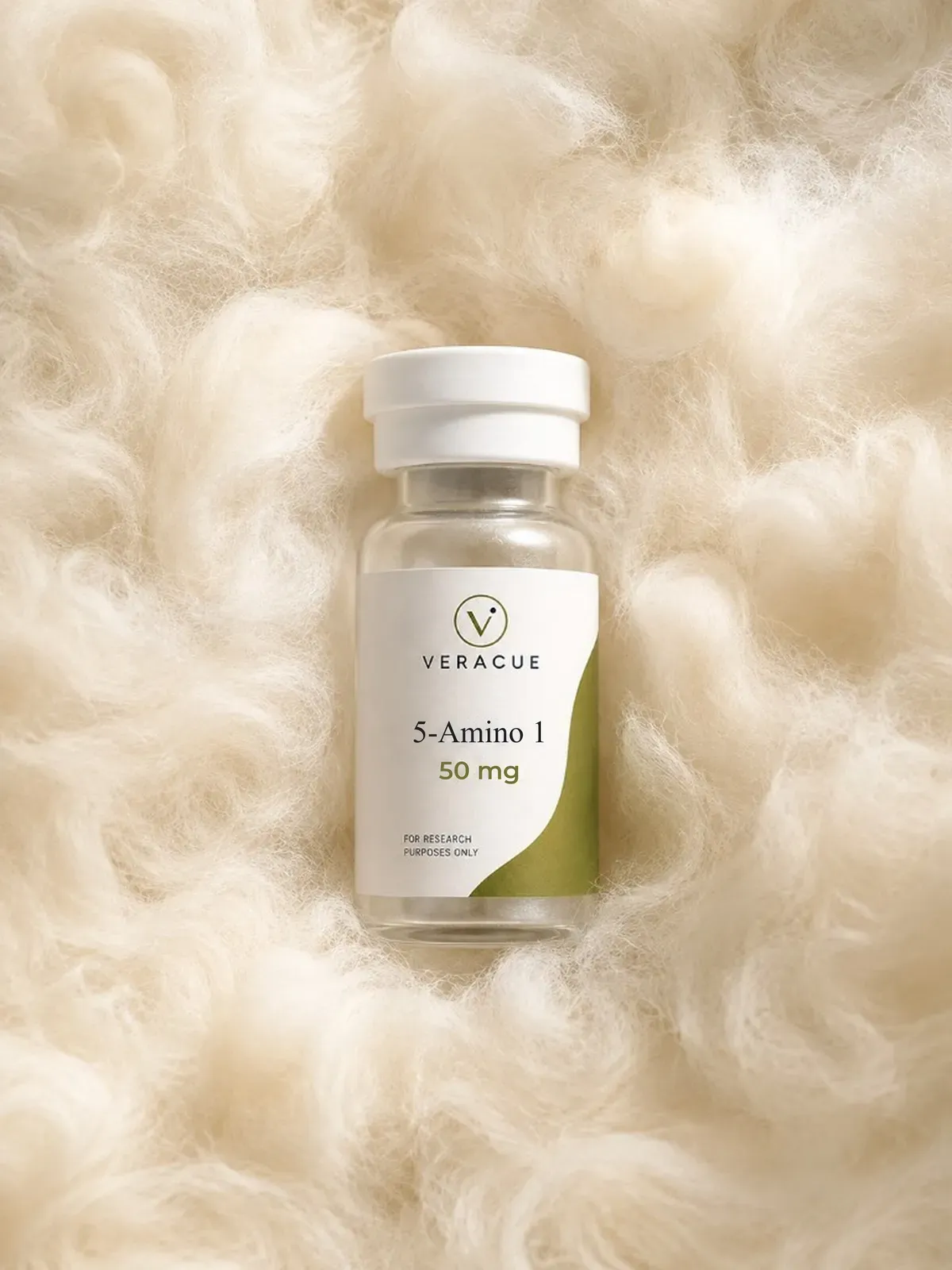
Not a peptide: 5-Amino-1MQ is a quinolinium cation, C10H11N2+ (159.21 g/mol); its iodide salt is 286.11. Check the form. Laboratory research, 50 mg.

RESEARCH PEPTIDE
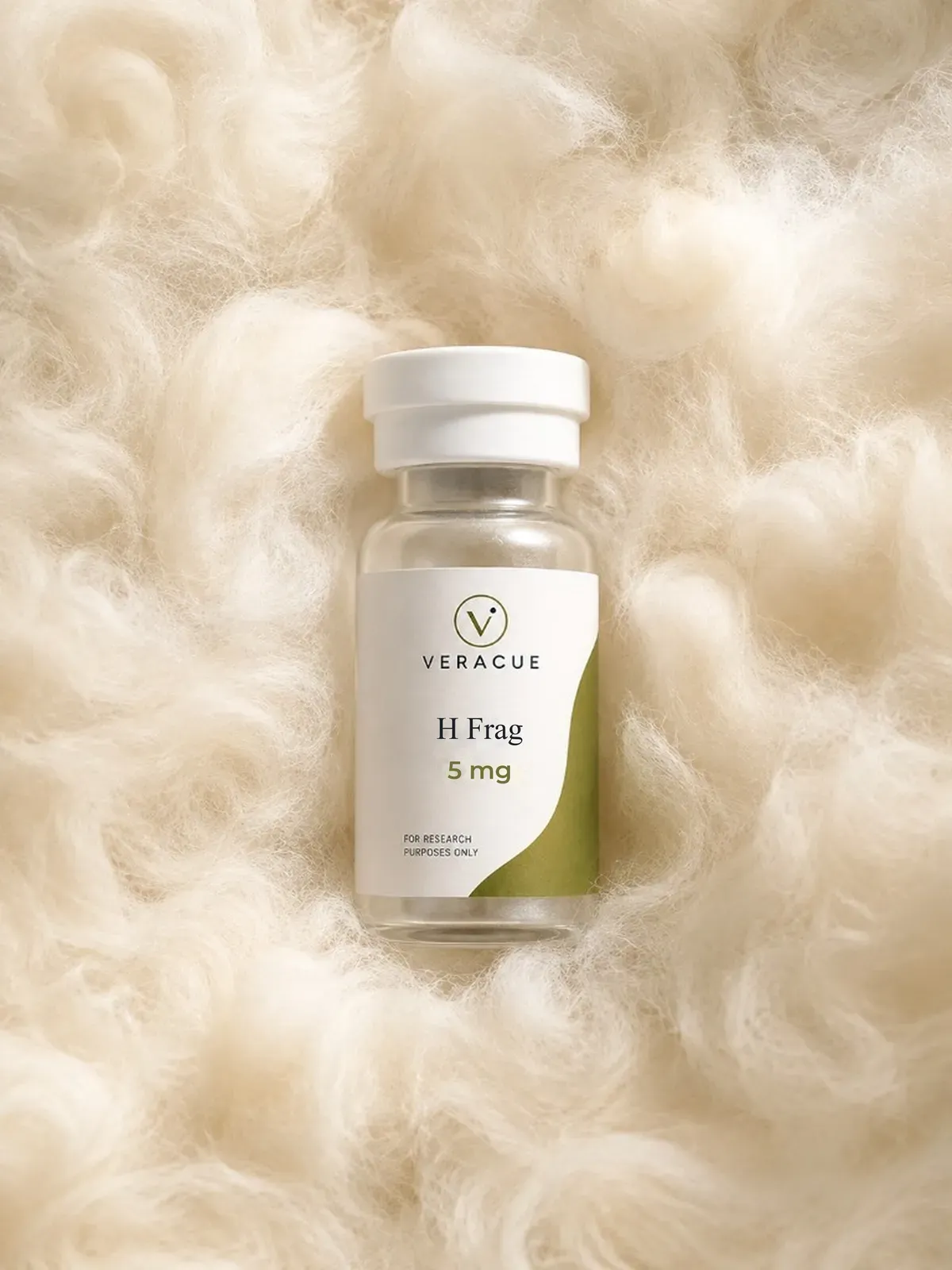
Is H-Frag just AOD 9604 under another name? No. It opens with Phe, not Tyr, and weighs 1799.1 g/mol (CAS 66004-57-7). A 5 mg vial for laboratory research.

RESEARCH PEPTIDE
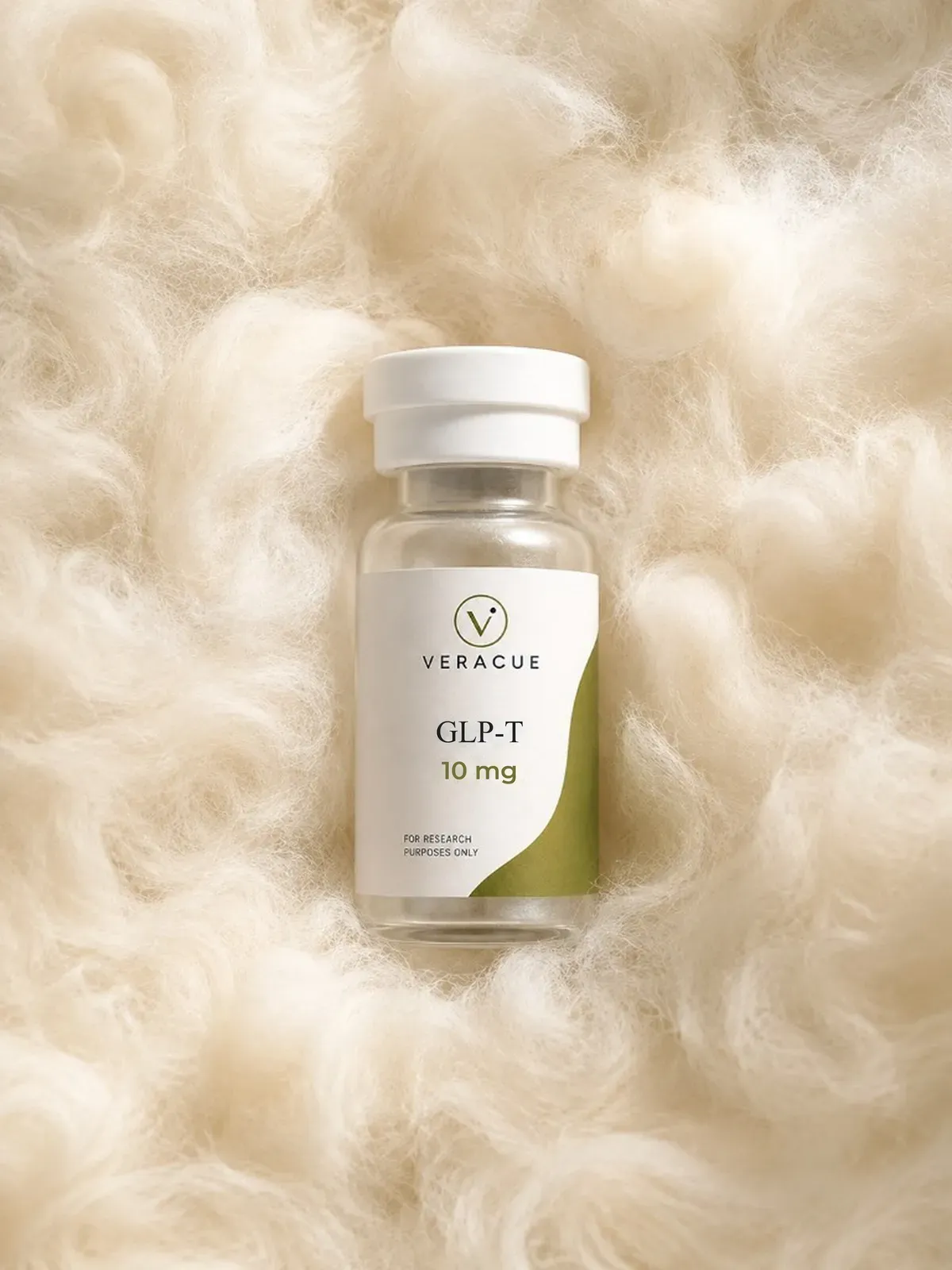
GLP-T (LY3298176) is a 39-residue peptide with a C20 fatty diacid, CAS 2023788-19-2. See the COA notes. 10 to 60 mg, research use only.

RESEARCH PEPTIDE
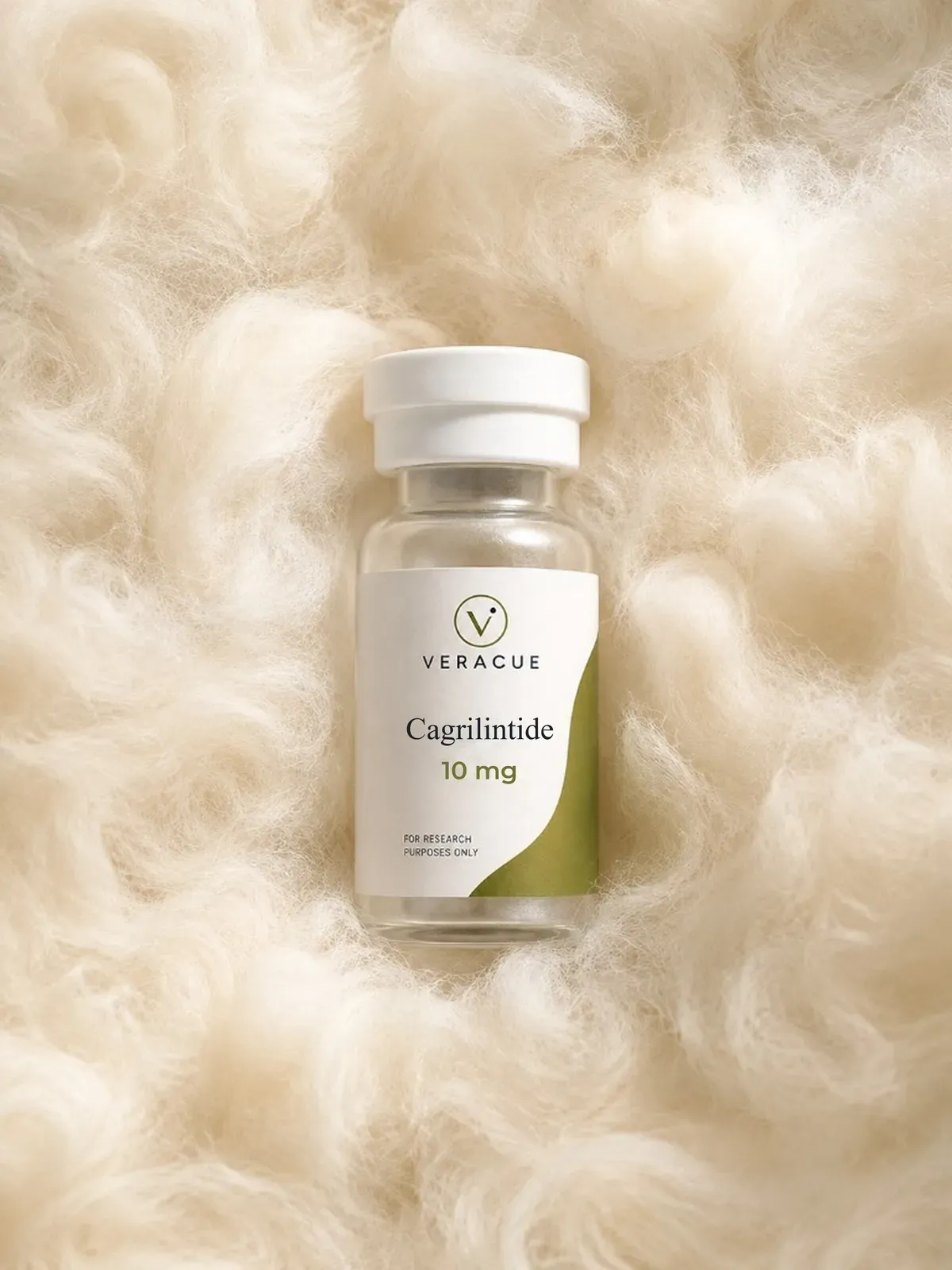
Cagrilintide (AM833) is a 37-residue lipidated peptide (CAS 1415456-99-3). Read the identity data and COA checks. 10 mg vial, research use only.