NAD+ and AHK-Cu in Metabolic and Longevity Research: A Deep Dive
A research overview of NAD+ and AHK-Cu covering mitochondrial metabolism, sirtuin activation, copper-peptide signaling, and laboratory handling protocols.

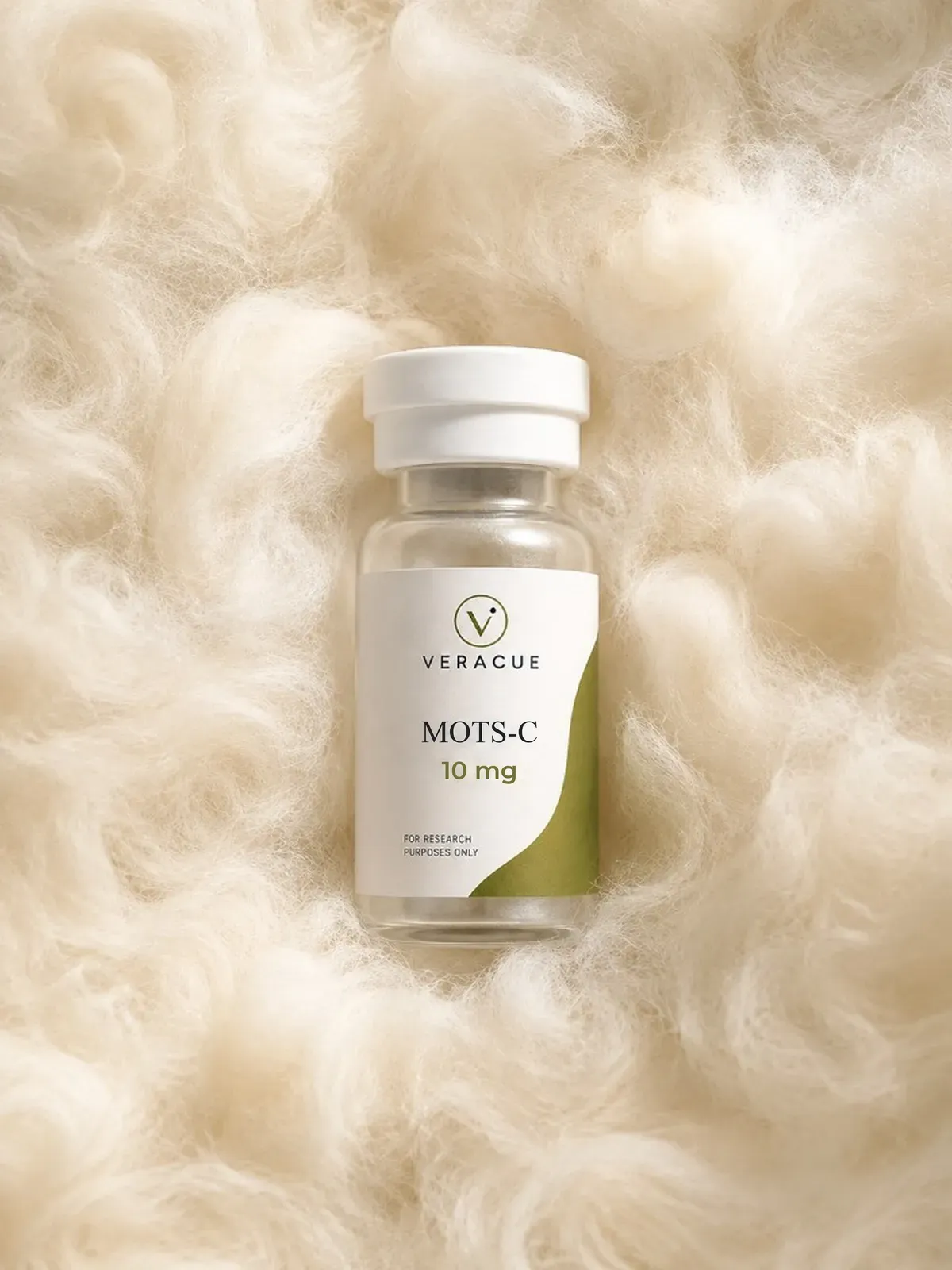
MOTS-C (also written MOTS-c) is a 16-residue mitochondrial-derived peptide with the sequence MRWQEMGYIFYPRKLR, encoded within the mitochondrial 12S rRNA gene. The free peptide has the formula C101H152N28O22S2, an average mass near 2174.6 g/mol and CAS 1627580-64-6. Laboratory work has looked at it in cell-level folate, AICAR and AMPK signaling models. Vials come in 10 mg and 40 mg, for laboratory research use only.
Ask for the analytical documentation of any lot.
HPLC is the method used to measure purity
Ask for the report for a specific lot through the contact page
Supplied for laboratory research use only
Mass spectrometry is the method used to confirm identity
MOTS-C is a 16-amino-acid peptide with the sequence MRWQEMGYIFYPRKLR, encoded in a short open reading frame inside the mitochondrial 12S rRNA gene. It is classed as a mitochondrial-derived peptide. Veracue supplies it for laboratory research only.
The name stands for mitochondrial open reading frame of the 12S rRNA-c, and the sequence is often written MOTS-c. Researchers look at it because it points to mitochondria as a source of signaling peptides, studied mainly in cultured cells.
| Product name | MOTS-C (also written MOTS-c, MOTSc) |
| Full name | Mitochondrial open reading frame of the 12S rRNA-c |
| Sequence | MRWQEMGYIFYPRKLR |
| Length | 16 amino acids |
| Molecular formula (free peptide) | C101H152N28O22S2 |
| Molecular weight (average) | About 2174.6 g/mol |
| Monoisotopic mass (calculated) | 2173.11 Da |
| CAS Registry Number | 1627580-64-6 (as listed in reference databases) |
| PubChem CID | 146675088 |
| Genomic origin | Short open reading frame within the mitochondrial 12S rRNA gene (MT-RNR1) |
| Research designation | Research Use Only |
Formula and mass describe the free peptide as a reference structure. That is not a statement about the form Veracue supplies. Salt or counterion form, physical form, purity, lot results and storage conditions are reported on each lot’s documentation and can be requested through the contact page.
MOTS-C is a linear peptide of 16 L-amino acids with a free amine at one end and a free carboxylic acid at the other. Three arginines and a lysine, set against a single glutamate, give it a strongly basic character.
Two methionines (positions 1 and 6) and a tryptophan (position 3) are the residues most prone to oxidation. These features matter at the bench because they shape how the peptide behaves in chromatography and mass spectrometry.
MOTS-C, MOTS-c and MOTSc all point at the same target, but a name on a label is not evidence of what is in the vial. Treat MRWQEMGYIFYPRKLR as the identity of the material, and check that a COA states the sequence, the C-terminal form and the mass it was compared against.
| Attribute | MOTS-C | Humanin | SS-31 |
|---|---|---|---|
| Compound class | Mitochondrial-derived peptide | Mitochondrial-derived peptide | Synthetic aromatic-cationic tetrapeptide |
| Origin | Short ORF in the mitochondrial 12S rRNA gene | Short ORF in the mitochondrial 16S rRNA gene | Designed synthetic peptide |
| Size | 16 amino acids | 24 amino acids (cytoplasmic translation); 21 (mitochondrial translation) | 4 residues: D-Arg-Dmt-Lys-Phe-NH2 |
| Structural features | All L-amino acids; free C-terminal acid; two Met, one Trp | Length variant depends on translation context | D-arginine, 2′,6′-dimethyltyrosine, C-terminal amide |
| Research context | Folate and purine metabolism, AMPK, nuclear stress signaling in cells | Cytoprotection research | Cardiolipin binding at the inner mitochondrial membrane |
The comparison covers identity and research context only. It does not rank the compounds.
In cultured cells, MOTS-C was reported to inhibit the folate cycle and the de novo purine pathway tied to it. The purine intermediate AICAR accumulated and AMPK, the cell’s energy-sensing kinase, became active. The authors proposed this route as partly responsible for the effects they saw.
A later cell-culture study reported that, under metabolic stress, MOTS-C moved into the nucleus in an AMPK-dependent manner. There it was reported to interact with stress-responsive transcription factors such as NRF2 and to regulate genes carrying antioxidant response elements.
Researchers use it as a tool to study mitochondrial-to-nuclear signaling, folate metabolism and purine synthesis. It also helps probe AMPK signaling and cellular responses to glucose restriction and oxidative stress, and it can serve for analytical method development on mid-sized basic peptides.
It reports molecular reference information and general assay-level context. It cannot establish what is in a particular vial, and cell findings do not carry over automatically to other systems. Veracue provides no dosing, administration or usage guidance of any kind.
Ask which cell type or system was used, which stressor and timing, whether endogenous or added peptide was measured, and which chemical form the authors used. Keep each claim at the level of its evidence, for example “activated AMPK in cultured cells”, and do not merge separate findings into one broad claim.

A useful COA answers four questions. What is the material? How pure is it by a named method? How much peptide is actually present? Does the report belong to your lot? A generic specification sheet is not a lot-specific COA.
| COA element | What it tells you | What it does not establish |
|---|---|---|
| Exact product name and sequence | Which peptide the report claims to describe | Identity, unless supported by analytical data |
| Chemical form (terminus, counterion) | Which mass and molecular weight apply | Net peptide content |
| Lot or batch number | Links the report to a production lot | Anything, unless it matches the vial label |
| HPLC purity with method | Share of detected signal in the main peak | Identity, net content or biological activity |
| Mass spectrometry result | Whether observed mass fits the expected species | Purity, sequence order or chirality |
| Chromatogram and spectrum images | Whether the numbers are supported by raw data | Results for any other lot |
| Net peptide content (if tested) | How much of the powder is peptide | Chromatographic purity |
| Laboratory name and test date | Who tested the lot and when | Independence, unless the relationship is disclosed |
Every item above depends on the lot’s own documentation, and Veracue confirms a field only when the lot certificate reports it. The certificate page explains how to request lot documentation.
It reports how much of the detected signal falls in the main peak under stated conditions. Detection near 214 to 220 nm reports peptide bonds, while tryptophan and tyrosine also absorb near 280 nm, so the wavelength changes relative responses. HPLC does not establish identity, counterion, water content or net peptide content, and closely related variants can co-elute with the main peak.
It tests whether the observed mass is consistent with MOTS-C. With four basic side chains, electrospray spectra usually show several charge states. A COA should state whether it reports monoisotopic or average mass, since mixing them creates an apparent 1.5 Da discrepancy. Intact mass alone cannot distinguish a scrambled sequence of the same composition, and it cannot detect D-amino-acid isomers.
| Species (calculated, free acid) | Value |
|---|---|
| Monoisotopic mass, M | 2173.11 Da |
| Average mass | About 2174.6 Da |
| [M+2H]2+ | m/z 1087.56 |
| [M+3H]3+ | m/z 725.38 |
| [M+4H]4+ | m/z 544.28 |
| One methionine oxidized (+O) | 2189.10 Da |
| Both methionines oxidized (+2O) | 2205.10 Da |
| C-terminal amide variant | 2172.12 Da |
These reference values are calculated from the sequence for identification purposes. They are not Veracue lot results.
Tandem MS fragmentation or Edman sequencing confirms residue order. Amino acid analysis supports net peptide content, counterion analysis shows how much of the powder is trifluoroacetate or acetate, and chiral amino acid analysis addresses D-isomer content.
Analytical results describe only the lot that was tested, so match the lot number on the COA to your vial. If a lot document is not in the certificate library, ask the Veracue team for it before the material enters a study.
MOTS-C is supplied solely for laboratory research, scientific investigation and analytical characterization. It is not a drug, dietary supplement, food or cosmetic, and it is not intended for human or veterinary use. This page contains no dosing, administration or usage guidance of any kind. See the Medical Disclaimer and the Terms and Conditions for sitewide policies.

RESEARCH PEPTIDE
Not a peptide: 5-Amino-1MQ is a quinolinium cation, C10H11N2+ (159.21 g/mol); its iodide salt is 286.11. Check the form. Laboratory research, 50 mg.

RESEARCH PEPTIDE
GLP-S is a 31-residue GLP-1 analog with a C18 diacid on lysine 26 (C187H291N45O59, CAS 910463-68-2). Available from 5 to 30 mg, research use only.

RESEARCH PEPTIDE
Is H-Frag just AOD 9604 under another name? No. It opens with Phe, not Tyr, and weighs 1799.1 g/mol (CAS 66004-57-7). A 5 mg vial for laboratory research.

RESEARCH PEPTIDE
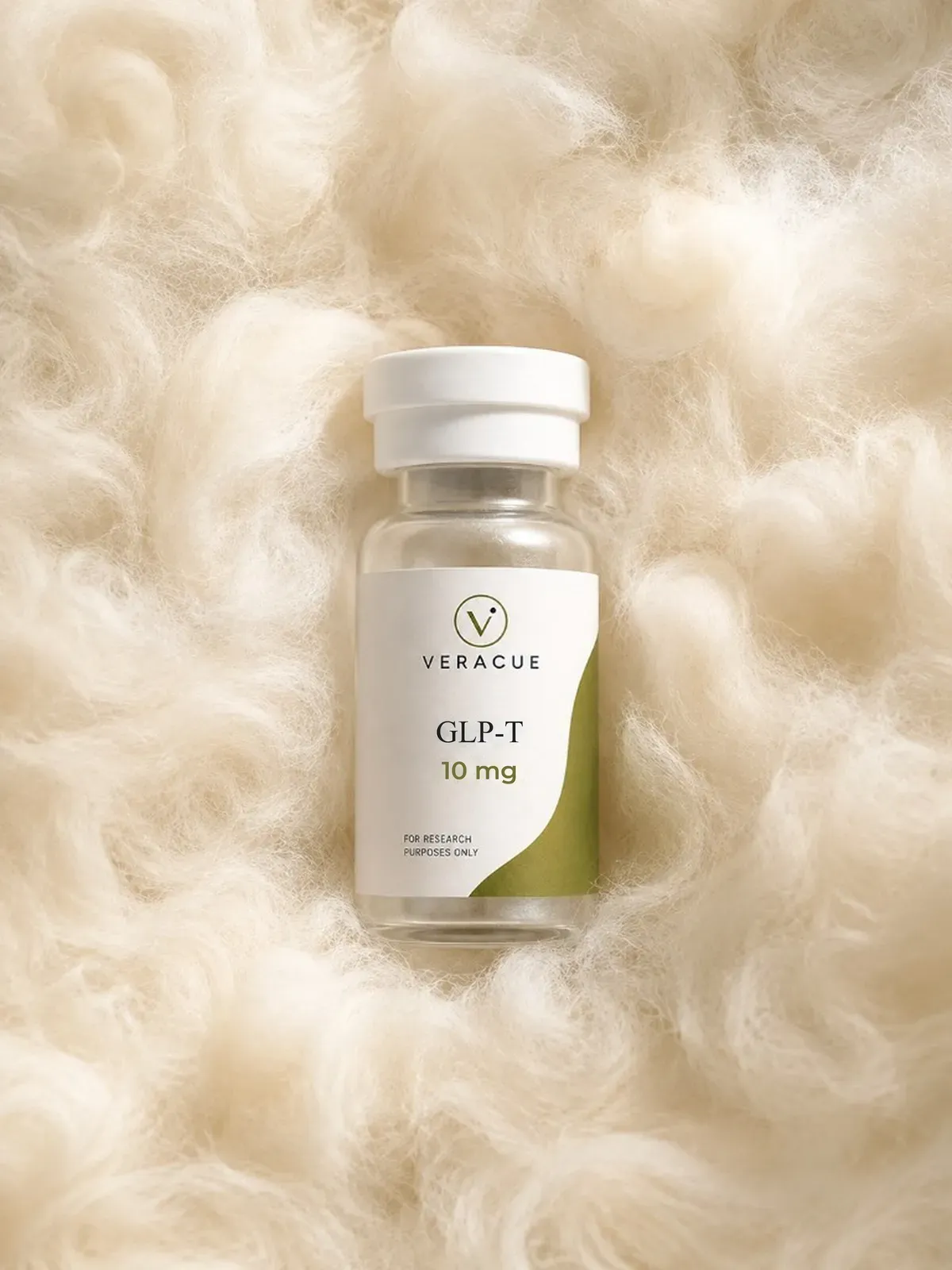
GLP-T (LY3298176) is a 39-residue peptide with a C20 fatty diacid, CAS 2023788-19-2. See the COA notes. 10 to 60 mg, research use only.