NAD+ and AHK-Cu in Metabolic and Longevity Research: A Deep Dive
A research overview of NAD+ and AHK-Cu covering mitochondrial metabolism, sirtuin activation, copper-peptide signaling, and laboratory handling protocols.

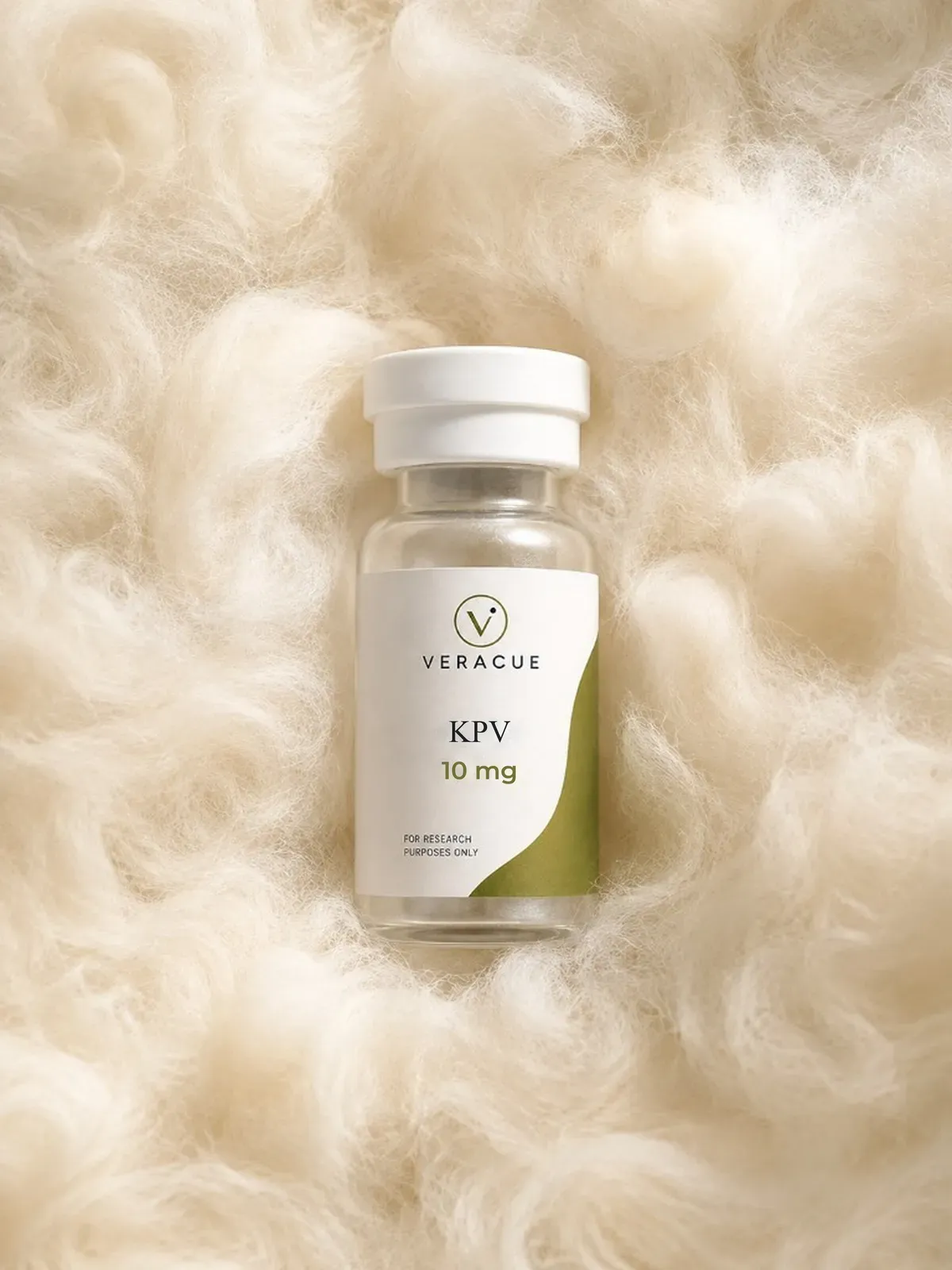
KPV is the three-residue peptide Lys-Pro-Val, the C-terminal end of alpha-MSH (residues 11 to 13). Its free-acid reference form is C16H30N4O4 with an average mass of 342.44 g/mol and CAS 67727-97-3. Because it is so small, KPV is easy to confuse with its parent alpha-MSH and the related tripeptide KdPT, so identity should be checked against the sequence and mass. A 10 mg vial is offered for laboratory research use only.
Ask for the analytical documentation of any lot.
HPLC is the method used to measure purity
Ask for the report for a specific lot through the contact page
Supplied for laboratory research use only
Mass spectrometry is the method used to confirm identity
KPV is a synthetic tripeptide made of lysine, proline and valine (Lys-Pro-Val). The same three residues form the C-terminal end of α-melanocyte-stimulating hormone, so the literature also calls it α-MSH (11-13). Its free-acid reference form has the formula C16H30N4O4 and CAS number 67727-97-3. Veracue supplies KPV for laboratory research only.
Interest in the fragment goes back to 1980s work on α-MSH, when researchers asked how much of the hormone’s activity a short tail could carry. Since then KPV has been studied mainly in cell culture and rodent systems, including work on the PepT1 peptide transporter.
| Product name | KPV |
| Alternate names | Lys-Pro-Val; H-Lys-Pro-Val-OH; α-MSH (11-13); KPV tripeptide |
| Sequence | Lys-Pro-Val (K-P-V) |
| Length | 3 amino acids (tripeptide) |
| Reference chemical form | Free acid, all L-amino acids (as indexed in PubChem) |
| Molecular formula (free acid) | C16H30N4O4 |
| Average molecular weight (free acid) | 342.44 g/mol |
| Monoisotopic mass (free acid) | 342.2267 Da |
| CAS Registry Number (free acid) | 67727-97-3 |
| PubChem CID | 125672 |
| Parent peptide | C-terminal residues 11 to 13 of α-MSH |
| Vial size offered | 10 mg |
| Research designation | Research Use Only |
Formula and identifiers are from the PubChem record and describe the free acid as a reference structure. That is not a statement about the form Veracue supplies. Salt or counterion form, physical form, purity, lot results and storage conditions are reported on each lot’s documentation and can be requested through the contact page.
KPV is short enough that every residue matters. Lysine contributes two basic amino groups. Proline adds a ring that restricts backbone flexibility, and valine closes the chain with a small hydrophobic side group. None of the three residues is aromatic, a detail that shapes how KPV behaves in HPLC analysis.
Inside native α-MSH, this sequence sits at an amidated C-terminus. The standalone reference compound indexed in PubChem is the free acid. Because published studies do not always use the same form, check the terminal chemistry before comparing results.
No. α-MSH is a 13-residue hormone, and KPV is only its final three residues. KPV lacks the His-Phe-Arg-Trp core that melanocortin receptor binding depends on. Findings for the full hormone describe the full hormone, so keep parent and fragment separate.
| Attribute | KPV | α-MSH | KdPT |
|---|---|---|---|
| Sequence | Lys-Pro-Val | Ac-Ser-Tyr-Ser-Met-Glu-His-Phe-Arg-Trp-Gly-Lys-Pro-Val-NH2 | Lys-D-Pro-Thr |
| Length | 3 residues | 13 residues | 3 residues |
| Average MW | 342.44 g/mol (free acid) | About 1664.9 g/mol | 344.41 g/mol |
| Relationship | C-terminal residues 11 to 13 of α-MSH | Parent hormone, derived from POMC | KPV-related derivative; sequence matches IL-1β (193 to 195) with a D-proline |
| Analytical note | Near-isobaric with GHK and KdPT; shares its formula with sequence isomers | Large enough that intact mass is highly specific | Differs from KPV by a Val to Thr swap and a D-residue |
The table describes identity only and does not rank the peptides.
| Form | Formula | Average MW (g/mol) | Monoisotopic mass (Da) | Expected [M+H]+ (m/z) |
|---|---|---|---|---|
| H-Lys-Pro-Val-OH (free acid) | C16H30N4O4 | 342.44 | 342.2267 | 343.234 |
| H-Lys-Pro-Val-NH2 (C-terminal amide) | C16H31N5O3 | 341.46 | 341.2427 | 342.250 |
| Ac-Lys-Pro-Val-NH2 (acetylated amide) | C18H33N5O4 | 383.49 | 383.2533 | 384.261 |
| KPV acetate (salt) | Peptide plus acetate counterion(s) | Depends on counterion stoichiometry | Peptide ion as for the free base | As for the free base |
Values are calculated from molecular formulas using standard atomic weights. The free-acid values agree with the reference figures for CAS 67727-97-3.
In published work, KPV was reported to be taken up through PepT1, a di- and tripeptide transporter, in human intestinal epithelial and T-cell lines. That link makes it a useful probe for peptide-transport questions in cell culture.
The evidence suggests not primarily. Some groups reported effects that were at least partly independent of the MC1R melanocortin receptor, and another proposed interference with IL-1β signaling instead. The transporter, receptor and IL-1β ideas come from different systems and have not been reconciled, so the mechanism remains open.
Common areas are di- and tripeptide transport through PepT1, structure and function questions about which parts of α-MSH carry which activities, and delivery-system design using carriers such as nanoparticles and hydrogels. Analog work with stereoisomers and the related tripeptide KdPT adds structure-activity comparisons.
The KPV studies cited in the literature are cell-culture and animal experiments. Each shows that KPV changed a specific measured marker under specific conditions in a specific system. This page gives molecular reference information and general research context. It cannot establish what is in a particular vial. Veracue does not provide dosing, administration or usage guidance of any kind.
Two methods do most of the work, and each answers a different question.
Reversed-phase HPLC (RP-HPLC) separates the components of a sample. It reports purity as a percentage of total peak area at a stated detection wavelength. For KPV, detection relies on peptide-bond absorbance in the low-UV range, because the molecule has no aromatic side chains. HPLC shows how much of the detected material elutes as the main peak. By itself, it cannot prove that the main peak is KPV.
Mass spectrometry (ESI-MS or LC-MS) measures molecular mass. A result matching the expected mass supports identity, provided the report says whether it shows the neutral mass or a protonated ion. For the free acid, [M+H]+ is expected near m/z 343.23. Mass alone cannot tell KPV apart from sequence isomers such as Lys-Val-Pro, or from D-residue variants, because they share its exact formula.
Orthogonal checks close those gaps. Tandem MS (MS/MS) fragmentation supports residue order. Co-elution with a characterized reference standard supports retention identity, and chiral analysis addresses stereochemistry. Not every COA will include all of these. Knowing which questions a document leaves open is part of reading it well.
| Method | What it can establish | What it cannot establish on its own |
|---|---|---|
| RP-HPLC (UV) | Chromatographic purity as area %; impurity profile; batch-to-batch consistency | Molecular identity; counterion or water content; stereochemistry |
| ESI-MS / LC-MS (intact mass) | Mass consistent with KPV in the stated form | Residue order (isomers share the mass); D- vs L-configuration; purity |
| MS/MS fragmentation | Residue sequence from fragment ions | Quantitative purity; stereochemistry |
| Chiral analysis | D/L configuration of residues | Sequence or overall purity |
| Net peptide content (for example amino acid analysis) | Fraction of the weighed powder that is peptide | Identity of the peptide or its impurities |
A certificate of analysis describes one manufacturing lot. It is not a general statement about KPV and should not be carried over to a different lot. For a molecule this small, with this many look-alikes, the details on the certificate matter more than the headline purity figure.
| COA element | Why it matters for KPV |
|---|---|
| Exact product identity and sequence | Confirms the document covers Lys-Pro-Val, not a blend or an analog such as KdPT |
| Chemical form and counterion | Free acid, amide, acetylated amide and salt forms differ in mass and composition |
| Lot number matching the vial | Ties every result to the physical material in hand |
| Testing laboratory and test date | Shows who performed the work and how current it is |
| HPLC result with chromatogram | Lets a reader see peak shape, retention and impurities, not only a percentage |
| Mass result, stating neutral or [M+H]+ | Prevents a roughly 1 Da reporting ambiguity from hiding a form mismatch |
| Stated tolerance and method | Shows how tightly the observed mass was compared with theory |
| Traceability back to the report | Allows the document to be checked independently of the listing |
Every field above depends on the lot’s own documentation, and Veracue confirms a field only when the lot certificate reports it. The certificates page explains how to request lot documentation, including through the contact page.
No. “KPV” appears on single-peptide listings, inside multi-peptide blend names, and as a frequent misspelling (“KVP”). Similar abbreviations such as KPT and KdPT describe different peptides. Confirm the full Lys-Pro-Val sequence on the lot’s documentation, check whether the material is a single compound or a blend, and confirm the chemical form.
Not from intact mass. Lys-Val-Pro and Pro-Val-Lys contain the same three residues and share the formula C16H30N4O4. MS/MS fragmentation reveals residue order, and co-elution with a characterized reference standard offers a second, independent line of support.
Swapping an L-residue for a D-residue does not change mass, and the KPV literature includes D-amino acid analogs. If configuration matters to your work, ask whether it was tested or simply assumed from the synthesis inputs. Chiral analysis addresses it directly. Standard RP-HPLC and MS may not.
Match the form to the study you are comparing against. The monoisotopic masses separate them: 342.23 Da for the free acid, 341.24 Da for the amide and 383.25 Da for Ac-KPV-NH2. A COA should state the form explicitly rather than leave it to inference.
Purified peptides are commonly isolated as salts, and KPV’s two amine groups can each carry a counterion. Weighed powder includes counterion and residual water as well as peptide. Look for a named counterion and, ideally, a net peptide content figure, or comparisons between lots rest on an unstated assumption.
No. A sample can be chromatographically clean and still be the wrong molecule. HPLC describes how much of the detected material is the main component, and mass spectrometry describes whether that component has the expected mass. Ask for both, and for the chromatogram itself, including the detection wavelength and where the main peak elutes relative to the solvent front.
GHK (340.38 g/mol) and KdPT (344.41 g/mol) sit within a few daltons of KPV (342.44 g/mol), and some listings round KPV to about 340 Da. The amide’s protonated ion (m/z 342.25) also lands almost exactly on the free acid’s neutral mass (342.23). Compare observed and theoretical values using the same convention, and check whether the report gives neutral or [M+H]+ mass and average or monoisotopic values.
File the COA against the lot number on the vial. Note the chemical form, counterion, storage conditions on receipt and any in-house identity checks. That record lets a result be repeated, or explained when it is not.
Lot details, including chemical form, purity method and testing laboratory, are reported on each lot’s documentation. Ask the Veracue team for the paperwork that matches your vial, or browse the certificate library.

KPV is supplied for laboratory research, scientific investigation and analytical characterization only. It is not intended for human or veterinary use, or for ingestion, injection, inhalation or any form of administration, and it has not been evaluated by the FDA. This page contains no dosing, administration or usage guidance of any kind. See the Medical Disclaimer and the Terms and Conditions for sitewide policies.

RESEARCH PEPTIDE
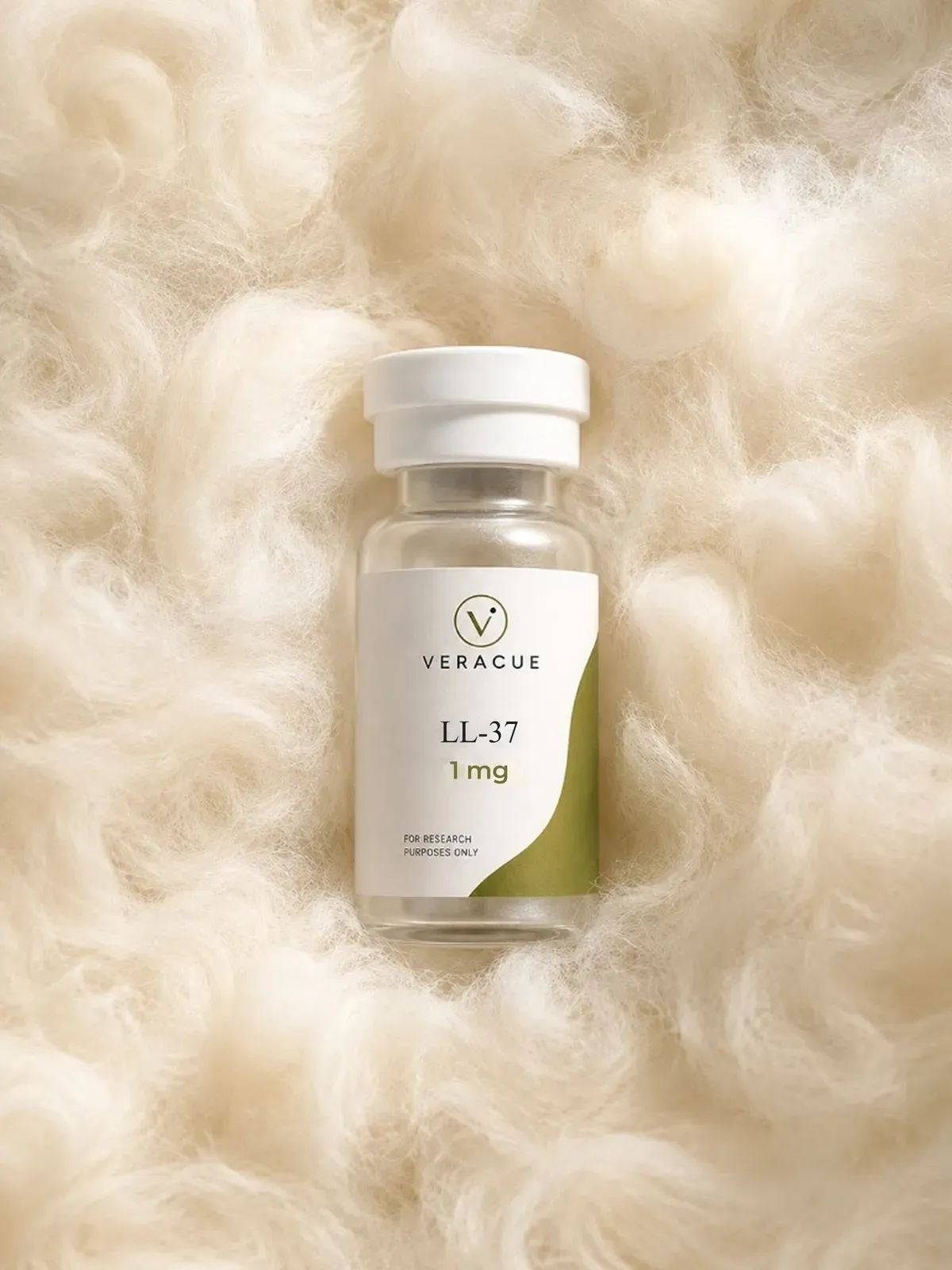
LL-37 or hCAP-18? The vial holds the 37-residue peptide (C205H340N60O53, about 4493.3 g/mol), not the precursor. 1 mg, laboratory research only.

RESEARCH PEPTIDE
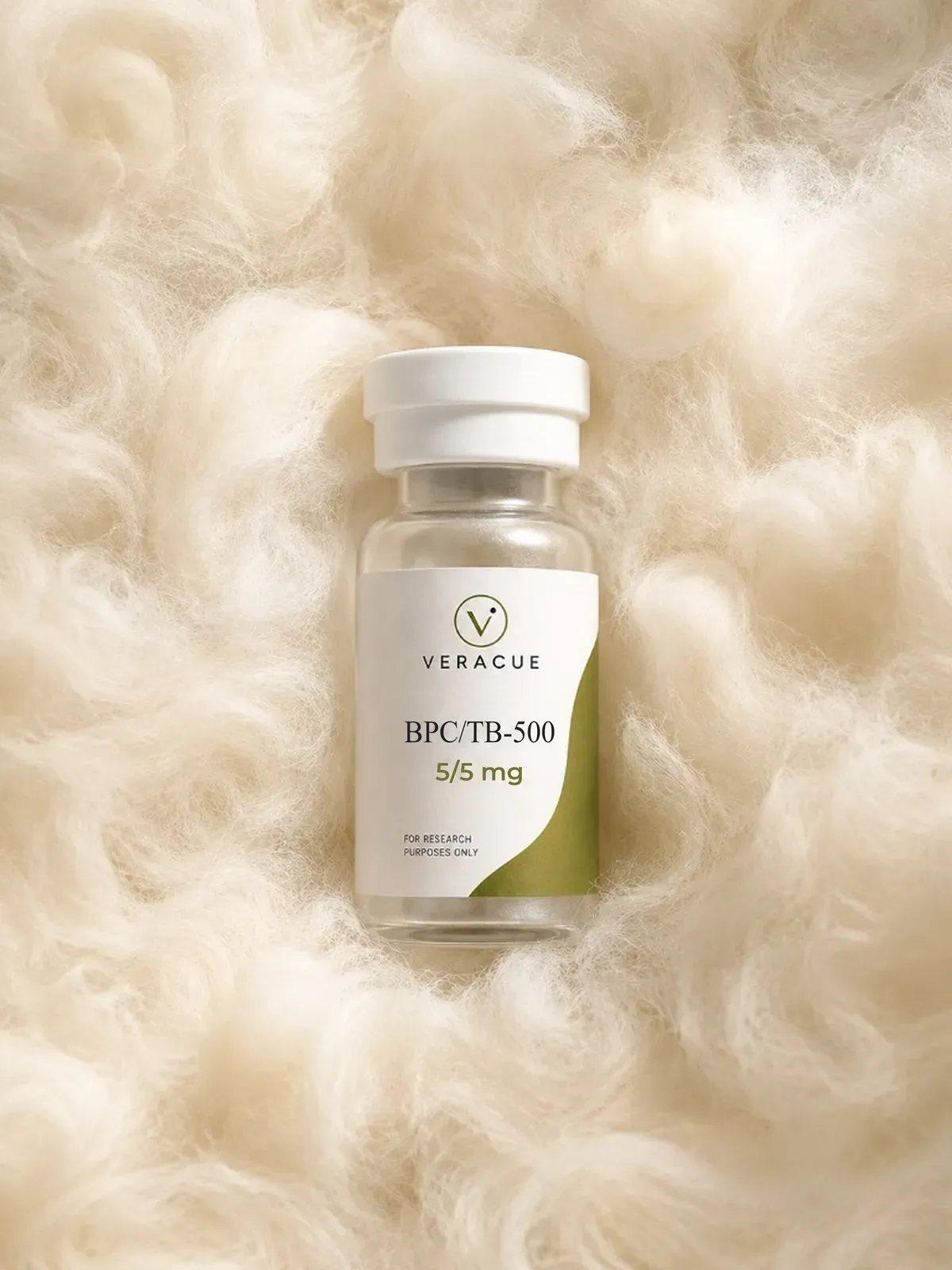
Two peptides in one vial: BPC-157 (GEPPPGKPADDAGLV) and acetylated TB-500 (Ac-LKKTETQ), each with its own CAS number. 5/5 and 10/10 mg, research use only.

RESEARCH PEPTIDE
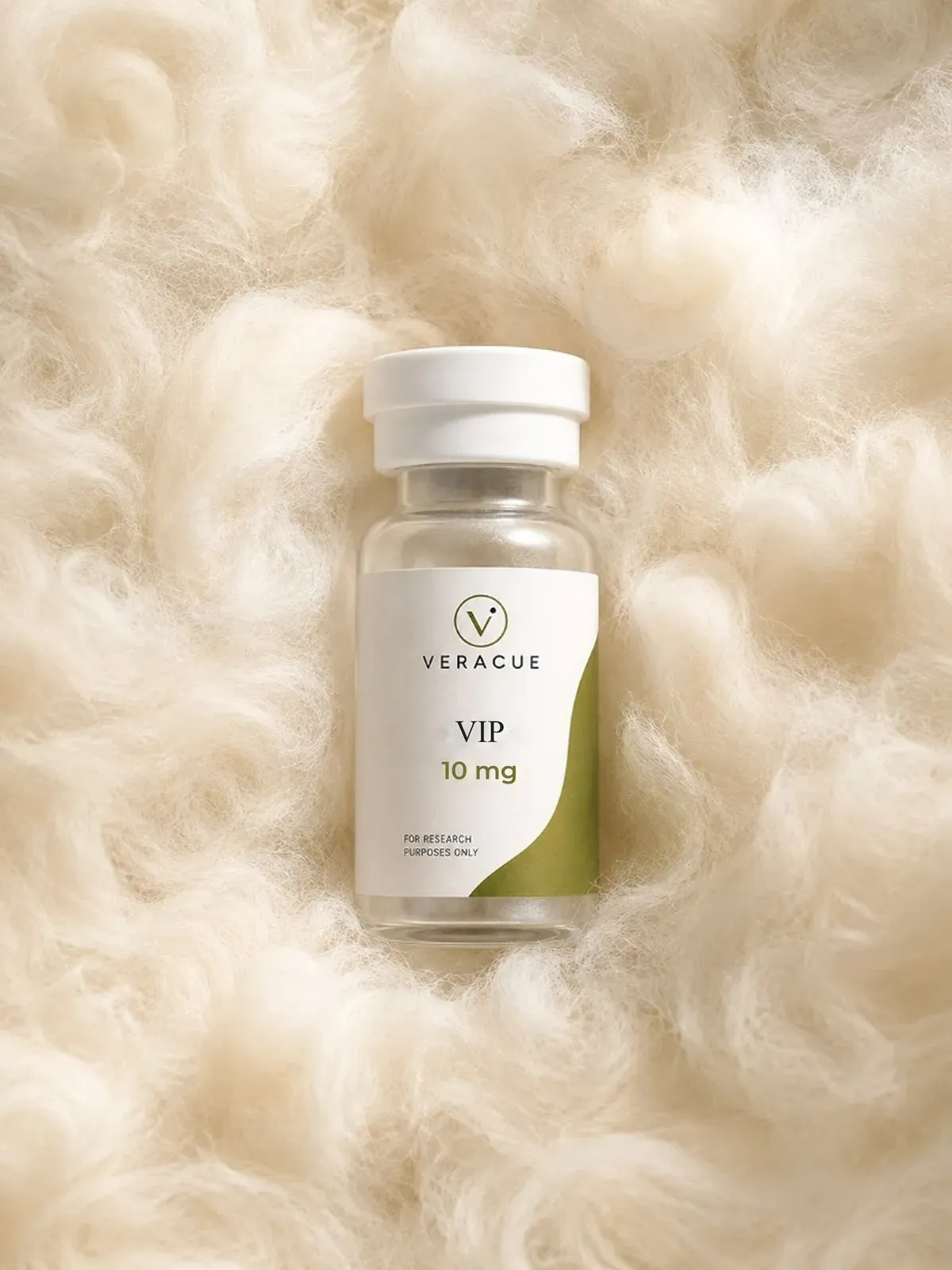
Is VIP the same as PACAP? No. It is a 28-residue amidated peptide, C147H238N44O42S, CAS 40077-57-4. Research use only; supplied as a 10 mg vial.

RESEARCH PEPTIDE
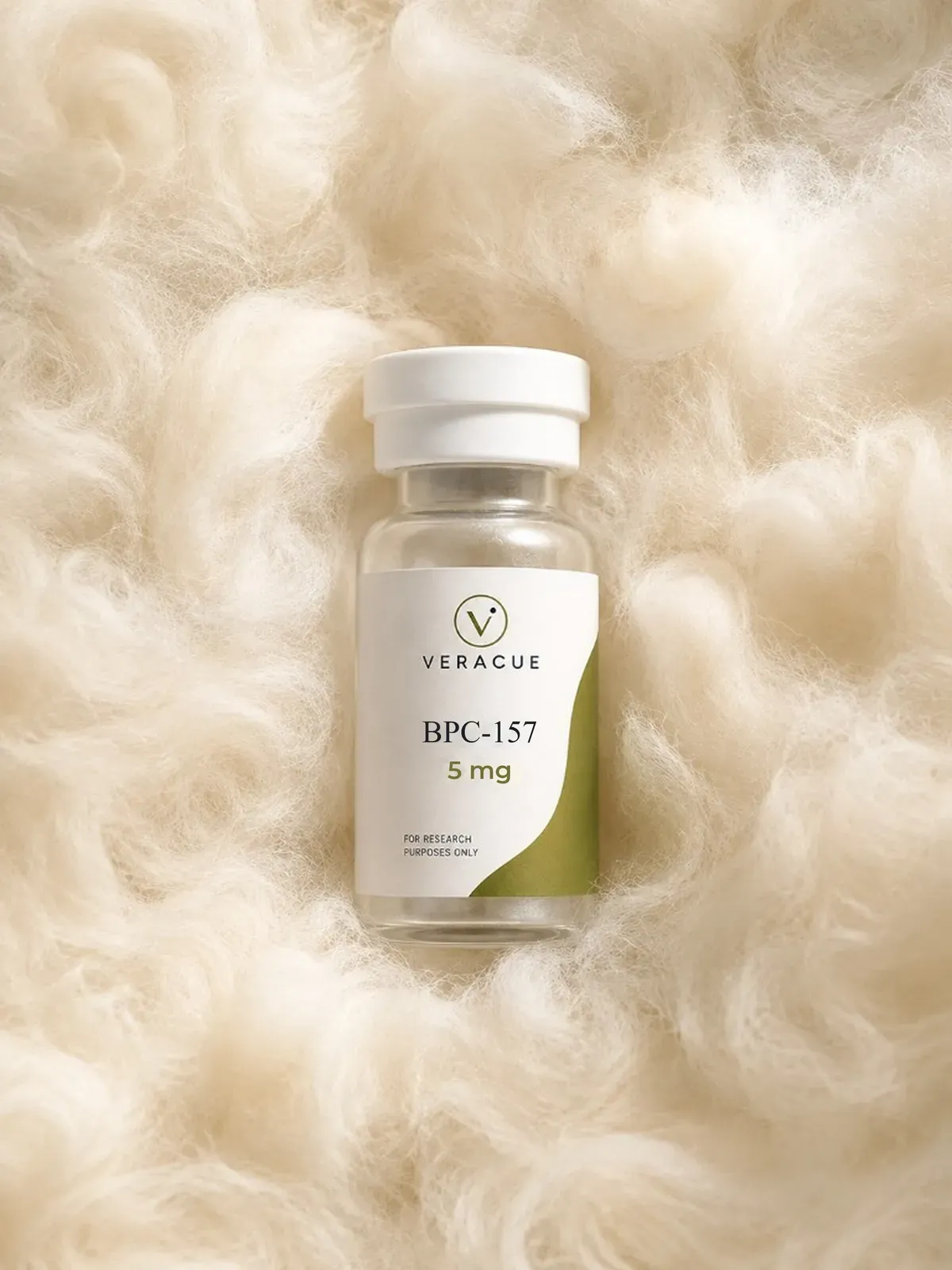
Is BPC-157 a blend or one peptide? It is a single 15-residue molecule, GEPPPGKPADDAGLV (CAS 137525-51-0). Sold in 5 and 10 mg for research use only.