NAD+ and AHK-Cu in Metabolic and Longevity Research: A Deep Dive
A research overview of NAD+ and AHK-Cu covering mitochondrial metabolism, sirtuin activation, copper-peptide signaling, and laboratory handling protocols.

H-Frag Spray is a spray-dispensed research material built on HGH Fragment 176-191, the sixteen amino acids FLRIVQCRSVEGSCGF taken from the tail end of human growth hormone and closed into a ring by a Cys7-Cys14 disulfide bond. The free peptide works out to C78H123N23O22S2 at an average mass near 1799.1 g/mol, filed under CAS 66004-57-7, and its first residue is phenylalanine, where AOD 9604 carries tyrosine. The 5 mg size comes with 45 sprays per bottle. Veracue offers H-Frag Spray for laboratory research use only.
Ask for the analytical documentation of any lot.
HPLC is the method used to measure purity
Ask for the report for a specific lot through the contact page
Supplied for laboratory research use only
Mass spectrometry is the method used to confirm identity
| Product name | H-Frag Spray |
| Peptide | HGH Fragment 176-191 (also Fragment 176-191, GH Fragment 176-191, H Frag) |
| Strength | 5 mg |
| Spray count | 45 sprays per bottle |
| Dispensing format | Spray-dispensed bottle |
| Sequence | FLRIVQCRSVEGSCGF (Phe-Leu-Arg-Ile-Val-Gln-Cys-Arg-Ser-Val-Glu-Gly-Ser-Cys-Gly-Phe) |
| Length | 16 residues |
| Disulfide bond | Cys7 to Cys14, closing a ring inside the chain |
| Molecular formula (free peptide) | C78H123N23O22S2 |
| Average molecular weight | About 1799.10 g/mol |
| CAS Registry Number | 66004-57-7 |
| Parent protein record | UniProt P01241, human somatotropin (mature-chain numbering used here) |
| Research designation | Research Use Only |
Identity values describe the closed-ring free peptide and are reference data, not a lot result. Concentration and fill volume are lot details, recorded in the documentation for each lot and available through the contact page.
The final sixteen residues of mature human growth hormone, positions 176 to 191, make up this peptide. Position 176 is phenylalanine, so the sequence opens with Phe. Neither end carries a cap or tag, leaving a free amine at the front and a free carboxylic acid at the back. Veracue supplies the sequence as one defined compound, never as a blend.
Catalogs and search results use several names for it: H Frag, HGH Frag, hGH Fragment 176-191, GH Fragment 176-191 and plain Fragment 176-191. Whatever the wording, the sequence, formula and CAS number above are the reliable way to confirm which material a listing describes.
Sixteen. The two numbers are positions in the 191-residue mature hormone and both are counted, so 176 through 191 spans sixteen residues. The fifteen-residue stretch is 177-191, which starts at leucine and is the base sequence that AOD 9604 extends with a tyrosine.
Because it is the only place the two look-alike peptides differ. The other fifteen residues are identical, so a document that prints FLRIVQCRSVEGSCGF describes H-Frag and one that prints YLRIVQCRSVEGSCGF describes AOD 9604, whatever the product name says.
The table lines up each position in the peptide with its position in the mature hormone. The two cysteines at peptide positions 7 and 14 are Cys182 and Cys189 in hormone numbering, and they are the pair joined by the disulfide bond.
| Peptide position | Residue | Hormone position | Note |
|---|---|---|---|
| 1 | Phe (F) | 176 | |
| 2 | Leu (L) | 177 | |
| 3 | Arg (R) | 178 | |
| 4 | Ile (I) | 179 | |
| 5 | Val (V) | 180 | |
| 6 | Gln (Q) | 181 | |
| 7 | Cys (C) | 182 | Disulfide partner |
| 8 | Arg (R) | 183 | |
| 9 | Ser (S) | 184 | |
| 10 | Val (V) | 185 | |
| 11 | Glu (E) | 186 | |
| 12 | Gly (G) | 187 | |
| 13 | Ser (S) | 188 | |
| 14 | Cys (C) | 189 | Disulfide partner |
| 15 | Gly (G) | 190 | |
| 16 | Phe (F) | 191 |
The composition is plain. Aromatic side chains come only from the two phenylalanines at positions 1 and 16, and sulfur only from the two cysteines. The single acidic residue, Glu at position 11, is outweighed by the arginines at positions 3 and 8, so the charge at neutral pH sits near +1 once the two chain ends cancel. Closing the ring removes two hydrogen atoms, so the open-chain form would read about 2 Da heavier than the closed peptide.
Mislabeled paperwork is the usual source of confusion between these two peptides. The table translates the values most often seen on supplier documents.
| If a document shows | It describes |
|---|---|
| Sequence beginning FLR | H-Frag, the unmodified fragment |
| Sequence beginning YLR | AOD 9604 |
| Average mass near 1799.1 | H-Frag with its disulfide closed |
| Average mass near 1801.1 | H-Frag with the ring opened (reduced) |
| Average mass near 1815.1 | AOD 9604 with its disulfide closed |
| CAS 66004-57-7 | The H-Frag record |
| CAS 221231-10-3 | The AOD 9604 record |
| YLR sequence with CAS 66004-57-7, or the reverse | A document that mixes two records; ask for a corrected one |
AOD 9604, which is also written AOD-9604 or AOD9604, has the formula C78H123N23O23S2 and an average mass of about 1815.1 g/mol. The extra oxygen belongs to the tyrosine hydroxyl group.
Intact growth hormone folds a single 191-residue chain. H-Frag keeps only the closing sixteen, roughly one residue in twelve, together with the C-terminal disulfide bond between Cys182 and Cys189. Everything else in the parent chain is absent. Results gathered with the intact hormone describe a different molecule, and they should not be treated as data on this peptide unless the study names the 176-191 sequence itself.
Veracue provides molecular reference information here and gives no dosing, administration or usage guidance of any kind.

A certificate of analysis belongs to one lot. Match its lot number to your bottle before reading anything else, then work through the questions below.
| Question | What a good answer looks like |
|---|---|
| Which molecule? | The FLRIVQCRSVEGSCGF sequence or CAS 66004-57-7, not the YLR sequence or CAS 221231-10-3 |
| Does the mass agree? | A measured mass close to 1799.1 on an average basis, or 1797.9 monoisotopic, with the expected value printed beside it |
| Which chemical form? | Free peptide or a named salt, stated outright |
| How pure? | An HPLC result with its chromatogram and method |
| Who and when? | The testing laboratory and the test date |
| What about the liquid? | Concentration and fill volume for the bottle, stated on the lot record |
Concentration and fill volume should come from the lot record, not be inferred from the 5 mg label or the 45-spray count. The certificate library explains how to request documentation for a lot.
Electrospray mass spectra normally show multiply charged ions, so an observed m/z has to be converted back to a neutral mass before it is compared with a reference value. For a peptide of this size the neutral mass is the number to match, and instruments that report monoisotopic values read about 1.2 Da below the average-mass figure.
Salt forms shift the expected number. A one-to-one acetate salt calculates to C80H127N23O24S2 at about 1859.1 g/mol, which is 60 g/mol above the free peptide. A lot that reports a salt should therefore be checked against the expected mass for that form and not against 1799.1. A 16 Da gap from the expected value is the signature of the tyrosine analogue, and a 2 Da gap suggests an opened ring.
It reports the share of detected material that elutes as the main peak under one set of conditions. It does not name that peak. A related peptide with similar retention could produce an equally clean trace, so identity needs a mass result from the same lot.
It supports identity, but it says nothing about purity or quantity. Pair it with the HPLC result and the stated concentration and fill volume before treating a lot as fully characterized.
Treat the document as unreliable until it is corrected. Some supplier sheets print one peptide’s sequence next to the other peptide’s CAS number, and the mass value shows which record the lot actually follows.
Contact the Veracue team about records for a specific lot, or look through the certificate archive.
H-Frag Spray is offered for laboratory research and analytical work only. Human and veterinary use fall outside its intended scope, and it is not a pharmaceutical, nutritional supplement, personal-care item or food. Veracue provides no dosing, administration or usage guidance of any kind. Researchers and institutions who buy it are responsible for lawful handling and for following their own institutional policies. See the Medical Disclaimer and the Terms and Conditions for sitewide policies.
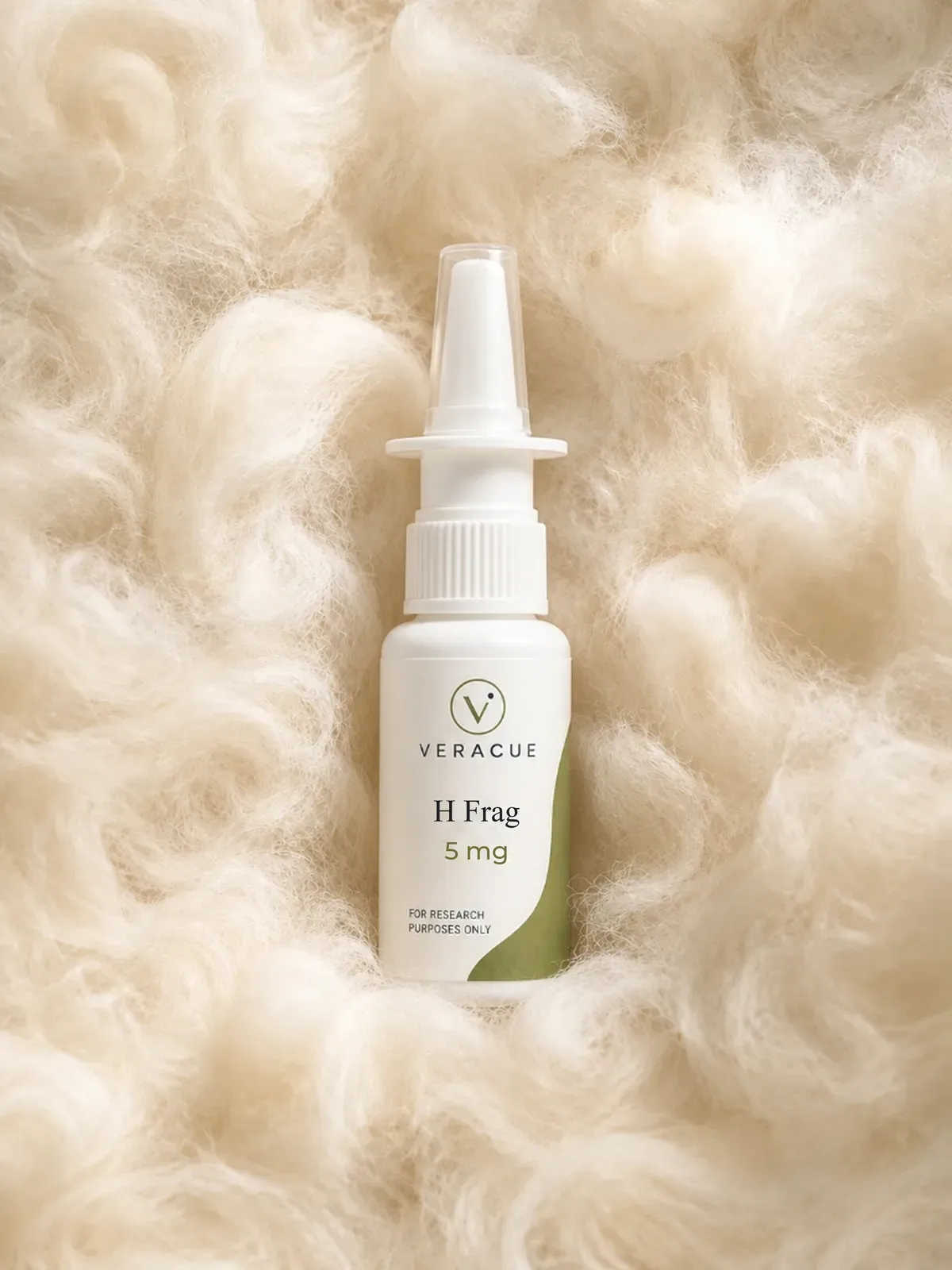
The molecular data on this listing, meaning sequence, disulfide ring, formula, mass and CAS number, applies to the H-Frag peptide as a reference molecule. Identity, purity, concentration and fill volume for any particular bottle can be confirmed only from the documentation issued for its lot.

RESEARCH PEPTIDE
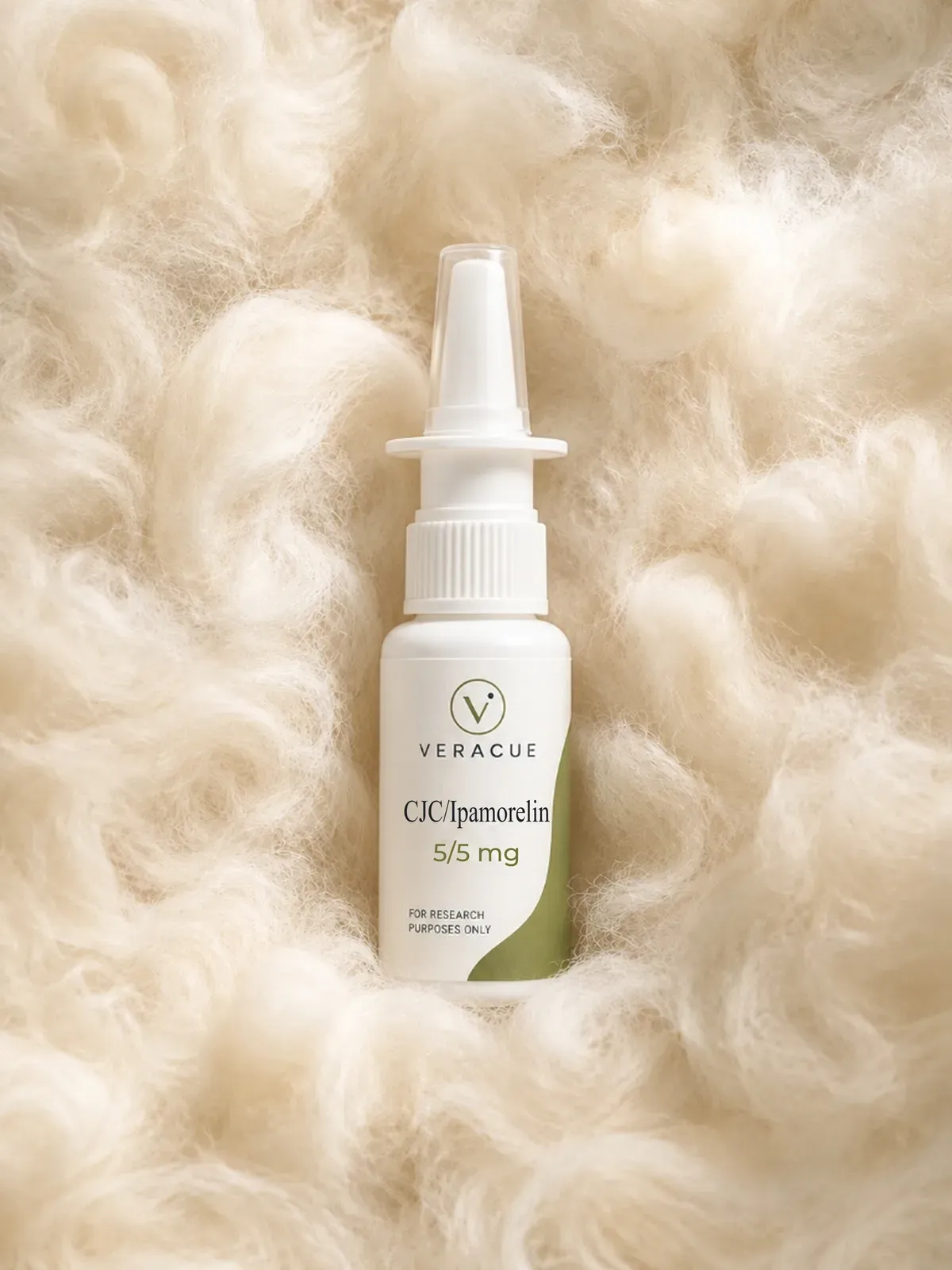
Spray bottle pairing a 29-residue GHRH analog with the pentapeptide Ipamorelin, 5 mg of each and 45 sprays per bottle. Laboratory research use only.

RESEARCH PEPTIDE
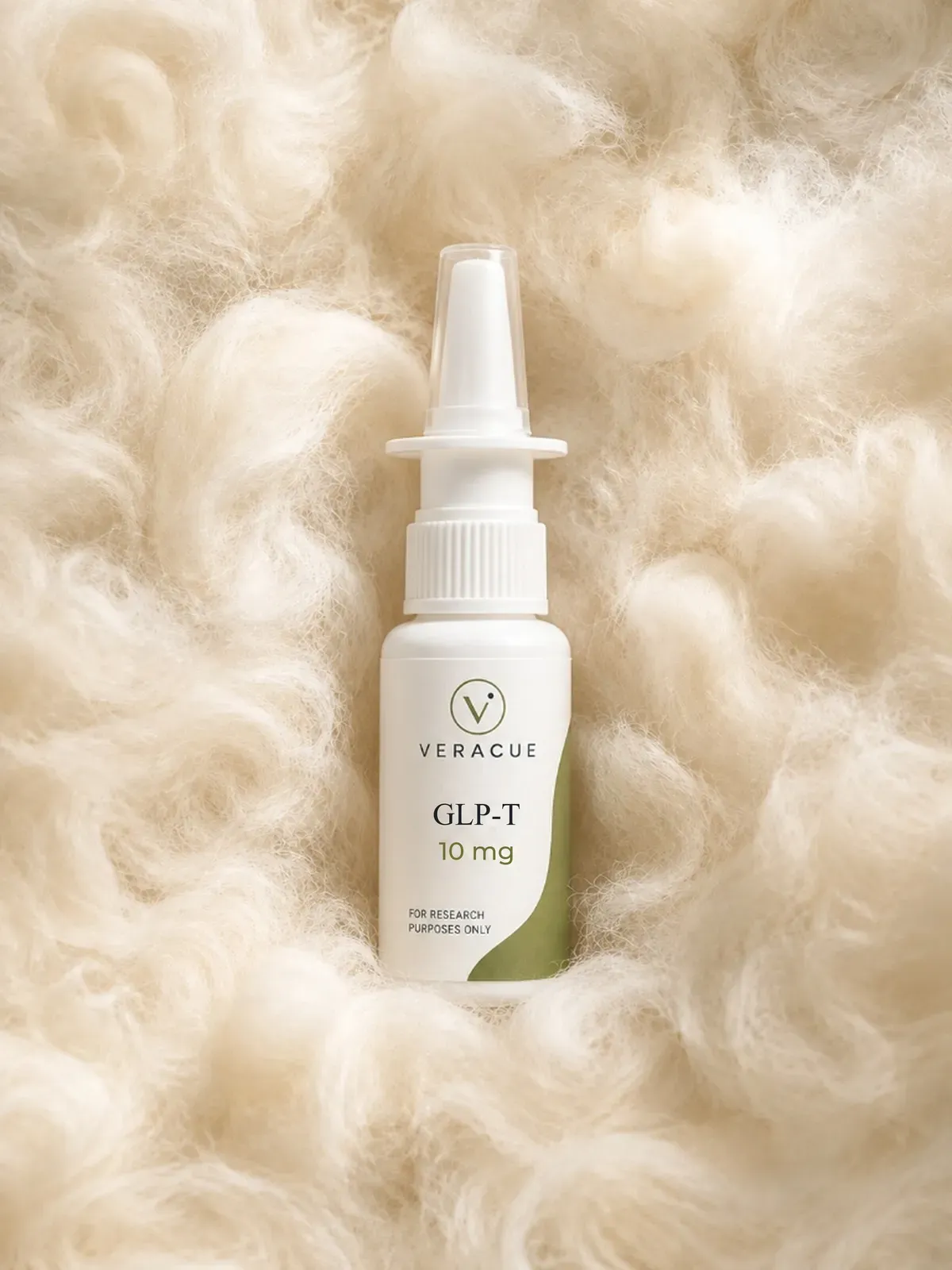
GLP-T Spray pairs a 39-residue peptide, LY3298176 (CAS 2023788-19-2), with a C20 diacid on lysine 20. 10 to 60 mg, research use only, 45 sprays a bottle.

RESEARCH PEPTIDE
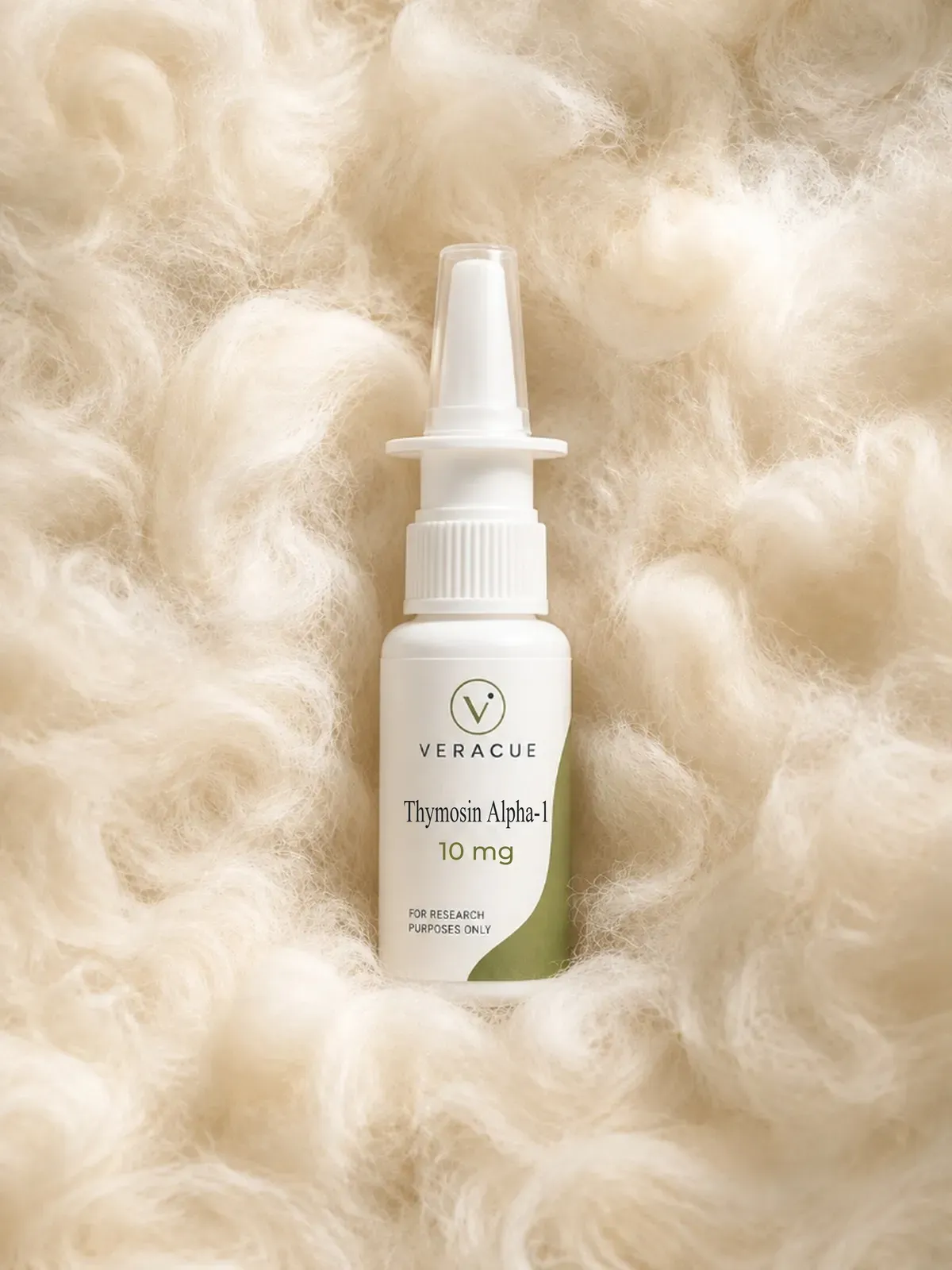
A 28-residue, N-acetylated peptide at 3108.3 g/mol, spray-dispensed in a 10 mg bottle with 45 sprays. Supplied for research use only.

RESEARCH PEPTIDE
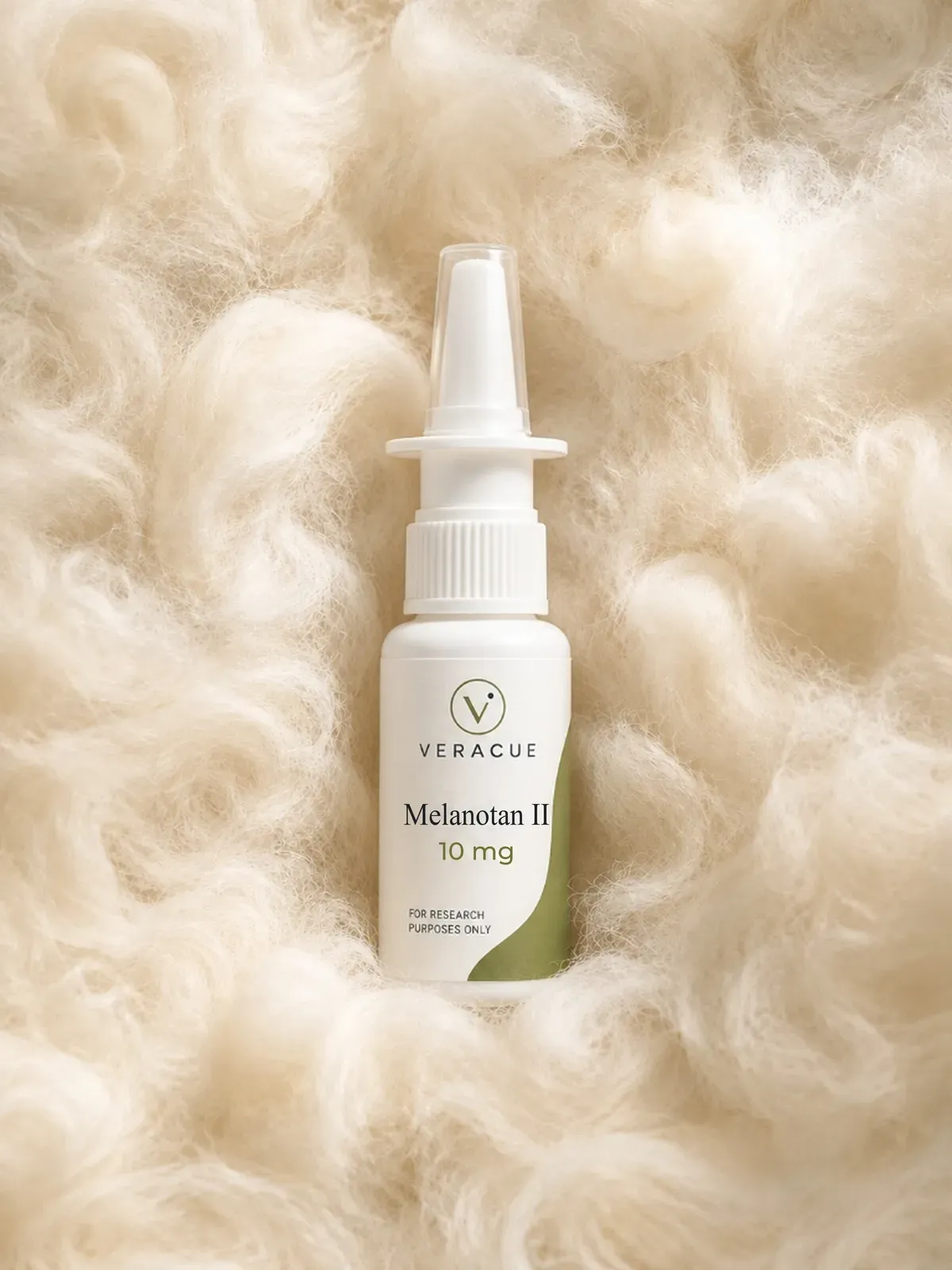
Seven residues, a lactam ring and an amide terminus: Melanotan II, CAS 121062-08-6, in a 10 mg bottle of 45 sprays. Laboratory research only.