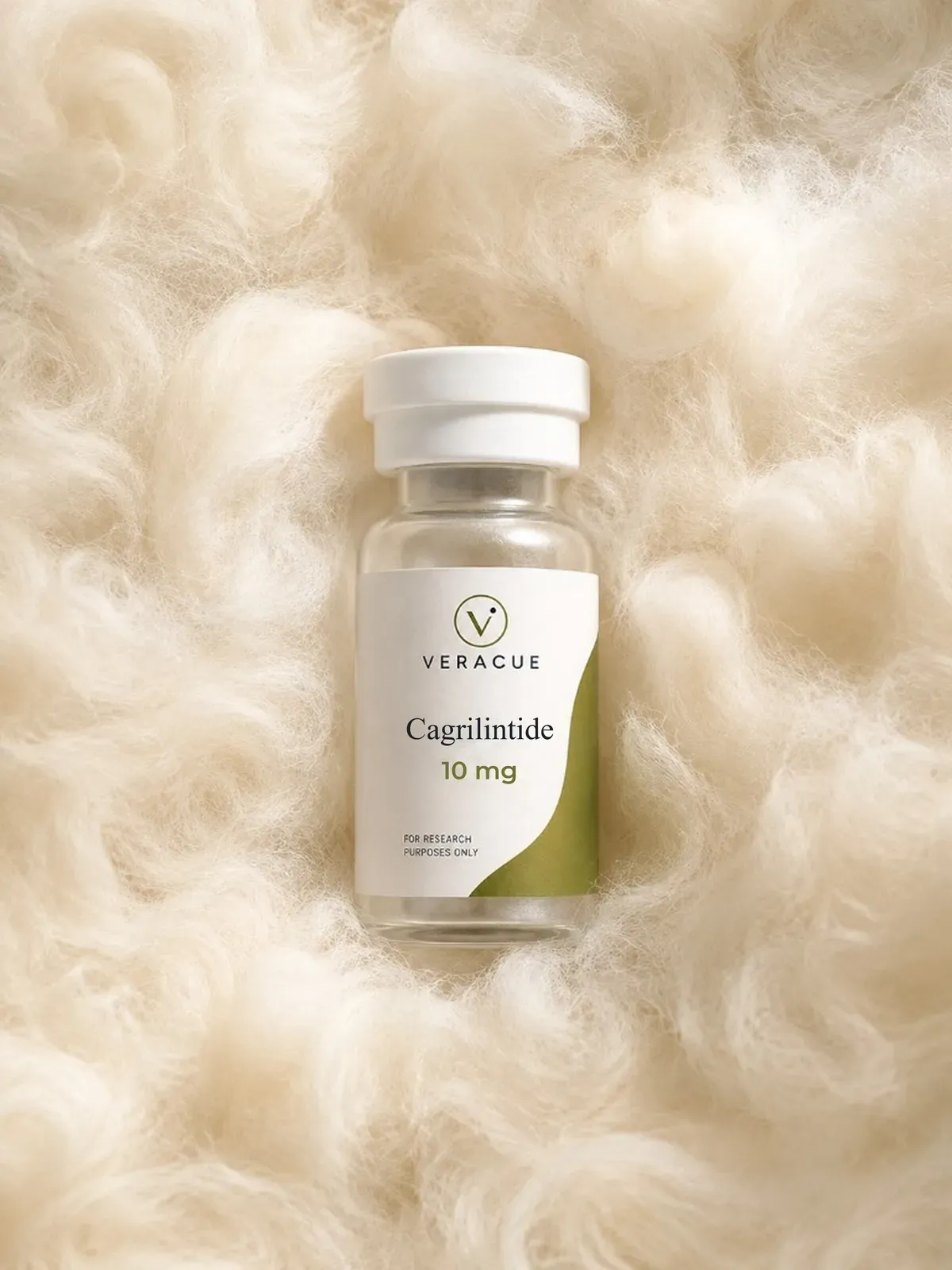
Analytical Testing and Certificate Documentation
HPLC separates a sample into its component species and reports what proportion of total detected peak area the target compound represents. That is chromatographic purity. It indicates related substances, truncated sequences or counterions, and it does not identify the main peak.
Mass spectrometry measures molecular mass against the theoretical mass for the target sequence, within a stated tolerance. This is what establishes identity. For Cagrilintide the comparison point is a theoretical mass near 4,409 g/mol for the free-acid form. Material supplied as a salt or acetate will differ, which is worth confirming before flagging a mismatch.
A certificate of analysis should carry the product name, lot number, test date, testing laboratory, the specification, and the measured result for each test, with enough method detail to interpret them. A specification is the threshold a batch must meet, while the result is what it measured. A certificate showing only specifications says what was required, not what was found.
How to Read a Cagrilintide COA
Read it in this order.
- Confirm the compound name, and that any CAS number or formula matches Cagrilintide: 1415456-99-3 and C194H312N54O59S2 for the free acid.
- Find the lot number and check it against the vial.
- Read the purity result, not the specification, and note the method beside it.
- Find the identity result and confirm the measured mass falls within the stated tolerance of the theoretical mass for the form supplied.
- Check the testing laboratory and the test date, and confirm the date is consistent with the production run.
If any of those five is missing, the document is incomplete, and an incomplete certificate is a fair reason to ask a supplier for more.
Verification Questions, Answered
Is a name on a label enough to confirm identity?
No. A label states what a supplier intends to sell, not what is in the vial. Identity is established by measuring molecular mass against the theoretical mass, cross-referenced to CAS 1415456-99-3 and formula C194H312N54O59S2. Ask for the identity result, not the label.
Are purity and identity the same question?
No. HPLC answers how much of a sample is one species. Mass spectrometry answers which species it is. A sample can return a sharp, high-purity peak and still be the wrong compound, so complete documentation reports both together.
Why does the lot number matter?
Purity and identity vary between production runs. A certificate with no batch number, or one reused across listings and vial sizes, documents a sample rather than your sample. The lot code on the vial should match the lot number on the certificate, and it is best checked on receipt.
What makes a purity figure believable?
A percentage with no method, wavelength, laboratory attribution or underlying chromatogram cannot be independently assessed. Useful documentation names the method, how purity was calculated, the technique used for mass spectrometry, the laboratory and the date.
Is a database entry always the right comparison?
Not always. Registries hold records for salt and related forms as well as the free acid, so confirm which form a database entry or certificate refers to before comparing numbers.
Before You Order Research Material
This checklist applies to any supplier.
- Exact compound identity, stated unambiguously
- CAS number on the listing and on the documentation, matching
- Stated quantity per vial and the supplied chemical form
- Current lot or batch number
- A lot-specific certificate of analysis, not a generic one
- HPLC result with the method stated, result and not just specification
- Identity testing, with the measured mass and tolerance
- Named testing laboratory and a test date consistent with the production run
- Certificate-to-vial traceability, checked on receipt
- Research Use Only designation on both listing and documentation
Need lot documentation for Cagrilintide?
Purity results, identity results, physical form and storage conditions are reported on the documentation for each lot. Ask the Veracue team for the documentation on a specific lot, or review the certificate archive.