NAD+ and AHK-Cu in Metabolic and Longevity Research: A Deep Dive
A research overview of NAD+ and AHK-Cu covering mitochondrial metabolism, sirtuin activation, copper-peptide signaling, and laboratory handling protocols.

GLP-3RTA is a lab-grade synthetic peptide built as a single molecule that engages three receptors at once: GIP, GLP-1 and glucagon. Its 39-amino-acid backbone (formula C221H342N46O68, about 4,731 g/mol) carries a C20 fatty diacid on lysine 17, and its research code is LY3437943 (CAS 2381089-83-2). Because it is one engineered molecule and not a blend, identity is best confirmed by mass spectrometry. Choose 10, 20, 30 or 60 mg vials, sold strictly for laboratory research use.
Ask for the analytical documentation of any lot.
HPLC is the method used to measure purity
Ask for the report for a specific lot through the contact page
Supplied for laboratory research use only
Mass spectrometry is the method used to confirm identity
GLP-3RTA is a synthetic peptide supplied for laboratory research. Its research code is LY3437943 (also written LY-3437943), and it is built as one engineered molecule: a 39-amino-acid peptide backbone carrying a C20 fatty diacid. That design lets a single compound engage three receptors in research systems, namely the GIP receptor (GIPR), the GLP-1 receptor (GLP-1R) and the glucagon receptor (GCGR).
Veracue supplies GLP-3RTA strictly for laboratory use, and lot documentation is available on request.
| Product name | GLP-3RTA |
| Research code | LY3437943 (also LY-3437943) |
| Molecular class | 39-amino-acid peptide conjugated to a C20 fatty diacid |
| Receptor targets | GIPR, GLP-1R and GCGR (agonist activity in receptor assays) |
| Lipid attachment | C20 fatty diacid through a linker at lysine 17 |
| Molecular formula | C221H342N46O68 |
| Molecular weight (average) | About 4,731 g/mol |
| Monoisotopic mass | About 4,728.47 Da |
| CAS Registry Number | 2381089-83-2 |
| Research designation | Research Use Only |
Formula from the PubChem record (CID 171390338). Masses are calculated from that formula. CAS number as listed in chemical databases.
Physical form, salt or counterion, purity, lot results and storage conditions are reported on the documentation for each lot. Request lot documentation through the contact page.
GLP-3RTA is the name Veracue uses for this material. The same molecule is catalogued under the research code LY3437943, also written LY-3437943, in PubChem and in the IUPHAR/BPS Guide to PHARMACOLOGY, which makes those records a useful reference when checking a certificate of analysis.
The backbone is a 39-amino-acid peptide engineered from a GIP sequence, with a few non-standard residues that contribute to enzymatic stability and receptor activity. A C20 fatty diacid is attached through a linker at lysine 17. That lipid supports reversible albumin binding, which shapes how long the molecule persists in biological test systems. The residue-level sequence is available in the PubChem record.
This is the central identity point. GLP-3RTA is a single engineered molecule, not a blend. In the reported receptor assays it showed a distinct balance of activity across GIPR, GLP-1R and GCGR, with greater relative activity at GIPR than at GLP-1R or GCGR.
| Receptor | Full name | Research background |
|---|---|---|
| GIPR | Glucose-dependent insulinotropic polypeptide receptor | Linked to glucose-dependent insulin secretion |
| GLP-1R | Glucagon-like peptide-1 receptor | Linked to glucose-dependent insulin secretion |
| GCGR | Glucagon receptor | Mainly known for glucagon’s role in glucose and energy metabolism |
Established. In receptor and cell-based studies, GLP-3RTA activates GIPR, GLP-1R and GCGR. These receptors belong to a wider signaling network involved in glucose handling and energy metabolism.
Hypothesis. Researchers have proposed that combining the three receptor activities in one molecule may produce signaling patterns that differ from single-receptor or dual-receptor peptides. The glucagon receptor is the most interesting addition, because glucagon is traditionally associated with raising blood glucose. How the three signals interact is still being worked out, so these ideas remain hypotheses.
“Peptide” suggests a plain chain of amino acids, yet GLP-3RTA also carries a lipid, and it helps to know what that adds.
GLP-3RTA is described as a single peptide conjugated to a fatty diacid: a C20 diacid attached through a linker at lysine 17. The lipid supports reversible binding to albumin, a common design strategy for longer persistence in test systems. It also makes the molecule more hydrophobic, which is worth remembering when interpreting analytical data. None of this is a handling or preparation instruction. It describes how the molecule was designed.
Researcher takeaway: The lipid is part of the molecule’s identity, not an accessory.
“Triple agonist” can sound like three compounds combined.
The term describes the receptor profile of one molecule and does not mean three peptides mixed together. Activity at GIPR, GLP-1R and GCGR comes from a single structure with a lipid attached. A mixture of separate peptides would behave differently, because each component would have its own stability and behavior in an assay. The three-receptor activity is best treated as a property of the intact molecule.
Researcher takeaway: “Triple” counts receptors, not ingredients.
It is tempting to give each receptor a single job, but metabolic signaling is more interconnected than that.
GLP-1R and GIPR are both linked to glucose-dependent insulin secretion, while the glucagon receptor is mainly known for glucagon’s role in glucose and energy metabolism. The hypothesis behind combining them is that the three signals together may shape metabolic readouts differently from single-receptor approaches. How the signals combine remains an open research question.
Researcher takeaway: Keep receptor biology and mechanistic hypotheses in separate boxes.
Certificates vary between laboratories and testing programs, so treat this as what a COA may include rather than a fixed checklist.
| COA item | What it helps establish |
|---|---|
| Product name / identifier | What material the report refers to |
| Lot number | Links the report to a specific batch |
| Identity method | How identity was assessed |
| MS / mass result | Supports molecular identity |
| HPLC or other purity method | Reports analytical purity under the stated method |
| Test date | Establishes when testing occurred |
| Laboratory | Identifies who performed the analysis |
| Specification / acceptance criterion | Provides context for the reported result |
HPLC alone does not prove identity, and mass spectrometry alone does not prove purity. If a lot-specific certificate is available, use it as the primary source for that lot’s reported analytical results. The certificate page explains how to request lot documentation.
GLP-3RTA is a lipid-conjugated peptide: a 39-residue backbone carrying a C20 fatty diacid through a linker. Its calculated molecular weight (about 4,731 g/mol average, about 4,728.47 Da monoisotopic, from the PubChem formula) is not the same as an observed LC-MS m/z value, because instruments typically report multiply charged ions and adducts can shift peaks. Confirm the charge state and processing method, and check that the method detected the intact conjugate rather than a fragment. Identity and purity are also separate questions. Mass data speak to what a material is, while chromatographic purity speaks to how much of the detected signal belongs to a single component. A mass quoted without its method is therefore hard to verify.
Related lipidated peptides can look similar in product catalogs, and a name on a label tells you what a material is called, not what it is.
Identity comes from analytical data compared with a defined reference. For GLP-3RTA, the reference is the published structure and the PubChem record: a 39-amino-acid peptide conjugated to a C20 fatty diacid, formula C221H342N46O68. Mass spectrometry can support that match by showing an intact mass consistent with the reference. A clean chromatography peak cannot do the same job, because it shows that a sample is uniform and not what the molecule is.
Researcher takeaway: A name is not an analytical identity. Ask which reference and which method a report used.
A certificate of analysis is only useful if you know what each line can and cannot show.
Depending on the testing program, a lot-specific COA may include a product identifier, lot number, test date, analytical method, identity result, purity or assay value, an acceptance criterion and the testing laboratory. Two points matter most for a lipidated peptide. The identity result should say what it was matched against, and the purity value should name its method. It also helps to confirm that the report refers to the lot in hand.
Researcher takeaway: Read a COA for method, lot and identity basis, not just the percentage.
A single mass number appears on many listings, and it is easy to compare it with the wrong thing.
A calculated molecular mass and an LC-MS m/z value are not automatically the same number. Average molecular weight and monoisotopic mass are both calculated from the formula and differ slightly, whereas an instrument usually reports m/z for multiply charged ions. An observed peak therefore has to be read alongside its charge state, any adducts and the deconvolution method. A figure quoted without those details cannot be checked.
Researcher takeaway: Ask which m/z values, charge states and processing method sit behind a mass claim.
A product page can read like a guarantee, but the material in a vial is a specific lot.
Identity, purity, physical form and storage details belong to the lot record, and a report for one lot does not describe another lot, even for the same compound. The product page provides molecular and research context, while lot-specific documentation provides the analytical results reported for that particular material. The certificate page explains how to request lot documentation.
Researcher takeaway: Use the page to understand the molecule and the lot record to understand the material.
Ask the Veracue team about available documentation for a specific lot, or review the certificate library.

GLP-3RTA is supplied for laboratory research use only and is not intended for human or veterinary use. It has not been evaluated by the FDA. This page contains no dosing, administration or usage guidance of any kind. See the Medical Disclaimer and the Terms and Conditions for sitewide policies.

RESEARCH PEPTIDE
Not a peptide: 5-Amino-1MQ is a quinolinium cation, C10H11N2+ (159.21 g/mol); its iodide salt is 286.11. Check the form. Laboratory research, 50 mg.

RESEARCH PEPTIDE
GLP-S is a 31-residue GLP-1 analog with a C18 diacid on lysine 26 (C187H291N45O59, CAS 910463-68-2). Available from 5 to 30 mg, research use only.

RESEARCH PEPTIDE
Is H-Frag just AOD 9604 under another name? No. It opens with Phe, not Tyr, and weighs 1799.1 g/mol (CAS 66004-57-7). A 5 mg vial for laboratory research.

RESEARCH PEPTIDE
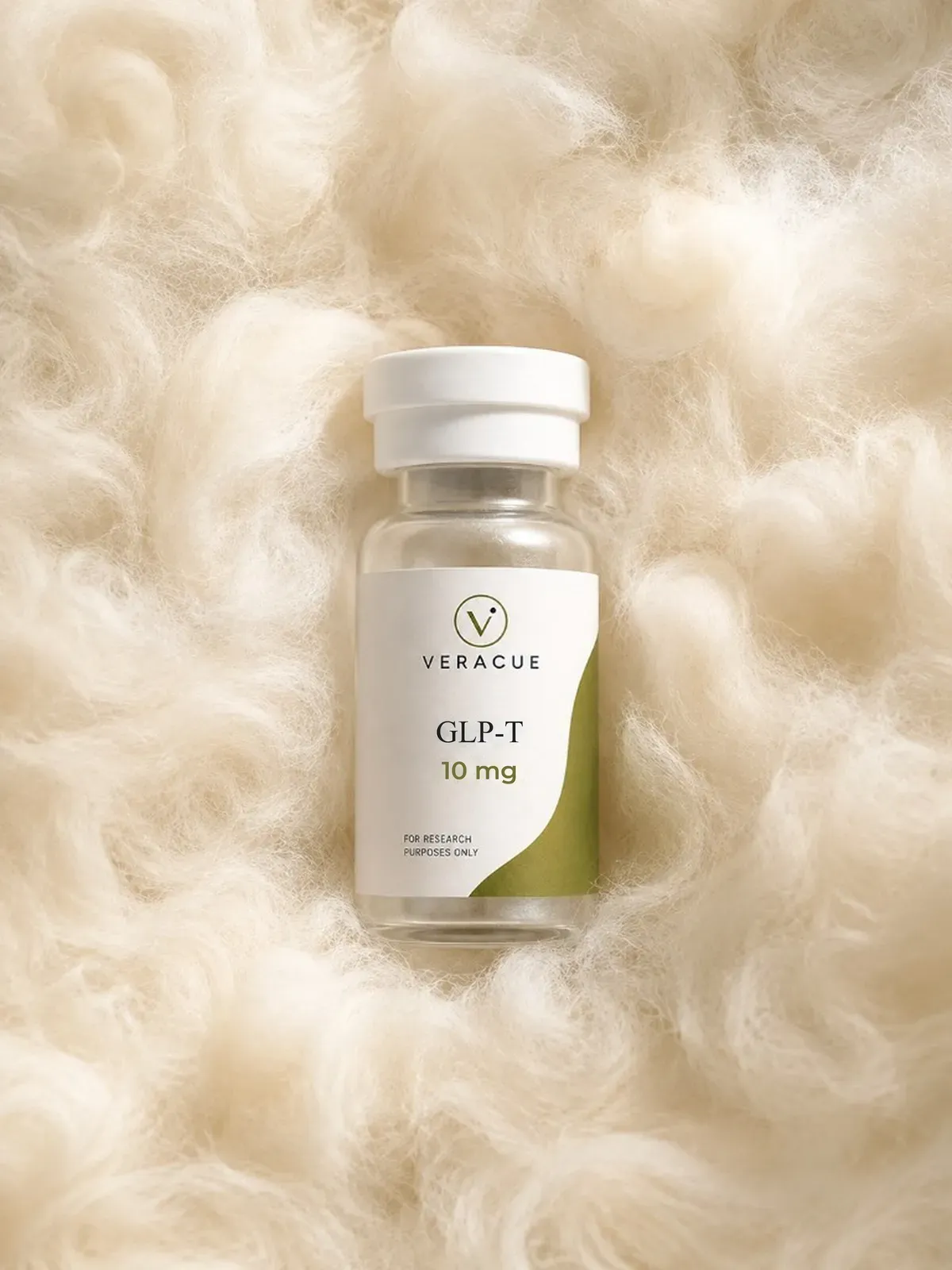
GLP-T (LY3298176) is a 39-residue peptide with a C20 fatty diacid, CAS 2023788-19-2. See the COA notes. 10 to 60 mg, research use only.