NAD+ and AHK-Cu in Metabolic and Longevity Research: A Deep Dive
A research overview of NAD+ and AHK-Cu covering mitochondrial metabolism, sirtuin activation, copper-peptide signaling, and laboratory handling protocols.

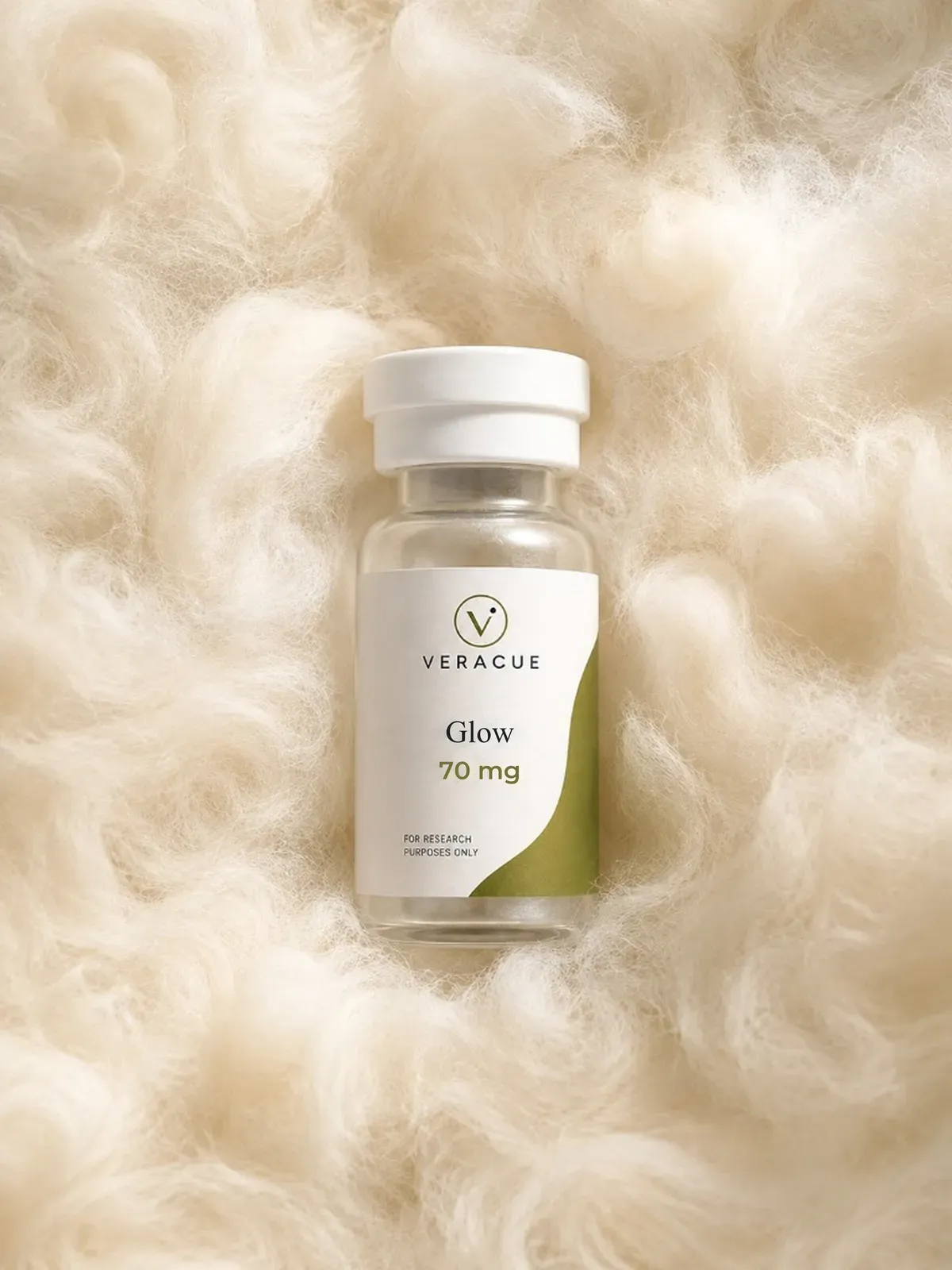
Glow is a Veracue research blend of several peptides in one vial, not a single peptide. The components named for it are GHK-Cu (a copper complex of Gly-His-Lys, CAS 89030-95-5), BPC-157 (a 15-residue peptide, CAS 137525-51-0) and TB-500 (the acetylated fragment Ac-LKKTETQ, CAS 885340-08-9). Because it is a mixture, Glow has no CAS number or molecular weight of its own, and it should not be confused with any single component or with the related KLOW blend. Offered as a 70 mg vial for laboratory research use only.
Ask for the analytical documentation of any lot.
HPLC is the method used to measure purity
Ask for the report for a specific lot through the contact page
Supplied for laboratory research use only
Mass spectrometry is the method used to confirm identity
Glow is a research blend, not a single peptide. It combines GHK-Cu, BPC-157 and TB-500 in one vial, and the name is a supplier convention rather than a defined chemical entity. Veracue offers it as a 70 mg vial for laboratory research only.
Because Glow is a mixture, it has no CAS number or molecular weight of its own. Two vials sold under the same name by different suppliers can hold different peptides in different ratios, so identity has to be checked component by component.
| Product name | Glow |
| Type | Multi-component research blend |
| Components named | GHK-Cu, BPC-157, TB-500 |
| Size offered | 70 mg vial |
| CAS number for the blend | None; each component has its own |
| Research designation | Research Use Only |
Per-component amounts, salt form, purity, physical appearance and storage conditions are reported on each lot’s documentation and can be requested through the contact page.
Each component is a separate compound with its own identifiers. A blend does not inherit a molecular weight from its parts, so identity has to be established one component at a time. The table sets out what the source gives for each.
| Component | Sequence or structure | Formula | CAS | Also listed as |
|---|---|---|---|---|
| GHK-Cu | Gly-His-Lys coordinated to Cu(II) | C14H22CuN6O4 (complex) | 89030-95-5 (complex); 49557-75-7 (free peptide) | Copper Tripeptide-1, Cu-GHK |
| BPC-157 | Gly-Glu-Pro-Pro-Pro-Gly-Lys-Pro-Ala-Asp-Asp-Ala-Gly-Leu-Val (GEPPPGKPADDAGLV), 15 residues | C62H98N16O22 | 137525-51-0 | Body Protection Compound-157, PL 14736, Bepecin |
| TB-500 | Ac-Leu-Lys-Lys-Thr-Glu-Thr-Gln (Ac-LKKTETQ), 7 residues | C38H68N10O14 | 885340-08-9 | Thymosin beta-4 fragment (17-23) |
No. GHK is the free tripeptide, 340.38 g/mol, CAS 49557-75-7. GHK-Cu is the copper(II) complex, CAS 89030-95-5. Sources describe different species with different masses, so a COA should say which one its identity result was matched against.
TB-500 is the most ambiguous name in this blend. The defined entity is the seven-residue acetylated fragment Ac-LKKTETQ, about 889 Da, which is the actin-binding motif of thymosin beta-4 (residues 17 to 23). Full-length thymosin beta-4 is a different molecule, a 43-residue protein of roughly 4963 Da.
Products sold as TB-500 are sometimes the fragment and sometimes the full protein. The mass spectrometry result on the lot certificate settles it: an observed mass near 889 Da is the heptapeptide, and a mass near 4963 Da is the full protein. Which species is supplied in Glow is reported on each lot’s documentation.
Very little on its own. Glow is a market naming convention, so formulations under the name differ between suppliers, and the composition of one vendor’s vial should not be read onto another’s.
Not automatically. Each body of laboratory work describes the compound that was actually studied. The source found no controlled study that evaluated these components together, so a combined or synergistic effect is not established by the component literature. Published work under the name TB-500 may also have used full-length thymosin beta-4 rather than the fragment.
It reports molecular reference information for the named components. It cannot establish what is in a particular vial, and it does not show that concentrations used in cell culture correspond to any other amount or route. A purity figure does not establish sterility, endotoxin status or biological activity either. Veracue does not provide dosing, administration or usage guidance of any kind.

A single purity percentage is the standard way blends are documented and the least useful. Area normalization on one chromatogram shows how the detected signal spreads across peaks. On a three-component blend, a well-resolved run gives three main peaks, and one overall purity number leaves open which peak is which and whether any component is short.
Identity and quantity are separate questions from purity, and a blend needs all three answered per component. What a given Glow lot reports is stated on that lot’s own COA.
| COA element | What it establishes for a blend | What it does not establish |
|---|---|---|
| HPLC purity, single figure | Share of detected signal in the main peaks under stated conditions | Which component each peak is, or whether the ratio matches the label |
| HPLC with per-component assignment | Separation and relative area of each named component, if the method is validated for this blend | Absolute amount of each component without reference standards |
| LC-MS or ESI-MS | Whether observed masses are consistent with each expected component | Purity, ratio, or how much material is present |
| Quantitative LC-MS against standards | Amount of each component, so the stated ratio can be checked | Sterility, endotoxin or biological activity |
| Net peptide content | How much of the vial mass is peptide rather than counterion and water | The split between components |
| Copper content | Whether copper is present at the expected ratio to the GHK peptide | Purity of the peptide portion |
| Lot number and test date | That the report belongs to the vial in hand | Anything at all, unless it matches the vial label |
Not necessarily. Synthetic peptides are normally supplied as acetate or trifluoroacetate salts, and residual counterion and water are part of the weighed mass. Net peptide content is the figure that answers the question, and it belongs on the lot certificate.
Storage conditions follow the lot’s own documentation and label. Handle the material as a laboratory chemical with appropriate personal protective equipment. The certificate page explains how to see lot documentation.
Ask the Veracue team for the documentation that belongs to a specific lot, or browse the certificate library.
Glow supplied by Veracue is intended solely for laboratory research. It is not a drug, cosmetic, dietary supplement or food, and it must not be given to humans or animals. The information here describes molecular identity and analytical documentation and is not advice or a statement of efficacy or safety. This page contains no dosing, administration or usage guidance of any kind. See the Medical Disclaimer and the Terms and Conditions for sitewide policies.
RESEARCH PEPTIDE
LL-37 or hCAP-18? The vial holds the 37-residue peptide (C205H340N60O53, about 4493.3 g/mol), not the precursor. 1 mg, laboratory research only.

RESEARCH PEPTIDE
Two peptides in one vial: BPC-157 (GEPPPGKPADDAGLV) and acetylated TB-500 (Ac-LKKTETQ), each with its own CAS number. 5/5 and 10/10 mg, research use only.

RESEARCH PEPTIDE
Is VIP the same as PACAP? No. It is a 28-residue amidated peptide, C147H238N44O42S, CAS 40077-57-4. Research use only; supplied as a 10 mg vial.

RESEARCH PEPTIDE
Is BPC-157 a blend or one peptide? It is a single 15-residue molecule, GEPPPGKPADDAGLV (CAS 137525-51-0). Sold in 5 and 10 mg for research use only.