NAD+ and AHK-Cu in Metabolic and Longevity Research: A Deep Dive
A research overview of NAD+ and AHK-Cu covering mitochondrial metabolism, sirtuin activation, copper-peptide signaling, and laboratory handling protocols.

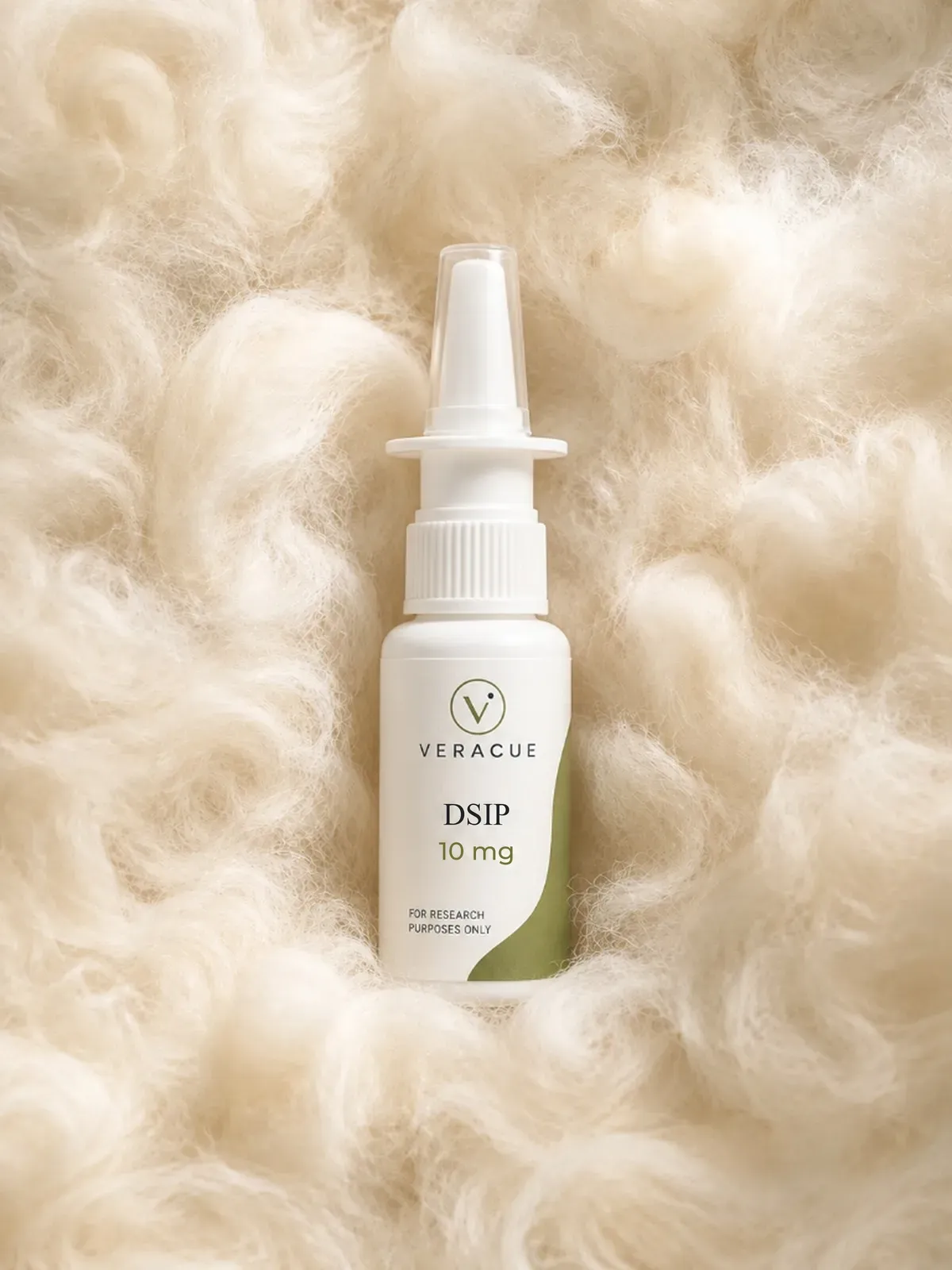
DSIP Spray is a spray-dispensed bottle of the nonapeptide WAGGDASGE, known as delta sleep-inducing peptide, with an unmodified free N-terminus and C-terminus. Reference values for the free peptide are formula C35H48N10O15, average mass 848.8 g/mol and CAS 62568-57-4, and Emideltide is a registry synonym. Three glycines, two alanines, one tryptophan, one serine and acidic residues at positions five and nine make up the whole chain, with no basic side chain at all. The 10 mg size comes at 90 sprays per bottle, strictly for laboratory research use only.
Ask for the analytical documentation of any lot.
HPLC is the method used to measure purity
Ask for the report for a specific lot through the contact page
Supplied for laboratory research use only
Mass spectrometry is the method used to confirm identity
The only peptide named on a bottle of DSIP Spray is a single synthetic nonapeptide, written WAGGDASGE in one-letter code and Trp-Ala-Gly-Gly-Asp-Ala-Ser-Gly-Glu in three-letter code. DSIP abbreviates delta sleep-inducing peptide, a historical name for this sequence. The name labels the molecule, and Veracue makes no statement about what the material does in any system.
Neither terminus carries a modification: the N-terminus is a free amine, the C-terminus a free carboxylic acid, and all nine residues are L-configured. The registry also lists the peptide as Emideltide. The figures below are reference values for the free peptide, not measured lot results.
| Listed name | DSIP Spray |
| Peptide | DSIP, delta sleep-inducing peptide (registry synonym: Emideltide) |
| Chain length | 9 residues, linear nonapeptide |
| Sequence, one-letter | WAGGDASGE |
| Sequence, three-letter | Trp-Ala-Gly-Gly-Asp-Ala-Ser-Gly-Glu |
| Chain ends | Free N-terminal amine, free C-terminal acid |
| Molecular formula | C35H48N10O15 |
| Average molecular mass | 848.8 g/mol |
| Monoisotopic mass (calculated) | 848.33 Da |
| CAS Registry Number | 62568-57-4 |
| Second registry number | 69431-45-4 (NLM MeSH indexing of the same peptide) |
| PubChem CID | 68816 |
| InChIKey | ZRZROXNBKJAOKB-GFVHOAGBSA-N |
| Size and count | 10 mg, 90 sprays per bottle |
| Research designation | Research Use Only |
Counterion form, concentration, purity and storage details are not stated here. Each lot’s own paperwork carries them, and the contact page is the place to ask for it.
| Residue | Position | Count | Side chain |
|---|---|---|---|
| Glycine | 3, 4, 8 | 3 | Hydrogen only, no side chain |
| Alanine | 2, 6 | 2 | Methyl, nonpolar |
| Tryptophan | 1 | 1 | Indole ring, the only aromatic residue |
| Aspartic acid | 5 | 1 | Carboxylic acid |
| Serine | 7 | 1 | Hydroxyl |
| Glutamic acid | 9 | 1 | Carboxylic acid |
The composition is short and polar. There is no cysteine, so no disulfide bond is possible, no methionine, and no lysine, arginine or histidine. The one basic site is the N-terminal amine, set against three acidic groups (the aspartic and glutamic acid side chains plus the C-terminal acid), so the free peptide carries a net negative charge near neutral pH. Tryptophan at position one is the only aromatic residue and the only strong absorber near 280 nm.
Each of these features shows up later in analytical data, which is why they are worth noting before reading any certificate.
Records for this peptide appear under DSIP, delta sleep-inducing peptide, Emideltide, delta sleep peptide and delta sleep factor. Chemical suppliers and compound databases use CAS 62568-57-4. The National Library of Medicine’s MeSH vocabulary files the same peptide under 69431-45-4, so a search on one number alone can miss records filed under the other.
Because the names are scattered, the sequence WAGGDASGE together with CAS 62568-57-4 is a firmer anchor than any single name. A structure-based identifier is harder still to confuse: the InChIKey is ZRZROXNBKJAOKB-GFVHOAGBSA-N and the PubChem CID is 68816.
| Candidate | Difference from DSIP | Mass versus 848.8 |
|---|---|---|
| (Asn5)-DSIP, CAS 80064-67-1 | Asparagine in place of aspartic acid at position 5; a separately registered peptide | About 1 Da lower, near 847.8 |
| C-terminal amide of the same nine residues | Carboxamide at the C-terminus instead of the free acid | About 1 Da lower, near 847.8 |
| N-terminally acetylated nonapeptide | Acetyl cap on the N-terminal amine | About 42 Da higher |
| Longer peptide sold under the same label | More than nine residues, so a different formula altogether | Far from 848.8 |
Two of these rows share a shift. The amidated chain and the Asn5 analog both sit about 0.98 Da below the reference, and both work out to the same elemental formula, C35H49N11O14. A loose mass tolerance can pass either one as the real peptide, and even an exact mass cannot separate them from each other. Only fragment-ion sequencing, or a stated sequence backed by it, tells them apart.
Count the residues and read the ends. The chain has nine residues, begins with tryptophan, ends with glutamic acid and has free termini. The formula C35H48N10O15 and an average mass of 848.8 g/mol should appear together with it.
A name can be reused for a chain of a different length, and an analog can inherit the base name with one substitution. A listing that gives more than nine residues, or a mass well away from 848.8, describes a different compound whatever it is called.
Search the CAS number and the sequence alongside each name variant. A search on delta sleep-inducing peptide alone will not return records indexed only under Emideltide or only under a registry number. Veracue provides no dosing, administration or usage guidance of any kind.

| Quantity | Value | Notes |
|---|---|---|
| Average molecular mass | 848.8 g/mol | Formula weight of C35H48N10O15 |
| Monoisotopic neutral mass | 848.33 Da | Calculated from the most abundant isotopes |
| [M+H]+ | 849.34 | Singly protonated ion |
| [M+2H]2+ | 425.17 | Doubly protonated ion, m/z |
| [M-H]- | 847.32 | Singly deprotonated ion |
These numbers are calculated from the formula and are not measurements of any lot. Sodium and potassium adducts appear above the protonated ion. Since the only basic site is the N-terminal amine, a quoted m/z means little unless the polarity and charge state are stated next to it.
| Offset from 848.33 | Likely meaning |
|---|---|
| About +42.01 | Acetyl group on the N-terminus |
| About -0.98 | C-terminal amide, or asparagine at position 5 |
| About +15.99 | One added oxygen, for example an oxidized tryptophan |
| About -57.02 | Chain missing one glycine |
| About -71.04 | Chain missing one alanine |
Reverse-phase HPLC reports the share of detected signal that falls in the main peak under stated conditions. A nine-residue chain this polar typically elutes early, so the column, the gradient start and the detection wavelength all shape what the percentage means. The lone tryptophan adds a reading near 280 nm to the peptide-bond signal at lower wavelengths. A purity figure without those conditions cannot be compared with another laboratory’s figure.
HPLC does not identify the main peak, and it is silent on how much peptide a bottle holds by weight. Identity comes from the mass result and, where isomers matter, from fragment ions.
A certificate describes one lot and nothing more general. For paperwork on a specific lot, start at the certificate page, or write to the Veracue team through the contact page.
DSIP Spray is supplied for laboratory research and analytical work only. Neither people nor animals are its intended end users, and it is not a drug, supplement, cosmetic or food. Veracue provides no dosing, administration or usage guidance of any kind, and nothing in the product description should be read as a claim about what the material does.
Purchasers are responsible for lawful use within an appropriate research setting. Sitewide policies are set out in the Medical Disclaimer and the Terms and Conditions.

RESEARCH PEPTIDE
Spray bottle pairing a 29-residue GHRH analog with the pentapeptide Ipamorelin, 5 mg of each and 45 sprays per bottle. Laboratory research use only.

RESEARCH PEPTIDE
GLP-T Spray pairs a 39-residue peptide, LY3298176 (CAS 2023788-19-2), with a C20 diacid on lysine 20. 10 to 60 mg, research use only, 45 sprays a bottle.

RESEARCH PEPTIDE
A 28-residue, N-acetylated peptide at 3108.3 g/mol, spray-dispensed in a 10 mg bottle with 45 sprays. Supplied for research use only.

RESEARCH PEPTIDE
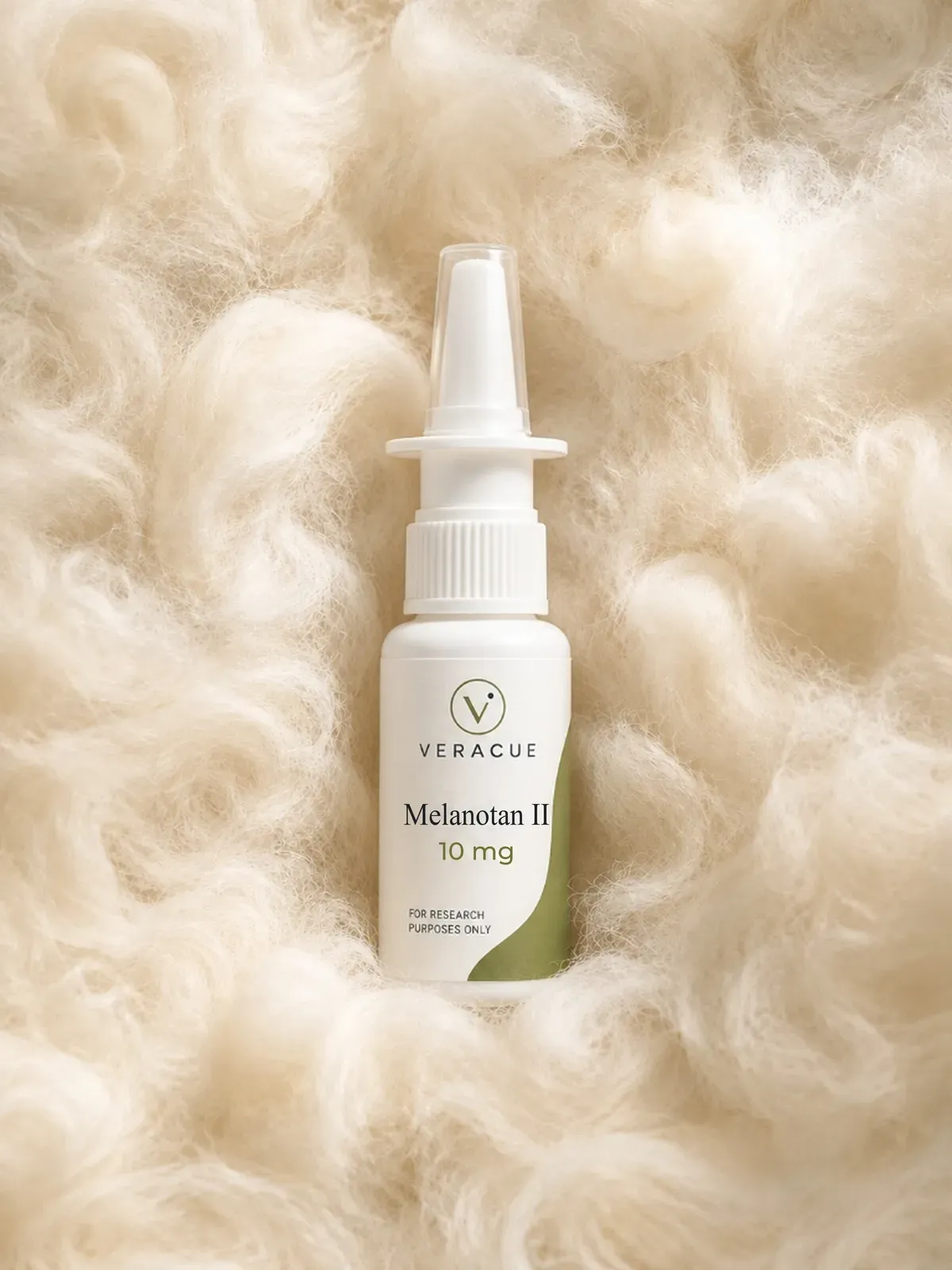
Seven residues, a lactam ring and an amide terminus: Melanotan II, CAS 121062-08-6, in a 10 mg bottle of 45 sprays. Laboratory research only.