NAD+ and AHK-Cu in Metabolic and Longevity Research: A Deep Dive
A research overview of NAD+ and AHK-Cu covering mitochondrial metabolism, sirtuin activation, copper-peptide signaling, and laboratory handling protocols.

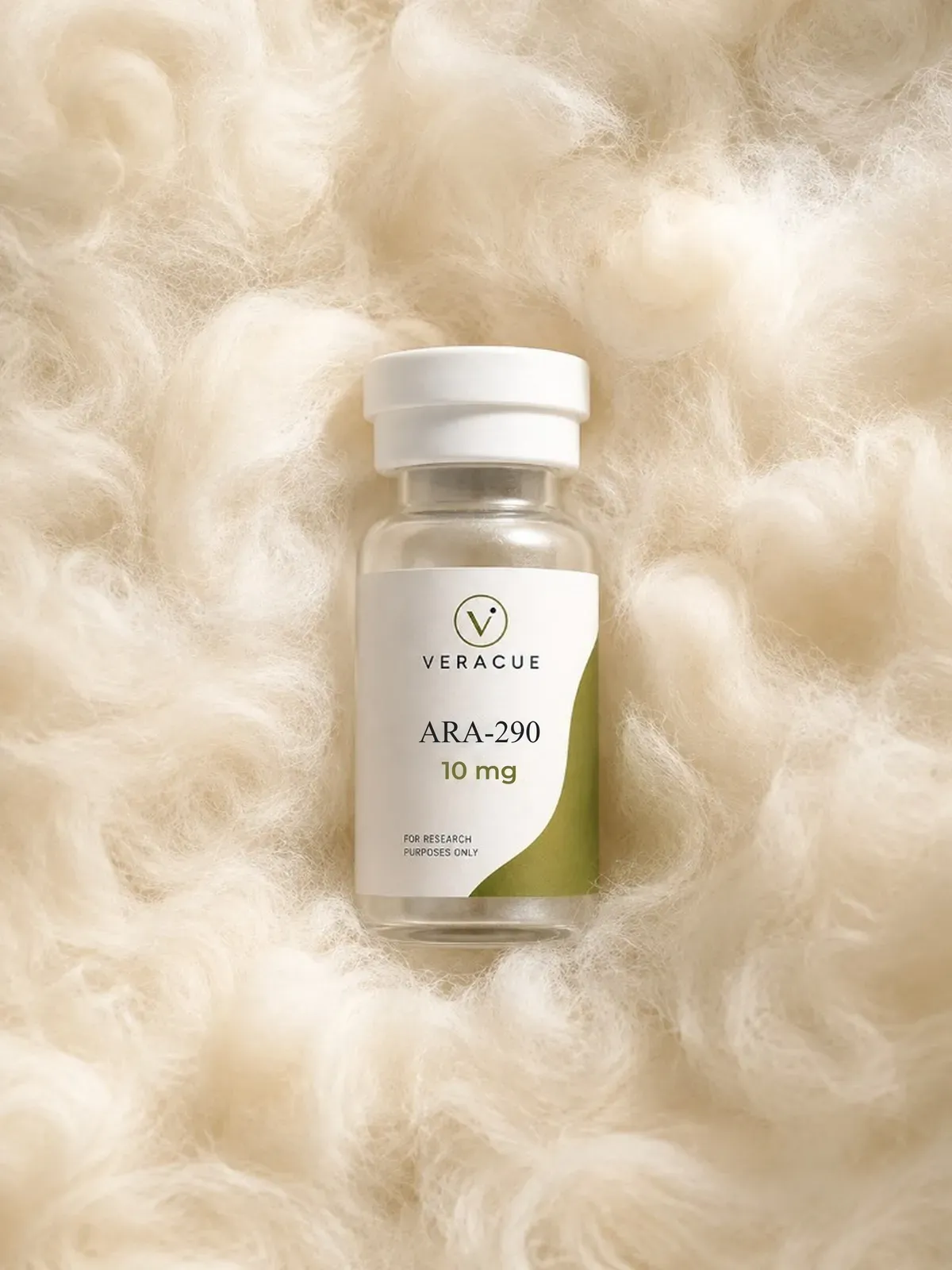
ARA-290 is an 11-residue synthetic peptide, pGlu-EQLERALNSS, with an N-terminal pyroglutamate. It is modeled on the helix B surface of erythropoietin (EPO) and is also written ARA290 or pHBSP. The formula is C51H84N16O21, the average mass is about 1257.3 g/mol and the CAS number is 1208243-50-8. It appears in innate repair receptor (IRR) signaling models. Supplied as a 10 mg vial for laboratory research use only.
Ask for the analytical documentation of any lot.
HPLC is the method used to measure purity
Ask for the report for a specific lot through the contact page
Supplied for laboratory research use only
Mass spectrometry is the method used to confirm identity
ARA-290 is a synthetic 11-amino-acid peptide with the sequence pGlu-EQLERALNSS, built around the helix B surface region of erythropoietin (EPO). Cibinetide is the International Nonproprietary Name for the same molecule (CAS 1208243-50-8). Veracue supplies it for laboratory research only.
ARA-290 was its development code name, and both terms describe one compound. It was designed by Araim Pharmaceuticals to ask whether the signaling linked to EPO could be studied separately from EPO’s classical red-blood-cell activity.
| Product name | ARA-290 (INN: cibinetide) |
| Also written | ARA290, ARA 290, pHBSP, Pyroglutamate Helix B Surface Peptide |
| Sequence | pGlu-EQLERALNSS (pE-Glu-Gln-Leu-Glu-Arg-Ala-Leu-Asn-Ser-Ser) |
| Length | 11 amino acids |
| Molecular formula | C51H84N16O21 |
| Average molecular weight | 1257.3 g/mol (1257.324 g/mol per PubChem) |
| CAS Registry Number | 1208243-50-8 |
| FDA UNII | 9W5677JKDA |
| PubChem CID | 91810664 |
| Structural origin | Modeled on the helix B surface domain of erythropoietin |
| Research designation | Research Use Only |
Formula and identifiers describe the free peptide as a reference structure, taken from the PubChem record and the FDA substance registry. Salt or counterion form, physical form, net peptide amount, purity, lot results and storage conditions are reported on each lot’s documentation and can be requested through the contact page.
pGlu-EQLERALNSS is eleven residues: pyroglutamate, glutamic acid, glutamine, leucine, glutamic acid, arginine, alanine, leucine, asparagine, serine and serine. The N-terminal pE is a cyclized glutamine residue at position 1.
The notation trips people up. Some reference sources write the sequence with an X in place of the pyroglutamate, so pGlu-EQLERALNSS and XEQLERALNSS describe the same molecule. A genuine ARA-290 record should resolve to these same eleven residues in this order.
No. ARA-290 is a short peptide taken from one surface region of the much larger EPO protein. It is not intact EPO, and the literature treats it as pharmacologically distinct from EPO. Findings about one molecule should not be carried over to the other.
Free peptide and salt forms have different masses. The 1257.3 g/mol figure here is the free-peptide value, while a commonly cited acetate figure is roughly 1,317 g/mol. Which form a given vial contains is a lot-level fact and should not be assumed from the parent molecular weight.
EPO’s classical activity runs through the EPO receptor homodimer (EPOR/EPOR) on erythroid precursor cells. Researchers also proposed that a different complex, EPOR paired with the beta-common receptor (βcR/CD131), mediates EPO’s effects in other cell types at higher concentrations. That proposed complex is called the innate repair receptor (IRR).
ARA-290 was developed around this model: a peptide built from the EPO helix B surface, meant to engage IRR-linked signaling without engaging the EPOR homodimer.
No. A 2018 biophysical study tested the extracellular domains of EPOR and the beta-common receptor directly, with and without EPO and with and without ARA-290. It used surface plasmon resonance, microscale thermophoresis, size-exclusion chromatography, pull-down assays and analytical ultracentrifugation, and found no detectable physical association between the two domains.
The authors noted that transmembrane or intracellular regions, which that study did not test, remain a possible site of interaction. So whether the two receptors associate at the molecular level is still an open, actively discussed question.
| Item | Detail |
|---|---|
| Classical EPO receptor | EPOR homodimer (EPOR/EPOR) on erythroid precursor cells |
| Proposed alternative complex | EPOR paired with the beta-common receptor (βcR/CD131), called the IRR |
| ARA-290 design rationale | Helix B surface peptide intended to engage IRR-linked signaling |
| Status of the model | Research framework; direct extracellular EPOR to βc association not detected in a 2018 biophysical study |
Treat the IRR as a research model and not as a confirmed drug target. When you read a paper, ask four questions: which system was used, which comparator, which endpoint, and which chemical form of the peptide. Many papers do not say whether they used the free peptide or a salt, so they cannot be matched to a specific lot.
Veracue does not provide dosing, administration or usage guidance of any kind.

A purity percentage alone does not show that a vial contains ARA-290. A useful COA ties together identity, purity and lot traceability, not just a number. Certificates vary between laboratories, so treat the list below as what a COA may include rather than a fixed checklist.
| COA item | What it helps establish |
|---|---|
| Peptide identity | The compound name, which should agree with the formula and weight shown. |
| Sequence | Whether the record ties the material to pGlu-EQLERALNSS. |
| Lot or batch number | Which production run the results describe. It should match the vial label. |
| Purity method | The method behind the purity value, for example RP-HPLC. |
| Mass spectrometry or identity result | Whether the measured mass fits the molecular form in the vial. |
| Salt or counterion | Free peptide or a salt form such as acetate, where applicable. |
| Net peptide content | Peptide content, where documented. |
| Testing laboratory and test date | Who ran the analysis and how recent it is. |
Any field above depends on the lot’s own documentation, and Veracue confirms a field only when the lot certificate reports it. The certificate page explains how to request lot documentation, and an ARA-290 record may not be listed there yet, so ask through the contact page rather than assuming a COA exists.
HPLC helps assess chromatographic purity. Mass spectrometry helps assess molecular identity and mass. Neither one alone establishes every aspect of material quality, so read the purity value together with the method reported on the analytical record.
| Value | Figure |
|---|---|
| Average molecular weight (free peptide, reference) | 1257.3 g/mol |
| Molecular formula | C51H84N16O21 |
The 1257.3 g/mol figure is a reference value for the free peptide and not an observed lot-specific result. A COA should report what was actually measured for that lot, and the observed mass should correspond to the molecular form in the vial, free peptide or salt.
Molecule identity and lot identity are different things. CAS, PubChem and UNII data describe the reference molecule in general, while a specific vial is confirmed only by that lot’s own sequence or mass match, purity result and lot number together.
Ask the Veracue team about the documentation available for a specific lot, or browse the certificate library.
ARA-290 supplied by Veracue is intended solely for laboratory and analytical research. It is not a drug, dietary supplement, cosmetic or food, and it is not intended to diagnose, treat, cure or prevent any disease. It must not be administered to humans or animals, and it is not for ingestion, injection or any form of administration. This page contains no dosing, administration or usage guidance of any kind. See the Medical Disclaimer and the Terms and Conditions for sitewide policies. Purchasers are responsible for using this material lawfully and within an appropriate research setting.
RESEARCH PEPTIDE
LL-37 or hCAP-18? The vial holds the 37-residue peptide (C205H340N60O53, about 4493.3 g/mol), not the precursor. 1 mg, laboratory research only.

RESEARCH PEPTIDE
Two peptides in one vial: BPC-157 (GEPPPGKPADDAGLV) and acetylated TB-500 (Ac-LKKTETQ), each with its own CAS number. 5/5 and 10/10 mg, research use only.

RESEARCH PEPTIDE
Is VIP the same as PACAP? No. It is a 28-residue amidated peptide, C147H238N44O42S, CAS 40077-57-4. Research use only; supplied as a 10 mg vial.

RESEARCH PEPTIDE
Is BPC-157 a blend or one peptide? It is a single 15-residue molecule, GEPPPGKPADDAGLV (CAS 137525-51-0). Sold in 5 and 10 mg for research use only.