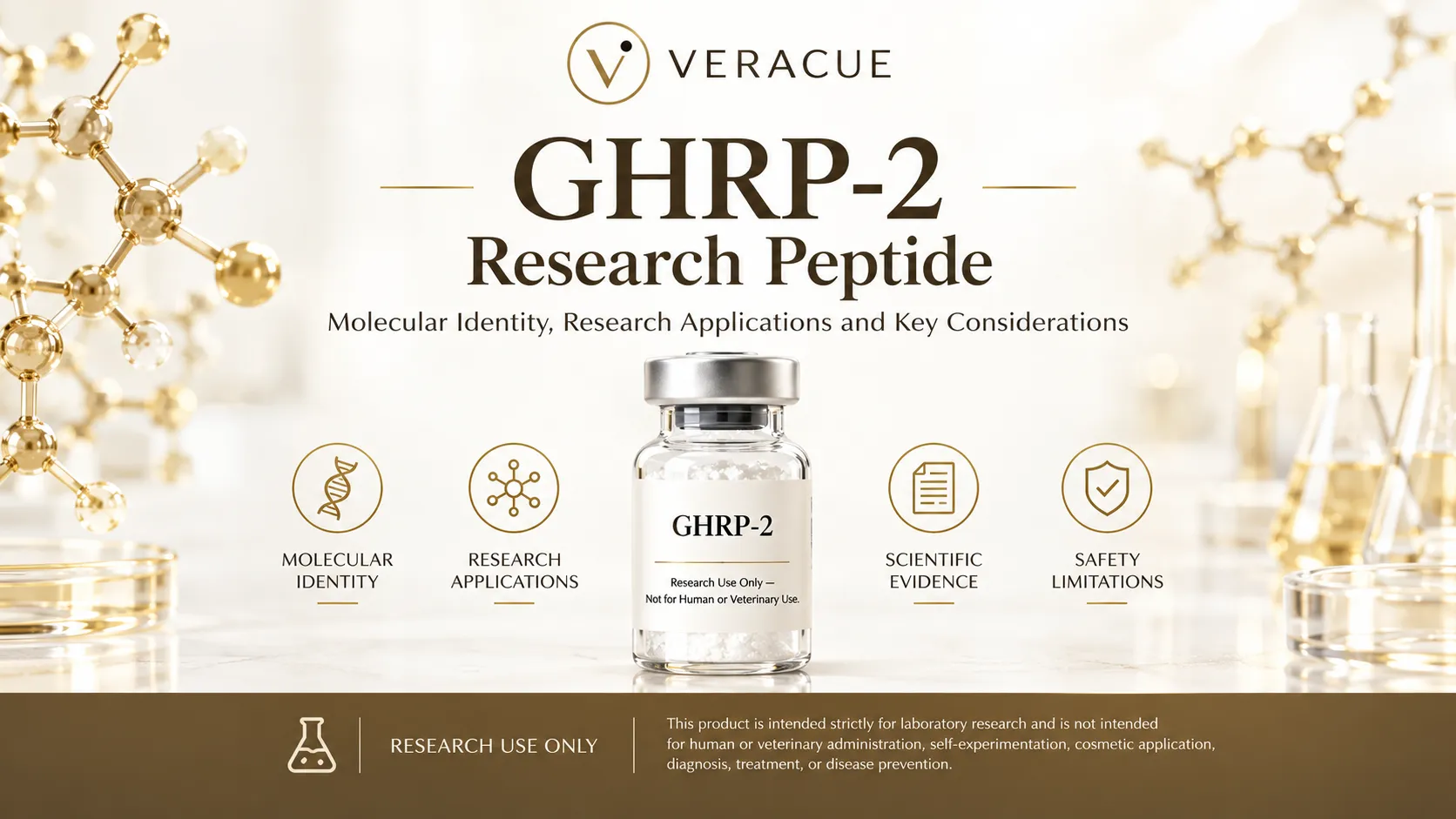
- GHRP-2 is a synthetic hexapeptide agonist of GHS-R1a, the same receptor ghrelin binds; it is distinct from GHRH-receptor agonists such as sermorelin or CJC-1295.
- Human research includes a validated diagnostic test for adult growth hormone deficiency, a controlled appetite study in healthy men, and a 12-month pediatric study on oral GHRP-2 — none of it establishes safety or benefit for general wellness, bodybuilding, or anti-aging use.
- Pralmorelin (GHRP-2) has a diagnostic role in Japan for assessing growth hormone secretory function; that is a specific, jurisdiction-bound clinical use and is not FDA approval for any indication.
- FDA lists GHRP-2 (for injectable and nasal routes) in Category 2 of its bulk-drug-substances compounding framework, citing immunogenicity concerns and reports of serious adverse events in which causality was not established — a safety flag, not a drug-approval status.
GHRP-2 shows up in two very different contexts that are easy to blur together: as pralmorelin, a compound with an established diagnostic use in Japan, and as a research-use-only (RUO) material — including Veracue's GHRP-2 listing — sold for laboratory investigation of ghrelin-receptor signaling. Neither context makes the other true. This guide works through what GHRP-2 is, the receptor it activates, what the human clinical literature actually measured, what the FDA and Japan's PMDA have each said about it, and where the evidence stops. Nothing here is dosing guidance, and nothing here should be read as evidence that GHRP-2 is approved for human administration in the United States.
Growth Hormone Secretagogue
GHRP-2
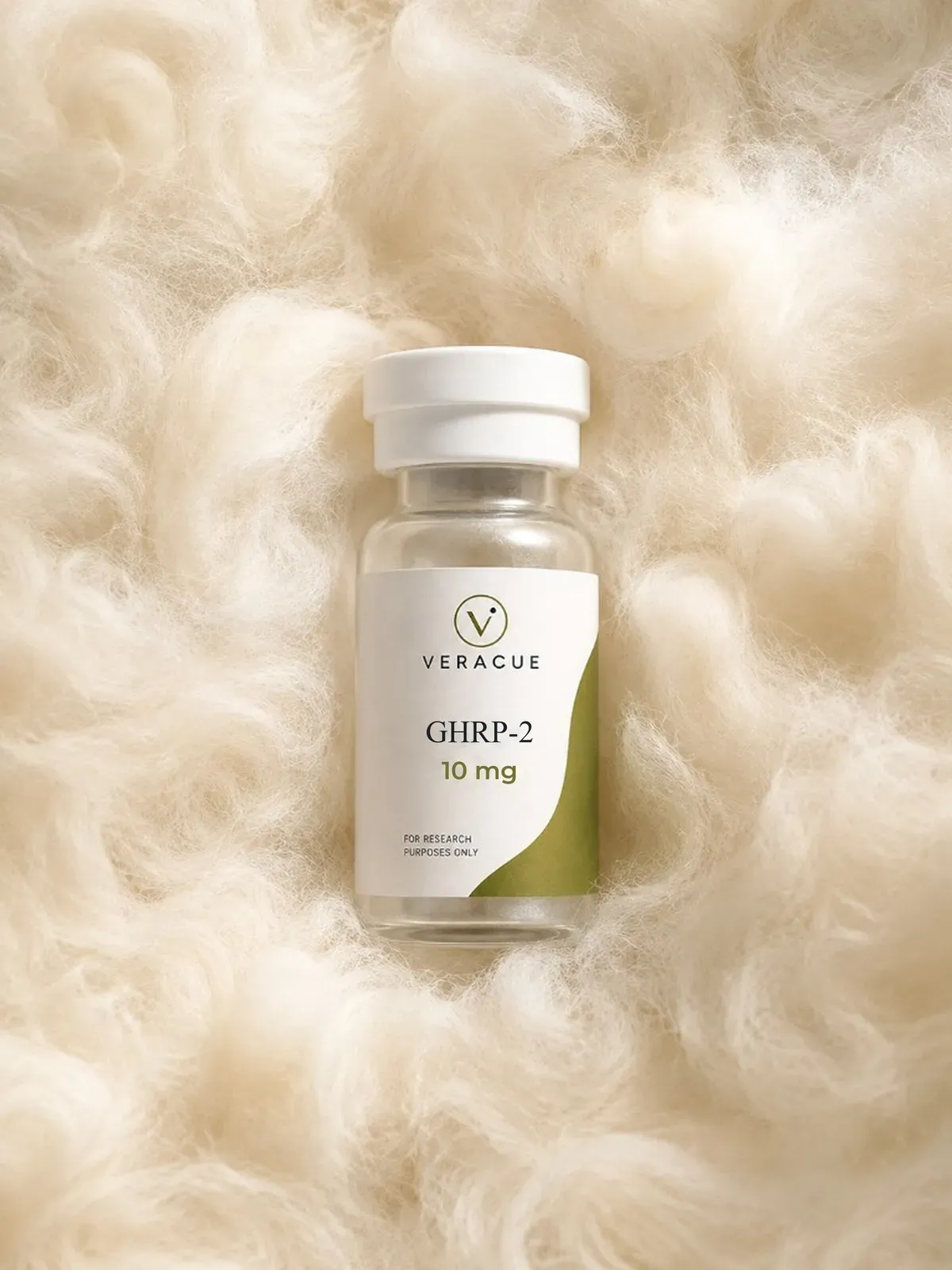
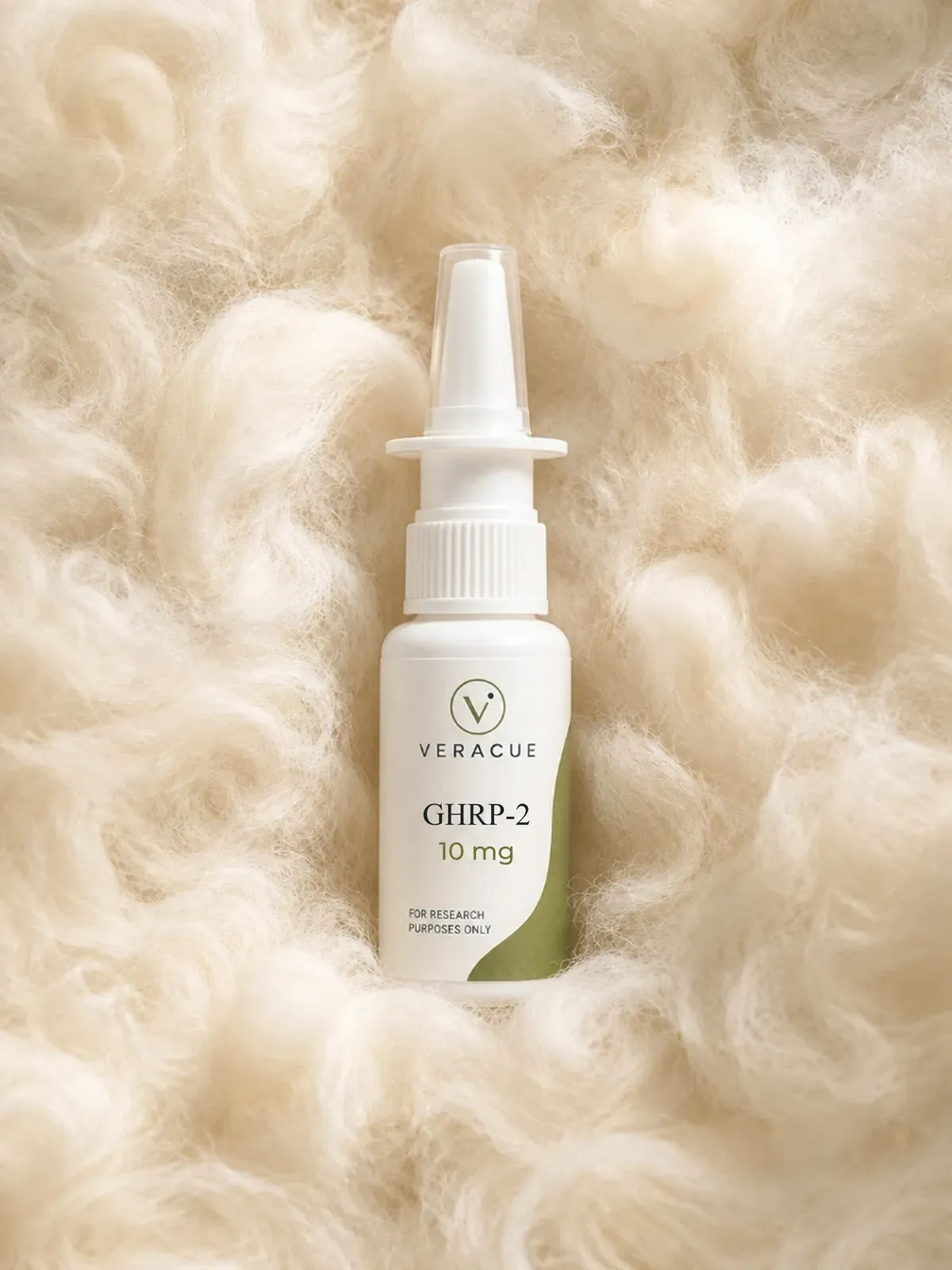
GHRP-2 (Growth Hormone Releasing Peptide-2) is a synthetic hexapeptide amide with the sequence D-Ala-D-2-Nal-Ala-Trp-D-Phe-Lys-NH2. It binds the ghrelin receptor, GHS-R1a, in research systems and belongs to the same family as GHRP-6 and hexarelin. The free base has the formula C45H55N9O6, a molecular weight of 817.99 g/mol and CAS 158861-67-7. A single 10 mg vial size is offered, intended only for laboratory use.
Nasal Sprays
GHRP-2 Spray
GHRP-2 Spray contains GHRP-2, a synthetic hexapeptide amide, sequence D-Ala-D-2-Naphthylalanine-Ala-Trp-D-Phe-Lys-NH2, studied as an agonist at the growth hormone secretagogue receptor, GHS-R1a. Its free-base reference values are C45H55N9O6, 817.99 g/mol, CAS 158861-67-7. The sequence shares its receptor target with GHRP-6 and Ipamorelin but is chemically distinct from both, so identity should rest on sequence and CAS rather than name alone. Veracue supplies a 10 mg spray-dispensed size for laboratory research use only.
Growth Hormone Secretagogue
CJC/Ipamorelin
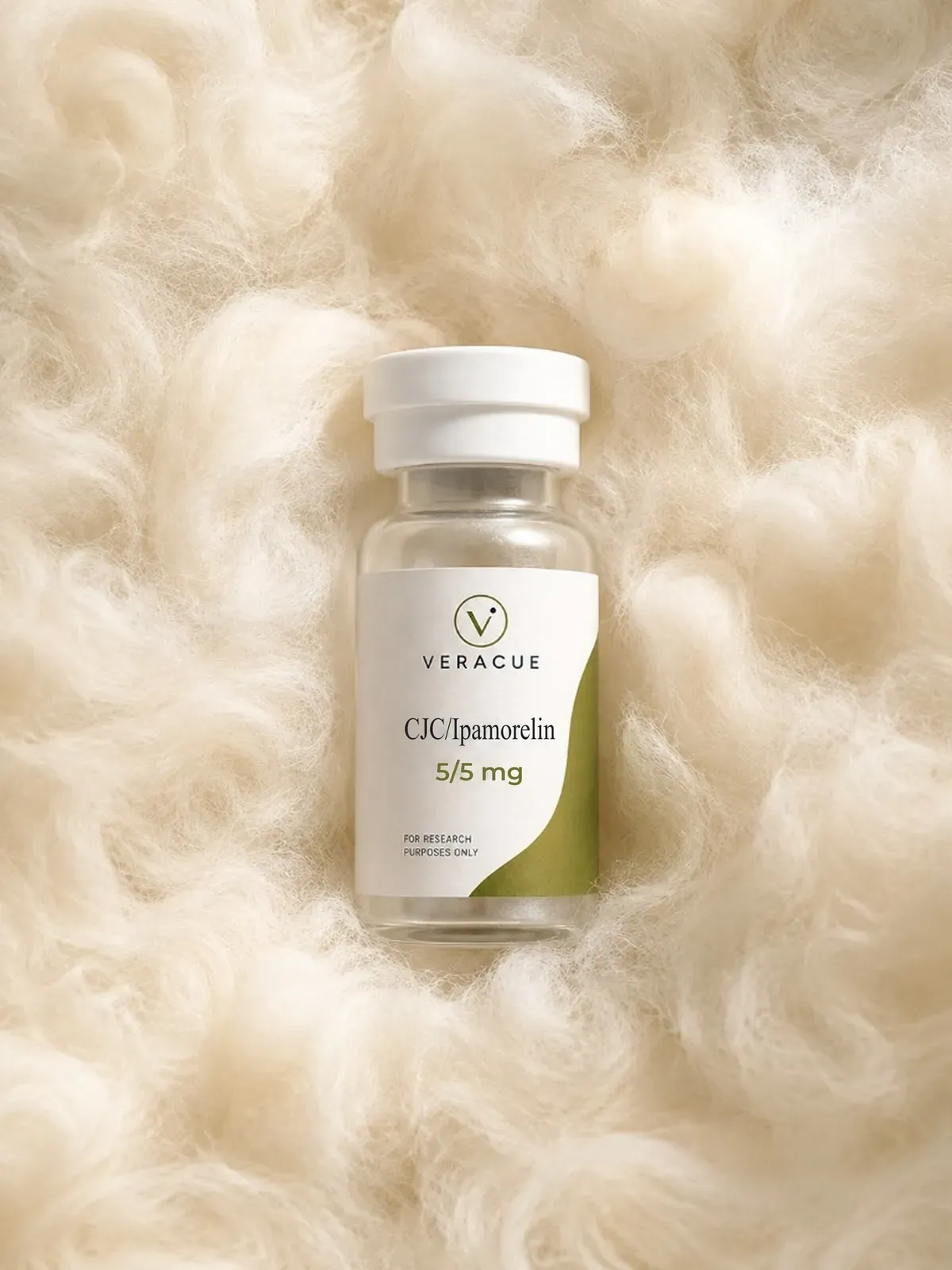
CJC/Ipamorelin is a two-peptide research blend of CJC-1295 No DAC and Ipamorelin, 5 mg of each. CJC-1295 No DAC, also called Mod GRF 1-29, is a 29-residue growth hormone-releasing hormone analog, YADAIFTQSYRKVLAQLSARKLLQDILSR-NH2 with D-alanine at position 2 (C152H252N44O42, average mass about 3367.9 g/mol, CAS 863288-34-0 and 446036-97-1). Ipamorelin is the pentapeptide Aib-His-D-2-Nal-D-Phe-Lys-NH2 (C38H49N9O5, about 711.85 g/mol, CAS 170851-70-4), studied at the ghrelin receptor rather than the GHRH receptor. The vial is labeled 5/5 mg and is supplied strictly for laboratory research use only.
What Is GHRP-2?
GHRP-2 is one specific, chemically defined peptide — not a brand name, and not a synonym for the whole GHRP class. GHRP-2 — Growth Hormone Releasing Peptide-2 — is a synthetic hexapeptide amide with the sequence D-Ala-D-2-Naphthylalanine-Ala-Trp-D-Phe-Lys-NH2. PubChem lists the free-base formula as C45H55N9O6, a molecular weight of 817.99 g/mol, and CAS number 158861-67-7 (PubChem CID 6852372). It belongs to a family of growth hormone-releasing peptides first developed in the 1980s through work led by endocrinologist Cyril Bowers and collaborators, alongside related compounds GHRP-1, GHRP-6, and hexarelin. The same molecule is also known in the pharmaceutical literature as pralmorelin, GPA-748, and KP-102 — names that surface in different contexts (research supply catalogs versus a Japanese diagnostic product) and are not interchangeable in regulatory terms. A research compound sold under CAS 158861-67-7 for laboratory use is not the same artifact as a finished, regulator-reviewed pharmaceutical product, even when both share the same active molecule.
How Does GHRP-2 Work?
GHRP-2 activates GHS-R1a, not the GHRH receptor — a measured hormone pulse is not the same thing as a demonstrated clinical effect. GHRP-2 acts as an agonist at the growth hormone secretagogue receptor type 1a (GHS-R1a) — the same receptor that the gut-derived hormone ghrelin binds naturally. GHS-R1a is expressed in the hypothalamus and anterior pituitary, where its activation is associated with pulsatile growth hormone release, and in several peripheral tissues. This is a separate receptor system from the growth hormone-releasing hormone (GHRH) receptor, which is targeted by a different peptide class (sermorelin, tesamorelin, CJC-1295). Both receptor pathways converge on pituitary somatotroph cells and ultimately on growth hormone secretion, which is why GHRP-2 and GHRH analogues are often discussed together in the literature, despite acting on structurally distinct receptors. Measuring a receptor-level response — a GH pulse on a blood draw — is a biochemical finding, not a clinical outcome; a 2026 narrative review in Frontiers in Endocrinology notes that the GHRP class 'largely preserv[es] physiological regulatory loops within the GH–IGF-1 axis ... in contrast to exogenous recombinant GH administration,' which is a mechanistic observation about regulation, not a statement about therapeutic benefit (Dominikowski et al., 2026).
What Is the Difference Between GHRP-2, GHRP-6, and GHRH-Class Peptides?
Family resemblance is not functional equivalence — match the specific peptide and its specific receptor before comparing evidence across compounds. GHRP-2 and GHRP-6 are both hexapeptide GHS-R1a agonists from the same Bowers-era research program, but they are chemically distinct: GHRP-2 is D-Ala-D-2-Nal-Ala-Trp-D-Phe-Lys-NH2, while GHRP-6 is His-D-Trp-Ala-Trp-D-Phe-Lys-NH2. GHRH-class peptides — sermorelin (GRF 1-29), tesamorelin, and CJC-1295 — act on an entirely different receptor, the GHRH receptor, even though all of these compounds are loosely grouped as 'growth hormone peptides' in casual use. The Frontiers review groups sermorelin, tesamorelin and the two CJC-1295 variants under 'GHRH analogues' and GHRP-2, GHRP-6, hexarelin and ipamorelin under 'GH secretagogues (GHS)' — two mechanistically separate categories. No controlled, head-to-head human trial comparing GHRP-2 against GHRP-6 or against a GHRH analogue on a single outcome measure was identified in this review; claims ranking one peptide as more potent, 'cleaner,' or safer than another typically rest on informal secondary sources rather than such a trial.
Attribute | GHRP-2 (pralmorelin) | GHRP-6 | Sermorelin / CJC-1295 (GHRH-class) |
|---|---|---|---|
Receptor target | GHS-R1a (ghrelin receptor) | GHS-R1a (ghrelin receptor) | GHRH receptor |
Sequence/class | Hexapeptide amide, D-Ala-D-2-Nal-Ala-Trp-D-Phe-Lys-NH2 | Hexapeptide amide, His-D-Trp-Ala-Trp-D-Phe-Lys-NH2 | GHRH(1-29) analogues with stabilizing substitutions |
Strongest human evidence | Validated single-dose diagnostic test for adult GH deficiency (Chihara et al. 2007) | Early phase I/mechanistic human studies; no controlled efficacy trials | Sermorelin: historical pediatric GHD use; CJC-1295 with DAC: randomized dose-ranging trial in healthy adults |
Japan diagnostic approval | Yes, as pralmorelin, for GH secretory/hypothalamic-pituitary assessment | Not established in the sources reviewed here | Not applicable to this comparison |
FDA compounding category | 503B Category 2 (injectable/nasal), added Sept 29, 2023 | 503B Category 2, added Sept 29, 2023 | CJC-1295: FDA Category 2; sermorelin (Geref) previously FDA-approved, withdrawn 2009 for non-safety reasons |
WADA 2026 Prohibited List | Listed by name under S2.2.4 (GHRPs) | Listed by name under S2.2.4 (GHRPs) | GHRH and its analogues listed under S2.2.4 as a class |
This table compares structure, receptor target, and regulatory record only. It is not a ranking of potency, safety, or effectiveness. For a GHRH+GHS combination already in Veracue's catalog, see the CJC/Ipamorelin blend.
What Does GHRP-2 Research Reveal About Growth Hormone Regulation?
A validated GH-pulse response is evidence of receptor activity and diagnostic utility — not evidence of a therapeutic growth hormone effect in healthy adults. The core human finding is from a 2007 European Journal of Endocrinology validation study in 77 healthy subjects and 58 patients with confirmed GH deficiency: a single intravenous 100 microgram dose of GHRP-2 produced a GH peak within 60 minutes in essentially all subjects, and peak concentrations were far higher in healthy subjects (mean 84.6 micrograms/L) than in GH-deficient patients (mean 1.36 micrograms/L) (Chihara et al., 2007). This establishes that GHRP-2 reliably triggers a measurable GH pulse through the GHS-R1a pathway and that the size of that pulse distinguishes GH-sufficient from GH-deficient physiology — which is exactly why it has diagnostic value. It does not establish that repeated GHRP-2 exposure produces durable increases in lean mass, strength, or any other downstream clinical outcome in non-deficient adults; the study was designed and validated as a single-dose diagnostic test, not as a repeated-dosing efficacy trial.
What Does Research Say About Ghrelin Receptor Signaling and Appetite?
An acute, single-session appetite increase in seven healthy men supports a mechanistic link to ghrelin signaling; it says nothing about long-term appetite or weight effects. Because GHS-R1a is ghrelin's own receptor, and ghrelin is also an appetite-stimulating ('orexigenic') signal, GHRP-2 has been studied for its effect on food intake, separately from its GH-releasing effect. A 2005 Journal of Clinical Endocrinology & Metabolism study subcutaneously infused seven lean, healthy men with GHRP-2 (1 microgram/kg/hour) or saline for 270 minutes, then measured intake at an ad-libitum buffet meal: subjects ate 35.9% ± 10.9% more food on GHRP-2 than on saline, with GH levels rising sharply as expected (Laferrère et al., 2005). This is a single acute-exposure experiment in seven subjects measuring one meal — informative about mechanism, but not a basis for any claim about sustained appetite change, weight management, or body-composition outcomes in general use.
What Does the Human Clinical Research Actually Show?
The three primary human studies are a diagnostic validation trial, a small acute appetite experiment, and a 12-month pediatric GH-deficiency study — each answers a narrow question, and none evaluates general wellness, performance, or anti-aging use. Three human studies anchor most of what is publicly known. First, the 2007 diagnostic validation study described above (Chihara et al.) — a controlled clinical trial in 135 total subjects, the strongest design in the GHRP-2 literature, but scoped to single-dose diagnostic testing. Second, the 2005 acute appetite study in seven healthy men (Laferrère et al.) — small, acute, and mechanistic. Third, a 2003 Journal of Pediatric Endocrinology & Metabolism study gave ten prepubertal children with confirmed GH deficiency oral GHRP-2 (900 micrograms/kg twice daily) for 12 months and tracked appetite and BMI: seven of ten patients reported increased appetite in the first six months, and BMI standard-deviation score showed a non-statistically-significant upward trend over the study (Mericq et al., 2003). That is a long-duration study, but in a specific pediatric GH-deficient population using an oral regimen — its findings do not transfer to adults, to non-deficient individuals, or to other routes of administration. A 2004 unsigned review in Drugs in R&D adds regulatory and development history but is a secondary review, not an independent trial, and some of the commercial and timeline details it reports (licensing, projected launch dates) are now more than two decades old and should not be treated as current status.
What Are the Known Safety Concerns and Potential Side Effects?
Treat these as three separate facts — a mild, transient endocrine side-effect profile in short controlled studies; an FDA safety flag built on unconfirmed-causality adverse event reports; and an absence of long-term safety data — rather than folding them into one blanket safety verdict. Three distinct evidence streams bear on safety, and they should not be merged. First, within the controlled studies above: transient appetite increase was the most consistently reported effect, and the 2026 Frontiers review notes that GHRP-2, like other early ghrelin-mimetic GHRPs, has been associated with transient increases in cortisol and prolactin in short-term human testing. Second, FDA's compounding-safety notice: the agency placed 'Growth hormone releasing peptide-2 (GHRP-2) (for injectable and nasal routes of administration)' in Category 2 of its Section 503B bulk-drug-substances list on September 29, 2023, stating that compounded GHRP-2 'may pose risk for immunogenicity due to the potential for aggregation and peptide-related impurities,' that it 'contains an unnatural amino acid, which adds to the complexity of peptide characterization,' and that FDA is aware of reports of serious adverse events in patients who received GHRP-2, including increased insulin requirement to maintain blood glucose levels, death of critically ill study subjects, infection, and pancreatitis — though causality has not been established. FDA's own language is explicit that causality for those serious events was not established — the reports exist, but a causal link to GHRP-2 specifically was not confirmed. Third, outside any controlled study: there is no systematic long-term human safety dataset for repeated GHRP-2 exposure in healthy adults at any dose, frequency, or duration, a gap the Frontiers review flags across the entire GHRP class.
What Are the Limitations of Current GHRP-2 Research?
Small samples, single clinical populations, narrow endpoints, and formulation differences all limit how far any single GHRP-2 finding can be generalized. Every major human study on GHRP-2 has a narrow scope. The diagnostic trial used a single intravenous dose and was designed purely to distinguish GH-deficient from GH-sufficient physiology, not to assess repeated-dose safety or efficacy for any other purpose. The appetite study involved seven subjects, one infusion session, and one meal. The pediatric study followed ten GH-deficient children on an oral regimen for 12 months — a specific clinical population, route, and formulation that cannot be assumed to generalize to healthy adults using an injectable research material of unverified purity. None of the three studies assessed body composition, strength, athletic performance, wound healing, or longevity outcomes. Research-use material sold under RUO designation also differs from the clinical trial material and the Japanese diagnostic formulation in ways that matter: synthesis route, salt/counterion form, excipients, and batch-to-batch purity are not guaranteed to match what was used in any cited study, so results from these trials cannot be read as predictions about what any particular RUO vial will do.
How Does GHRP-2 Compare With Pralmorelin's Clinical Diagnostic Use?
Japan's pralmorelin diagnostic authorization is real and specific — and it does not transfer to U.S. regulatory status, to other formulations, or to non-diagnostic uses. Pralmorelin is the same molecule as GHRP-2 under a different name, developed and licensed by Kaken Pharmaceutical for diagnostic use in Japan to help evaluate growth hormone secretory function and hypothalamic-pituitary status, building on the same GH-peak validation data described above. This is a real, jurisdiction-specific authorization — but it is a single diagnostic indication under Japan's regulatory system, reviewed and approved there, not a global or FDA-recognized status. It says nothing about the safety, purity, formulation, or legality of an unrelated research-use material sold in the United States under the same CAS number. Treat 'approved as a diagnostic agent in Japan' and 'approved, safe, or legal for any use in the United States' as two separate claims that cannot be substituted for one another.
What Is GHRP-2's Current Regulatory and Anti-Doping Status?
FDA Category 2 (a safety flag), Japan's diagnostic approval, and WADA's doping prohibition are three distinct, non-interchangeable regulatory facts about GHRP-2. In the United States, GHRP-2 (for injectable and nasal routes) sits in Category 2 of FDA's interim policy under Section 503B of the Federal Food, Drug, and Cosmetic Act — a list of bulk substances FDA has flagged as potentially presenting significant safety risks for compounding, added September 29, 2023. Category 2 status is not a drug approval category: it is a safety-nomination review outcome under the compounding framework, and it is distinct from Section 503A (which governs compounding by licensed pharmacies for identified patients) — GHRP-2's Category 2 listing here applies specifically to Section 503B (outsourcing facilities), not 503A. FDA has not approved GHRP-2 as a finished drug product for any indication in the United States. Separately, in Japan, pralmorelin (GHRP-2) holds the diagnostic authorization described above. In competitive sport, the World Anti-Doping Agency's 2026 Prohibited List (in force January 1, 2026) explicitly names 'GHRP-2 (pralmorelin)' among growth hormone-releasing peptides prohibited at all times under category S2.2.4, alongside GHRP-1, GHRP-3 through GHRP-6, alexamorelin, and hexarelin. These are three independent regulatory facts from three different authorities — a U.S. compounding-safety flag, a Japanese diagnostic approval, and a worldwide anti-doping prohibition — and none of them substitutes for or implies the others.
How Should Researchers Evaluate GHRP-2 Identity, Purity, and COA Claims?
Identity and purity are separate analytical questions, each requiring its own named method and its own named salt form — ask for both, tied to the specific lot. A certificate of analysis for GHRP-2 should report, at minimum: the lot or batch number (matching the vial label), the purity method used (typically HPLC, reported as a percentage under stated conditions), a mass spectrometry identity result stated against the reference free-base formula C45H55N9O6, the salt or counterion form the mass figures refer to, net peptide content, and the testing laboratory's name and test date. HPLC purity alone does not establish identity — a clean chromatography peak only shows sample uniformity, not that the peak is GHRP-2 rather than a closely related hexapeptide such as GHRP-6. Mass spectrometry alone does not establish purity — an observed mass consistent with the reference formula says nothing about what fraction of the vial's content is that compound versus salts, water, or synthesis byproducts. On Veracue's own live product page, HPLC is listed as the purity method and mass spectrometry as the identity method, with lot-specific documentation available through the certificate library or the contact page rather than published by default; this is a general testing methodology disclosure, not a batch-specific result, and the two should not be conflated when evaluating any individual vial.
What Does Research Use Only Mean for GHRP-2?
RUO means laboratory-only, not pre-approved, pre-certified, or pre-validated for any other purpose — the underlying evidence still has to be read study by study. Research Use Only (RUO) labeling means a material is supplied for laboratory and research purposes and explicitly excludes human or veterinary administration. RUO status does not certify safety, efficacy, purity, or FDA approval — it is a restriction on intended use, not a quality or regulatory seal. Everything laid out above holds at once: GHS-R1a agonism is a well-characterized receptor mechanism; a validated diagnostic GH-pulse test exists; pralmorelin carries a specific Japanese diagnostic authorization; the FDA has flagged compounded GHRP-2 as a Category 2 safety concern built on reports whose causality was not established; and no human trial has evaluated repeated GHRP-2 exposure for body composition, performance, or longevity outcomes in healthy adults. Readers evaluating GHRP-2 as a research subject should go to the primary sources cited throughout rather than secondary summaries, and should weigh each claim against the specific population, dose, route, and endpoint it was actually tested under. See the Medical Disclaimer for sitewide RUO policy.
Frequently Asked Questions
GHRP-2 is a synthetic hexapeptide amide (D-Ala-D-2-Nal-Ala-Trp-D-Phe-Lys-NH2) that activates GHS-R1a, the ghrelin receptor, in research systems. It is also known as pralmorelin. Veracue supplies it strictly as a laboratory research material, not for human or veterinary use.
It binds and activates GHS-R1a on pituitary and hypothalamic cells, the same receptor ghrelin naturally binds, which is associated with pulsatile growth hormone release. This is a separate receptor pathway from GHRH-class peptides, which act on the GHRH receptor instead.
GHS-R1a — the growth hormone secretagogue receptor 1a, also called the ghrelin receptor. It is distinct from the GHRH receptor that sermorelin, tesamorelin, and CJC-1295 target, though both pathways converge on growth hormone release from the pituitary.
Both are hexapeptide GHS-R1a agonists from the same research lineage, but their sequences differ (GHRP-2: D-Ala-D-2-Nal-Ala-Trp-D-Phe-Lys-NH2; GHRP-6: His-D-Trp-Ala-Trp-D-Phe-Lys-NH2). No controlled head-to-head human trial comparing them on a single outcome was identified, so claims that one is stronger or cleaner than the other are not supported by that kind of evidence.
A validated 2007 study used a single GHRP-2 dose to distinguish GH-deficient adults from healthy adults via peak GH response. A 2005 study found an acute 35.9% increase in food intake in seven healthy men after infusion. A 2003 pediatric study found increased appetite and a non-significant BMI trend over 12 months of oral dosing in GH-deficient children. None of these evaluate general wellness, performance, or anti-aging use.
FDA placed GHRP-2 (injectable and nasal routes) in Category 2 of its Section 503B bulk drug substances list in September 2023, citing immunogenicity risk from peptide impurities and aggregation, the complexity of characterizing its unnatural amino acid, and reports of serious adverse events including increased insulin requirements, death in critically ill subjects, infection, and pancreatitis — while stating that causality for those events has not been established.
No. FDA has not approved GHRP-2 as a finished drug product for any indication in the United States. Its appearance on the Category 2 compounding-safety list is a safety-risk flag within the compounding framework, not a drug approval.
Pralmorelin (GHRP-2) has a diagnostic role in Japan, used to help assess growth hormone secretory function and hypothalamic-pituitary status, based on the same GH-peak response pharmacology described in the clinical research. This is a jurisdiction-specific authorization and does not extend to other countries, formulations, or non-diagnostic uses.
Yes. WADA's 2026 Prohibited List, in force from January 1, 2026, names GHRP-2 (pralmorelin) explicitly under category S2.2.4, growth hormone-releasing peptides, which are prohibited at all times in competitive sport.
RUO means the material is supplied for laboratory research only and is not intended for human or veterinary administration. It does not certify safety, efficacy, purity, or regulatory approval — those remain separate questions that depend on the specific lot, study, and jurisdiction in question.
No. Veracue's GHRP-2 listing and this article contain no dosing, reconstitution, or administration guidance of any kind. The material is supplied strictly for laboratory research use.
- 01Chihara K, Shimatsu A, Hizuka N, Tanaka T, Seino Y, Katofor Y. A simple diagnostic test using GH-releasing peptide-2 in adult GH deficiency. Eur J Endocrinol. 2007;157(1):19-27.
- 02Laferrère B, Abraham C, Russell CD, Bowers CY. Growth hormone releasing peptide-2 (GHRP-2), like ghrelin, increases food intake in healthy men. J Clin Endocrinol Metab. 2005;90(2):611-614.
- 03Mericq V, Cassorla F, Bowers CY, Avila A, Gonen B, Merriam GR. Changes in appetite and body weight in response to long-term oral administration of the ghrelin agonist GHRP-2 in growth hormone deficient children. J Pediatr Endocrinol Metab. 2003;16(7):981-985.
- 04Pralmorelin: GHRP 2, GPA 748, growth hormone-releasing peptide 2, KP-102 D, KP-102 LN (unsigned review). Drugs R D. 2004;5(4):236-239.
- 05Dominikowski A, Rękoś Z, Olejarz M, Szczepanek-Parulska E, Domin R, Ruchała M. The emerging landscape of performance-enhancing peptides modulating GH-IGF1 axis. Front Endocrinol. 2026;17:1822475.
- 06U.S. Food and Drug Administration. Certain Bulk Drug Substances for Use in Compounding that May Present Significant Safety Risks.
- 07World Anti-Doping Agency. The 2026 Prohibited List, effective January 1, 2026 — category S2.2.4, Growth hormone releasing factors / GH-releasing peptides.
- 08PubChem Compound Summary for CID 6852372, GHRP-2 (free base). National Center for Biotechnology Information.
Veracue Research Team
Research & Product Team
Our in-house team tracks published peptide and coenzyme research and translates it into clear, source-cited overviews for the research community.
Reviewed by in-house research chemists
orders@veracuelabs.com