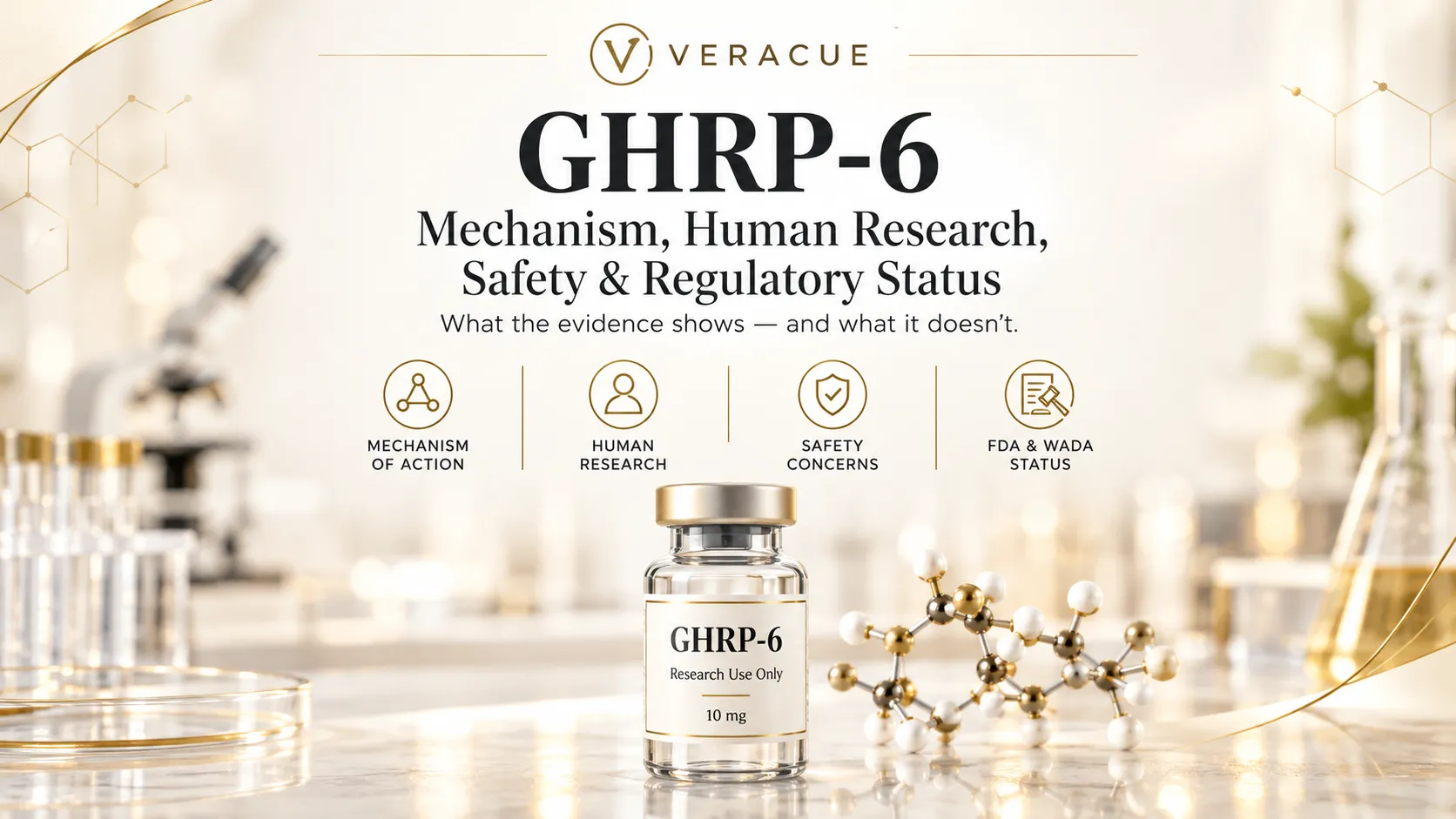
- GHRP-6 activates GHS-R1a, the ghrelin receptor, to trigger acute, measurable growth hormone release — a receptor-level signaling effect, not evidence of a clinical benefit.
- Human research on GHRP-6 is limited to small, short-duration mechanistic and diagnostic studies; no controlled trial has established a long-term safety profile or a body-composition or performance outcome.
- The FDA has not approved GHRP-6 and has listed it as a Category 2 bulk drug substance for 503B compounding, citing immunogenicity, impurity, cortisol, and glucose/insulin-sensitivity concerns.
- GHRP-6 is explicitly named on the current WADA Prohibited List, a separate framework from FDA regulatory status, and Veracue markets it strictly as a Research Use Only laboratory reagent.
GHRP-6 is a synthetic six-amino-acid peptide that activates the same receptor ghrelin naturally targets, triggering a pulse of growth hormone release. It is not FDA-approved, appears in the FDA's Category 2 listing for certain bulk substances nominated for 503B compounding (FDA), and is named on the 2026 WADA Prohibited List (official list PDF). Decades of small human studies document its acute hormone effects — but not long-term safety or any proven performance or body-composition benefit. Veracue Labs supplies GHRP-6 strictly for laboratory research use.
Growth Hormone Secretagogue
GHRP-6
GHRP-6, also called growth hormone-releasing hexapeptide or SKF-110679, is a six-residue synthetic peptide with the sequence His-D-Trp-Ala-Trp-D-Phe-Lys-NH2. The free peptide is C46H56N12O6 at 872.45 g/mol (CAS 87616-84-0). In secretagogue research it is used as a reference ligand for the ghrelin receptor, GHS-R1a, and it is often set beside GHRP-2. It is sold as a 10 mg vial for research use only.
Growth Hormone Secretagogue
GHRP-2
GHRP-2 (Growth Hormone Releasing Peptide-2) is a synthetic hexapeptide amide with the sequence D-Ala-D-2-Nal-Ala-Trp-D-Phe-Lys-NH2. It binds the ghrelin receptor, GHS-R1a, in research systems and belongs to the same family as GHRP-6 and hexarelin. The free base has the formula C45H55N9O6, a molecular weight of 817.99 g/mol and CAS 158861-67-7. A single 10 mg vial size is offered, intended only for laboratory use.
What Is GHRP-6?
GHRP-6 (growth hormone-releasing peptide-6, developmental code SKF-110679) is a synthetic hexapeptide with the sequence His-D-Trp-Ala-Trp-D-Phe-Lys-NH2 — a chain of six amino acids, two of them in the mirror-image "D" form, with an amidated tail. The inclusion of D-amino acids reflects the structure-activity research that helped shape this class of secretagogues. It's one of the oldest members of a class of compounds called growth hormone secretagogues (GHS), first characterized in the 1980s and subsequently studied in diagnostic testing and mechanistic research protocols.
One naming mix-up worth flagging: "GHRP-6" is sometimes confused with Examorelin, which is actually the INN for a related but chemically distinct compound more commonly known as hexarelin. The two are structurally related GHS-class peptides, not the same molecule, and vendor listings that blur the two should be read carefully.
GHRP-6's scientific identity — a well-characterized synthetic ghrelin-receptor agonist with a long research history — is a separate question from its regulatory status. It is not approved by the FDA for any clinical indication, and Veracue Labs lists it strictly as a laboratory research reagent, not a human-use product.
How Does GHRP-6 Work?
GHRP-6 binds and activates the growth hormone secretagogue receptor type 1a (GHS-R1a) — the same receptor that the body's own hormone, ghrelin, naturally activates. This receptor sits primarily in the hypothalamus and anterior pituitary, where its activation triggers a pulse of growth hormone release, but it's also expressed in peripheral tissues including the pancreas, thyroid, adrenal glands, adipose tissue, and heart muscle.
This is mechanistically distinct from how GHRH-analog peptides work. Compounds like CJC-1295, sermorelin, and tesamorelin act on a completely different receptor — the growth hormone-releasing hormone receptor (GHRH-R) — so GHRP-6 and a GHRH analog can both raise growth hormone, but through separate signaling pathways. A 2026 narrative review in Frontiers in Endocrinology notes that some members of the broader GHRP class have been described as having a secondary molecular target, CD36 (a scavenger receptor found on endothelial cells, immune cells, and several other tissue types) — though the evidence specifically tying this second target to GHRP-6, as distinct from other GHRPs, is not clearly delineated in the literature reviewed here, so it's noted as a class-level observation rather than a confirmed GHRP-6-specific mechanism.
The important distinction for interpreting any of this: demonstrating that GHRP-6 activates a receptor and triggers a hormone pulse is a pharmacological finding, not proof of a downstream clinical benefit. The same 2026 review explicitly cautions against treating this kind of acute endocrine signal as evidence for broader outcomes like improved body composition.
GHRP-6 vs. GHRP-2, Ghrelin, and CJC-1295
Compound | Molecular class | Primary receptor/pathway | Research context | Key caution |
|---|---|---|---|---|
GHRP-6 | Synthetic hexapeptide | GHS-R1a (ghrelin receptor) agonist | One of the earliest GHS-class peptides studied in humans; used in diagnostic GH-deficiency testing | Raises ACTH and cortisol in controlled studies; prolactin effects are described in some reports/reviews; no established clinical benefit |
GHRP-2 (Pralmorelin) | Synthetic hexapeptide | GHS-R1a agonist | Also used diagnostically; its appetite-stimulating effect is documented in both obese and healthy human subjects | Shares the ACTH/cortisol/prolactin-elevating pattern seen with GHRP-6 |
Ghrelin (endogenous) | Natural 28-amino-acid acylated peptide hormone | GHS-R1a's native ligand | Physiologically regulates appetite, energy balance, and pulsatile GH secretion | GHRP-6 mimics ghrelin's receptor activity but is a structurally distinct synthetic molecule, not ghrelin itself |
CJC-1295 (specify DAC status) | Synthetic GHRH analog / GHRH-derived compound | GHRH receptor pathway, distinct from GHS-R1a | GHRH-pathway research; pharmacokinetics depend on the exact compound and whether a DAC-containing form is intended | Commercial naming is not always consistent; DAC-containing CJC-1295 should not be treated as interchangeable with products marketed as "no DAC" or Mod GRF (1-29) |
These compounds are grouped here for research-context comparison only. None of this is a ranking of relative safety, effectiveness, or suitability — the available literature does not support that kind of comparison.
What Does Human Research Actually Show?
Human data on GHRP-6 comes almost entirely from small, short-duration mechanistic and diagnostic studies, not from large or long-term clinical trials. A representative sample:
A controlled crossover study in healthy men gave repeated intravenous GHRP-6 boluses overnight and measured hormone levels and sleep EEG patterns. Growth hormone, ACTH, and cortisol secretion all rose significantly compared to placebo, and stage-2 sleep increased slightly, while slow-wave sleep was unchanged (Frieboes et al., 1995).
A diagnostic study tested whether GHRP-6, alone or combined with GHRH, could substitute for the insulin tolerance test (the reference standard) in diagnosing adult growth hormone deficiency, across 20 patients. The GHRP-6-based tests identified GH-deficient patients with comparable sensitivity and specificity to the insulin tolerance test; the only reported side effect in this cohort was transient flushing (Petersenn et al., 2002).
Two related crossover studies in healthy, lean men examined how fasting and a GH-receptor-blocking drug (pegvisomant) altered GHRP-6-stimulated GH release. Fasting alone increased the GH response to GHRP-6; combining fasting with GH-receptor blockade produced a synergistic effect (Muller et al., 2001a). In the companion study, a measurable rise in insulin and glucose — a tissue-specific insulin-resistance signal — appeared only when GH-receptor blockade was combined with GHRP-6 in the non-fasting state, and was not seen with GHRP-6 alone or with blockade during fasting (Muller et al., 2001b).
A study comparing patients with hypercortisolism (from Cushing's syndrome or exogenous steroid use) to healthy controls found that the GH response to GHRP-6 was blunted in patients with endogenous hypercortisolism, but preserved in those with exogenous glucocorticoid excess — a different pattern from the GH response to GHRH, which was blunted in both groups (Borges et al., 1997).
An earlier study testing GHRP-6 across adult men and women at different points in the menstrual cycle, and in prepubertal children, found the GH response was consistent regardless of sex or age, and was not altered by two adrenergic-pathway drugs (propranolol, clonidine), though a third (prazosin) increased the response (Peñalva et al., 1993).
Taken together, these are acute, mechanistic, or diagnostic-context findings in small and often selected populations. None of them measured long-term outcomes, body composition, or performance-related endpoints, and none should be read as evidence of a therapeutic benefit from repeated or self-directed use.
What Does Research Say About Appetite and Ghrelin Signaling?
Because GHRP-6 activates the same receptor as ghrelin — the hormone most associated with hunger signaling — it's reasonable to ask whether it affects appetite. A 2026 narrative review describes GHRP-6's appetite-stimulating ("orexigenic") effect as a consistently documented and clinically relevant response tied to its activity at the ghrelin receptor pathway.
That finding needs careful framing. An orexigenic signal is a receptor-level and appetite-level observation; it is not evidence of a favorable or controlled weight outcome, and it does not establish any particular body-composition result. The same review is explicit on this point, stating that direct evidence for meaningful changes in body composition in humans remains limited and should be interpreted cautiously — directly rejecting the kind of extrapolation that turns an acute appetite or hormone signal into a weight-loss, muscle-growth, or recomposition claim. No study in the primary literature reviewed here followed GHRP-6 exposure over an extended period to measure sustained appetite or weight change.
What Safety Concerns Have Been Reported?
Safety-relevant findings come from two separate sources that should not be blended together: the controlled human studies themselves, and the FDA's own compounding-safety review.
From the primary studies: transient flushing was the only reported side effect in a 20-patient diagnostic study (Petersenn et al., 2002); acute rises in cortisol and ACTH appeared in controlled dosing studies (Frieboes et al., 1995; Borges et al., 1997); and a tissue-specific insulin-resistance signal appeared only under a specific combination of conditions — GH-receptor blockade plus a non-fasting state — rather than as a general effect of GHRP-6 by itself (Muller et al., 2001b). A 2026 review of the broader literature describes short-term GH/ACTH/cortisol stimulation as generally well tolerated in the healthy-adult study populations examined, while also noting transient cortisol and prolactin increases, possible effects on sleep architecture, no available long-term safety data, and a theoretical (not established) concern about mitogenic GH/IGF-1 signaling, with no confirmed carcinogenic signal tied to GHRP-6 specifically.
From the FDA: GHRP-6 appears on the FDA's list of bulk drug substances nominated for use in compounding that may present significant safety risks, under Category 2, effective September 29, 2023. The agency's stated concerns are that compounded products containing GHRP-6 may pose a risk for immunogenicity depending on route of administration, cite "the potential for aggregation and peptide-related impurities," and note that although available safety-related information is limited, it reveals potential effects on cortisol and an increase in blood glucose linked to decreased insulin sensitivity.
None of this amounts to a complete, quantified side-effect profile or an established incidence rate — it is a set of reported findings and identified evidence gaps, and should be read as exactly that.
Is GHRP-6 FDA-Approved?
No. GHRP-6 has not been approved by the FDA as a drug for any indication. The relevant FDA action is its inclusion, effective September 29, 2023, in Category 2 of the agency's bulk drug substances nomination list for use in compounding under Section 503B of the Federal Food, Drug, and Cosmetic Act.
That listing is a compounding-safety framework, not a drug-approval pathway. FDA's 503B bulk-substance categories sort nominated substances by whether the agency believes they can be safely compounded (Category 1), whether it has identified significant safety risks that are not yet resolved (Category 2, where GHRP-6 sits), or whether it has determined the substance presents risks that outweigh any benefit (Category 3). A Category 2 listing means the FDA has flagged specific, unresolved safety concerns for this substance in compounding contexts — it says nothing about whether the molecule itself is "safe" or "unsafe" for research purposes, and it is wholly separate from the FDA's new-drug approval process, which requires demonstrated safety and efficacy for a specific clinical indication. Veracue's own product listing states plainly that GHRP-6 "has not been evaluated by the FDA" and is supplied for laboratory research use only, not for human or veterinary use.
Is GHRP-6 Prohibited in Competitive Sports?
Yes. GHRP-6 is explicitly named on the 2026 WADA Prohibited List, grouped with other growth hormone-releasing peptides (GHRP-1 through GHRP-5, and Examorelin/hexarelin) under the S2 category covering peptide hormones, growth factors, and related substances. The 2026 list, effective January 1, 2026, places these substances among those prohibited at all times — both in and out of competition.
This is a separate framework from FDA regulatory status and answers a different question. WADA's prohibited list exists to protect fair competition in sport; FDA's compounding and approval frameworks exist to evaluate drug-product safety and efficacy for clinical use. A substance's anti-doping status says nothing about whether it has (or hasn't) been FDA-approved, and vice versa — the two should never be treated as interchangeable facts about a compound.
What Are the Main Limitations of GHRP-6 Research?
A 2026 narrative review in Frontiers in Endocrinology places GHRP-6 at an intermediate evidence tier within the broader growth hormone secretagogue literature: phase I and small mechanistic or diagnostic human studies, without controlled efficacy data for performance-related or long-term clinical endpoints. Several specific gaps follow from that characterization:
Study populations are generally small and either healthy-adult volunteers or narrowly selected clinical groups (patients referred for suspected pituitary or adrenal disease, or hypercortisolism cohorts) — not representative samples for broader claims. The outcomes measured are almost always acute hormone secretion or other surrogate endocrine markers, not long-term clinical outcomes, body composition, or performance. Study durations are short, generally a single dosing session or a few days, not the months or years needed to assess durable effects or long-term safety. The review's authors note they did not perform formal risk-of-bias scoring across this literature, relying instead on an informal evidence-tier classification. And separately from the controlled-study evidence, there's no standardized way to verify product identity, purity, or actual exposure in people sourcing and using GHRP-6-labeled material outside of a research or clinical setting — a real-world gap distinct from the clinical literature itself.
Preclinical and animal literature touches on some additional potential effects within the broader GHRP/ghrelin-pathway research space, but those findings have not been confirmed in human trials specific to GHRP-6, and shouldn't be read across as established human effects.
What Do GHRP-6's Sequence and Chemical Identifiers Tell Us?
GHRP-6's sequence is His-D-Trp-Ala-Trp-D-Phe-Lys-NH2 — a hexapeptide with an amidated C-terminus and two D-amino acids (D-tryptophan and D-phenylalanine) at positions 2 and 5. As the free peptide, GHRP-6 has the formula C46H56N12O6. Its monoisotopic mass is approximately 872.45 Da, while its average molar mass is approximately 873.0 g/mol. Veracue's current product page displays 872.45 g/mol; technically, that numerical value corresponds to the monoisotopic-mass convention and should be labeled precisely rather than presented as the average molar mass. The CAS number commonly associated with the free peptide is 87616-84-0. Veracue's product page also notes that some supplier databases list CAS 145177-42-0 for an acetate-salt form; salt identity and net peptide content should be checked against lot-specific documentation rather than inferred from the sequence alone.
The distinction between a free peptide and its acetate (or other counter-ion) salt matters because they share the same bioactive sequence but differ in formula and mass due to the attached salt. Net peptide content — the actual proportion of peptide, by weight, once salt, moisture, and counter-ions are accounted for — is a separate, lot-specific analytical figure. A sequence, molecular formula, or CAS number tells you what the molecule is; it does not tell you what is actually present, in what purity, in any specific vial.
How Should Researchers Interpret HPLC, Mass Spectrometry, and a COA?
Three distinct things get conflated in casual peptide-research discussion, and they answer different questions. High-performance liquid chromatography (HPLC) separates a sample's components and is generally used to estimate purity — what fraction of the material, by that method, corresponds to the intended peptide rather than other species. It does not, by itself, confirm molecular identity. Mass spectrometry (MS) is used to confirm identity, by matching an observed mass to the expected molecular weight of the target compound; it is not generally the primary method used to quantify purity precisely the way HPLC is.
A certificate of analysis (COA), to be meaningful for a given vial, needs to be lot-specific — tied to an exact batch or lot code, not a generic reference value for the compound in general — and should name the analytical methods used, their dates, the salt form and net peptide content, and an identifiable testing party. A document that only restates the molecule's known reference chemistry isn't a substitute for that.
As of this review, Veracue's GHRP-6 product page names HPLC and mass spectrometry as its stated testing methods and describes lot documentation and a certificate of analysis as available "on request" rather than published for this compound. Separately, the site's own certificates library page states that it is still in the process of publishing batch-specific COAs and shows no populated reports at the time this was checked. Nothing here should be read as implying that the Veracue GHRP-6 listing currently carries a verified purity percentage or a publicly posted, lot-specific COA — a generic reference value or vendor description of testing methods is not the same thing as a lot-matched, publicly available result.
What Does Research Use Only Mean for GHRP-6?
"Research Use Only" (RUO) means a product is supplied and intended solely for laboratory and research applications — not for human or veterinary use, ingestion, injection, or any other form of administration. It is a scope-of-sale and scope-of-use statement, not a claim about safety, efficacy, or regulatory approval. A compound can be legitimately sold under an RUO designation for genuine laboratory research while simultaneously carrying FDA-identified safety concerns (as GHRP-6 does, through its Category 2 bulk-substance listing) and having no established therapeutic approval for any clinical use; none of those facts contradict each other.
Taken together, here is a balanced summary of where the evidence actually stands. Established: GHRP-6 reliably and measurably stimulates acute growth hormone release (along with ACTH and cortisol) in controlled human studies, acting through the GHS-R1a ghrelin receptor pathway, and has a multi-decade history of mechanistic and diagnostic research behind it. Unresolved: its long-term safety profile, any sustained body-composition or performance benefit, and lot-specific identity or purity documentation for any particular commercial vial. For anyone evaluating a GHRP-6 product or claim, the practical takeaway is to check the primary source behind any specific figure — a study's actual population and endpoints, a regulator's actual current wording, or a vendor's actual documentation — rather than taking secondhand summaries, including marketing copy, at face value.
Frequently Asked Questions
GHRP-6 is a synthetic six-amino-acid peptide (His-D-Trp-Ala-Trp-D-Phe-Lys-NH2) that activates the ghrelin receptor to trigger growth hormone release. It is one of the earliest-studied members of the growth hormone secretagogue class and is not FDA-approved for any clinical use.
GHRP-6 binds and activates GHS-R1a, the ghrelin receptor, in the hypothalamus and pituitary, triggering a pulse of growth hormone release. This is a receptor-signaling event; it does not by itself establish a clinical benefit.
Its primary target is GHS-R1a, the ghrelin receptor. Some members of the broader GHRP class have been described as also engaging CD36, a secondary scavenger-receptor target, though the evidence tying this specifically to GHRP-6 rather than other GHRPs is not well delineated in the literature.
No. Ghrelin is the body's own 28-amino-acid hormone and GHS-R1a's natural ligand. GHRP-6 is a structurally distinct synthetic hexapeptide that activates the same receptor — shared receptor target, different molecule.
Both are synthetic hexapeptides that activate GHS-R1a. Human research clearly documents acute ACTH and cortisol responses with GHRP-6; prolactin changes are described in some reports and reviews but should not be assumed to occur identically in every study protocol. Neither should be treated as safer, more effective, or more suitable than the other without direct evidence.
GHRP-6 activates GHS-R1a (the ghrelin receptor), while CJC-1295 is associated with the separate GHRH-receptor pathway. CJC-1295 naming can vary across commercial listings, and DAC-containing and products marketed as no-DAC/Mod GRF (1-29) should not be assumed to be interchangeable. Head-to-head safety or effectiveness conclusions require direct evidence.
Small, short-duration human studies show that GHRP-6 reliably triggers acute growth hormone, ACTH, and cortisol release, and has been used in diagnostic testing for adult growth hormone deficiency. No study has established long-term safety or a body-composition or performance outcome.
A 2026 literature review describes GHRP-6's appetite-stimulating effect as consistently documented, tied to its activity on the ghrelin receptor pathway. That is a receptor/appetite-signaling finding, not evidence of a controlled weight outcome — the same review explicitly cautions against extrapolating it into body-composition claims.
Reported findings include transient flushing, acute rises in cortisol and ACTH, and a tissue-specific insulin-resistance signal observed only under a specific combination of experimental conditions. These are reported findings from small studies, not a complete or quantified side-effect profile.
The FDA lists GHRP-6 under Category 2 of its bulk drug substances nomination list for 503B compounding (effective September 29, 2023), citing potential immunogenicity risk, aggregation and peptide-related impurities, and limited safety data that nonetheless reveals potential effects on cortisol and blood glucose/insulin sensitivity.
No. GHRP-6 is not FDA-approved as a drug for any indication. Its FDA Category 2 listing is a compounding-safety classification, not a drug-approval status, and is a separate framework entirely.
Yes. GHRP-6 is explicitly listed in the 2026 WADA Prohibited List under S2, within growth hormone-releasing peptides. The list is effective from 1 January 2026 and classifies these substances as prohibited at all times, in and out of competition. This is a sports anti-doping classification, separate from FDA approval status.
His-D-Trp-Ala-Trp-D-Phe-Lys-NH2 — a hexapeptide with an amidated C-terminus and D-amino acids at two positions.
The free peptide formula is C46H56N12O6. Its monoisotopic mass is about 872.45 Da, while its average molar mass is about 873.0 g/mol. Veracue's product page displays 872.45 g/mol, so the mass convention and unit should be labeled precisely. Salt forms can have a different total mass; verify the specific form against lot documentation.
HPLC is generally used to estimate purity; mass spectrometry is used to confirm molecular identity by matching observed to expected mass. Neither alone does the other's job, and neither substitutes for a lot-specific COA.
A meaningful certificate of analysis should be tied to a specific lot or batch code, name the analytical methods and dates used, and state the salt form and net peptide content — not just restate the compound's generic reference chemistry.
No. Available studies are short-duration and acute; a 2026 literature review explicitly states that no long-term safety data is available for GHRP-6.
It means the product is supplied and intended solely for laboratory research, not for human or veterinary use or administration in any form. RUO labeling does not itself establish safety, efficacy, or regulatory approval.
- 01Frieboes RM, Murck H, Maier P, Schier T, Holsboer F, Steiger A. Growth hormone-releasing peptide-6 stimulates sleep, growth hormone, ACTH and cortisol release in normal man. Neuroendocrinology. 1995.
- 02Petersenn S, Jung R, Beil FU. Diagnosis of growth hormone deficiency in adults by testing with GHRP-6 alone or in combination with GHRH: comparison with the insulin tolerance test. Eur J Endocrinol. 2002.
- 03Muller AF, Janssen JA, Lamberts SW, Bidlingmaier M, Strasburger CJ, Hofland L, van der Lely AJ. Effects of fasting and pegvisomant on the GH-releasing hormone and GH-releasing peptide-6 stimulated growth hormone secretion. Clin Endocrinol. 2001.
- 04Muller AF, Janssen JA, Hofland LJ, Lamberts SW, Bidlingmaier M, Strasburger CJ, van der Lely AJ. Blockade of the growth hormone (GH) receptor unmasks rapid GH-releasing peptide-6-mediated tissue-specific insulin resistance. J Clin Endocrinol Metab. 2001.
- 05Borges MH, DiNinno FB, Lengyel AM. Different effects of growth hormone releasing peptide (GHRP-6) and GH-releasing hormone on GH release in endogenous and exogenous hypercortisolism. Clin Endocrinol. 1997.
- 06Peñalva A, Pombo M, Carballo A, Barreiro J, Casanueva FF, Dieguez C. Influence of sex, age and adrenergic pathways on the growth hormone response to GHRP-6. Clin Endocrinol. 1993.
- 07Dominikowski A, Rękoś Z, Olejarz M, Szczepanek-Parulska E, Domin R, Ruchala M. The emerging landscape of performance-enhancing peptides modulating GH-IGF1 axis. Front Endocrinol. 2026.
- 08U.S. Food and Drug Administration. Certain Bulk Drug Substances for Use in Compounding that May Present Significant Safety Risks — GHRP-6 (Category 2).
- 09World Anti-Doping Agency. The Prohibited List 2026 — GHRP-6 under S2.2.4, growth hormone-releasing peptides.
- 10PubChem Compound Summary for His-D-Trp-Ala-Trp-D-Phe-Lys-NH2 (GHRP-6, free base). National Center for Biotechnology Information.
Veracue Research Team
Research & Product Team
Our in-house team tracks published peptide and coenzyme research and translates it into clear, source-cited overviews for the research community.
Reviewed by in-house research chemists
orders@veracuelabs.com