- TB-500 and full-length thymosin beta-4 are not the same molecule. An independent 2012 analytical study identified commercial TB-500 as Ac-LKKTETQ, the acetylated 17-23 fragment of the 43-residue thymosin beta-4 protein, and Veracue's own listing describes the same fragment — a related but distinct compound from the full-length protein.
- A 2026 scoping review found 80 relevant studies on thymosin beta-4 and TB-500 combined; 70 (87.5%) tested full-length thymosin beta-4, and only 1 (1.3%) tested TB-500 directly. In that one direct study, TB-500 itself showed no significant wound-healing effect in vitro — a breakdown metabolite did.
- No identified human clinical trial has tested TB-500 itself, and FDA stated in its 2026 review that it found no human exposure data for TB-500 drug products via any route.
- TB-500's U.S. regulatory status is unresolved: an FDA advisory committee reportedly voted narrowly in July 2026 to recommend TB-500 for a compounding substances list, against FDA staff's own recommendation, but FDA has taken no final rulemaking action as of this article's research date.
- Veracue's own published pages are not fully consistent on COA/testing access: the medical disclaimer states every batch ships with a public analytical report, while the live certificate library shows zero published reports and the product page itself lists documentation as available only on request.
TB-500 shows up constantly in recovery and performance forums, usually described in the same breath as thymosin beta-4 — as if the two names referred to one thing. They don't, at least not according to the analytical and regulatory record reviewed for this article. The material sold commercially as TB-500 has been chemically identified, independently of any one vendor, as a short, seven-amino-acid synthetic fragment of the much larger thymosin beta-4 protein — not the protein itself. That distinction is not a technicality. It determines which studies can honestly be cited as evidence for TB-500, and which ones — the large majority of the published literature — are actually studies of a different, naturally occurring molecule.
Healing & Recovery
TB-500
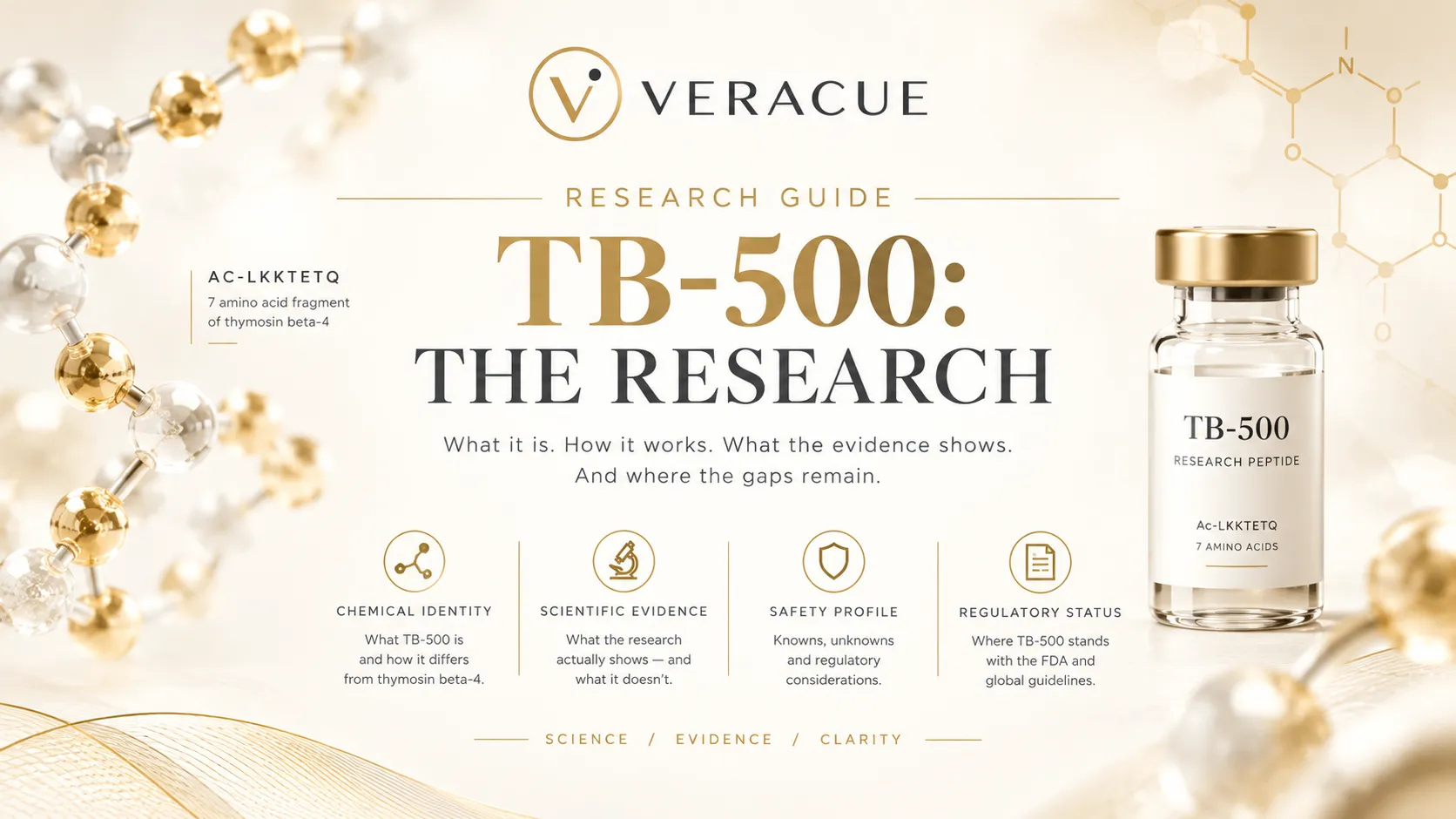
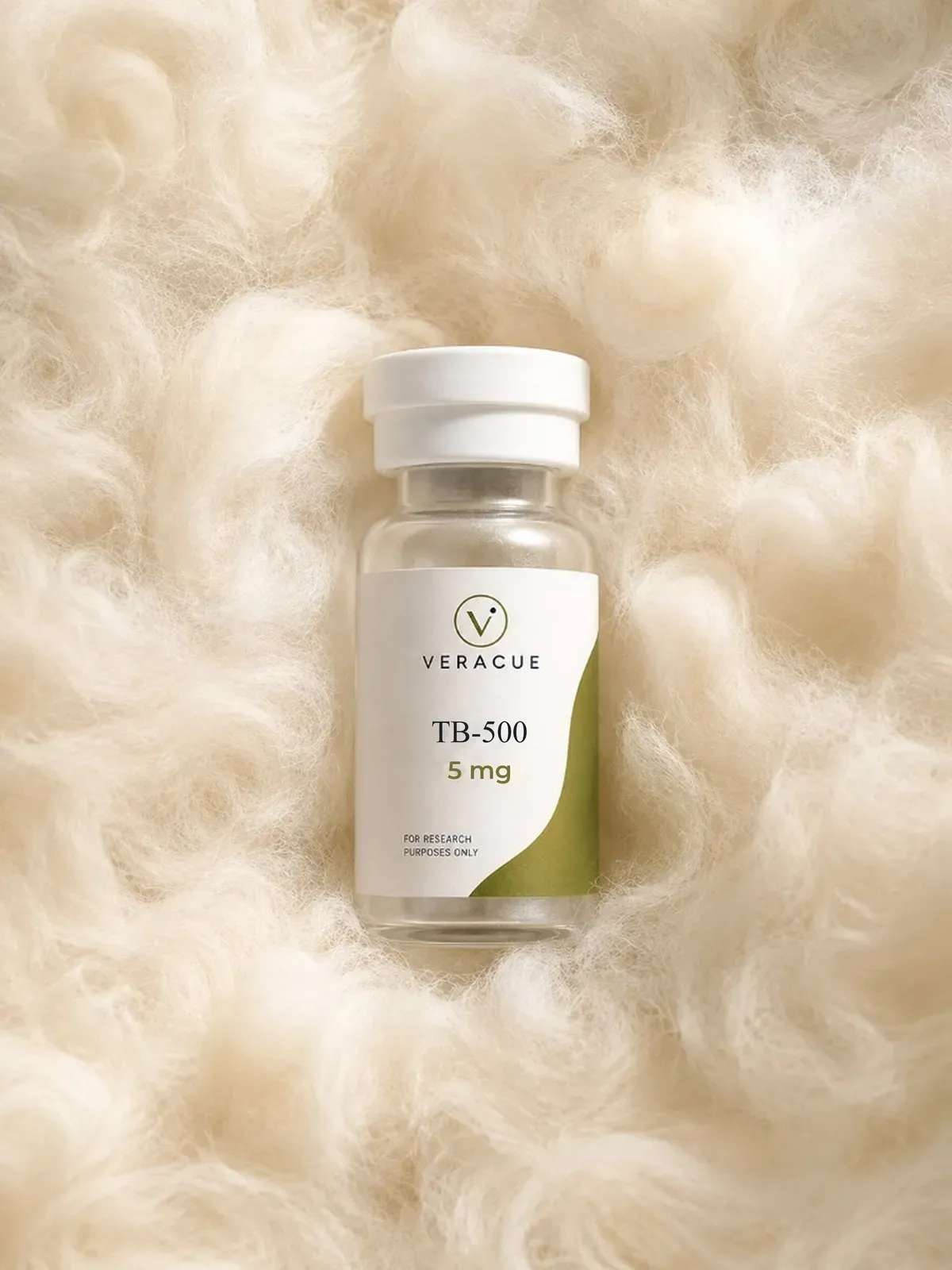
TB-500 is a short synthetic peptide with the sequence Ac-LKKTETQ, seven amino acids with an acetyl group at the N-terminus. It corresponds to residues 17 to 23 of thymosin beta-4, a much larger 43-residue protein, so it is a fragment and not another name for the full molecule. As the free base it has the formula C38H68N10O14, a mass of about 889 g/mol and CAS 885340-08-9. Available in 5 mg and 10 mg vials, for laboratory research only.
Healing & Recovery
BPC/TB-500
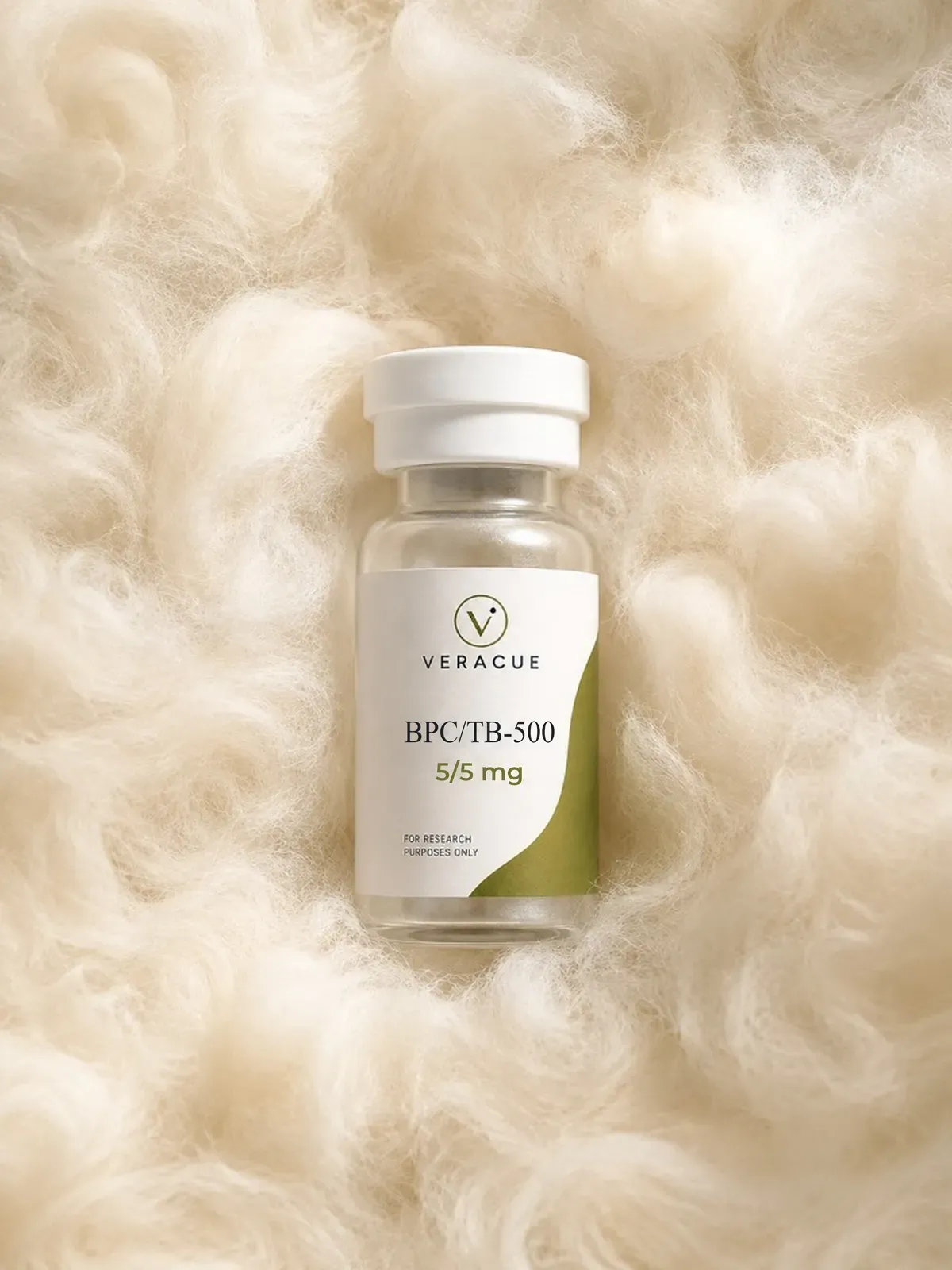
BPC/TB-500 is a two-peptide research material that places BPC-157 and TB-500 in one vial. BPC-157 is the 15-residue chain GEPPPGKPADDAGLV (C62H98N16O22, average mass about 1419.56 g/mol, CAS 137525-51-0). TB-500 is the N-acetylated 7-residue thymosin beta-4 fragment Ac-LKKTETQ (C38H68N10O14, about 889 g/mol, CAS 885340-08-9). The peptides are not chemically joined, so each keeps its own identifiers and the vial as a whole has no single formula or CAS number. Veracue supplies it in 5/5 mg and 10/10 mg vials, strictly for laboratory research use only.
This guide works through what TB-500 is chemically, what the research literature does and does not establish about it, what United States regulators have said about it through October 2026, and how to read a certificate of analysis without overreading it — including a documentation inconsistency on Veracue's own site that this research found and is reporting rather than quietly smoothing over. It does not recommend using TB-500 for any purpose; Veracue's TB-500 listing is Research Use Only (RUO) material, not intended for human or veterinary administration.
What Is TB-500?
TB-500 is the market name for a synthetic, N-terminally acetylated seven-amino-acid peptide fragment, not a single, officially defined pharmaceutical substance. Veracue's TB-500 listing identifies the material it sells under this name as Ac-Leu-Lys-Lys-Thr-Glu-Thr-Gln-OH (Ac-LKKTETQ) — a fragment corresponding to residues 17 through 23 of the 43-residue thymosin beta-4 protein, with a free carboxylic acid at the C-terminus and an acetyl group on the N-terminus. The page states this directly: the fragment is a fragment of thymosin beta-4, not another name for it.
That identification isn't unique to one vendor's labeling. A 2012 anti-doping laboratory analysis (Esposito et al., *Drug Testing and Analysis*) used high-resolution mass spectrometry to detect and characterize this same acetylated 17-23 fragment in the specific commercial TB-500 material the researchers examined, then separately synthesized it to build a detection method. A 2024 pharmacokinetics study (Rahaman et al., *Journal of Chromatography B*) likewise worked directly with TB-500 (Ac-LKKTETQ) as its test article. Together these are the strongest available confirmations that material sold as TB-500 is, at least in the samples actually tested, this specific fragment — though neither study, nor Veracue's own listing, claims to speak for every vial ever sold under the name. "TB-500" functions more like a trade name for a short peptide than a term with one fixed, internationally registered chemical meaning, which is also why FDA's own briefing materials describe it as a common name, not a USAN, INN, or IUPAC designation.
Chemical-reference values such as a CAS number, a molecular formula, or a molecular weight describe this general molecular form — they are not, by themselves, evidence about any specific vial. Veracue's product page makes this point explicitly, noting that its listed identity values come from chemical databases and are not a Veracue lot result. What a particular lot actually contains is a separate, lot-specific question, covered later in this guide.
Is TB-500 the Same as Thymosin Beta-4?
No. TB-500 is a seven-residue fragment; thymosin beta-4 is the full, naturally occurring 43-residue protein it was cut from. They share a sequence relationship, not an identity. Confusing them is the single most consequential mistake in reading the TB-500 literature, because it lets a reader apply decades of thymosin beta-4 research — wound healing, angiogenesis, cardiac studies — directly to TB-500, when only a small fraction of that research actually tested the shorter fragment.
A 2026 scoping review (McGuire et al., *Applied Sciences*) quantifies the gap. Researchers identified 1,772 records, removed duplicates to leave 1,506 for title/abstract screening, and ultimately included 80 studies. Of those 80, 70 (87.5%) used full-length thymosin beta-4 as the intervention, 5 (6.3%) were endogenous-only with no administered intervention, 4 (5.0%) involved other derivatives or fragments, and exactly 1 (1.3%) tested TB-500 itself. That single TB-500 study is identifiable: the same 2024 Rahaman et al. paper that quantified TB-500 and its metabolites in human serum, other in-vitro enzyme systems, and rats, then compared the parent compound's and its metabolites' wound-healing activity in cultured fibroblasts. In short: the name "TB-500" appears constantly online, but the fragment itself has barely been studied directly, and the one study that did test it is worth reading closely rather than citing by name alone.
TB-500 vs. Full-Length Thymosin Beta-4
Feature | Thymosin Beta-4 (full-length) | TB-500 (market material) |
|---|---|---|
Length | 43 amino acids | 7 amino acids (fragment, residues 17-23) |
Origin | Naturally occurring intracellular/paracrine protein | Synthetic fragment, N-terminally acetylated |
CAS number | 77591-33-4 | 885340-08-9 (free base, per Veracue's listing) |
Approx. molecular weight | ~4,963 Da | ~889.01 g/mol (free base) |
Share of the 2026 scoping-review evidence base (80 studies) | 70 studies (87.5%) | 1 study (1.3%) |
A publication's title or abstract mentioning "thymosin beta-4" is not evidence about TB-500 unless the methods section confirms the shorter fragment was the actual test article.
What Does the Ac-LKKTETQ Sequence Tell Us?
The sequence tells researchers exactly which seven residues are present and how the ends are modified — it does not, by itself, tell anyone what is actually inside a given vial. Ac-LKKTETQ is shorthand for an N-terminally acetylated chain of seven amino acids — leucine, two lysines, threonine, glutamic acid, threonine, and glutamine — ending in a free carboxylic acid rather than an amide. Veracue's listing gives the free-base molecular formula as C38H68N10O14, an average molecular weight near 889.01 g/mol, and CAS 885340-08-9.
Two details matter for reading these numbers correctly. First, acetylation is not cosmetic: removing it leaves a different compound. The Rahaman et al. 2024 study notes that the unacetylated LKKTETQ sequence has reported biological activity in its own right, distinct from the acetylated form Veracue lists, and the same study found that TB-500 is progressively broken down in the body into shorter fragments (down to Ac-LK and Ac-LKK) — so the acetylated, seven-residue parent molecule and its own metabolites are not interchangeable either. Second, "free base" versus a salt form (such as an acetate) describes the counterion state of the molecule, and FDA's own review treated TB-500 free base and TB-500 acetate as two separate substances requiring separate characterization, not interchangeable labels for the same thing.
Because of this, matching identifiers — a CAS number, a formula, a molecular weight that lines up with published reference data — confirm that a vendor is describing a recognized molecular form. They do not confirm that a specific lot actually contains that form at the stated purity, free of aggregates or related impurities, or that a particular effect belongs to the parent compound rather than one of its breakdown products. That confirmation requires dedicated, lot-specific analytical testing, covered later in this guide.
How Does TB-500 Relate to Actin and Cellular Signaling?
The biology connecting this peptide family to cell structure is well established for full-length thymosin beta-4 — and only cautiously extended, by sequence relationship, to the shorter TB-500 fragment. Thymosin beta-4 belongs to the beta-thymosin family of small, highly conserved intracellular proteins whose defining biochemical role is binding monomeric (G-)actin and holding it in a polymerization-incompetent state. A widely cited 2009 peer-reviewed review (Mannherz & Hannappel, *Cell Motility and the Cytoskeleton*) describes beta-thymosins as the principal intracellular actin-sequestering factor in many eukaryotic cells, regulating the pool of free actin available for the constant assembly and disassembly of the cytoskeleton that occurs in activated cells. Because actin dynamics underlie cell shape change and movement, this sequestering function is the mechanistic thread connecting thymosin beta-4 to cell motility, and — in paracrine settings — to reported effects on wound healing, angiogenesis, and hair growth noted in the same review.
The actin-binding region of thymosin beta-4 is distributed across more of the protein than the 17-23 stretch alone, so a seven-residue fragment carrying only part of that region is not guaranteed to reproduce full-length actin-sequestering activity at the same potency. The 2026 scoping review's data — one direct TB-500 study against 70 full-length-protein studies — reflects exactly this gap: the mechanism is established for the parent protein, and has not been separately confirmed at comparable depth for the fragment sold as TB-500. A plausible mechanistic story, carried over by sequence relationship, is not the same as demonstrated activity for this specific molecule.
What Does Research Say About Cell Migration and Tissue Repair?
Most of what exists on cell migration and tissue-repair signaling in this space comes from cell-culture and animal-model work on full-length thymosin beta-4, investigated across skin, vascular, and ocular tissue far more than musculoskeletal tissue — and the one study that tested TB-500 itself found a more qualified result than its name suggests. The 2026 scoping review breaks its 80 studies down by design: 23 were purely in vitro (28.8%), 11 were animal studies (13.8%), 19 were human studies (23.8%), and 27 combined more than one design (33.8%). Evidence concentration followed tissue type — wound and skin/soft-tissue research, vascular and endothelial research, and ocular/cornea research were the most represented categories, while tendon, ligament, muscle, cartilage, and spine/intervertebral-disc research were comparatively sparse.
The single TB-500-specific study in that review is the Rahaman et al. 2024 analytical-chemistry paper that measured TB-500 and its metabolites in human serum, other enzyme systems, and rat urine, then compared wound-healing activity across the parent compound and its breakdown products in a cultured-fibroblast assay. Its authors reported no cytotoxicity for the parent compound or its metabolites, but found that only one metabolite, Ac-LKKTE — not intact TB-500 itself — produced a statistically significant wound-healing effect compared to control. The authors suggested that wound-healing activity previously reported for TB-500 in other literature may actually be attributable to this metabolite rather than the parent molecule. That is a meaningfully different claim than "TB-500 accelerates wound healing in cell culture," and it illustrates exactly the kind of overreach this article is trying to help readers avoid.
No TB-500-specific animal studies of musculoskeletal repair were identified by the review, and the one TB-500-specific study located was a metabolism-and-bioactivity screen, not a tissue-repair or injury model. Readers evaluating a tissue-repair claim about TB-500 should ask which molecule — the parent compound or a named metabolite — which tissue, and which model actually produced the cited result.
What Does the Human Clinical Research Actually Show?
As of this article's research date, no identified clinical trial has directly tested TB-500 itself in humans, and FDA's own 2026 review reached the same conclusion. This is a statement about what the authoritative sources reviewed here found — the 2026 scoping review and FDA's briefing materials — not a claim that absolutely no person anywhere has ever been exposed to the compound, and not a claim that no human-derived material has ever been used in a laboratory study of it.
The scoping review did find 19 human studies within its 80-study set (23.8%), but these were concentrated in ocular/cornea and wound/skin/soft-tissue research on full-length thymosin beta-4, and the review's single TB-500-specific study was an in-vitro/animal analytical design, not a human clinical trial. That same 2024 study did use human serum as one of its in-vitro enzyme systems to study how TB-500 is metabolized — a laboratory procedure using human biological material, not a clinical trial administering TB-500 to a person. Separately, FDA's July 2026 Pharmacy Compounding Advisory Committee briefing document states directly: "FDA is concerned about the lack of human data on drug products containing TB-500," adding that it found no clinical studies, no human exposure data via any administration route, and no nonclinical toxicity studies supporting the nominated wound-healing use.
If an older study is cited in support of a TB-500 claim, the first question to ask is which molecule it actually tested. A trial of full-length thymosin beta-4 — for example, in cardiovascular or ocular research contexts noted by other regulatory sources — is evidence about that protein, not about the seven-residue fragment sold under the TB-500 name, unless the paper's methods specifically confirm the shorter fragment was used.
What Is Known About TB-500 Safety and Potential Side Effects?
The honest answer is that a comprehensive, fragment-specific safety profile for TB-500 does not yet exist, and regulators have said so directly — which is a different statement from saying the compound has been shown to be dangerous. FDA's 2026 briefing materials raise several concerns in the specific context of evaluating TB-500 for a bulk-drug-substances compounding list, not as findings from a controlled human trial: injected peptides generally carry a meaningful immunogenicity risk, which aggregation and peptide-related impurities can increase; the acetate salt form's submitted certificate of analysis lacked data on individual impurities and aggregation potential; and neither the free base nor the acetate form had bioburden or endotoxin data on file. FDA also noted it found no adverse-event reports for TB-500 in its own surveillance database (FAERS), but stated explicitly that this absence does not mean the substance is safe — an absence of reports is not the same as a demonstrated absence of risk.
On the available bench data, the one study that directly tested TB-500 reported no cytotoxicity for the parent compound or its metabolites in its fibroblast assay — but a negative cytotoxicity result in one in-vitro assay is a narrow finding, not a safety clearance, and it says nothing about immunogenicity, systemic toxicity, or outcomes in a living organism given a real dose over time.
It is important to keep theoretical and regulatory-process concerns separate from confirmed clinical findings. FDA's immunogenicity and impurity concerns were raised during a bulk-substance safety assessment, not drawn from an observed adverse-event rate in a controlled trial of TB-500 — because no such trial was identified. Readers should treat unsourced lists of "TB-500 side effects" circulating online with caution; the authoritative sources reviewed here do not supply a verified side-effect profile for the fragment itself, only documented uncertainty about one.
Why Can't Animal or In-Vitro Results Establish Human Benefits?
Biochemical plausibility, cell-culture activity, and animal outcomes each answer a narrower question than "does this help a person," and conflating them is the most common way TB-500 claims get overstated. A biochemical mechanism — such as actin sequestration — establishes what a molecule is capable of doing to a purified protein system. A cell-culture (in-vitro) result establishes that an effect occurs in a specific cell type, under specific culture conditions, which may not reflect the complexity of living tissue. An animal-model result establishes an effect in a particular species, dose, and model, which does not automatically translate across species or to human physiology, dosing, or injury severity. Only a well-designed human clinical trial can establish a benefit in people — and, as covered above, no such trial for TB-500 itself was identified by the sources reviewed here.
The one direct TB-500 study available is a useful illustration of why these distinctions matter in practice: it included an in-vitro fibroblast assay and a rat component, but the rat work in that study characterized how TB-500 is metabolized (which breakdown products appear, and when), not whether TB-500 improved any injury or repair outcome in the animals. A pharmacokinetic (metabolism) study and an efficacy study are different things, and this is the only animal data this research could connect directly to TB-500 itself.
A practical way to evaluate a recovery claim is to ask four questions in order: What molecule was actually tested — full-length thymosin beta-4, intact TB-500, one of its metabolites, or something else? What model produced the result — a dish, an animal, or a person? What outcome was measured — a molecular marker, a metabolism profile, or an actual functional or biomechanical recovery? And does the cited source make that chain explicit, or does it skip straight from "peptide biology" to "heals tendons"? Given the current evidence, claims that TB-500 heals injuries, regenerates tissue, accelerates recovery, reduces inflammation, or treats any disease in humans go beyond what has been directly demonstrated for this specific fragment.
What Does the Literature Establish About Angiogenesis and Regenerative Biology?
Angiogenesis and broader regenerative signaling are genuine, well-studied properties of full-length thymosin beta-4 in preclinical research — but "increased blood-vessel activity" is not automatically a benefit, and the fragment-specific evidence remains minimal. The Mannherz & Hannappel 2009 review notes that paracrine effects reported for beta-thymosins in the literature include stimulation of angiogenesis alongside cardiac protection and wound healing. The 2026 scoping review likewise found vascular and endothelial research to be one of the more heavily represented tissue categories in the combined thymosin beta-4/TB-500 literature — but, as established above, the overwhelming majority of that literature tested the full-length protein, not TB-500, and the single TB-500-specific study in that review did not examine angiogenesis at all; it examined metabolism and in-vitro fibroblast wound healing.
Context matters biologically as well as evidentially. Increased cell migration or new blood-vessel formation is not inherently beneficial; the same signaling pathways implicated in tissue repair are also implicated in pathological processes, which is precisely why unsupported claims about safety in cancer-related contexts should not be made for TB-500 in either direction — this article does not assert that TB-500 is either safe or unsafe with respect to oncology, because the evidence reviewed here does not establish that for the fragment either way.
None of this amounts to a recommendation that TB-500 is appropriate for treating any medical condition. Regenerative biology research explains why a molecule is scientifically interesting; it does not substitute for a demonstrated, direct, fragment-specific clinical benefit, which the sources reviewed here do not report.
What Is TB-500's Current Regulatory Status?
Through this article's October 2026 research date, TB-500 is not an FDA-approved drug, is not currently on the Section 503A bulk drug substances compounding list, and remains labeled Research Use Only by sellers such as Veracue — but an advisory committee has reportedly voted, narrowly and non-bindingly, to recommend its addition to that compounding list, with no final FDA action confirmed as of this research pass. These are distinct facts that should not be merged into one headline:
- FDA drug approval: TB-500 is not an FDA-approved finished drug product under any brand or generic name, and a committee recommendation discussed below would not change that even if finalized.
- Section 503A bulk-substance review: TB-500 free base and TB-500 acetate were nominated for the 503A bulks list for a wound-healing indication; the original nomination was withdrawn, and FDA proceeded to evaluate the substances at its own discretion. FDA's own briefing document recommended *against* adding either form, citing the lack of human exposure data, unresolved immunogenicity and impurity concerns, and the absence of a standardized name for the substance.
- Advisory committee vote: At the Pharmacy Compounding Advisory Committee meeting on July 23, 2026, the committee reportedly voted 8-6, with one abstention, to recommend TB-500 for the compounding list for a wound-healing indication — against FDA staff's own recommendation. This exact tally is not posted on FDA's own meeting-materials page as of this research pass (which still shows only pre-meeting documents); it is corroborated independently by a specialty life-sciences law firm's client alert and a medical-spa trade association's report, which agree on the same 8-6-1 result. Five of the six other peptides reviewed over the two-day meeting (BPC-157, KPV, MOTS-c, Epitalon, and Semax) were also recommended by similarly narrow margins; one (Emideltide) was not.
- What the vote does not mean: A committee recommendation is advisory, not a final agency decision, not FDA approval of a finished drug product, and not a change in the legality of any specific product or use. A contemporary legal analysis published in August 2026 states plainly that the July votes "did not amend the 503A Bulks List," and that any formal rule change would require proposed rulemaking, a public comment period, and a final rule — a process with no fixed statutory deadline and, in a comparable prior case, more than two years between proposal and finalization. No search conducted for this article turned up a final FDA rulemaking action on TB-500 through the October 23, 2026 research date; that status can change at any time after this date and should be re-checked before publication.
- Anti-doping status: Separately from FDA's drug-compounding framework, Sport Integrity Australia lists Thymosin Beta-4 — with TB-500 named on that page as an alternate term for the same prohibited entry — as banned at all times in sport under category S2.3 (Growth Factors and Growth Factor Modulators) of the 2026 World Anti-Doping Code Prohibited List, with no therapeutic-use exemption available. This sport-specific source does not itself draw the TB-500/thymosin-beta-4 identity distinction emphasized elsewhere in this article, and it operates under a separate legal regime from FDA drug law.
None of the above authorizes human or veterinary use of TB-500, and none of it changes Veracue's own RUO positioning for the material it sells.
How Should Researchers Evaluate TB-500 Identity, Purity, and COA Claims?
A certificate of analysis is only as informative as what it actually tested, and — separately — Veracue's own published pages do not currently agree with each other on how consistently that documentation is produced or how it is accessed, which this section reports rather than resolves. High-performance liquid chromatography (HPLC) separates a sample's components and, from relative peak areas, estimates purity. Mass spectrometry (MS) measures molecular mass to help confirm identity. Veracue's own product page describes HPLC as its purity method and MS as its identity method for TB-500, and its certificates page describes reverse-phase HPLC with photodiode-array detection and ESI-MS or MALDI-TOF MS as its general testing approach across products. Neither method, independently, establishes everything a researcher might assume a passing result implies: an HPLC trace supports a purity estimate for whatever was injected into the column, not molecular identity; a matching mass from MS supports identity, not purity, sterility, endotoxin status, stability, or biological activity. FDA's review of the TB-500 acetate submission makes this gap concrete — the certificate it examined lacked data on individual impurities and aggregation potential, and neither form on file had bioburden or endotoxin testing.
Separately from what any given test can establish, Veracue's own pages describe the existence and accessibility of TB-500 documentation in ways that do not fully agree with one another:
- The product page lists purity results and lot data as "On Request" and does not claim this specific listing has a report already on file; it also carries extensive "how to read a COA" guidance that explicitly cautions readers to check the specific document rather than assuming a standard set of tests was run.
- The certificate library states the public COA collection currently shows zero published reports and is "being added," with no TB-500-specific entry present, and describes documentation as something the team helps a customer locate by lot code on request, rather than something browsable today.
- The medical disclaimer states, in a section headed "Analytical Purity & Identity Documentation," that "every batch distributed by Veracue Labs LLC ships with a public HPLC and MS analytical report."
These three statements describe different things — a general testing methodology, a request-based lookup process, and a claim that every single batch already has a public report — and, on the pages as currently published, they do not reconcile cleanly: if every batch truly ships with a public report, the public library should not show zero reports for any product, including TB-500.
This research could not determine from the public pages alone whether (a) testing is in fact performed on every batch but the resulting reports simply haven't yet been uploaded to the public library, (b) "public" in the disclaimer is intended to mean "available on request" rather than self-serve browsable, or (c) the disclaimer's wording is simply ahead of the certificates page's current build-out. Rather than guess, this article flags the inconsistency for Veracue to resolve, and recommends that any researcher evaluating a specific TB-500 lot request that lot's actual certificate directly rather than relying on any one page's general description of the process.
What Does Research Use Only Mean for TB-500?
Research Use Only (RUO) is a labeling and marketing classification, not a safety certification, an efficacy claim, or a grant of legal permission to use a compound in or on a person or animal. Veracue's own medical disclaimer states this directly: products are designated strictly for in vitro experimentation and laboratory research purposes only, are not drugs, medicines, dietary supplements, or food, and are not intended for human or veterinary use; self-administration or any use outside a research setting is described as prohibited and potentially unlawful. The product page adds that TB-500 specifically has not been evaluated by the FDA and is not sold for ingestion, injection, or any form of administration.
RUO labeling exists because a seller is representing that the material is intended for laboratory research — it says nothing, on its own, about whether the compound is independently verified as pure, safe at any dose, or effective for any purpose, and, as this guide has shown, it does not even guarantee that a site's own documentation claims are fully consistent with each other. Analytical documentation access, human-trial evidence, and FDA's own safety review each remain incomplete, unresolved, or internally inconsistent for TB-500 specifically, regardless of how the product is labeled or marketed.
There is a meaningful difference between discussing a compound's chemistry and biology — which is the purpose of this article — and recommending it for personal use, which this article does not do. Readers who want to go further than a single guide allows should start from primary sources: the 2026 scoping review and the 2024 TB-500 metabolism study for the actual state of the direct evidence, FDA's own 503A bulk-substance and advisory-committee materials for current regulatory status, and a specific lot's actual certificate of analysis — requested directly from the seller, not inferred from a product page's general chemical identifiers — for any purity or identity question about material already in hand.
TB-500 is a good case study in why chemical identity matters before evidence gets applied, and in why a vendor's own pages deserve the same scrutiny as outside sources. The seven-residue fragment sold under this name shares a sequence relationship with thymosin beta-4, not an identity with it, and the published research overwhelmingly concerns the full-length protein rather than the fragment itself. No identified human trial has tested TB-500 directly, FDA's own 2026 review found the same evidence gap and flagged unresolved safety questions, and the compound's U.S. regulatory status remains unsettled. Keep a clear line between what chemistry and mechanism make plausible and what has actually been demonstrated for this specific molecule.
Frequently Asked Questions
TB-500 is the common name for a synthetic seven-residue peptide, Ac-LKKTETQ, corresponding to a region of thymosin beta-4. Veracue supplies it for laboratory research only.
No. Thymosin beta-4 is a naturally occurring 43-residue protein, while TB-500 is a synthetic 7-residue fragment related to it, with a different mass and a separate body of research.
Ac-LKKTETQ denotes a seven-amino-acid chain (leucine, lysine, lysine, threonine, glutamic acid, threonine, glutamine) with an acetyl group on the N-terminus and a free acid at the C-terminus. TB-500 also breaks down in the body into shorter metabolites, so the intact acetylated molecule and its metabolites are treated as chemically distinct.
Not automatically. A 2026 scoping review found that 87.5% of relevant studies tested full-length thymosin beta-4, versus 1.3% testing TB-500 directly, so most published findings about thymosin beta-4 cannot be assumed to apply to TB-500.
The single study that directly tested TB-500 found no significant wound-healing effect for the intact compound itself in a fibroblast assay; a breakdown metabolite showed the effect instead, suggesting some prior TB-500 healing claims may actually trace to that metabolite.
No verified, fragment-specific safety profile for TB-500 currently exists. FDA's 2026 review raised concerns about immunogenicity risk tied to aggregation and impurities and noted the absence of bioburden, endotoxin, and human-exposure data, while one in-vitro study found no cytotoxicity for TB-500 or its metabolites in that limited assay.
TB-500 is not an FDA-approved drug and is not currently on the Section 503A compounding bulks list. An FDA advisory committee reportedly voted narrowly in July 2026 to recommend adding it for wound healing, against FDA staff's own recommendation, but this vote was advisory only and no final FDA rulemaking action had been confirmed as of this article's October 2026 research date.
Veracue's pages don't fully agree on this. The product page lists TB-500 purity and lot data as available only on request, and the public certificates library shows zero published reports with no TB-500 entry, while the medical disclaimer separately states every batch ships with a public analytical report. This article flags that gap rather than resolving it.
Useful fields include the stated chemical form, an identity result with expected and observed mass, the purity method and detection conditions, and the lot number, laboratory, and test date.
Research Use Only (RUO) means a seller represents the product as intended for laboratory research rather than human or veterinary use. It is a labeling designation, not an independent certification of safety, efficacy, purity, or legal clearance for administration.
- 01Veracue Labs. TB-500 Research Peptide (Ac-LKKTETQ) product page
- 02Veracue Labs. Certificates of Analysis library
- 03Veracue Labs. Medical Disclaimer
- 04Esposito S, Deventer K, Goeman J, Van der Eycken J, Van Eenoo P. Synthesis and characterization of the N-terminal acetylated 17-23 fragment of thymosin beta 4 identified in TB-500. Drug Test Anal. 2012;4(9):733-738.
- 05McGuire F, Hughes E, Maak T, Cushman DM. Thymosin Beta-4 and TB-500 in Tissue Healing, Regeneration, and Musculoskeletal Repair: A Scoping Review. Applied Sciences. 2026;16(12):6202.
- 06U.S. Food and Drug Administration. Pharmacy Compounding Advisory Committee Meeting briefing document (TB-500 free base and TB-500 acetate), July 23-24, 2026.
- 07American Med Spa Association. FDA Advisory Committee Recommends Adding Six of Seven Peptides to Compounding List. Published 2026-07-24.
- 08Mannherz HG, Hannappel E. The beta-thymosins: intracellular and extracellular activities of a versatile actin binding protein family. Cell Motil Cytoskeleton. 2009;66(10):839-851.
- 09Rahaman KA, Muresan AR, Min H, Son J, Han HS, Kang MJ, Kwon OS. Simultaneous quantification of TB-500 and its metabolites in in-vitro experiments and rats by UHPLC-Q-Exactive orbitrap MS/MS. J Chromatogr B. 2024;1235:124033.
Veracue Research Team
Research & Product Team
Our in-house team tracks published peptide and coenzyme research and translates it into clear, source-cited overviews for the research community.
Reviewed by in-house research chemists
orders@veracuelabs.com