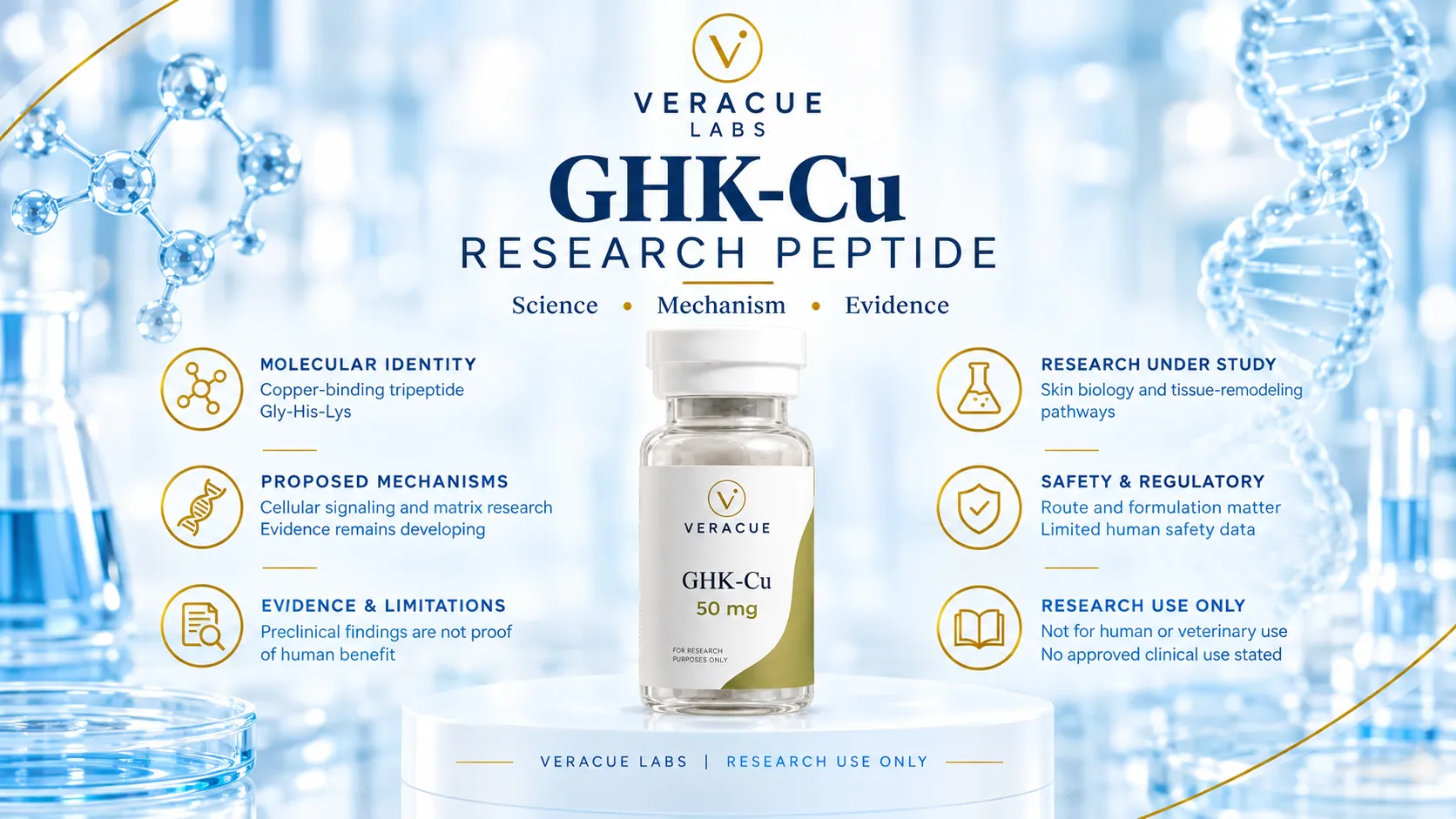
- GHK-Cu is the copper(II) complex of the human tripeptide GHK, studied mainly in cell and animal models for effects on collagen synthesis, wound healing, and oxidative stress.
- At least four chemically distinct forms — a neutral 1:1 complex, a cationic form, a 2:1 peptide-to-copper adduct, and an acetate salt — are sold under the single "GHK-Cu" name, and a 2026 systematic review argues this unresolved identity problem is the field's main barrier to comparing studies and products.
- Human clinical evidence is thin: the one identified blinded, randomized trial with objective endpoints (a 13-patient CO2-laser study) found no significant improvement in erythema or skin quality versus control.
- FDA's own bulk-drug-substances compounding page lists "GHK-Cu (for injectable routes)" among nominations withdrawn from its significant-safety-risk category, citing immunogenicity risk and limited human safety data for injectable use specifically.
- Research Use Only labeling describes intended use, not safety or efficacy, and is not a substitute for a batch-specific certificate of analysis.
GHK-Cu is the copper(II) complex of glycyl-L-histidyl-L-lysine (GHK), a naturally occurring human tripeptide studied since the 1970s for its role in tissue remodeling and wound repair — and, despite the single name, not always the same molecule from one product to the next.
Cosmetic & Skin
GHK-Cu
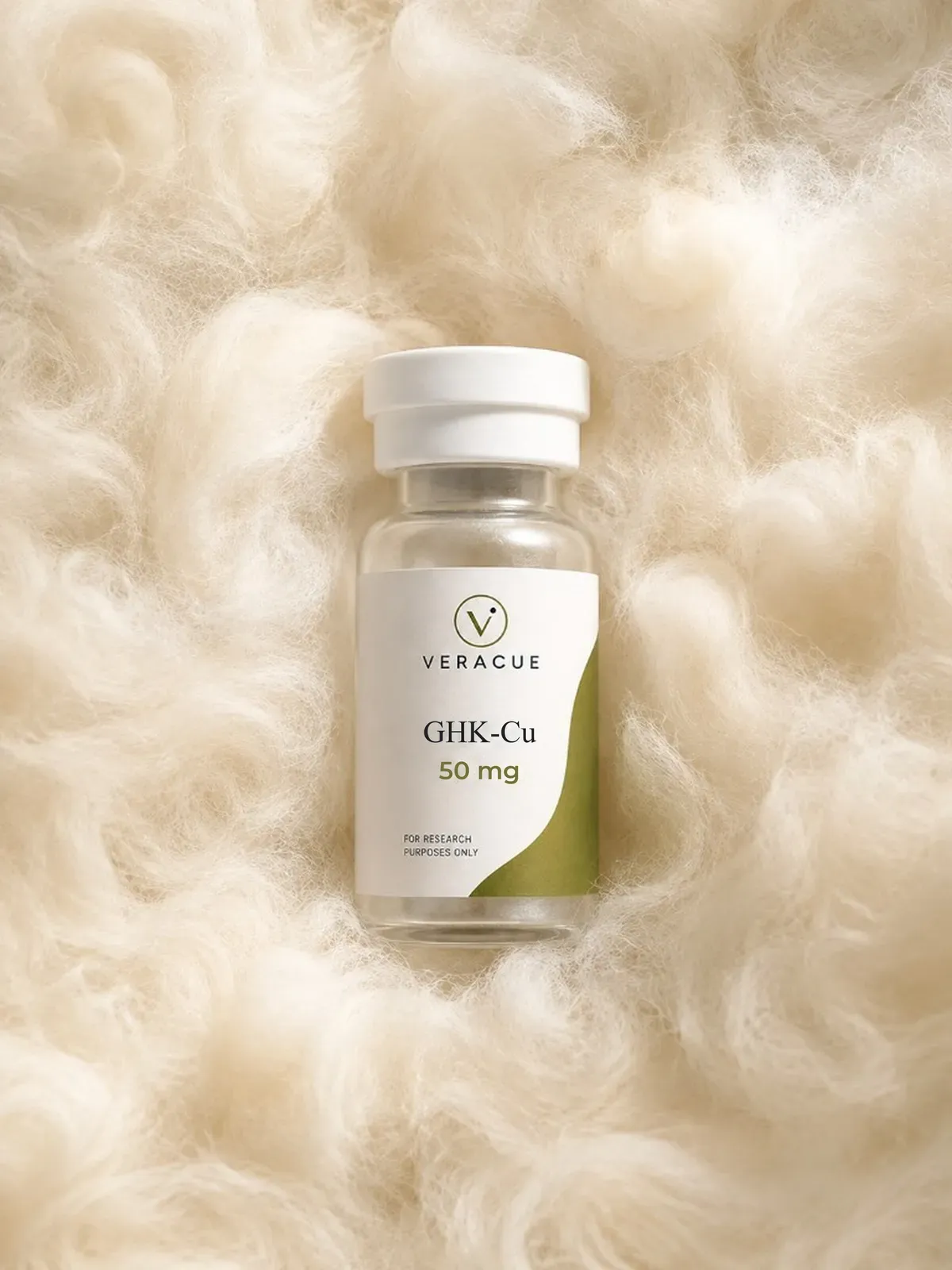
GHK-Cu is the copper(II) complex of the tripeptide glycyl-L-histidyl-L-lysine, usually written Gly-His-Lys, and it is also sold as copper tripeptide-1. The standard complex holds one copper ion per peptide: C14H22CuN6O4, 401.91 g/mol, CAS 89030-95-5. That is a different substance from the free peptide GHK (CAS 49557-75-7), so the exact form named on the certificate matters. Available as 50 mg and 100 mg vials, for laboratory research use only.
Cosmetic & Skin
AHK-Cu
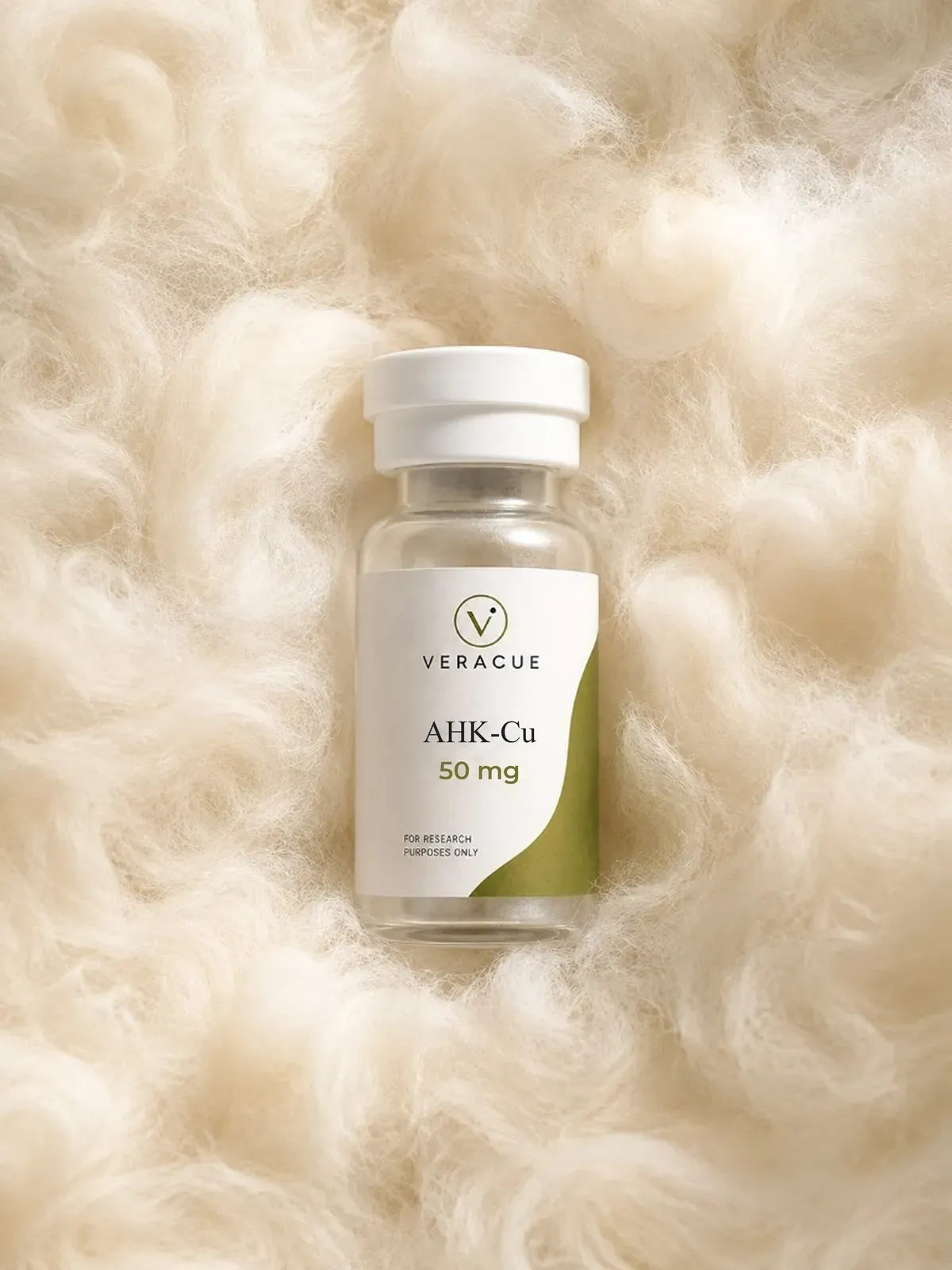
AHK-Cu is a copper(II) complex of the tripeptide alanyl-histidyl-lysine (Ala-His-Lys), also listed as Copper Tripeptide-3. Its molecular weight depends on the form: 354.41 g/mol for the free peptide, 415.94 for the neutral complex (C15H24CuN6O4) and 451.39 for a hydrochloride form, with CAS 682809-81-0 commonly listed by suppliers. It is easy to mix up with GHK-Cu, which starts with glycine instead of alanine. Veracue offers AHK-Cu in 50 mg and 100 mg vials for laboratory research use only.
Type "GHK-Cu" into a search bar and you'll land somewhere between a biochemistry textbook and a skincare ad within three clicks. One page calls it a 50-year-old discovery with "a plethora" of regenerative effects; another sells it as a copper serum that visibly tightens skin. Neither extreme answers the actual question a careful reader has: what does the research establish, and where do the claims run past the data?
Decades of laboratory and animal research describe real, reproducible biological activity: effects on extracellular-matrix remodeling, wound-repair signaling, and oxidative stress in cell and animal models. None of that is in serious dispute. What is far less settled is how much of that preclinical picture translates into reliable, reproducible outcomes in people — and that gap matters, because biological plausibility and a strong laboratory signal are not the same thing as clinical proof.
This guide reviews what GHK-Cu is, how it's proposed to work, what the in-vitro, animal, and human evidence shows (and doesn't), and what Research Use Only labeling does and doesn't mean for material sold as a research compound. It does not provide dosing, reconstitution, or administration guidance of any kind.
What Is GHK-Cu Peptide?
GHK-Cu, in one definition: GHK-Cu is the copper(II) coordination complex of glycyl-L-histidyl-L-lysine (GHK), a three-amino-acid peptide first identified in human plasma. GHK has a strong affinity for copper(II) ions; when bound, the resulting complex is commonly referenced by the CAS number 89030-95-5 (prezatide copper) and the INCI/cosmetic name Copper Tripeptide-1. GHK-Cu is studied mainly for its proposed roles in tissue-remodeling and wound-repair biology — the same compound behind Veracue's research-grade GHK-Cu peptide, identity-confirmed by mass spectrometry.
GHK itself — the copper-free tripeptide — occurs naturally in human serum, saliva, and urine, and its measured levels decline with age (one review cites an average around 200 ng/mL at age 20 falling to roughly 80 ng/mL by age 60) (Pickart & Vasquez-Soltero, 2015, PMID 26236730; Dou et al., 2020, PMID 35083444). GHK-Cu is not interchangeable with free GHK: the copper ion changes the molecule's coordination chemistry, its stability, and — per a 2026 systematic review — its behavior as a drug-delivery "cargo" (Mateescu et al., 2026, PMID 42797253). Studies on one form shouldn't be read as automatically describing the other.
Compound identity matters here more than it might for a simple small molecule, because "GHK-Cu" is not a single, universally defined chemical entity across the market. Veracue's own product documentation for GHK-Cu lists several related forms with different masses — a neutral 1:1 complex (401.91 g/mol, C14H22CuN6O4), a cationic form (~402.92 g/mol), a 2:1 peptide-to-copper adduct (~744.31 g/mol), and prezatide copper acetate (860.39 g/mol, CAS 130120-57-9) — which is exactly the kind of speciation ambiguity the 2026 Mateescu review flags as a barrier to comparing studies and products on equal footing (Mateescu et al., 2026, PMID 42797253). A related compound, AHK-Cu, is a different tripeptide-copper complex entirely and should not be assumed to share GHK-Cu's evidence base just because the names look similar.
Because of this, two GHK-Cu-labeled materials are not automatically equivalent, and neither are two "copper peptide" products more broadly — a theme this guide returns to throughout.
How Does GHK-Cu Work?
The mechanistic picture comes almost entirely from in-vitro and animal research, and it should be read as a set of proposed and partially supported pathways rather than an established clinical mechanism — and, consistent with the identity problem above, as mechanisms studied on specific forms of the molecule rather than "GHK-Cu" as a single interchangeable entity.
Extracellular-matrix remodeling and collagen biology. In cell-culture and animal studies, GHK and GHK-Cu have been associated with increased synthesis of collagen, elastin, and glycosaminoglycans (including dermatan sulfate and chondroitin sulfate), along with modulation of matrix metalloproteinases and their inhibitors (Pickart & Vasquez-Soltero, 2015, PMID 26236730; Pickart, 2008, PMID 18644225). A 2026 systematic review frames GHK as an endogenous "matricryptin" — a bioactive fragment released from larger matrix proteins (collagen Iα2 and SPARC) — and highlights copper's role as a cofactor for lysyl-oxidase-family enzymes involved in collagen cross-linking (Najafi et al., 2026, PMID 42787770).
Fibroblast and keratinocyte research. Laboratory studies describe increased fibroblast and keratinocyte proliferation, and GHK-Cu has been reported to help restore the replicative capacity of fibroblasts after radiation exposure in experimental models (Pickart & Vasquez-Soltero, 2015, PMID 26236730).
Oxidative-stress and inflammatory signaling. Preclinical work describes antioxidant and anti-inflammatory activity — including suppression of free-radical generation and modulation of inflammatory mediators such as TNF-alpha and TGF-beta1 in experimental systems — alongside proposed ferritin/iron-related antioxidant effects (Pickart, 2008, PMID 18644225; Najafi et al., 2026, PMID 42787770). The 2026 microneedle-delivery systematic review adds further mechanistic detail beyond this general picture: proposed decorin and glycosaminoglycan organization within newly deposited matrix, and TGF-beta3-mediated reduction of fibrosis, alongside the ferritin-iron antioxidant pathway (Najafi et al., 2026, PMID 42787770). These remain cell- and animal-level findings, not demonstrated human outcomes.
Angiogenesis and tissue models. Chemoattraction of repair-associated cells (macrophages, mast cells, capillary cells) and pro-angiogenic activity have been reported in animal and tissue models, alongside effects on nerve outgrowth and hair-follicle size in some experimental systems (Pickart, 2008, PMID 18644225).
Copper coordination, formulation, and stability. This is where the 2026 literature is most pointed. A systematic evidence-mapping review notes that most delivery and formulation studies report particle size, encapsulation efficiency, and bulk peptide/copper content — but rarely resolve molar copper occupancy, "labile" (loosely bound, bioavailable) copper, or whether what's actually released is intact GHK-Cu versus free copper and apo-GHK (copper-free peptide) (Mateescu et al., 2026, PMID 42797253). Separately, GHK-Cu's hydrophilicity limits its ability to cross the lipophilic stratum corneum unassisted, which is why delivery-enhancement approaches (including microneedles and liposomal encapsulation) are an active, not yet clinically resolved, area of study (Ogórek et al., 2025, PMID 39795193; Najafi et al., 2026, PMID 42787770).
Every mechanism above comes from in-vitro, ex-vivo, or animal research. None of it should be read as proof that a specific commercial formulation — in any format — reproduces these effects in humans.
What Does Scientific Research Say About GHK-Cu?
In-vitro research. Cell-culture studies describe GHK-Cu's effects on fibroblast and keratinocyte behavior, collagen/matrix protein synthesis, and modulation of inflammatory and oxidative-stress pathways (Pickart, 2008, PMID 18644225; Pickart & Vasquez-Soltero, 2015, PMID 26236730).
Animal and preclinical research. Wound-healing and tissue-remodeling effects have been reported across multiple animal models (rodents, pigs, and dogs in older literature), along with preliminary mouse data on markers of age-related cognitive change (Pickart, 2008, PMID 18644225; Dou et al., 2020, PMID 35083444). A 2026 scoping review covering GHK-Cu alongside five other research peptides found that roughly two-thirds of the identified musculoskeletal-focused literature used animal models, most commonly rats (Tewari et al., 2026, PMID 42578445).
Ex-vivo and delivery-focused research. Porcine ex-vivo skin models have been used to study microneedle-assisted GHK-Cu delivery, with enhanced uptake reported versus passive topical application — though this work has not yet progressed to a published, adequately powered human trial using the same delivery method (Najafi et al., 2026, PMID 42787770).
Human studies. Direct human evidence is limited and mixed. In a randomized, blinded 13-patient trial of a GHK-Cu-containing regimen after CO2 laser resurfacing, objective, computer-assisted and blinded-evaluator assessments found no statistically significant difference in erythema resolution or in wrinkle/skin-quality improvement between the GHK-Cu and control groups; patient-reported satisfaction was significantly higher in the GHK-Cu group (P = .04), which is a subjective, not an objective, endpoint (Miller et al., 2006, PMID 16847171). A 2026 systematic review separately references an 18-participant split-face study reporting positive cosmetic hair-related outcomes, but notes that study did not characterize GHK-Cu speciation or confirm local tissue exposure (Mateescu et al., 2026, PMID 42797253). The same review identifies one registered Phase 2 acute-wound trial (ClinicalTrials.gov NCT07437586) as still recruiting, with no efficacy results available — a trial registration is not evidence of a result.
Unresolved questions and evidence gaps. The most recent systematic reviews (2026) converge on the same conclusion: preclinical biology is comparatively well mapped, but clinical translation is held back less by implausibility than by unresolved pharmaceutical questions — what exact chemical species reaches tissue, in what amount, and whether published studies are even describing the same active entity (Mateescu et al., 2026, PMID 42797253; Najafi et al., 2026, PMID 42787770).
Scientific Evidence at a Glance
Research area | Evidence type | What was observed | Key limitation |
|---|---|---|---|
Collagen/matrix synthesis, MMP modulation | In-vitro (fibroblast/keratinocyte culture) | Increased collagen, elastin, GAG synthesis; modulation of metalloproteinases | Cell-culture conditions don't replicate in-vivo delivery, concentration, or exposure time |
Wound healing, tissue repair | Animal (rodent, porcine, canine models) | Accelerated wound closure/remodeling across several tissue types | Species differences and route-of-administration differences limit extrapolation to human topical/cosmetic use |
Antioxidant / anti-inflammatory signaling | In-vitro and animal | Reduced markers of oxidative stress and inflammatory mediator activity in experimental systems | Mechanistic/biomarker endpoints, not clinical outcomes |
Cognitive/neuroprotective markers | Animal (preliminary, mouse) | Preliminary reversal of some cognitive-impairment markers in aged mice | Described by the authors themselves as preliminary; no human cognitive trials identified |
Post-CO2-laser skin regimen | Human RCT, n=13, blinded assessment | No significant objective difference in erythema or wrinkle/skin-quality improvement vs. control; higher subjective patient satisfaction | Small sample; objective endpoints were negative; satisfaction is a subjective endpoint |
Split-face cosmetic (hair-related outcome) | Human, n=18 | Positive cosmetic outcome reported | GHK-Cu speciation and local tissue exposure not characterized, per the citing systematic review |
Microneedle-assisted delivery | Ex-vivo (porcine skin) | Enhanced skin uptake vs. passive topical application | Not yet validated in a published, adequately powered human trial |
Acute wound healing | Human, registered Phase 2 (NCT07437586) | Trial recruiting; no efficacy results published | Registration is not a result; outcome currently unknown |
What Does Research Use Only Mean?
"Research Use Only" (RUO) is a labeling designation, not a safety or efficacy rating. It communicates that a material is manufactured, labeled, and sold for laboratory and scientific research — not for diagnosis, treatment, prevention of disease, or administration to humans or animals.
A few things RUO labeling does not establish:
- It does not mean the material has been evaluated by the FDA for human or veterinary use, safety, or effectiveness.
- It is not a substitute for batch-specific quality documentation (a certificate of analysis, purity data, or identity confirmation) — RUO and "independently verified" are two separate claims.
- Laboratory or animal research findings about a compound do not, by themselves, establish approval or authorization for human use of a commercial research material.
- It does not describe or certify a specific supplier's manufacturing process, storage conditions, or handling chain.
Researchers working with RUO materials are generally expected to check the applicable laws in their jurisdiction, their institution's own policies on research-material use, and the specific documentation a supplier does or doesn't provide for a given lot — rather than relying on the RUO label itself as a quality or safety guarantee.
Is GHK-Cu FDA Approved?
No FDA-approved drug product containing GHK-Cu as its active ingredient was identified in the course of this review. That is a statement about what wasn't found, not a certification that none exists anywhere in any form — readers researching a specific formulation should check current FDA resources directly.
A few regulatory categories are worth keeping separate, because "FDA approved" gets applied loosely to all of them in casual discussion:
- Research material. Material sold and labeled for research use only, like the product discussed on this page, is not FDA-approved for any human or veterinary purpose.
- Cosmetic ingredient. Copper Tripeptide-1 (the INCI name tied to the GHK-Cu/prezatide-copper substance, CAS 89030-95-5) appears in FDA's Substance Registration System under the name prezatide copper (UNII 6BJQ43T1I9). That registry explicitly states that UNII availability "does not imply any regulatory review or approval" — an ingredient identifier is not an approval, and the registry entry should not be read as one.
- Compounded injectable use — a documented FDA safety flag. FDA's "Certain Bulk Drug Substances for Use in Compounding That May Present Significant Safety Risks" page lists an entry for "GHK-Cu (for injectable routes of administration)" in its table of substances nominated but withdrawn from Category 2 of the interim compounding policies. The stated concern: compounded injectable drugs containing GHK-Cu "may pose risk for immunogenicity" due to "the potential for aggregation and peptide-related impurities," and the agency notes "limited data in humans to inform safety-related considerations" (FDA, Certain Bulk Drug Substances for Use in Compounding That May Present Significant Safety Risks). Because the nomination was withdrawn, GHK-Cu is not currently listed in FDA's active Category 2 significant-safety-risk table — but the underlying concern (immunogenicity risk from aggregation/impurities in injectable use, and limited human safety data generally) is FDA's own stated assessment and is directly relevant to anyone considering any injectable use of this compound. This entry concerns compounded injectable drug products specifically; it should not be read as a blanket statement about topical cosmetic use or about laboratory research use.
- 503A compounding (general nomination activity). Separately, FDA's Pharmacy Compounding Advisory Committee reviewed several other research peptides for 503A bulk drug substance list inclusion at its July 2026 meeting (BPC-157, KPV, TB-500, MOTS-c, Epitalon, and Semax were recommended; Emideltide/DSIP was not), per one legal-industry tracking source. GHK-Cu was not part of that specific nominated-for-inclusion batch — its separate regulatory history runs through the withdrawn-injectable-nomination entry described above and its cosmetic-ingredient registration, not through that 503A review round.
Readers should not describe GHK-Cu as an FDA-approved drug based on ingredient registration, cosmetic terminology, or its presence in the research literature, and should verify the current status of any specific product and intended route against FDA's own resources directly.
How Should You Evaluate GHK-Cu Research Material Quality?
This is a neutral framework for evaluating any GHK-Cu research material — not a claim about what any specific supplier, including Veracue, currently provides. Check the following before treating a batch-specific claim as verified:
- Clear compound identification. Does the listing specify which form of GHK-Cu it's describing (the neutral 1:1 complex, a cationic form, a 2:1 adduct, or an acetate salt), with a CAS number that matches?
- Batch and lot traceability. Is there a lot or batch code printed on the vial that ties back to a specific manufacturing run?
- Availability of batch-specific analytical documentation. Is there an actual certificate of analysis for that lot, or only a general claim of testing?
- Analytical methods and their limits. Does the documentation name the method used (e.g., HPLC for purity, mass spectrometry for identity), and do you understand what each method can and can't confirm?
- Purity reporting and what the number means. A purity percentage describes one analytical measurement on one batch — it does not, by itself, confirm sterility, biological activity, or that the vial contains only the stated compound.
- Storage and stability documentation. Is there guidance (or data) on how the material should be stored and how stable it is over time, where available?
- Transparency about what's unavailable. Does the supplier clearly state when documentation — a COA, a stability study, third-party verification — is not currently available, rather than implying it exists?
- Form/speciation disclosure. Given that at least four related GHK-Cu forms circulate under one name (see above), does the listing disclose which one was actually tested or confirmed by mass spectrometry — or does it just say "copper peptide" without specifying the coordination state?
On Veracue Labs specifically: Veracue's GHK-Cu product listing states that purity is assessed by HPLC and identity by mass spectrometry, with documentation available on request for specific lots; it also states that purity may vary by lot and that some items may test below 99%. At the time this article was researched, Veracue's public certificates library listed zero published GHK-Cu reports. This article does not assume or imply a specific purity percentage, a specific third-party test, a validated stability profile, or an independently verified batch for Veracue's GHK-Cu beyond what the company's own pages state — readers should request current lot-specific documentation directly.
How Does GHK-Cu Compare to Other Copper Peptides?
GHK-Cu is one of several copper-binding or copper-associated peptides sold into the research-compound market, and similarity in naming or amino-acid composition does not establish equivalent biology.
- AHK-Cu is a different tripeptide-copper complex (alanine-histidine-lysine, rather than glycine-histidine-lysine) sold alongside GHK-Cu on Veracue's own catalog. Its own evidence base is separate from GHK-Cu's and shouldn't be assumed to overlap just because both are copper tripeptide complexes.
- Other "copper peptide" market terms (including various blended serums marketed generically as "copper peptide") may or may not specify which underlying compound and coordination form they contain. Without that specification, a product claim can't be meaningfully compared to the GHK-Cu literature discussed in this article.
- Non-copper research peptides frequently searched alongside GHK-Cu — such as BPC-157, TB-500, and KPV — have entirely distinct structures, mechanisms, and (in several cases) active 2026 FDA 503A regulatory review histories that GHK-Cu does not share. They're referenced here only to note that shared popularity in the research-peptide market doesn't imply shared chemistry, mechanism, or regulatory status.
Structural similarity between copper peptides is a starting point for a researcher's own literature review, not a substitute for it.
Veracue Labs GHK-Cu Product Information
Researchers exploring GHK-Cu can review the Veracue Labs GHK-Cu product listing for the product information currently available, including compound identity (CAS 89030-95-5), format, and size options. Specifications and supporting documentation should be evaluated directly on that page and in any lot-specific certificate of analysis requested from Veracue, rather than inferred from the general GHK-Cu research discussed in this article.
This product is labeled Research Use Only. It is not intended for human or veterinary use, diagnosis, treatment, or prevention of any disease, and this article makes no claim about its purity, sterility, or biological activity beyond what Veracue's own product documentation states.
Where This Leaves a Careful Reader
GHK-Cu has a genuinely substantial preclinical research base — decades of in-vitro and animal work describing real effects on matrix remodeling, wound-repair signaling, and oxidative stress. That's not a small thing, and it's why the compound keeps attracting serious review articles as recently as 2026.
What that research base doesn't yet do is answer the questions a commercial research material actually raises: which exact chemical form is in a given vial, how it behaves once applied or delivered, and whether a specific formulation reproduces laboratory-scale effects in a controlled human study. The most recent systematic reviews are explicit that this is the open problem — not whether the underlying biology is plausible, but whether any given product can be shown, with proper chemical characterization, to deliver it. Until that gap closes, GHK-Cu is best treated as a promising, actively studied research compound — not a clinically validated one.
Frequently Asked Questions
GHK-Cu is the copper(II) complex of glycyl-L-histidyl-L-lysine (GHK), a tripeptide first identified in human plasma. It's studied mainly for proposed roles in extracellular-matrix remodeling and wound-repair biology, largely through in-vitro and animal research (Pickart, 2008, PMID 18644225).
GHK refers to the amino-acid sequence glycine-histidine-lysine. "Cu" denotes the copper(II) ion coordinated to that tripeptide, forming the complex commonly referenced by CAS number 89030-95-5.
GHK has a strong binding affinity for copper(II) ions, forming a coordination complex. Several related forms exist with different peptide-to-copper ratios and counterions, which is why specifying the exact form matters when comparing research or products.
Research has explored its role in extracellular-matrix remodeling, collagen/glycosaminoglycan synthesis, modulation of metalloproteinases, antioxidant and anti-inflammatory signaling, and angiogenesis-related activity — almost entirely in cell-culture and animal models (Pickart & Vasquez-Soltero, 2015, PMID 26236730).
In-vitro and animal studies report increased collagen and related matrix-protein synthesis. The one identified blinded human RCT with objective measurement, however, found no statistically significant improvement in skin quality or wrinkles versus control (Miller et al., 2006, PMID 16847171).
Comparatively weak relative to the preclinical literature. A 2026 systematic review describes the human clinical evidence as thin and fragmented, mostly small cosmetic-cream trials, with no adequately powered trial of modern delivery methods yet published (Najafi et al., 2026, PMID 42787770).
GHK is the copper-free tripeptide that occurs naturally in human serum and declines with age. GHK-Cu is its copper(II)-bound complex. The two have different chemistry and are not interchangeable in research comparisons.
No. FDA's ingredient registry (UNII 6BJQ43T1I9, prezatide copper) explicitly states that registration does not imply regulatory review or approval. Separately, FDA's compounding bulk-substances page lists "GHK-Cu (for injectable routes)" among nominations withdrawn from its significant-safety-risk category, citing immunogenicity risk and limited human safety data for injectable use specifically.
Overall human safety data for GHK-Cu are limited. FDA's own compounding bulk-substances page notes a specific concern for injectable use — potential immunogenicity from aggregation and peptide-related impurities — and states that human safety data are limited generally. This article does not describe GHK-Cu, in any form or formulation, as proven safe.
Research Use Only means the material is labeled, manufactured, and sold for laboratory research, not for human or veterinary use. It does not certify purity, safety, or efficacy, and it isn't a substitute for a batch-specific certificate of analysis.
Compound identity and CAS number, lot/batch traceability, a batch-specific certificate of analysis naming its analytical methods (e.g., HPLC, mass spectrometry), disclosure of which chemical form/speciation was tested, and clear disclosure of anything that isn't currently available or verified.
No. In-vitro and animal findings describe biological activity in those specific systems; they do not, by themselves, establish safety or efficacy for human use of a commercial research material.
On Veracue's own GHK-Cu product page, which lists current compound identity, format, and size information. This article does not restate or infer specifications beyond what that page and any requested lot-specific COA state.
- 01Pickart L. The human tri-peptide GHK and tissue remodeling. J Biomater Sci Polym Ed. 2008;19(8):969-88.
- 02Pickart L, Vasquez-Soltero JM, Margolina A. GHK Peptide as a Natural Modulator of Multiple Cellular Pathways in Skin Regeneration. Biomed Res Int. 2015;2015:648108.
- 03Pickart L, Vasquez-Soltero JM, Margolina A. The human tripeptide GHK-Cu in prevention of oxidative stress and degenerative conditions of aging: implications for cognitive health. Oxid Med Cell Longev. 2012;2012:324832.
- 04Dou Y, Lee A, Zhu L, Morton J, Ladiges W. The potential of GHK as an anti-aging peptide. Aging Pathobiol Ther. 2020;2(1):58-61.
- 05Miller TR, Wagner JD, Baack BR, Eisbach KJ. Effects of topical copper tripeptide complex on CO2 laser-resurfaced skin. Arch Facial Plast Surg. 2006;8(4):252-9.
- 06Ogórek K, Nowak K, Wadych E, Ruzik L, Timerbaev AR, Matczuk M. Are We Ready to Measure Skin Permeation of Modern Antiaging GHK-Cu Tripeptide Encapsulated in Liposomes? Molecules. 2025;30(1):136.
- 07Tewari K, Liu TP, Im C, Hamad C, Petrigliano F, Cheung EC, Kremen TJ. Peptide Supplements and Their Therapeutic Applications in Sports Medicine. Am J Sports Med. 2026.
- 08Najafi N, Maatouk H, Vardanyan KG, Vartanian KB, Agrawal DK. A Systematic Review of the Mechanisms and Therapeutic Applications of GHK-Cu in Topical Microneedle Delivery: A Case for Expanded Clinical Trials. Arch Intern Med Res. 2026;9(3):269-293.
- 09Mateescu DM, Gavrilescu DM, Mincioaga RI, Pah AM, Toma AO, Serban DV, Avram CA, Craciun ML, Enache B, Muresan CO. GHK-Cu as a Bioactive Metallopeptide and Drug-Delivery Cargo: Coordination Chemistry, Formulation Science, Therapeutic Evidence, and a Translational Roadmap. Pharmaceutics. 2026;18(9):1077.
- 10U.S. Food and Drug Administration. Certain Bulk Drug Substances for Use in Compounding That May Present Significant Safety Risks.
- 11FDA Substance Registration System / Global Substance Registration System. Prezatide Copper — UNII 6BJQ43T1I9.
Veracue Research Team
Research & Product Team
Our in-house team tracks published peptide and coenzyme research and translates it into clear, source-cited overviews for the research community.
Reviewed by in-house research chemists
orders@veracuelabs.com