Molecular Identity
Is HCG a peptide?
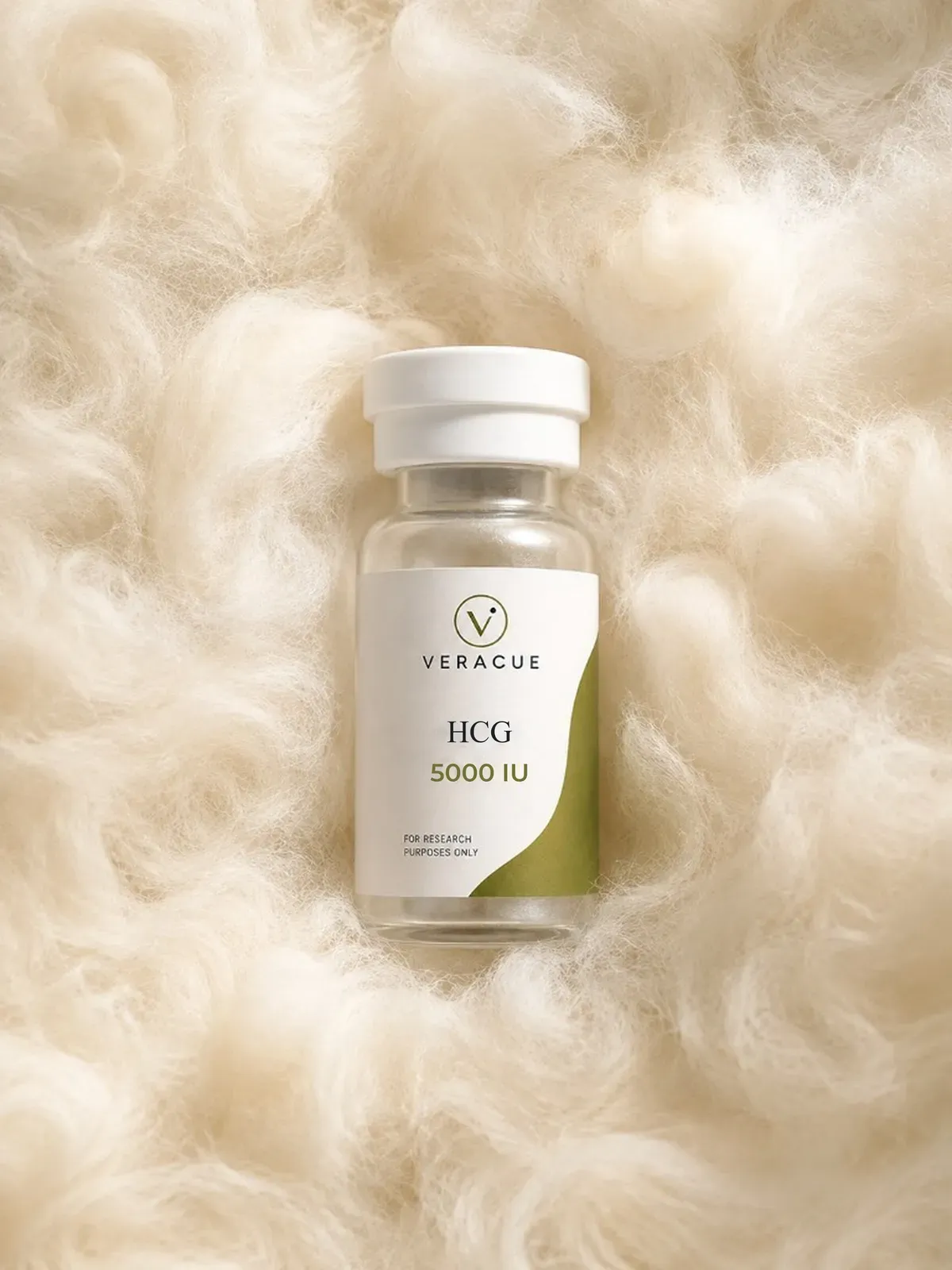
Not in the conventional sense. Across its two subunits HCG has 237 amino acids, its mass is near 37 kDa, and about 30% of that mass is carbohydrate. Short synthetic peptides are much smaller and typically carry no sugar chains.
As a result, several peptide conventions do not carry over. Molecular weight is a range rather than one value, potency is usually expressed in international units, and a mass-spectrometry identity reflects a distribution of glycoforms instead of one exact mass.
What do the alpha and beta subunits do?
The two chains associate without covalent bonds. Isolated subunits do not act on the receptor, and recombining them restores nearly full activity in dissociation and reassociation experiments. A free beta subunit also occurs as a variant, and it behaves differently from the intact dimer in assays and cell models.
| Property | General scientific value |
|---|
| Alpha subunit glycosylation | 2 N-linked chains (Asn52, Asn78) |
| Beta subunit glycosylation | 2 N-linked chains (Asn13, Asn30) and 4 O-linked chains (Ser121, Ser127, Ser132, Ser138) |
| Numbering | Mature-subunit numbering |
| Receptor | LHCGR, a 675-amino-acid class A G protein-coupled receptor |
| Genes | CGA for the alpha subunit (chromosome 6); a CGB gene cluster for the beta subunit (chromosome 19) |
The beta chain is about 80% homologous to LH-beta. It also carries a C-terminal extension that LH-beta lacks, and that extension holds the O-linked glycans. Sources give the extension as roughly 24 to 34 residues, depending on where they draw its boundary.
Why does glycosylation matter?
Sugar chains vary from molecule to molecule, so no single molecular weight fits every preparation. Reviews describe several forms with the same amino acid sequence: regular, hyperglycosylated and sulfated HCG, the free beta subunit and a hyperglycosylated free beta subunit. Nicked forms and the beta-core fragment are described as well. Sialic acid and other glycan features change receptor binding, activity and clearance, so glycoform analysis is a research field of its own.
HCG vs LH at a Glance
| Feature | HCG | LH |
|---|
| Structure | Alpha/beta glycoprotein heterodimer | Alpha/beta glycoprotein heterodimer |
| Subunits | Shared alpha (92 amino acids); beta of 145 amino acids | Shared alpha (92 amino acids); a different beta chain |
| Beta chain | Carries a C-terminal extension with O-linked glycans | About 80% homologous to HCG-beta, without that extension |
| Receptor | LHCGR | LHCGR |
| Cell-assay signaling | Different cAMP and beta-arrestin 2 responses from LH | Different responses from HCG in the same readouts |
| Glycosylation | 4 N-linked and 4 O-linked chains; about 30% carbohydrate | Sugar composition differs from HCG, which affects bioactivity and degradation rate |
| Key difference | The beta extension and its glycans | A different beta chain and sugar structure |
The comparison is descriptive and does not rank either molecule.
Receptor-Level Research Context
Which receptor does HCG activate?
HCG binds LHCGR, a class A G protein-coupled receptor with a large extracellular domain that also binds LH. The receptor couples mainly to Gαs, which drives adenylyl cyclase, cAMP and protein kinase A signaling. It can also activate ERK and AKT pathways, and at high hormone and receptor levels it couples to Gαq, which raises intracellular calcium.
What do cell studies show?
In one HEK293 model expressing human LHCGR, either HCG or LH raised cAMP within five minutes. Separate work compared recombinant HCG and LH in HEK293 cells and in mouse Leydig tumor cells and reported differences in cAMP and beta-arrestin 2 responses. These are cell-line findings, and which pathway dominates depends on receptor level, cell type and the hormone used.
What do these findings not tell me?
A receptor-level result describes a measured difference in a defined cell system. Cell-line responses depend on receptor level, cell type and species, and rodent and human cells already behave differently. Findings for one preparation may not apply to another, because recombinant and urine-derived material differ in glycosylation. This page gives no dosing, administration or usage guidance of any kind.
Research Areas
- LHCGR signaling: receptor-expressing cell lines allow cAMP, beta-arrestin recruitment and related readouts to be measured.
- Glycoprotein characterization: glycan features such as sialic acid influence receptor binding, activity and clearance.
- Assay research: reference materials exist for HCG and several of its molecular forms, and laboratories test how assays recognise each form.
- Subunit biochemistry: the shared alpha chain and hormone-specific beta chain are a standing comparison across four glycoprotein hormones.
Beta-hCG and Assay Method Labels
Because the beta chain differs from LH-beta, antibodies aimed at it can separate HCG from LH. The two beta chains are about 80% homologous, and early polyclonal assays suffered LH interference for that reason.
In testing, “beta-hCG” usually refers to assays directed at the beta chain. Some assays detect intact HCG only, and others detect intact HCG plus the free beta subunit, which laboratories call total beta-hCG. Method labels therefore matter. In one split-sample study, 9.3% of participating laboratories (22 of 235) reported intact HCG results as total beta-hCG, and 13.1% (8 of 61) reported total beta-hCG as intact HCG. That finding concerns reporting practice and does not rank assays by accuracy.
Research material sold under Research Use Only terms is a laboratory reagent, not a diagnostic test.
Research Questions Worth Asking
- Which form is meant: intact dimer, free beta subunit or a fragment?
- Is the material urine-derived, recombinant or another source? Glycosylation follows the source.
- Is potency given in IU, and by which assay type?
- What else is in the vial? Excipients and carrier change the relationship between vial mass and hormone mass.