
- Semax (MEHFPGP) combines the ACTH(4-7) fragment with an added Pro-Gly-Pro tail; it is a distinct sequence from both full-length ACTH and ACTH(4-10).
- The hippocampal BDNF/TrkB finding most often cited for Semax comes from a single 2006 rat study (Dolotov et al.) using intranasal dosing; no independently replicated version of that specific result was identified in this review.
- A 2001 study reported that Semax and Selank inhibit enkephalin-degrading enzymes in human serum in vitro — a laboratory enzyme assay, not evidence from living human subjects.
- Semax and Selank share a Pro-Gly-Pro ending but differ in their first four residues, general lineage, and molecular weight.
- Most published Semax research, including the hippocampal BDNF study, does not specify whether the free peptide or a salt form was tested — a gap that limits matching any paper to a specific research lot.
- Molecular identifiers (CAS, formula, PubChem CID) describe the reference molecule, not a specific vial's identity, purity, or salt form.
Semax (MEHFPGP) is a synthetic heptapeptide built from the ACTH(4-7) fragment plus a Pro-Gly-Pro tail, supplied by Veracue as a research peptide for laboratory use only. Its best-known research angle is neurotrophin signaling: a single rat study links Semax exposure to changes in hippocampal BDNF and TrkB. This guide looks at that study directly, places it next to Semax's other reported mechanisms, compares it structurally with Selank, and marks where the evidence actually stops rather than where marketing copy usually extends it.
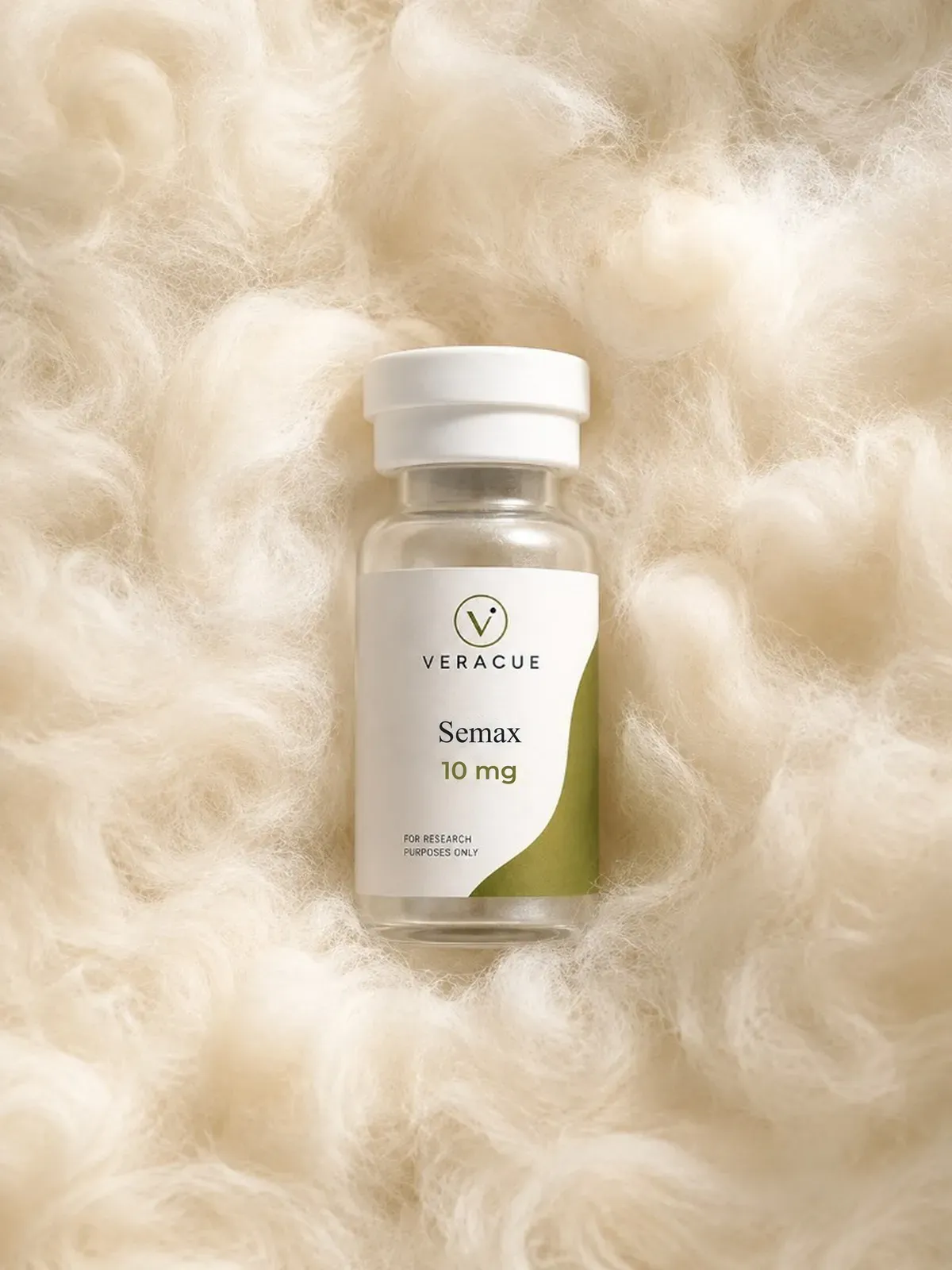
Cognitive & Nootropic
Semax
Semax is a seven-residue synthetic peptide, Met-Glu-His-Phe-Pro-Gly-Pro (MEHFPGP), made by joining the ACTH(4-7) fragment to a Pro-Gly-Pro tail. It has the formula C37H51N9O10S, an average mass of about 813.9 g/mol and CAS 80714-61-0. In the laboratory it has been studied in neurotrophin signaling and gene-expression work, and it is often compared with Selank. It is offered in 10 mg and 30 mg vials for research use only.

Cognitive & Nootropic
Selank
Selank is a seven-residue synthetic peptide with the sequence Thr-Lys-Pro-Arg-Pro-Gly-Pro (TKPRPGP) and a mass of about 751 g/mol. It is described as an analogue of tuftsin, a shorter, naturally occurring peptide, extended with a Pro-Gly-Pro tail. It shares that ending with Semax but differs in its first four residues, so the two are easy to mix up on paperwork. Veracue lists Selank as a single 10 mg vial for laboratory research only.
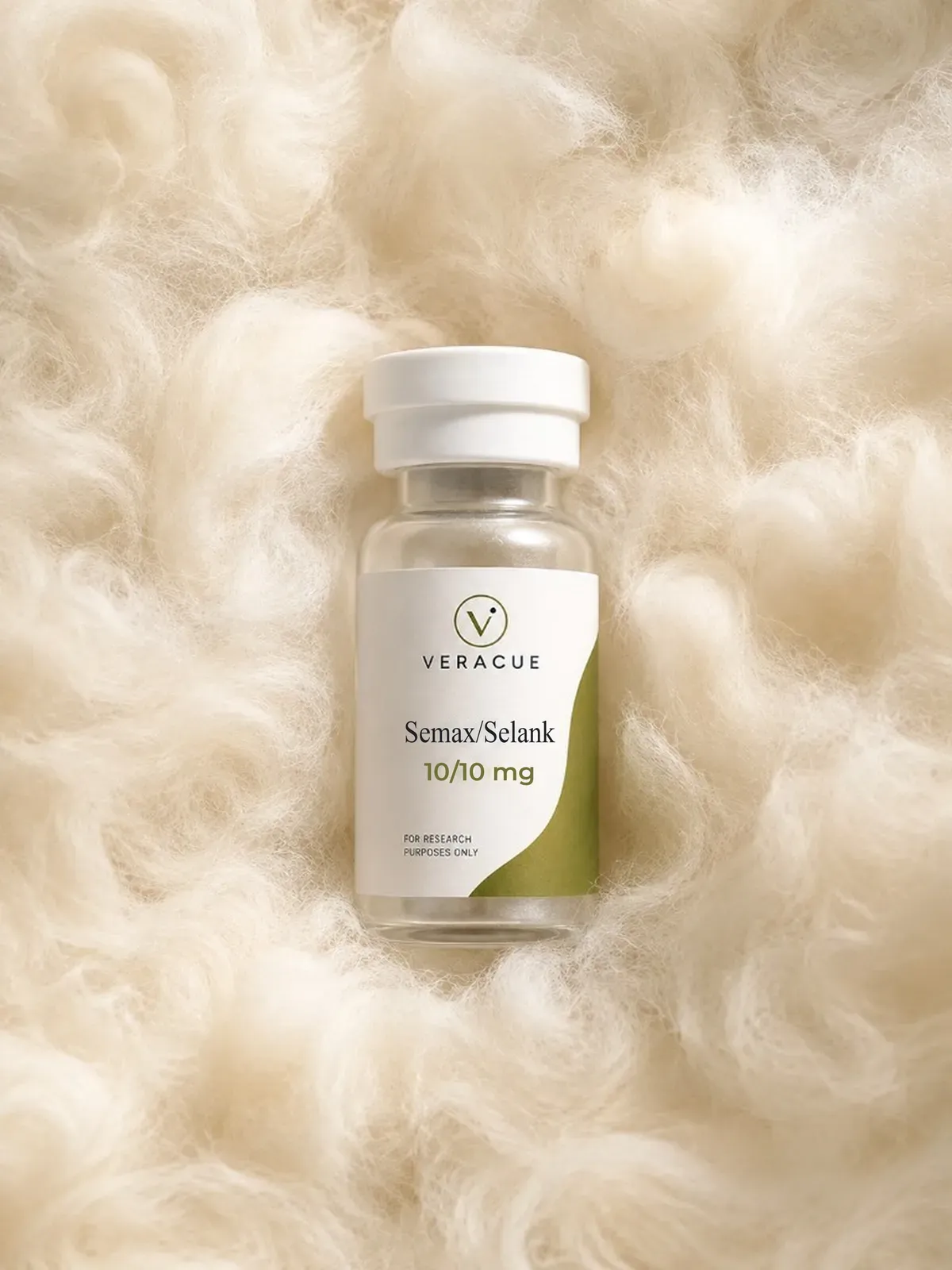
Cognitive & Nootropic
Semax/Selank
Semax/Selank is a research blend of two separate synthetic heptapeptides. Semax is Met-Glu-His-Phe-Pro-Gly-Pro (C37H51N9O10S, average mass 813.93, CAS 80714-61-0) and Selank is Thr-Lys-Pro-Arg-Pro-Gly-Pro (C33H57N11O9, average mass 751.89, CAS 129954-34-3). Both end in a Pro-Gly-Pro tail, which is why the two names are so easily mixed up. The vial holds 10 mg of each peptide and is supplied for laboratory research use only.
What the Sequence Actually Tells You
MEHFPGP is seven residues: methionine, glutamic acid, histidine, phenylalanine, proline, glycine, proline. The first four (MEHF) match ACTH(4-7); the last three (Pro-Gly-Pro) are an added extension thought to slow peptidase breakdown in biological test systems. ACTH(4-10) (MEHFRWG) is a related but distinct sequence — Semax keeps the MEHF core and substitutes PGP for ACTH(4-10)'s final three residues. These are three different molecules, and a finding reported for one should not be read onto another without the sequence actually being checked.
Molecular Identifiers
Property | Reference value |
|---|---|
Sequence | MEHFPGP (Met-Glu-His-Phe-Pro-Gly-Pro) |
Molecular formula | C37H51N9O10S |
Average molecular weight | ~813.93 g/mol |
Monoisotopic mass | ~813.348 Da |
CAS Registry Number | 80714-61-0 |
PubChem CID | 9811102 |
These identifiers describe the free peptide as a reference structure. They don't establish the salt form, purity, or identity of a specific vial — that requires lot-matched analytical documentation.
The BDNF/TrkB Finding: What the Study Actually Reported
The primary citation behind Semax's "neurotrophin signaling" reputation is a single 2006 rat study (Dolotov et al., Brain Research). Researchers gave rats a single intranasal dose of Semax and reported increased hippocampal BDNF protein and TrkB tyrosine phosphorylation, along with increases in BDNF and TrkB mRNA, alongside improved performance on an avoidance-learning task. The authors proposed that Semax may influence cognition partly through hippocampal BDNF/TrkB signaling.
This is one rat study, using intranasal dosing, with results reported at a small number of timepoints. No independently replicated version of this specific hippocampal finding was identified in this review, and the paper does not establish a receptor or a complete mechanism — only a measured association between Semax exposure and these markers.
What "Neurotrophin Signaling" Doesn't Mean Here
A measured change in BDNF/TrkB markers in a rat hippocampus after a single dose is not the same as a demonstrated cognitive benefit in humans, a defined receptor-level mechanism, or evidence that a given research lot will reproduce this result. Species, dose, administration route, and timepoint all affect whether a finding generalizes — treat this as a specific, scoped result, not a general claim about the molecule.
Other Reported Mechanisms
Semax's research literature includes findings outside the BDNF/TrkB angle. A 2001 study (Kost et al., Bioorganicheskaya Khimiya) reported that Semax and Selank inhibited enkephalin-degrading enzymes in human serum in vitro — a laboratory enzyme assay, not a study in living human subjects. Other sources describe possible melanocortin receptor activity at MC4/MC5; the primary source for that specific claim could not be independently verified in this review, so it's flagged here as unconfirmed rather than cited as established.
Semax vs. Selank: A Structural Comparison
Attribute | Semax | Selank |
|---|---|---|
Sequence | MEHFPGP | TKPRPGP |
General identity | ACTH-related | Tuftsin-related |
Length | 7 amino acids | 7 amino acids |
Average molecular weight | ~813.93 g/mol | ~751.9 g/mol |
Both peptides end in Pro-Gly-Pro but differ in their first four residues, general lineage, and mass. Semax/Selank is also offered as a combined research vial; a certificate for that product should confirm both CAS numbers, since it is two separate peptides in one vial rather than a single compound.
Salt Form: A Detail Most Papers Don't Specify
Public chemical records distinguish Semax free peptide from Semax acetate, but most of the research literature — including the hippocampal BDNF study above — doesn't always state which form was used. That's a meaningful gap: if a finding doesn't specify salt form, and a product page doesn't either, matching research literature to a specific research lot requires the lot's own analytical documentation, not the paper's methods section or the product description alone.
Reading Any Semax Paper: Four Questions Worth Asking
Before treating a Semax finding as established, it helps to check four things: which species or experimental system was used (rat hippocampus, human serum, cultured cells — each tells you something different), what the result was actually compared against (untreated controls, a different peptide, baseline), what was actually measured (a protein level, an mRNA level, a behavioral score — these aren't interchangeable), and which chemical form was tested. A paper that doesn't specify salt form, for instance, can't be matched to a particular supplier's lot even if the sequence lines up.
What a Certificate of Analysis Should Confirm for a Specific Lot
A product page describes the intended reference molecule. It doesn't establish what's in a specific container. A useful COA for a Semax lot should report the lot number, method (HPLC for purity, MS for identity), the actual result, the molecular form tested, the testing laboratory, and the test date. Request lot documentation before relying on an identity or purity claim for a specific order.
Research Use Only: Scope of This Article
Semax is supplied for laboratory research, scientific investigation, and analytical characterization only. It is not intended for human or veterinary use, administration, or ingestion, and it has not been evaluated by the FDA. Nothing here is dosing, preparation, or administration guidance. See the FAQ for Veracue's current RUO policy.
Frequently Asked Questions
A 2006 study (Dolotov et al., Brain Research) reported that a single intranasal dose of Semax increased BDNF protein and TrkB phosphorylation in the rat hippocampus, along with BDNF and TrkB mRNA increases, and improved performance on an avoidance-learning task.
Not that this review identified. It rests on one rat study using intranasal dosing at specific timepoints; treat it as a single, scoped finding rather than an established, repeated effect.
No. The cited study used rats and a behavioral avoidance task, not a human clinical trial. Species, dose, and measured endpoint all limit how far the finding generalizes.
A 2001 study found that Semax and Selank inhibited enkephalin-degrading enzymes in human serum in a laboratory assay. Claims about melanocortin receptor activity appear in secondary sources but were not independently verified in this review.
Semax (MEHFPGP) is ACTH-related; Selank (TKPRPGP) is tuftsin-related. Both are seven residues ending in Pro-Gly-Pro, but their first four residues and molecular weights (about 813.9 vs. 751.9 g/mol) differ.
No. Semax is MEHFPGP; ACTH(4-10) is MEHFRWG. They share the MEHF core but diverge in their final three residues, which makes them different molecules.
Often not. Most papers, including the hippocampal BDNF study, don't state whether the free peptide or a salt form was used, which limits matching the literature to a specific supplier's lot.
Lot number, purity method (typically HPLC) and result, an identity method (typically mass spectrometry), the molecular form tested, the testing laboratory, and the test date.
Two. The combined vial contains both peptides, and a certificate for it should confirm both CAS numbers separately.
No. This article is for scientific and literature-review purposes only; it does not provide dosing, preparation, or administration guidance.
- 01Dolotov OV, Karpenko EA, Inozemtseva LS, et al., 2006, Brain Research — "Semax, an analog of ACTH(4-10) with cognitive effects, regulates BDNF and trkB expression in the rat hippocampus" (vol. 1117, pp. 54-60)
- 02Kost NV, Sokolov OIu, Gabaeva MV, et al., 2001, Bioorganicheskaya Khimiya — "Semax and selank inhibit the enkephalin-degrading enzymes from human serum" (vol. 27, no. 3, pp. 180-183)
- 03Veracue Labs Semax product page — molecular identifiers and certificate-of-analysis guidance
Veracue Research Team
Research & Product Team
Our in-house team tracks published peptide and coenzyme research and translates it into clear, source-cited overviews for the research community.
Reviewed by in-house research chemists
orders@veracuelabs.com