- Kisspeptins are peptides derived from the KISS1 gene product; they activate the KISS1R (GPR54) receptor, which stimulates GnRH release and downstream LH and FSH secretion.
- Kisspeptin-10 (KP-10) is the ten-residue C-terminal fragment of the longer 54-residue peptide; the two are not interchangeable in study design or interpretation.
- Human genetics shows KISS1R is required for normal puberty, but that does not show that giving a kisspeptin preparation produces a clinical benefit.
- Published human studies are small, short and conducted under supervision; their results cannot be generalized to benefits for libido, fertility or testosterone.
- No universal human dosage exists; reported protocols differ by peptide, route, duration, population and endpoint, and repeated exposure caused desensitization in some studies.
- A certificate of analysis should be read for the specific lot: HPLC speaks to purity, mass spectrometry to molecular identity, and neither alone establishes every quality attribute.
- An RUO designation is not a regulatory approval; Veracue Labs' Kisspeptin-10 is for laboratory research only.
Quick answer: The kisspeptin peptide is a family of short peptide hormones, encoded by the *KISS1* gene, that signal through the KISS1R receptor (also called GPR54) to trigger the release of gonadotropin-releasing hormone (GnRH). GnRH in turn drives the pituitary to secrete luteinizing hormone (LH) and follicle-stimulating hormone (FSH). Kisspeptin research matters because this receptor is required for normal puberty, but the human studies are small and specialized, and a hormone response in a trial is not an established clinical benefit. This guide covers the mechanism, Kisspeptin-10 versus Kisspeptin-54, studies in women and men, why "kisspeptin dosage" has no universal answer, and how researchers evaluate research material. Veracue Labs' Kisspeptin-10 is a Research Use Only (RUO) material.
Sexual & Hormonal
Kisspeptin
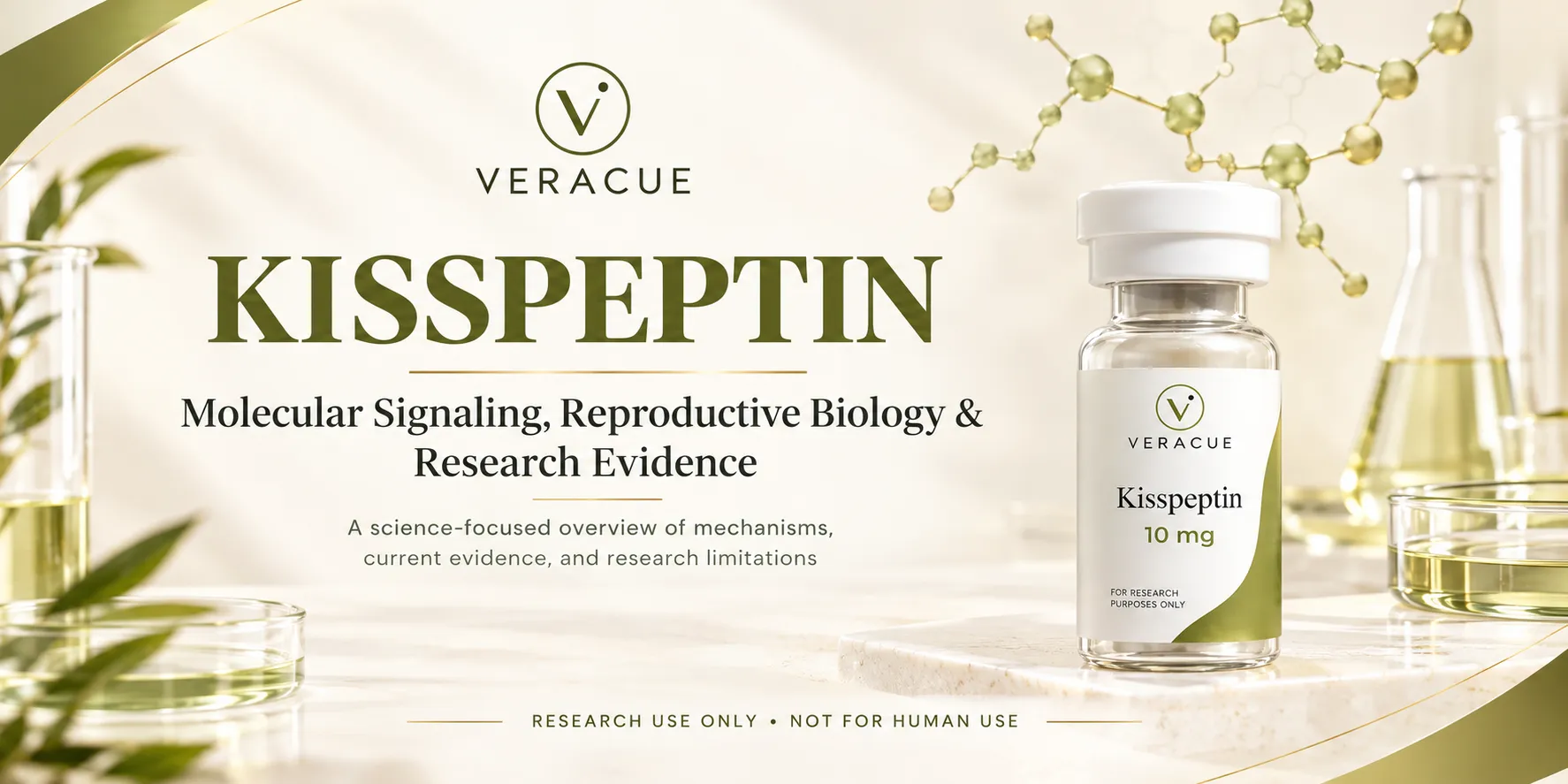
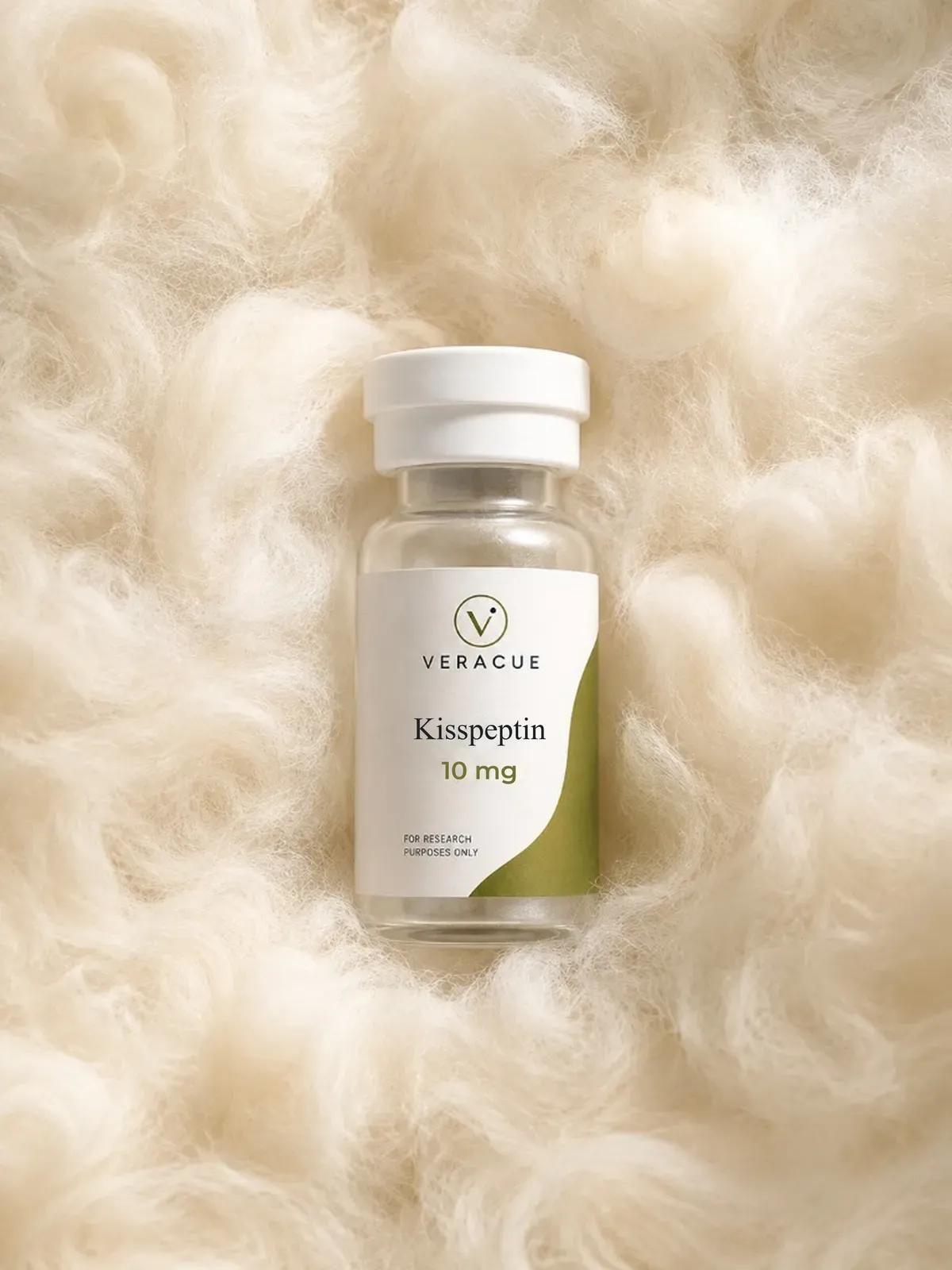
Kisspeptin-10 (KP-10) is the ten-residue C-terminal fragment of kisspeptin-54, with the sequence Tyr-Asn-Trp-Asn-Ser-Phe-Gly-Leu-Arg-Phe-NH2. The free base is C63H83N17O14 at 1302.45 g/mol, CAS 374675-21-5. In assays it is a reference ligand for the KISS1R (GPR54) receptor, and it is also listed as Metastin (45-54). It differs from the longer kisspeptin-54, so the fragment name matters when comparing suppliers. Sold as a 10 mg vial for laboratory research only.
What Is Kisspeptin?
The name comes from *KiSS-1*, a gene first studied as a metastasis suppressor in melanoma. In 2001 two groups showed that its product is the natural ligand of an orphan receptor: Ohtaki et al., 2001 isolated a 54-residue peptide from human placenta and named it metastin, while Kotani et al., 2001 isolated 54-, 14- and 13-residue peptides that share an RF-amide C-terminus and bind the receptor GPR54 with low nanomolar affinity. The peptides are now called kisspeptins, and the receptor is called KISS1R.
Information gap: gene versus peptide. *KISS1* is a gene; kisspeptins are peptides derived from its product. *Evidence:* the 2001 studies traced the peptides to the gene product (Kotani et al., 2001). *To assess a claim, you need:* to know whether it concerns gene expression, a specific peptide length, or receptor signaling.
Information gap: receptor versus peptide. KISS1R (GPR54) is the receptor; kisspeptin is the ligand. A finding about receptor mutations does not describe what a particular peptide preparation does. *You need:* the exact molecule used in the study, not just the pathway named in the title.
What Is Kisspeptin-10 (KP-10)?
Kisspeptin-10 is the ten-residue, C-terminally amidated fragment of the longer kisspeptins, with the sequence Tyr-Asn-Trp-Asn-Ser-Phe-Gly-Leu-Arg-Phe-NH₂ (YNWNSFGLRF-NH₂). In human physiology research it has been described as the minimal kisspeptin sequence with full intrinsic bioactivity (George et al., 2011). Reference identifiers listed by Veracue Labs for its Kisspeptin-10 are the free-base formula C63H83N17O14, an average mass of about 1302.45 g/mol, and CAS Registry Number 374675-21-5; listed synonyms include KP-10, metastin (45-54) and KISS-1 (112-121). People also search for this molecule as "kiss peptide" or "kisspeptin 10." Veracue Labs lists this material as a 10 mg lyophilized Kisspeptin-10 research product, identity-confirmed by mass spectrometry.
Information gap: molecular identity. Sequence, salt form and mass define what a peptide material is. A free-base mass of about 1302 g/mol will not match the mass reported for a salt form, and average and monoisotopic masses differ. *You need:* the sequence, the form (free base or salt), and the mass type stated on the lot's certificate.
How Does the Kisspeptin Peptide Work? KISS1R, GnRH, LH and FSH
KISS1R is a G protein-coupled receptor that signals through Gαq/11 (Millar and Babwah, 2015); in cell studies, kisspeptin triggered phosphoinositide hydrolysis and calcium mobilization (Kotani et al., 2001). In the hypothalamic-pituitary-gonadal (HPG) axis, the sequence described by Xie et al., 2022 runs as follows:
- Kisspeptin binds KISS1R on GnRH neurons and promotes GnRH secretion.
- GnRH acts on the pituitary, which releases LH and FSH.
- LH and FSH act on the ovaries or testes, regulating sex-steroid production and gamete development.
- Sex steroids feed back on the hypothalamus; arcuate-nucleus kisspeptin neurons that also express neurokinin B and dynorphin (KNDy neurons) take part in estrogen feedback to GnRH secretion.
Genetics shows the receptor is required. de Roux et al., 2003 reported a homozygous GPR54 deletion in a family with isolated hypogonadotropic hypogonadism, and Seminara et al., 2003 found GPR54 mutations in affected patients and showed that Gpr54-deficient mice had the same condition while still responding to exogenous GnRH and gonadotropins.
Information gap: mechanism is not benefit. Knowing the pathway does not show that stimulating it helps anyone. *Evidence:* the genetic studies show the receptor is necessary for puberty, not that a peptide improves an outcome. *You need:* controlled outcome data in a defined population.
How Does Kisspeptin-10 Compare to Kisspeptin-54?
Both peptides act on KISS1R, but they differ in length, mass and in the human studies that used them. The listed identifiers below are from Veracue Labs' product page; the free-base formulas and masses were also recomputed from the amino acid sequences and agree.
Feature | Kisspeptin-10 (KP-10) | Kisspeptin-54 (KP-54) |
|---|---|---|
Length | 10 residues, C-terminal amide | 54 residues |
Relationship | C-terminal fragment of the longer peptides | Full-length 54-residue form |
Free-base formula | C63H83N17O14 | C258H401N79O78 |
Average mass | about 1302.45 g/mol | about 5857.43 g/mol |
CAS Registry Number | 374675-21-5 | 374683-24-6 |
Receptor | KISS1R (GPR54) | KISS1R (GPR54) |
Human studies cited in this article | Healthy men (George et al., 2011) | Men, women with hypothalamic amenorrhea, healthy women, and IVF patients (Dhillo et al., 2005; Jayasena et al., 2009; Jayasena et al., 2013; Abbara et al., 2015) |
Information gap: treating the peptides as interchangeable. Different fragments, salts, formulations and analogues are different test articles. The sources reviewed here include no head-to-head clinical comparison of KP-10 and KP-54, so no difference in effectiveness should be assumed in either direction. *You need:* the exact peptide named in the methods section of any study you rely on.
What Does Research Say About Kisspeptin Benefits?
It helps to sort the evidence into tiers rather than pooling it:
- Established biology: the KISS1R pathway is required for normal pubertal development in humans (de Roux et al., 2003; Seminara et al., 2003).
- Cell and animal studies: receptor signaling in cultured cells, the mouse phenotype above, and, for example, oxytocin release after kisspeptin administration in rats (Kotani et al., 2001).
- Human physiology studies: small, short, supervised studies that measure hormones such as LH (below).
- Human clinical research: one phase 2 IVF study of kisspeptin-54 (Abbara et al., 2015) and trials of a kisspeptin receptor agonist analogue (Abbara et al., 2023).
What the literature supports is that kisspeptin and its analogues change gonadotropin levels in controlled settings. It does not establish kisspeptin benefits for libido, fertility, testosterone or any other outcome in the general population.
Information gap: animal results versus human evidence. Rodent and cell findings show mechanism and plausibility; they do not predict human outcomes. *You need:* human data from the same peptide, route and endpoint you care about, and the species stated in each result.
What Does Kisspeptin Research Show in Women?
Searches for "kisspeptin women" mostly lead to research that has so far been small and tied to specific clinical questions:
- Hypothalamic amenorrhea. In a randomized, double-blind study with five women per group, Jayasena et al., 2009 found that a single injection of kisspeptin-54 sharply raised LH and FSH, but after two weeks of repeated exposure the response was much smaller, a pattern called tachyphylaxis or desensitization. The women stayed responsive to GnRH.
- Healthy cycling women. Jayasena et al., 2013 (five women per arm) reported that a week of follicular-phase kisspeptin-54 did not abolish menstrual cyclicity; the mean cycle length was shorter (26.8 versus 28.6 days with saline), and the authors called for further work.
- IVF. In a phase 2, open-label, dose-allocation trial of 60 women at high risk of ovarian hyperstimulation syndrome (OHSS), Abbara et al., 2015 reported oocyte maturation in 95% of women after a single kisspeptin-54 trigger and no moderate, severe or critical OHSS. The trial compared kisspeptin doses with one another, not with a standard trigger.
- An analogue, not native kisspeptin. MVT-602 is a kisspeptin receptor agonist. In two placebo-controlled trials (24 and 75 women), Abbara et al., 2023 reported dose-dependent LH rises resembling a mid-cycle surge, with ovulation within five days in 75% to 100% of women across MVT-602 doses versus 60% with placebo (a placebo group of only five women).
Information gap: reading fertility results. These findings concern amenorrhea and assisted reproduction under clinical supervision. They do not show that kisspeptin treats infertility or improves pregnancy outcomes in general. *You need:* the population, the comparator, and whether the endpoint was a hormone, ovulation or a live birth.
What Does Kisspeptin Research Show in Men?
In a double-blind, placebo-controlled crossover study of six men, Dhillo et al., 2005 found that a 90-minute intravenous kisspeptin-54 infusion raised LH, FSH and testosterone compared with saline; the testosterone difference at 180 minutes was modest (24.9 versus 21.7 nmol/L). George et al., 2011 tested kisspeptin-10 in healthy men: intravenous bolus doses produced a rapid, dose-dependent LH rise, a higher bolus gave a smaller response than a lower one, and prolonged infusion increased LH, testosterone, LH pulse frequency and pulse size. Group sizes were four to six, and the authors concluded that kisspeptin analogues have therapeutic potential as regulators of LH and testosterone, which is a hypothesis rather than a demonstrated treatment. A review by Xie et al., 2022 also describes roles for kisspeptin in Leydig cell, spermatogenesis and sperm-function regulation.
Information gap: testosterone and libido. A short-term hormone rise in a supervised trial does not show a durable testosterone increase, better libido or better fertility. Repeated exposure caused desensitization in other studies (Jayasena et al., 2009; Jayasena et al., 2013). *You need:* long-term, controlled data on the outcome in question, which the studies above do not provide.
Kisspeptin Dosage: What Does the Research Establish?
Searches for kisspeptin dosage usually assume there is a standard amount. The research does not support that. Published human studies used different peptides (KP-10, KP-54 and analogues), delivery methods, durations, populations and endpoints, and the results were not always linear: as noted above, a higher bolus of kisspeptin-10 produced a smaller LH response than a lower one (George et al., 2011), and repeated kisspeptin-54 exposure produced desensitization in women with hypothalamic amenorrhea (Jayasena et al., 2009). This article gives no dosing guidance, and nothing here should be read as a recommendation to administer any peptide.
Why "kisspeptin dosage for men" has no single answer
The male studies above were conducted in clinical research units with defined peptides, measurement schedules and safety monitoring. Their protocols answered narrow physiological questions and were not designed as treatment regimens. For laboratory work, appropriate concentrations depend on the research question, model system, peptide form and the primary literature, under applicable institutional oversight.
Information gap: the universal dosage. *Evidence:* protocols vary and responses can be non-linear or fade with repetition. *You need:* the specific study design, peptide, route, duration and approved oversight context; a number taken out of that context is not transferable.
What Are the Limitations of Kisspeptin Research?
- Small samples. Several key human studies had four to six participants per group (Dhillo et al., 2005; George et al., 2011; Jayasena et al., 2009; Jayasena et al., 2013).
- Short duration. Most measured hormone responses over hours to weeks, not clinical outcomes over years.
- Different molecules and routes. KP-10, KP-54 and analogues such as MVT-602 are distinct test articles, and delivery methods differ between studies.
- Population differences. Results in healthy volunteers, in women with amenorrhea and in IVF patients do not transfer to one another, or between women and men.
- Surrogate endpoints. LH, FSH and testosterone are biomarkers; a change in them is not automatically a clinical benefit.
- Open design in some studies. The IVF dose-finding trial was open-label and compared kisspeptin doses only, with no standard-trigger arm (Abbara et al., 2015).
Larger, controlled trials would be needed before many of the questions above could be answered with confidence.
Is Kisspeptin Safe, and What Is Its Regulatory Status?
Individual trials have reported tolerability: the IVF study recorded no moderate, severe or critical OHSS (Abbara et al., 2015), and the MVT-602 trials described the agonist as safe and well tolerated across the doses tested (Abbara et al., 2023). Those statements apply to specific doses, populations and monitoring conditions. They do not establish that any kisspeptin preparation is safe outside them, and the desensitization findings show that repeated exposure can change the response.
Do not infer regulatory approval from a paper, a trial registration, or the fact that a molecule has been studied in people. Kisspeptin has been given to people within registered investigational studies; for example, one hospital consent form states that kisspeptin is not FDA-approved as a drug for that condition and that the study used it as an investigational agent with FDA permission (Massachusetts General Hospital consent form, ClinicalTrials.gov NCT02956447). This article does not establish the current approval status of any specific kisspeptin product, so verify that against official FDA sources.
Information gap: RUO versus approved treatment. A Research Use Only label means a material is supplied for laboratory work; it is not an FDA approval and carries no clinical claim. *You need:* the regulatory status of the specific product and intended use, checked at the source.
How Should You Evaluate Kisspeptin-10 Research Material?
Researchers who search for where to buy kisspeptin, or for kisspeptin for sale, are better served by comparing documentation than prices or marketing copy. A practical checklist:
- Name and sequence: YNWNSFGLRF-NH₂ for Kisspeptin-10, not a longer or modified peptide.
- Formula and mass: free base C63H83N17O14 (about 1302.45 g/mol average); confirm whether the certificate reports a salt form or a different mass type.
- CAS number: 374675-21-5 identifies the substance, not a batch.
- Lot identification: the lot number on the vial and on the certificate must match.
- Method details: the analytical methods, conditions and testing laboratory should be stated.
- Lot-specific documentation: a generic certificate is not evidence for your lot.
Information gap: what HPLC shows. High-performance liquid chromatography (HPLC) reports the relative proportion of the main peak under defined conditions. It does not confirm identity, and it does not measure sterility, endotoxin or net peptide content by weight. *You need:* the chromatogram, method and detection conditions alongside the purity figure.
Information gap: what mass spectrometry shows. Mass spectrometry (MS) tests whether the measured mass fits the expected molecular mass, supporting identity. It is not a purity assay, and a mass match alone does not confirm the full sequence. *You need:* the observed and expected values and which ion types were compared.
Information gap: general versus batch documentation. A supplier statement or a certificate for another lot says nothing certain about the vial you hold. *You need:* a certificate carrying your lot number and date, from a stated laboratory.
Veracue Labs lists a Kisspeptin-10 (KP-10) research product as a 10 mg lyophilized powder (SKU KISS-10MG) with HPLC for purity and mass spectrometry for identity, and offers lot-specific analytical documentation on request. Its certificates page explains how to request a certificate, and the medical disclaimer describes the research-only framework. To review the Kisspeptin-10 product specifications, note that the material is supplied for laboratory research use only. More background is in the Veracue Labs research blog.
Conclusion
The kisspeptin peptide is a well-established subject in reproductive neuroendocrinology: the KISS1R pathway is required for puberty, and small controlled studies show that kisspeptin and its analogues can raise LH in defined settings. What the literature does not provide is evidence of general benefits, a universal dosage, or approval of any research material for human use. Read each study for its peptide, population and endpoint, and read each certificate for its lot.
Research Use Only Notice
Research Use Only (RUO): This article is provided for educational and scientific research purposes. Veracue Labs' Kisspeptin-10 product is intended strictly for laboratory research and is not intended for human or veterinary consumption, administration, diagnosis, or treatment. This content is not medical advice. Research findings do not establish clinical safety or efficacy. Refer to applicable regulations, institutional research requirements, and relevant primary literature.
Frequently Asked Questions
Kisspeptin is a family of peptides encoded by the KISS1 gene. They activate the KISS1R (GPR54) receptor on GnRH neurons, which promotes GnRH release and, downstream, pituitary LH and FSH secretion. Human genetic evidence shows this receptor is required for normal puberty. That biology alone does not establish a treatment benefit for any particular peptide preparation.
Kisspeptin-10 is the ten-amino-acid, C-terminally amidated fragment of the longer kisspeptins, with the sequence YNWNSFGLRF-NH2. Human physiology research describes it as the minimal kisspeptin sequence with full intrinsic bioactivity. Veracue Labs lists it as a lyophilized research material, SKU KISS-10MG, supplied for laboratory use only.
Kisspeptin-54 is the full-length 54-residue peptide, while Kisspeptin-10 is its C-terminal fragment. Both act on KISS1R, but they differ in length, mass (about 1,302 versus about 5,857 g/mol as free bases) and in the human studies that used them. They should not be treated as interchangeable in experimental design or interpretation.
Kisspeptin binds KISS1R on hypothalamic GnRH neurons and stimulates GnRH release. GnRH then acts on the pituitary to release LH and FSH, which regulate the gonads. In controlled human studies, kisspeptin administration raised LH, showing the pathway is active, though that does not by itself demonstrate a clinical benefit.
The main evidence is genetic work showing KISS1R is required for puberty, plus small human studies showing that kisspeptin raises gonadotropins. One phase 2 IVF trial reported oocyte maturation after kisspeptin-54. These findings are specific to their populations and endpoints and do not establish general benefits for libido, fertility or testosterone.
Studies have examined kisspeptin-54 in women with hypothalamic amenorrhea (an acute LH rise, then desensitization with repeated exposure), in healthy women across the menstrual cycle, and as an IVF trigger in women at high risk of ovarian hyperstimulation. All were small, supervised clinical studies, and the results do not generalize to other settings.
In small studies of healthy men, intravenous kisspeptin-54 and kisspeptin-10 raised LH, and longer infusions of kisspeptin-10 also raised testosterone and LH pulse frequency. Group sizes were small and protocols were supervised clinical ones. These studies do not establish effects on libido, fertility or long-term testosterone.
No. Published studies used different peptides, routes, durations, populations and endpoints, and some showed non-linear responses or desensitization with repeated exposure. Any experimental concentration must be justified by the specific research question, model and oversight. This article gives no dosing guidance, and Veracue Labs' product is for laboratory research only.
No. KISS1 is a gene, kisspeptins such as KP-10 and KP-54 are peptides derived from its product, and KISS1R (also called GPR54) is the receptor those peptides activate. Studies of the gene or receptor, such as loss-of-function mutations, do not automatically describe the behavior of a specific peptide preparation.
Confirm the lot number matches the vial, then check the peptide name and sequence, the molecular mass and form (free base or salt), the HPLC method and purity result, and the mass spectrometry result. HPLC and MS do not by themselves cover sterility, endotoxin or net peptide content. Ask for lot-specific documentation, not a generic certificate.
- 01Ohtaki T, Shintani Y, Honda S, et al. Metastasis suppressor gene KiSS-1 encodes peptide ligand of a G-protein-coupled receptor. Nature. 2001;411(6837):613-7.
- 02Kotani M, Detheux M, Vandenbogaerde A, et al. The metastasis suppressor gene KiSS-1 encodes kisspeptins, the natural ligands of the orphan G protein-coupled receptor GPR54. J Biol Chem. 2001;276(37):34631-6.
- 03de Roux N, Genin E, Carel JC, Matsuda F, Chaussain JL, Milgrom E. Hypogonadotropic hypogonadism due to loss of function of the KiSS1-derived peptide receptor GPR54. Proc Natl Acad Sci U S A. 2003;100(19):10972-6.
- 04Seminara SB, Messager S, Chatzidaki EE, et al. The GPR54 gene as a regulator of puberty. N Engl J Med. 2003;349(17):1614-27.
- 05Dhillo WS, Chaudhri OB, Patterson M, et al. Kisspeptin-54 stimulates the hypothalamic-pituitary gonadal axis in human males. J Clin Endocrinol Metab. 2005;90(12):6609-15.
- 06George JT, Veldhuis JD, Roseweir AK, et al. Kisspeptin-10 is a potent stimulator of LH and increases pulse frequency in men. J Clin Endocrinol Metab. 2011;96(8):E1228-36.
- 07Jayasena CN, Nijher GM, Abbara A, et al. Subcutaneous injection of kisspeptin-54 acutely stimulates gonadotropin secretion in women with hypothalamic amenorrhea, but chronic administration causes tachyphylaxis. J Clin Endocrinol Metab. 2009;94(11):4315-23.
- 08Jayasena CN, Nijher GM, Comninos AN, et al. Twice-daily subcutaneous injection of kisspeptin-54 does not abolish menstrual cyclicity in healthy female volunteers. J Clin Endocrinol Metab. 2013;98(11):4464-74.
- 09Abbara A, Jayasena CN, Christopoulos G, et al. Efficacy of Kisspeptin-54 to Trigger Oocyte Maturation in Women at High Risk of Ovarian Hyperstimulation Syndrome (OHSS) During In Vitro Fertilization (IVF) Therapy. J Clin Endocrinol Metab. 2015;100(9):3322-31.
- 10Abbara A, Clarke S, Islam R, et al. Endocrine profile of the kisspeptin receptor agonist MVT-602 in healthy premenopausal women with and without ovarian stimulation: results from 2 randomized, placebo-controlled clinical trials. Fertil Steril. 2023;121(1):95-106.
- 11Xie Q, Kang Y, Zhang C, et al. The Role of Kisspeptin in the Control of the Hypothalamic-Pituitary-Gonadal Axis and Reproduction. Front Endocrinol (Lausanne). 2022;13:925206.
- 12Millar RP, Babwah AV. KISS1R: Hallmarks of an Effective Regulator of the Neuroendocrine Axis. Neuroendocrinology. 2015;101(3):193-210.
- 13Massachusetts General Hospital (ClinicalTrials.gov NCT02956447). Administration of Kisspeptin in Patients With Hyperprolactinemia (informed consent form).
Veracue Research Team
Research & Product Team
Our in-house team tracks published peptide and coenzyme research and translates it into clear, source-cited overviews for the research community.
Reviewed by in-house research chemists
orders@veracuelabs.com