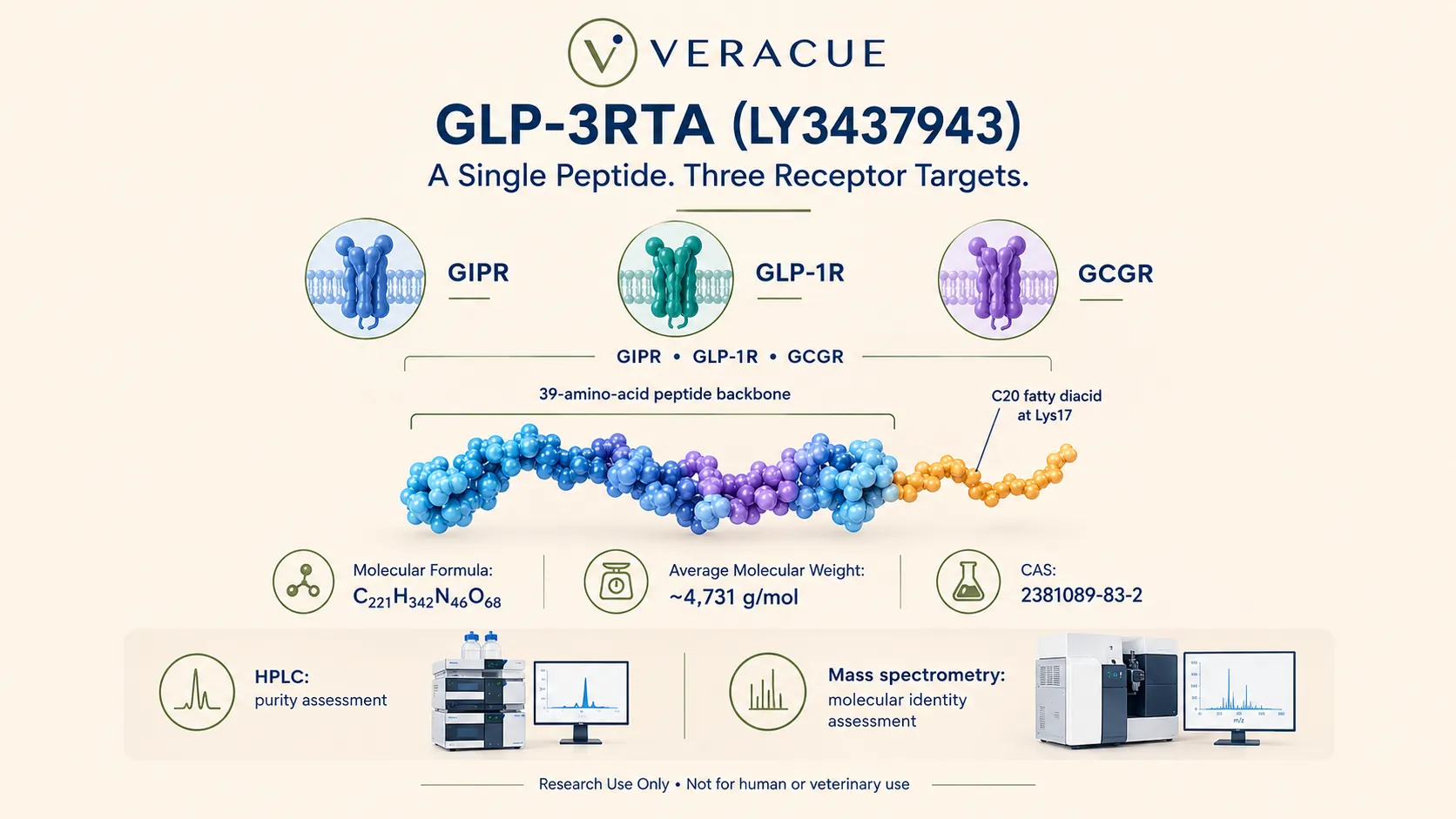
- GLP-3RTA is associated with the research code LY3437943, a molecule described in scientific literature as a single peptide with activity at GIP, GLP-1, and glucagon receptors.
- The GLP-3RTA product name and molecular reference data do not independently verify the identity, salt form, or purity of a specific lot.
- HPLC purity results and mass-spectrometry identity data answer different questions and must be interpreted using the specific method and lot report.
- Published Phase 3 clinical-trial results for the associated investigational molecule describe outcomes in trial participants, not the identity or performance of a Veracue research lot.
- A useful certificate of analysis names the lot, test date, method, result, and testing laboratory — a 'tested' label alone is not sufficient.
- As of October 2026, the molecule associated with GLP-3RTA's research code remains investigational and unapproved for human or veterinary use; RUO language is not a blanket legal authorization for sale or use.
GLP-3RTA is Veracue Labs' name for a laboratory research peptide associated on its product page with the research code LY3437943, also written LY-3437943 — described in scientific literature as a single peptide designed to engage three receptor systems: GIP, GLP-1, and glucagon. The distinction that matters for laboratory work is between that published reference molecule and the contents of a particular vial. This guide walks through the receptor biology, the molecular identifiers, what HPLC and mass spectrometry can (and can't) confirm, where the clinical literature currently stands, and the current U.S. regulatory context for GLP-3RTA — without treating clinical-trial findings about the investigational molecule as evidence about a supplier's individual research lot.
GLP-1 & Metabolic
GLP-3RTA
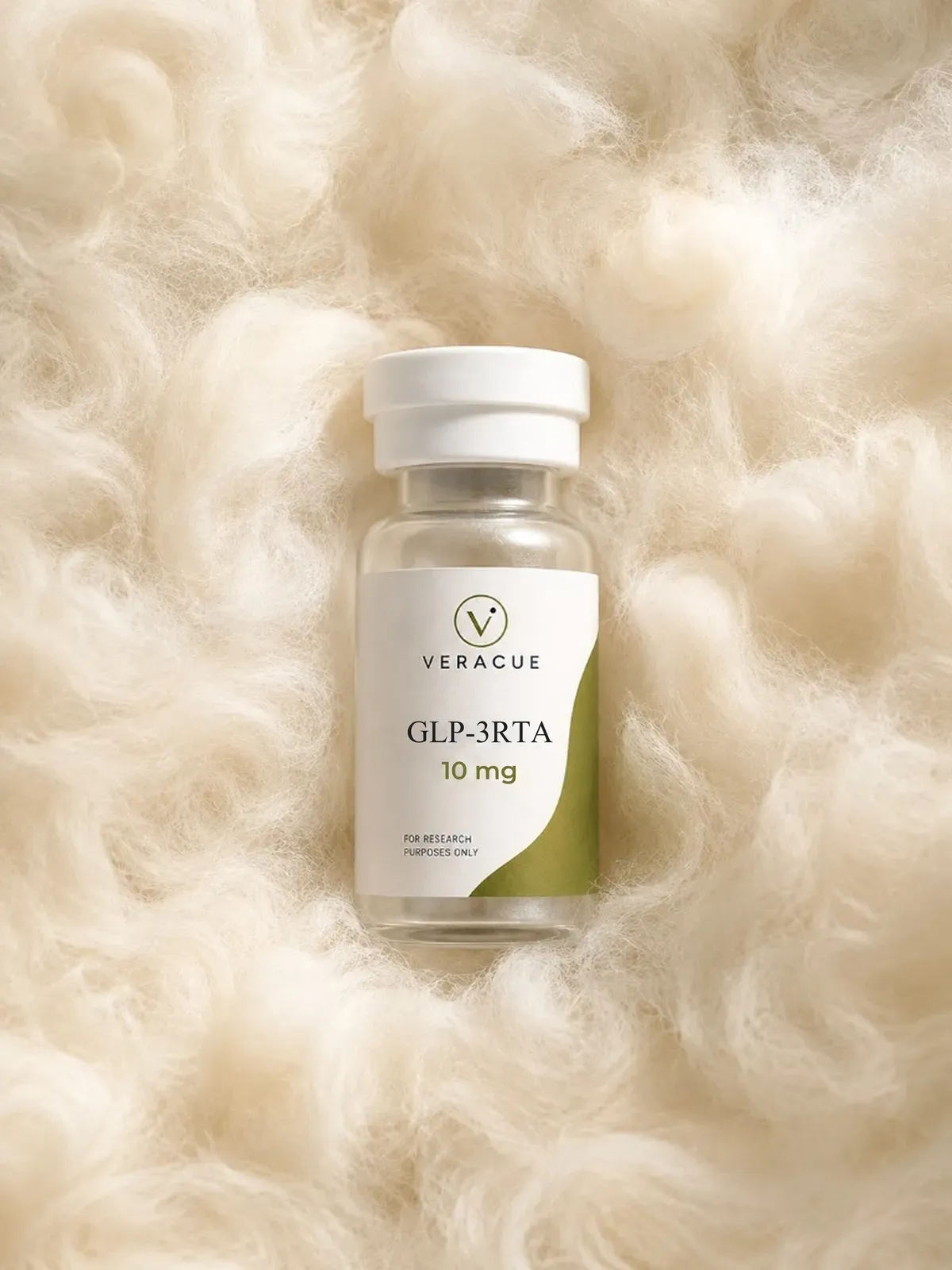
GLP-3RTA is a lab-grade synthetic peptide built as a single molecule that engages three receptors at once: GIP, GLP-1 and glucagon. Its 39-amino-acid backbone (formula C221H342N46O68, about 4,731 g/mol) carries a C20 fatty diacid on lysine 17, and its research code is LY3437943 (CAS 2381089-83-2). Because it is one engineered molecule and not a blend, identity is best confirmed by mass spectrometry. Choose 10, 20, 30 or 60 mg vials, sold strictly for laboratory research use.
What Is GLP-3RTA, and What Does Its Research Code Tell You?
Veracue Labs uses the name GLP-3RTA for a research material that its product page associates with the research code LY3437943, also written LY-3437943. In scientific publications, that code is tied to an investigational molecule — also referred to in the literature as retatrutide — described as a single peptide designed to activate the glucose-dependent insulinotropic polypeptide receptor (GIPR), the glucagon-like peptide-1 receptor (GLP-1R), and the glucagon receptor (GCGR). That nomenclature identifies the intended reference compound; it does not, by itself, verify the contents of any particular vial. For a specific lot, assess the product identifier and lot-matched analytical documentation rather than relying on a product name alone.
Why "Triple-Receptor Agonist"?
The term describes activity at three receptor systems from one molecule, not a vial containing three separate peptides. GIPR, GLP-1R, and GCGR are distinct G-protein-coupled receptors involved in metabolic signaling. Calling a molecule a triple agonist describes its reported pharmacological profile; it does not mean each receptor contributes equally in every experimental system, or that a particular downstream outcome will occur. Receptor activity, whole-organism effects, and clinical outcomes are different tiers of evidence and should be described separately.
Molecular Architecture: What the Reference Structure Shows
GLP-3RTA's associated research molecule (LY3437943) is described as a 39-residue peptide with non-standard amino-acid residues and a lipid-containing side chain. Reference chemical descriptions identify a C20 fatty diacid connected through a linker involving lysine 17. This is a structural description of the reference molecule — it should not be treated as confirmation that an individual research lot has the stated structure unless that lot's identity has been assessed using suitable analytical methods. A matching product label is not a substitute for analytical evidence.
Lipid conjugation is used in the design of some peptide molecules to influence interactions with serum albumin and persistence in biological systems. For this research molecule, the C20 fatty-diacid side chain is discussed in the scientific literature as part of its long-acting design. The mechanistic rationale for a reference molecule must be kept separate from any claim about the behavior of Veracue-supplied material.
Molecular Identifiers
Property | Reference value |
|---|---|
Research code | LY3437943 / LY-3437943 |
CAS Registry Number | 2381089-83-2 |
Molecular formula | C221H342N46O68 |
Average molecular weight | ~4,731 g/mol |
Monoisotopic mass | ~4,728.47 Da |
Salt/counterion form | Confirm per lot documentation |
These values are reference-structure information, not a lot-specific test result. External chemical-supplier listings describe this class of molecule in acetate or trifluoroacetate salt forms, while the listed average molecular weight is typically given as a free-base figure. The exact salt or counterion form of a supplied lot should be confirmed from its lot documentation rather than inferred from a free-base formula alone.
A product name, CAS number, or molecular formula identifies the intended reference compound. None of these, on their own, prove the identity, purity, or salt form of a specific vial. Request lot-matched documentation before relying on an identity claim.
What Does the Receptor Profile Establish — and What Remains Uncertain?
Published pharmacology studies report agonist activity at GIPR, GLP-1R, and GCGR. Some reference data report different potency values across these assays, but numerical comparisons depend on the assay design, receptor preparation, species, conditions, and molecular form tested. An EC50 value from one assay should not be presented as a universal potency ranking. Receptor assays characterize activity under defined experimental conditions; they do not alone establish a combined physiological outcome, a clinical benefit, or the performance of a specific commercial lot.
What Do the Clinical Trials Show — and What Don't They Show About a Research Lot?
Clinical evidence should be sourced from peer-reviewed reports where available. A Phase 3 trial (TRIUMPH-2) in adults with obesity or overweight and type 2 diabetes was published in The Lancet in October 2026 (Bellido et al.; see References). Its treatment-regimen analysis reported a mean body-weight change at week 80 of −18.8% in the highest study group, compared with −5.1% for placebo; the paper also reports a separate efficacy estimand, which yields a different number because it addresses a different analytic question. A second Phase 3 program (TRIUMPH-3) was described in a July 2026 sponsor announcement; a peer-reviewed results paper was not identified for that trial as of this writing, and its sponsor-reported cardiovascular (MACE) estimates had confidence intervals that crossed 1.0 — that is not proof of cardiovascular benefit.
These are clinical-trial findings for an investigational clinical formulation and its trial participants — not evidence of the identity, purity, quality, or performance of a Veracue research lot.
What Can Analytical Testing Actually Confirm?
HPLC Purity Data
High-performance liquid chromatography (HPLC) separates sample components under a defined method. A report may calculate relative purity from chromatographic peak areas, but the result is method-dependent. A chromatographic purity percentage is not automatically the same as mass fraction, and a dominant peak does not by itself prove that the peak is the intended molecule.
Mass Spectrometry
Mass spectrometry (MS) measures mass-to-charge ratios of detected ions. Interpreting a peptide result requires attention to charge states, adducts, deconvolution, and whether the reported number is an observed m/z or a calculated neutral molecular mass. A mass match can support an identity assessment, but MS alone does not establish sample purity.
What a Useful Certificate of Analysis Should Contain
A useful certificate of analysis (COA) identifies the product and lot it covers, states the test date, names each analytical method, reports the actual result, identifies any acceptance criterion, and gives enough information about the testing laboratory to know who performed the work. A statement such as "tested" or "verified" without the lot number, method, and result is not enough to independently evaluate a batch.
A product page describes what a supplier intends to offer — it does not establish the analytical result for every container or batch. Until documentation for the relevant lot is obtained and reviewed, treat purity and identity as unconfirmed for that lot. Request lot-specific documentation through Veracue's certificate library before relying on an identity or purity claim.
Research Use Only: What It Means, and the Current U.S. Regulatory Status
Research Use Only (RUO) means the material is presented for laboratory research and is not intended for human or veterinary administration, ingestion, injection, diagnosis, treatment, cure, or prevention of disease. RUO wording does not, by itself, determine whether every sale, distribution, or marketing practice is lawful. As of October 2026, the FDA states that this class of investigational molecule cannot be used in compounding under federal law and has not been found safe and effective for any condition (see References). A sponsor's announced plan to file a regulatory submission is a planned step, not an approval.
Before citing any regulatory or clinical status in your own research notes, check the [FAQ](/faq) and [Medical Disclaimer](/medical-disclaimer) pages for Veracue's current RUO policy language, and verify the FDA's statement directly, since regulatory guidance can change.
Why the GLP-3RTA–vs-Research-Molecule Distinction Matters
For procurement and lab documentation purposes, treat GLP-3RTA as the catalog identity Veracue assigns to a research material, and treat any receptor pharmacology, chemical reference data, or clinical-trial findings associated with its research code as information from the broader scientific literature — not as a substitute for your own lot's documentation. When evaluating a specific order, the questions worth asking are: what does the lot's COA actually report, what method was used and what are its limits, and does the available documentation answer the specific question your research protocol requires.
Frequently Asked Questions
GLP-3RTA is Veracue's name for a laboratory research material associated on its product page with LY3437943, the research code for the molecule. That naming identifies the intended reference compound; the identity of a particular lot should be assessed using its own analytical documentation.
Veracue's product page associates GLP-3RTA with the research code LY3437943, also referred to in scientific literature as retatrutide. The label alone does not independently prove the contents or salt form of an individual lot; request the relevant lot documentation before relying on that identity.
The reference molecule associated with GLP-3RTA is described in the literature as a single peptide designed to activate GIP, GLP-1, and glucagon receptors. 'Triple agonist' describes receptor activity, not three ingredients blended together.
Published pharmacology describes activity at the glucose-dependent insulinotropic polypeptide receptor (GIPR), glucagon-like peptide-1 receptor (GLP-1R), and glucagon receptor (GCGR). Assay results must be interpreted within their experimental conditions.
Veracue lists C221H342N46O68, an average molecular weight of about 4,731 g/mol, and a calculated monoisotopic mass of about 4,728.47 Da. These are reference values and do not establish the salt form or analytical identity of a specific lot.
No. A CAS Registry Number identifies a chemical record; it does not prove the contents, purity, counterion form, or quality of a supplier's individual lot.
HPLC can report a method-specific chromatographic purity estimate. It does not independently establish the identity of the main peak or prove that every lot has the same result.
MS can support an identity assessment by comparing measured ion data with an expected mass, accounting for charge states and adducts. It does not, by itself, establish sample purity or resolve every structural question.
Veracue's product page directs lot-specific documentation requests through its contact process. Request the COA for the exact lot being considered and check that the identifier, testing method, date, result, and laboratory details are clear.
As of October 2026, the investigational molecule associated with GLP-3RTA (LY3437943, also referred to in scientific literature as retatrutide) remains unapproved. The FDA states it has not been found safe and effective for any condition and cannot be used in compounding under federal law. Verify the FDA's current page before publication because regulatory information can change.
No. This article is for scientific education and laboratory research context only; it does not provide dosing, preparation, administration, or human-use guidance.
No. Clinical-trial outcomes apply to the investigational formulation and study conditions described in the cited trial, not to a separate RUO-labeled lot. Lot identity, purity, and other specifications require lot-specific documentation.
- 01Jastreboff AM, et al., 2023, New England Journal of Medicine — "Triple-Hormone-Receptor Agonist Retatrutide for Obesity: A Phase 2 Trial"
- 02Bellido V, le Roux CW, Ekinci EI, et al., 2026, The Lancet — TRIUMPH-2 Phase 3 trial results, published online September 29, 2026
- 03Eli Lilly, July 23, 2026 — TRIUMPH-2 and TRIUMPH-3 topline results announcement
- 04U.S. FDA — FDA's Concerns with Unapproved GLP-1 Drugs Used for Weight Loss
- 05MedChemExpress — Retatrutide acetate (LY3437943 acetate) reference datasheet
Veracue Research Team
Research & Product Team
Our in-house team tracks published peptide and coenzyme research and translates it into clear, source-cited overviews for the research community.
Reviewed by in-house research chemists
orders@veracuelabs.com