NAD+ and AHK-Cu in Metabolic and Longevity Research: A Deep Dive
A research overview of NAD+ and AHK-Cu covering mitochondrial metabolism, sirtuin activation, copper-peptide signaling, and laboratory handling protocols.

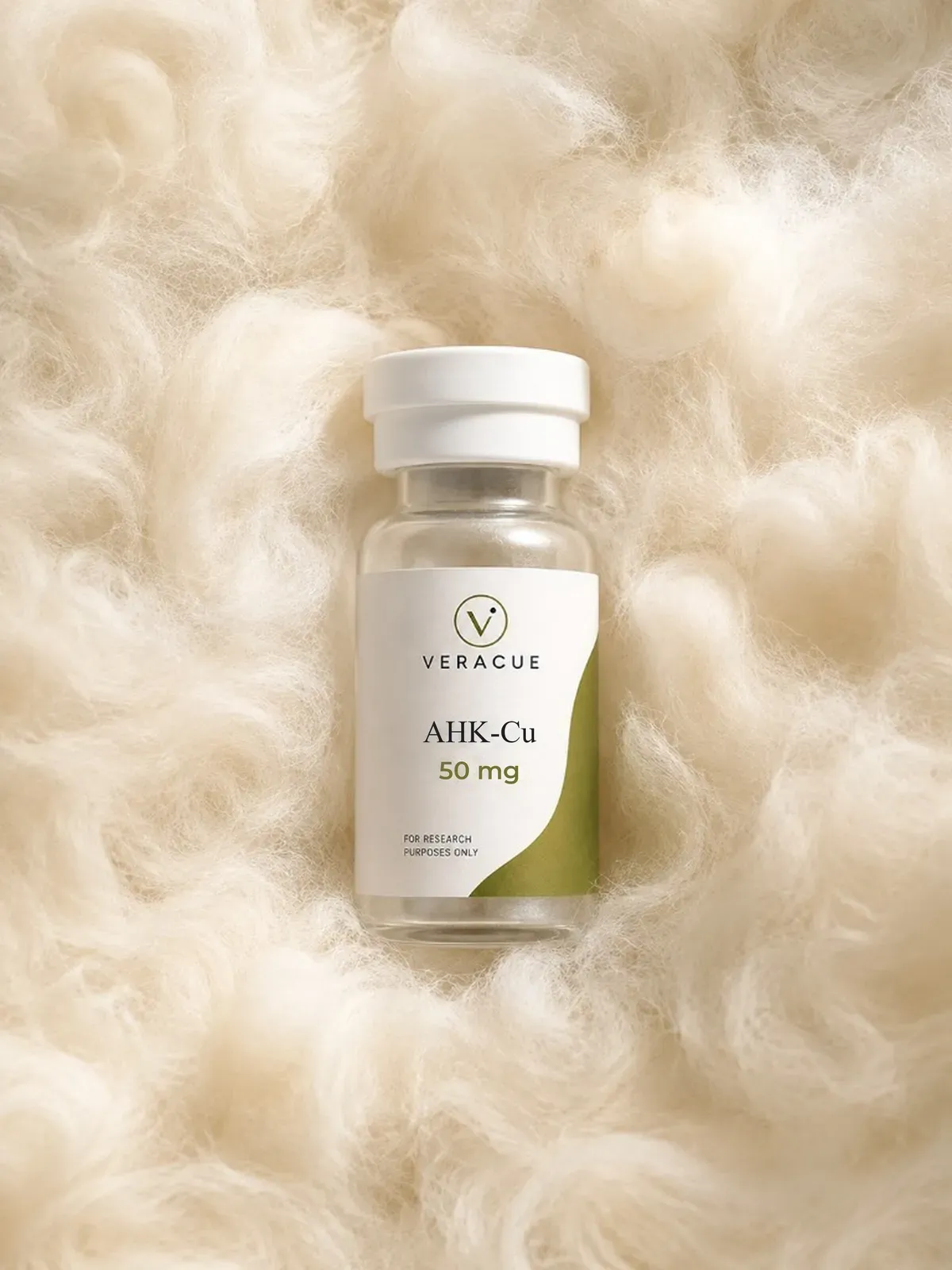
AHK-Cu is a copper(II) complex of the tripeptide alanyl-histidyl-lysine (Ala-His-Lys), also listed as Copper Tripeptide-3. Its molecular weight depends on the form: 354.41 g/mol for the free peptide, 415.94 for the neutral complex (C15H24CuN6O4) and 451.39 for a hydrochloride form, with CAS 682809-81-0 commonly listed by suppliers. It is easy to mix up with GHK-Cu, which starts with glycine instead of alanine. Veracue offers AHK-Cu in 50 mg and 100 mg vials for laboratory research use only.
Ask for the analytical documentation of any lot.
HPLC is the method used to measure purity
Ask for the report for a specific lot through the contact page
Supplied for laboratory research use only
Mass spectrometry is the method used to confirm identity
AHK-Cu is a small copper peptide: the tripeptide alanine-histidine-lysine bound to a copper(II) ion. The name is the one-letter codes of the three amino acids plus the metal. It is supplied by Veracue for laboratory research only, in 50 mg and 100 mg vials.
Ingredient suppliers commonly list it as Copper Tripeptide-3, which keeps it distinct from Copper Tripeptide-1, the name used for GHK-Cu.
| Name | AHK-Cu |
| Other names | Copper Tripeptide-3; Ala-His-Lys-Cu; L-alanyl-L-histidyl-L-lysine copper(II) |
| Peptide sequence | Ala-His-Lys (A-H-K), three amino acids |
| Metal | Copper(II) |
| Closest relative | GHK-Cu (Gly-His-Lys copper), differing only in the first amino acid |
| Molecular weight | Form-dependent, see the molecular form table |
| Sizes offered | 50 mg and 100 mg vials |
| Research designation | Research Use Only |
Physical form, appearance, purity, molecular form, formula, molecular weight, CAS number and storage conditions for a given vial are reported on each lot’s documentation and can be requested through the contact page.
The peptide portion is L-alanyl-L-histidyl-L-lysine. Chemical database nomenclature for the copper complex describes copper(II) bound through nitrogen atoms of the alanine terminus and the histidine residue, with two of the peptide’s N-H protons removed as the metal binds.
There is no single molecular weight for AHK-Cu that applies to every product. Published values differ because sources describe different forms: the free peptide, the copper complex written with different proton counts, or a hydrochloride salt. PubChem’s AHK-Cu record (CID 168431292) is a hydrochloride-associated entry. The table shows how each common representation produces a different number, so a COA or catalogue value can be matched to the form it describes.
| Representation | Formula | Molecular weight (g/mol) | Where you will see it |
|---|---|---|---|
| Uncomplexed tripeptide (AHK, no copper) | C15H26N6O4 | 354.41 | Peptide-only calculations |
| Neutral Cu(II) complex, two N-H protons removed | C15H24CuN6O4 | 415.94 | Some catalogue listings (about 416) |
| Cu(II) complex written with one additional proton | C15H25CuN6O4 | 416.95 | Common "about 416.9" listing value |
| Hydrochloride form, PubChem CID 168431292 formula | C15H24ClCuN6O4 | 451.39 | PubChem and several supplier pages |
| Hydrochloride form, alternative hydrogen count | C15H25ClCuN6O4 | 452.40 | Some chemical supplier listings |
Weights are calculated from standard atomic weights (C 12.011, H 1.008, N 14.007, O 15.999, Cl 35.45, Cu 63.546). Hydrates and other counter-ions would change these values again. The molecular form, formula and molecular weight for a given vial are reported on that lot’s documentation and can be requested through the contact page.
CAS 682809-81-0 is widely listed by suppliers for AHK-Cu, and at least one chemical supplier assigns it specifically to the hydrochloride while listing a separate CAS for the free base. Because suppliers attach these numbers to different forms, a CAS number is only meaningful when it is tied to the exact form stated on a lot’s documentation.
Typical contexts are cell-culture and tissue-culture work, copper-peptide chemistry and analytical method development. The material is offered for in vitro and laboratory research only.
AHK-Cu and GHK-Cu are not the same compound. Both are copper(II) complexes of a tripeptide ending in histidine-lysine, but AHK-Cu starts with alanine and GHK-Cu starts with glycine. AHK-Cu is commonly listed as Copper Tripeptide-3 and GHK-Cu as Copper Tripeptide-1.
| Attribute | AHK-Cu | GHK-Cu |
|---|---|---|
| Sequence | Ala-His-Lys + Cu(II) | Gly-His-Lys + Cu(II) |
| Common ingredient name | Copper Tripeptide-3 | Copper Tripeptide-1 |
| First amino acid | Alanine | Glycine |
Findings reported for one should not be assumed to apply to the other.
It reports molecular reference information and general research context. It cannot establish what is in a particular vial, and a purity figure does not establish sterility or biological activity either. Veracue does not provide dosing, administration or usage guidance of any kind.

A purity percentage on its own answers only one question. A useful AHK-Cu COA should let you confirm what the material is, how pure it is by a stated method, how much is actually in the vial, and that the report belongs to the lot you received.
Copper complexes add a wrinkle: the expected mass and molecular weight depend on whether a result refers to the free peptide, the copper complex or a salt form. A report should state which species its identity result was matched against.
| COA element | What it tells you | What it does not establish |
|---|---|---|
| Lot or batch number | Links the report to a specific production lot | Anything about quality unless it matches the vial label |
| HPLC purity (%) | The share of detected signal in the main peak under the stated method conditions | Identity, net peptide content, water or counter-ion content, sterility, endotoxin level or biological activity |
| Mass spectrometry / LC-MS | Whether an observed mass is consistent with the expected species | Purity, or the amount of material present |
| Net peptide content | How much of the vial’s mass is peptide rather than salts, water or other components | Chromatographic purity |
| Copper content (if tested) | Whether copper is present at the expected ratio to peptide | Purity of the peptide portion |
| Stated form and formula | Which molecular weight applies to the material | Identity by itself, since it must be supported by analytical data |
| Laboratory name and test date | Who tested the lot and when | Independence, unless the relationship is disclosed |
| Additional panels (endotoxin, microbial, heavy metals, residual solvents) | Results for those specific attributes, only where listed | Any attribute that was not tested |
Store according to the conditions stated on the lot’s documentation and label, and handle the material as a laboratory chemical using appropriate personal protective equipment. The certificate page explains how to see lot documentation.
Ask the Veracue team for the documentation that belongs to a specific lot, or look through the certificate library.
AHK-Cu supplied by Veracue is intended solely for laboratory research. It is not a drug, cosmetic, dietary supplement or food, and it must not be given to humans or animals. This page contains no dosing, administration or usage guidance of any kind. See the Medical Disclaimer and the Terms and Conditions for sitewide policies.
RESEARCH PEPTIDE
Snap8 is an eight-residue peptide, Ac-EEMQRRAD-NH2 (CAS 868844-74-0), and not the same as Argireline. Sold in 10 and 20 mg vials for research use only.

RESEARCH PEPTIDE
GHK-Cu is a copper complex, not the free GHK peptide, so the form on your COA matters (CAS 89030-95-5). 50 mg and 100 mg vials, research use only.