- There is no single, blanket prescription rule for every peptide — requirements depend on the specific product's regulatory classification and intended use, not on the word "peptide" itself.
- In a March 31, 2026 FDA warning letter, FDA ruled that Gram Peptides' products were unapproved human-use drugs based on the company's own website language, despite "Research Use Only" labeling — RUO status alone did not protect the seller.
- Under 21 CFR 201.128, a product's intended use can be shown by labeling, advertising, statements, or the circumstances of distribution, not just by the disclaimer text printed on a label.
- FDA approval and prescription status are separate questions; nonprescription drugs can be FDA-approved or marketed under an OTC monograph, and compounded drugs (Sections 503A/503B) are explicitly not FDA-approved.
- A Certificate of Analysis documents a specific lot's testing results. It does not establish FDA approval, prescription classification, or lawful marketing status.
- State laws and importation rules can add requirements on top of the federal baseline; this article covers U.S. federal law only.
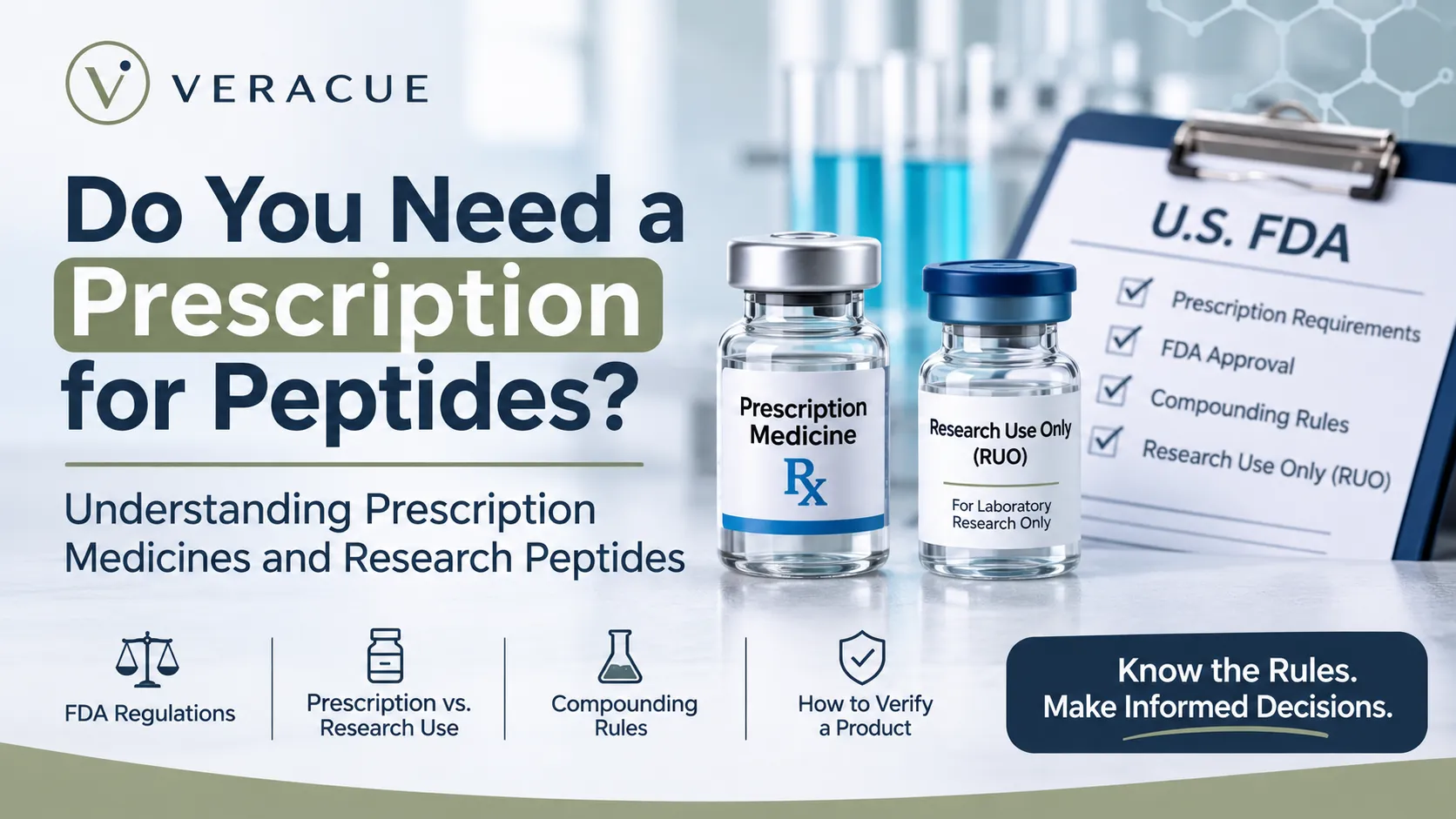
In March 2026, FDA sent a warning letter to a company called Gram Peptides over products labeled "Research Use Only" — not because of a lab test, but because of language on the company's own website. That letter is the clearest real-world illustration of the point this article makes throughout: the question of whether you need a prescription for peptides does not have one universal answer. In the United States, the requirement depends on the specific product, how it is classified under federal drug law, and its intended use. Some peptide-based drug products are classified as prescription medicines. Others may be marketed through nonprescription pathways or prepared by compounding pharmacies under specific legal conditions. Products supplied exclusively as laboratory research materials represent a different category, although a Research Use Only (RUO) label alone does not establish a product's legal status. This article explains the relevant U.S. federal regulatory framework, how to check a specific product's status, and what research-only labeling actually establishes. The scope of this article is United States federal law; state requirements and international regulations may differ.
Do You Need a Prescription for Peptides in the United States?
Sometimes. Certain peptide-based drug products require a prescription, but there is no blanket prescription requirement covering every substance described as a peptide. Under Section 503(b)(1) of the Federal Food, Drug, and Cosmetic Act (codified at 21 U.S.C. 353(b)), a drug intended for human use must be dispensed by prescription when it meets the statutory conditions. These include circumstances in which the drug is not safe for use except under the supervision of a licensed practitioner, or when an approved application restricts its use to professional supervision. However, prescription status is only one part of the regulatory picture. A product may be marketed as a human-use drug without having an approved drug application. That raises separate questions about whether the product may legally be marketed, distributed, and dispensed. Compounded preparations also follow a separate framework under Sections 503A and 503B. Meanwhile, a genuine laboratory research material is not automatically subject to the same prescription-dispensing framework as a medicine intended for a patient. The most useful question is therefore not simply whether a particular molecule is a peptide. It is how the specific product is classified and what it is actually intended for.
Why the Word "Peptide" Does Not Determine Prescription Status
The word peptide describes a type of molecule consisting of amino acid units. It does not, by itself, establish whether a product is prescription-only, nonprescription, compounded, or intended exclusively for laboratory research. Consider the difference between a chemical substance and a finished product. A substance may be manufactured as a laboratory reagent, incorporated into a compounded preparation, or developed into a finished pharmaceutical product. Those different forms and purposes can raise different regulatory requirements. The surrounding circumstances also matter: whether the product is represented as a medicine for human use, whether it is marketed as a laboratory research material, what its labeling and the supplier's website state, whether it is distributed through a pharmaceutical or research procurement channel, and whether an FDA approval or applicable compounding framework covers the specific product. Two products containing related peptide substances should not automatically be treated as having identical legal classifications. This is why general statements such as "all peptides require prescriptions" or "no peptides require prescriptions" can be misleading.
What Makes a Drug Prescription-Only Under U.S. Federal Law?
21 U.S.C. 353(b)(1) provides the federal framework for prescription-only dispensing. It identifies two relevant circumstances. First, practitioner supervision may be necessary: a drug may fall under prescription-only requirements because of its toxicity, potential harmful effects, method of use, or additional measures needed for its use, making it unsuitable for use without supervision by an appropriately licensed practitioner. Second, an approved application may restrict use: a drug may also be restricted to professional supervision through the conditions established in an approved application. Where the statutory prescription requirements apply, dispensing must occur under the appropriate written or qualifying oral prescription. An important distinction is that the first statutory criterion is not simply another way of saying that an FDA-approved product must be dispensed by prescription. Prescription classification and FDA approval are related regulatory concepts, but they should not be treated as identical. For anyone researching a particular peptide product, identifying its regulatory category is more useful than relying on the product's molecular description.
Does FDA Approval Mean a Product Is Always Prescription-Only?
No. FDA approval and prescription status are two separate questions. The United States has different regulatory pathways for prescription and nonprescription drug products. Some nonprescription products are marketed under an applicable FDA OTC monograph when they meet its requirements. Other nonprescription drugs follow an FDA-approved application pathway, including an NDA or ANDA where applicable, either marketed direct-to-nonprescription or through a prescription-to-nonprescription (Rx-to-OTC) switch. This distinction matters because a product being nonprescription does not mean it can simply be marketed without satisfying the relevant federal requirements. Likewise, a product being FDA-approved does not automatically mean that every formulation or related product containing the same substance has the same approval status. When checking a specific pharmaceutical product, the approval applies to the product and its approved conditions, not automatically to every version of a similar substance.
What Does Research Use Only Actually Mean?
Research Use Only, commonly abbreviated as RUO, describes the stated intended use of a material. In the context of Veracue Labs, the company's published Medical Disclaimer identifies its products as materials intended for in vitro experimentation and laboratory research, stating that they are not intended for human or veterinary administration. However, RUO labeling should not be confused with FDA approval, registration, certification, or a general exemption from drug-related requirements. The actual intended use of a product can be relevant to its regulatory classification. Under 21 CFR 201.128, objective intent may be shown by labeling claims, advertising matter, or oral or written statements, as well as the circumstances surrounding an article's distribution. This means a label cannot always be considered independently of the rest of a supplier's commercial presentation.
A useful, and very current, example is FDA's March 31, 2026 warning letter to Gram Peptides. In that enforcement action, concerning that one firm's retatrutide, tirzepatide, and bacteriostatic water listings specifically, FDA concluded the products were intended as human-use drugs based on evidence from the company's own website and marketing language, despite "Research Use Only" statements on the product labeling. The letter does not make a general finding about RUO-labeled products across the industry; it is scoped to this firm's specific website claims. But it demonstrates the importance of reviewing a supplier's complete product presentation, not just its disclaimer text. The practical distinction is straightforward: RUO describes a research-only intended-use position. It does not independently establish the legal classification of every product or transaction.
Can You Buy Research Peptides Online Without a Prescription?
The answer depends on what is actually being supplied and for what purpose. A laboratory purchasing a genuine research reagent for a qualifying research activity is not necessarily participating in the dispensing of a prescription medicine. The prescription framework that applies to human-use drug products is not automatically the correct test for every laboratory procurement transaction. However, this does not establish that every online product advertised as a research peptide can legally be sold or purchased without further regulatory consideration. The distinction depends on several factors: whether the material is genuinely supplied as a laboratory research reagent or represented as a human-use drug; what the labeling and surrounding commercial information communicate about intended use; whether the product descriptions and advertisements are consistent with laboratory-only use; and whether additional federal or state restrictions apply to the particular substance, seller, purchaser, or transaction. For this reason, an online listing stating that a product is for research use only should never be treated as conclusive proof of its legal status. The same principle applies to the phrase peptides for sale. Availability on a website does not independently establish regulatory authorization.
How Are Compounded Peptides Different From Research Peptides?
Compounded drugs and research-use-only laboratory materials belong to different regulatory contexts. Compounding involves preparing a drug product under applicable federal and state requirements, and FDA recognizes two principal statutory pathways for human drug compounding. Section 503A generally concerns compounding by a licensed pharmacist in a state-licensed pharmacy or by a licensed physician under statutory conditions; a valid prescription for an identified individual patient is generally required, limited quantities may be compounded before receiving prescriptions under applicable conditions, and the use of bulk drug substances is subject to specific eligibility requirements. Section 503B covers outsourcing facilities that voluntarily register with FDA and meet applicable statutory requirements; unlike the Section 503A patient-specific prescription framework, a qualifying 503B outsourcing facility may compound with or without individual patient prescriptions, though this does not create unrestricted permission to compound any substance. For bulk drug substances, 503B facilities must follow applicable statutory conditions, including FDA's 503B bulks list or qualifying drug shortage provisions, and registered outsourcing facilities are subject to requirements such as current good manufacturing practices and FDA oversight. An additional point is particularly important: FDA states that compounded drugs are not FDA-approved products, and they do not undergo the same premarket safety, effectiveness, and quality verification as FDA-approved drugs. A compounded preparation should therefore not automatically be described as FDA-approved simply because a licensed or registered facility prepared it.
Does Having a Doctor's Prescription Automatically Make a Peptide Legal?
No. A prescription and the regulatory status of a drug product are separate matters. A prescription may satisfy an applicable prescription-dispensing requirement, but it does not automatically establish that a product has FDA approval or that its manufacturing, compounding, marketing, importation, and distribution comply with applicable law. For example, Section 505(a) of the Federal Food, Drug, and Cosmetic Act generally prohibits introducing or delivering an unapproved new drug into interstate commerce unless an applicable legal pathway or exemption applies. Compounded preparations must also satisfy the conditions of the applicable statutory compounding pathway. Therefore, the existence of a prescription should not be used as a substitute for checking the underlying product's regulatory status. A useful way to approach this question is to separate three issues and investigate each independently rather than through one document or label: whether the product has an applicable FDA approval, whether it is being marketed under a lawful regulatory pathway, and whether the particular dispensing or distribution requires a prescription.
How Can You Verify the Regulatory Status of a Specific Peptide Product?
When evaluating a specific product, start with its exact identity and regulatory classification. A supplier's description may be useful for identifying what is being offered, but it is not a substitute for primary regulatory documentation. First, identify the exact product: record the product name, manufacturer, formulation, strength, and other identifying information, and do not assume that products with similar names or chemical descriptions have identical regulatory status. Second, check FDA approval records using Drugs@FDA to search for approved human drug products and review the actual product entry, available approval information, and official labeling; Drugs@FDA includes most drug products approved since 1939, along with many prescription, nonprescription, and therapeutic biological products, and should be treated as a starting point rather than a complete record of every possible regulated product. Third, establish whether compounding is involved: if the product is described as compounded, identify the applicable pathway, checking relevant pharmacy and state requirements for 503A, or the outsourcing facility's registration and applicable bulk-substance and drug-shortage conditions for 503B. Fourth, examine the complete RUO labeling and website presentation rather than relying on one disclaimer sentence, reviewing product descriptions, labeling, advertisements, and related statements to determine whether they consistently communicate laboratory-only use. Fifth, check applicable jurisdictional requirements, since state and federal requirements may need separate review, particularly where a product is distributed or imported. If the classification remains unclear, an appropriately qualified regulatory professional or attorney can assess the specific circumstances.
Does a Certificate of Analysis Prove FDA Approval or Legal Status?
No. A Certificate of Analysis (COA) is an analytical document, not regulatory authorization. Its purpose is to report testing information about a particular sample or batch, according to the methods and specifications documented in the report. Depending on the testing performed, a COA may include HPLC purity results, mass spectrometry identity information, reported analytical values, batch identification, testing dates, laboratory and method information, and relevant acceptance criteria. These records can help researchers understand the analytical documentation available for a material. However, a COA does not establish FDA approval, prescription classification, authorization for human or veterinary use, compliance with all federal or state regulations, lawful marketing or distribution, or any testing attribute that is not actually documented. For example, an HPLC purity result is not automatically evidence of sterility or endotoxin testing; those are separate analytical questions requiring their own documented methods and results. The distinction is important because analytical evidence and regulatory evidence answer different questions. A batch report describes what its documented testing establishes. It does not determine whether a product may legally be marketed as a medicine. Veracue's own Certificates of Analysis page reflects this same limitation: a COA, once published for a given lot, documents that lot's testing and nothing about the product's broader legal classification.
Do State Laws and Importation Rules Change the Answer?
They can, and this is one reason a single nationwide purchasing statement should be avoided. Federal drug requirements provide an important baseline, but state requirements may separately address pharmacy practice, dispensing, professional licensing, controlled substances, chemical handling, and other regulated activities. The exact rules depend on the state and the specific substance or transaction. Importation can raise additional questions: a product shipped into the United States from another country may be subject to FDA import requirements and U.S. Customs requirements depending on its classification, intended use, and circumstances. The presence of an RUO label does not automatically eliminate these considerations. For researchers, laboratories, and suppliers dealing with cross-border transactions, the appropriate approach is to check the precise product and jurisdiction rather than depend on a general internet statement. This article does not provide a state-by-state legal determination or importation clearance.
How Does Veracue Labs Classify Its Research Materials?
Veracue Labs states that its products are supplied strictly for in vitro experimentation and laboratory research. Its published Medical Disclaimer identifies the company's materials as intended for controlled laboratory or research environments and states that they are not intended for human or veterinary administration. The same disclaimer describes Veracue Labs as a research-compound supplier rather than a healthcare provider or compounding pharmacy. The company's Certificates of Analysis page also describes its analytical documentation approach, including HPLC purity information and mass spectrometry identity data. These statements explain Veracue Labs' stated product scope and documentation approach. However, a supplier's disclaimer is not an independent determination of the legal classification of every product or transaction. Actual regulatory status remains dependent on the applicable law, intended use, labeling, product presentation, and circumstances of distribution. For readers researching laboratory materials, the distinction between analytical documentation and pharmaceutical authorization should remain clear. Veracue Labs' published research-only position should be understood within that limited context.
Prescription Medicines vs. Compounded Products vs. Research Materials
Factor | FDA-approved prescription drug | 503A compounded drug | 503B compounded drug | Genuine RUO laboratory material |
|---|---|---|---|---|
FDA drug approval | Yes, for the approved product | No | No | Not approved as a human drug |
Prescription framework | Prescription required where classified Rx | Generally patient-specific prescription | May be prepared with or without individual prescriptions, subject to 503B conditions | Not ordinarily a prescription-drug dispensing transaction |
Intended context | Approved patient-use conditions | Individual patient under applicable compounding requirements | Applicable outsourcing facility framework | Laboratory research only |
Main regulatory framework | FD&C Act drug approval and dispensing rules | Section 503A | Section 503B | Depends on actual classification and applicable requirements |
Important distinction | Approval and Rx status are product-specific | Compounding is not FDA approval | Registration does not equal product approval | RUO labeling alone does not establish legality |
*A product represented or distributed as a human-use drug without the required approval may raise separate federal issues, even when a prescription is involved.*
The Key Distinction Is the Product's Intended Use and Regulatory Status
There is no universal prescription rule covering every peptide. The word peptide identifies a type of molecule, not a complete regulatory category. A peptide-based drug classified as prescription-only must meet the applicable prescription-dispensing requirements. Nonprescription drug products follow their own authorized pathways. Compounded preparations are subject to Sections 503A or 503B, depending on the applicable framework. Genuine research-use-only materials represent a different intended-use category, but RUO labeling should never be considered automatic proof of legal compliance — the Gram Peptides warning letter above shows exactly how that assumption can fail. For anyone researching a particular product, the most useful starting points are its exact regulatory classification, applicable FDA records, labeling, intended use, and relevant distribution requirements.
This article is provided for general informational and educational purposes only. It is not legal advice, medical advice, or a substitute for advice from a qualified professional. Federal and state requirements may change. Readers should verify current requirements using authoritative government sources or consult qualified legal counsel for product-specific or jurisdiction-specific questions. Veracue Labs products are stated to be strictly for in vitro laboratory research and analytical experimental use and are not intended for human or veterinary administration.
Frequently Asked Questions
It depends on the specific product. Certain peptide-based drugs are classified as prescription-only and require a valid prescription. Compounded products follow separate statutory requirements. Genuine research-use-only laboratory materials are not automatically treated as prescription medicines. The product's actual regulatory classification and intended use determine which requirements apply.
No. Peptide describes a molecular category rather than a single legal classification. Different products may be subject to prescription, nonprescription, compounding, or research-material requirements. The exact product and its intended use must be considered before reaching a regulatory conclusion.
A prescription is not necessarily the relevant requirement for a genuine laboratory research-material transaction. However, an RUO label alone does not prove that every product can legally be sold or purchased. The supplier's representations, actual intended use, product classification, and applicable laws all matter.
No. RUO is not FDA approval, registration, or certification. It describes the stated intended use of a material. FDA can consider the complete labeling, marketing presentation, and circumstances of distribution when evaluating a product's intended use.
No. FDA states that compounded drugs are not FDA-approved. Sections 503A and 503B establish specific conditions under which eligible compounded drugs may qualify for certain exemptions from federal drug requirements. Those pathways do not give compounded products the same premarket approval status as FDA-approved medicines.
A qualifying 503B outsourcing facility may compound with or without individual patient prescriptions. However, it must satisfy applicable statutory requirements, including restrictions on bulk drug substances, manufacturing standards, registration, and other regulatory conditions.
No. A COA reports the analytical results covered by its testing documentation. It does not establish FDA approval, prescription classification, legal marketing status, or suitability for human or veterinary use.
Start with FDA's Drugs@FDA database. Search using the exact product or brand name and review the associated approval information and official labeling. Additional FDA resources may be needed when a product does not appear in that database.
- 0121 U.S.C. § 353(b), Prescription Drug Requirements.
- 0221 CFR § 201.128, Meaning of "Intended Uses."
- 03U.S. Food and Drug Administration, Warning Letter: Gram Peptides (MARCS-CMS 721806), March 31, 2026.
- 04U.S. Food and Drug Administration, Prescription Drugs and Over-the-Counter Drugs: Questions and Answers.
- 05U.S. Food and Drug Administration, Drug Application Process for Nonprescription Drugs.
- 06U.S. Food and Drug Administration, Compounding and the FDA: Questions and Answers.
- 07U.S. Food and Drug Administration, FD&C Act Provisions That Apply to Human Drug Compounding.
- 08U.S. Food and Drug Administration, Bulk Drug Substances Used in Compounding.
- 09U.S. Food and Drug Administration, About Drugs@FDA.
- 10Veracue Labs, Medical Disclaimer.
- 11Veracue Labs, Certificates of Analysis.
Veracue Research Team
Research & Product Team
Our in-house team tracks published peptide and coenzyme research and translates it into clear, source-cited overviews for the research community.
Reviewed by in-house research chemists
orders@veracuelabs.com