NAD+ and AHK-Cu in Metabolic and Longevity Research: A Deep Dive
A research overview of NAD+ and AHK-Cu covering mitochondrial metabolism, sirtuin activation, copper-peptide signaling, and laboratory handling protocols.

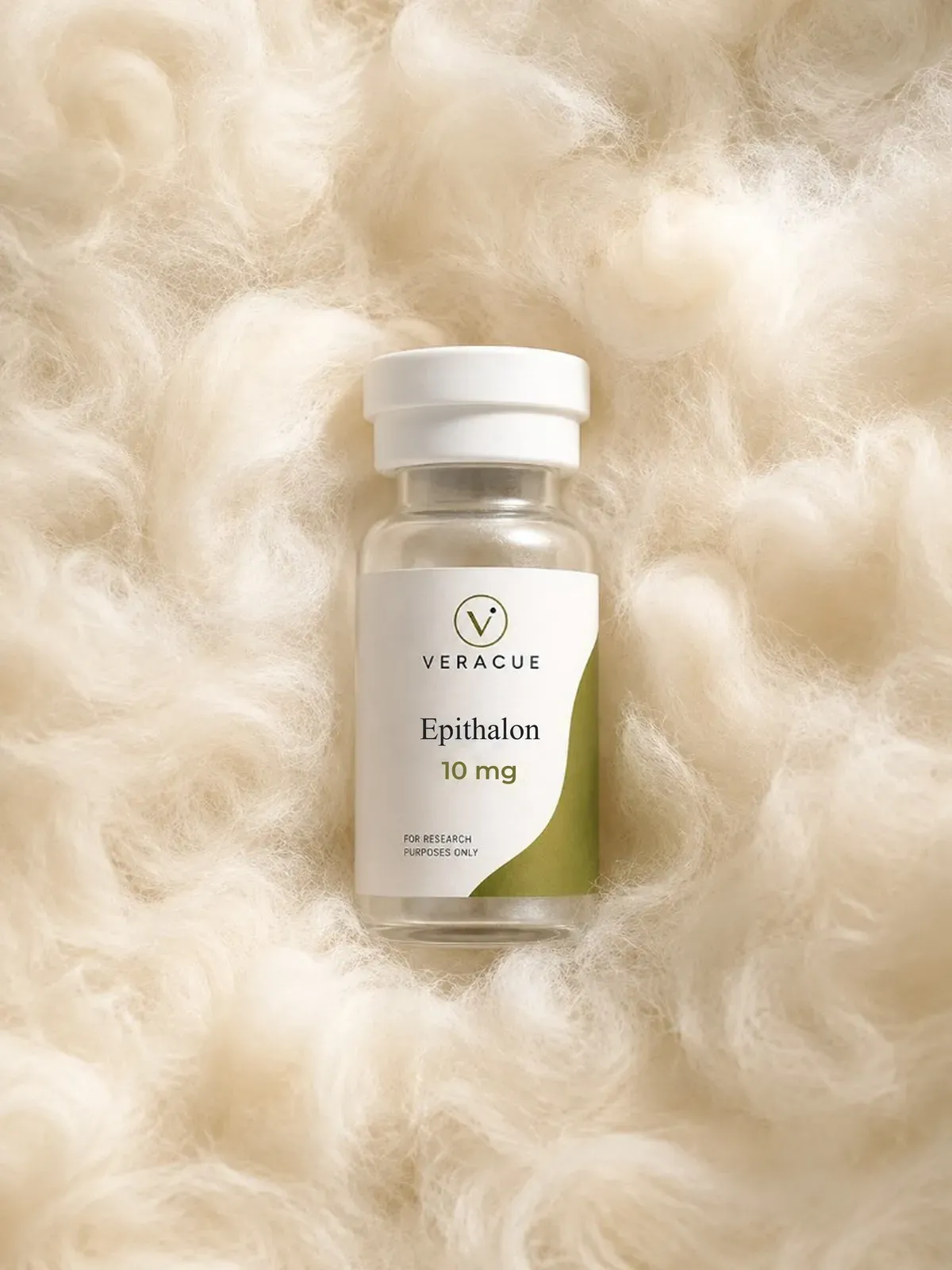
Epithalon, also spelled Epitalon, is a four-amino-acid synthetic peptide with the sequence Ala-Glu-Asp-Gly (AEDG). It was developed as a defined-sequence counterpart to epithalamin, a pineal-derived tissue preparation, which is why the two names often appear together and why checking the exact sequence matters. It is offered in 10 mg and 50 mg vials for laboratory research use only, and each lot's form and purity are reported in its documentation.
Ask for the analytical documentation of any lot.
HPLC is the method used to measure purity
Ask for the report for a specific lot through the contact page
Supplied for laboratory research use only
Mass spectrometry is the method used to confirm identity
Epithalon is a short synthetic peptide made of four amino acids, Ala-Glu-Asp-Gly, usually abbreviated AEDG. It was developed as a sequence-defined analog of epithalamin, a pineal-tissue preparation. Veracue supplies Epithalon for laboratory research only.
Researchers pay attention to Epithalon because a four-residue sequence is easy to verify and because it gives a reproducible peptide in place of a variable tissue extract. That makes it a straightforward reference material for labs that want documented, sequence-checked material.
| Product name | Epithalon (also written Epitalon) |
| Sequence | AEDG (Ala-Glu-Asp-Gly) |
| Length | 4 amino acids (tetrapeptide) |
| Related material | Epithalamin, a pineal-tissue preparation |
| Sizes offered | 10 mg and 50 mg vials |
| Research designation | Research Use Only |
Physical form, purity, lot results and storage conditions are reported on each lot’s documentation and can be requested through the contact page.
Yes. Epitalon is the more direct transliteration from Russian-language sources, and Epithalon is the spelling common in Western writing. Both point to the same AEDG tetrapeptide, and the difference is a translation artifact. Still, confirm the sequence on any documentation you are working from, because the two spellings occasionally get attached to unrelated products in careless listings.
AEDG is four residues in this order: alanine, glutamic acid, aspartic acid and glycine. A record that resolves to a different length or a different order describes a different compound, so the sequence is the first thing to match against supplier paperwork.
Epithalamin is a polypeptide extract from bovine or porcine pineal tissue, studied within a Russian research program associated with Vladimir Khavinson and colleagues. Epithalon was developed as a synthetic, sequence-defined counterpart to that extract, the idea being a reproducible peptide rather than a variable biological preparation.
The two are related but not identical. Older literature does not always separate findings on one from findings on the other, so when you read a primary source, check which material the study actually used.
It is a laboratory-model literature made up of cell-culture work, animal studies and older Russian-language publications. Results are specific to the models and conditions used, and none of it should be read as an established mechanism of action.
Retinal and ocular work is sometimes mentioned alongside this peptide family, but it is more strongly associated with a related peptide preparation, Retinalamin. If that is your angle, check the primary source rather than assuming it used Epithalon.
Epithalon comes out of the same research program as other short synthetic peptides, each developed as an analog of a different tissue-derived preparation.
| Peptide | Tissue analog |
|---|---|
| Epithalon (Epitalon) | Pineal gland (epithalamin) |
| Thymalin | Thymus |
| Cartalax | Cartilage |
Shared lineage does not mean shared findings. Each of these has its own separate literature, and results for one should not be assumed to apply to another.
It gives molecular reference information and general research context. It cannot establish what is in a particular vial. Veracue does not provide dosing, administration or usage guidance of any kind.

A certificate of analysis documents one lot, so read it as a set of linked facts. Certificates vary between laboratories and testing programs, so treat this as what a COA may include rather than a fixed checklist.
| COA item | What it helps establish |
|---|---|
| Lot number | Which production run the results describe. It should match the vial. |
| Product identity | The compound name, which should agree with the sequence shown. |
| Sequence | Whether the record ties the material to Ala-Glu-Asp-Gly. |
| Purity | The reported chromatographic purity value. |
| HPLC method | The method and detection conditions behind the purity value. |
| Mass spectrometry result | Whether the measured mass fits the reference mass for the AEDG tetrapeptide. |
| Molecular form | Free peptide, acetate, trifluoroacetate or another counterion. |
| Testing laboratory and date | Who performed the analysis and how recent it is. |
Every field above depends on the lot’s own documentation, and Veracue confirms a field only when the lot certificate reports it. Check that the pieces agree with each other. The certificate page explains how to request lot documentation.
HPLC helps assess chromatographic purity. Mass spectrometry helps assess molecular identity and mass. Neither one alone establishes every aspect of material quality, and HPLC purity should be read together with the method and detection conditions on the analytical record.
Observed m/z depends on charge state and on ion or adduct conditions, so a report should not be judged against one universal value. Interpretation should rest on the complete spectrum and method.
Handling should follow your own institutional protocol. Veracue does not specify reconstitution volumes or exposure concentrations, since those are study-design decisions and not general recommendations.
Ask the Veracue team about the documentation for a specific lot, or review the certificate library.
Epithalon is supplied for laboratory research and analytical characterization only, by qualified personnel in an appropriate institutional setting. It is not a drug, dietary supplement or cosmetic product, and it is not intended for human or veterinary use or self-administration. This page contains no dosing, administration or usage guidance of any kind. Use of this material should follow applicable institutional, local and federal rules. See the Medical Disclaimer and the Terms and Conditions for sitewide policies.
RESEARCH PEPTIDE
Glutathione comes as reduced GSH (CAS 70-18-8) or oxidized GSSG, so check which one your COA covers. 600 and 1500 mg, research use only.

RESEARCH PEPTIDE
SS-31 is a four-residue peptide built around D-Arg and Dmt (CAS 736992-21-5). Salt forms differ, so read the COA. 10 and 50 mg, research use only.